
Cushing syndome
I'll read the medical library skill first, then research Cushing syndrome comprehensively.
Reading File
Now I'll run parallel searches across the library for Cushing syndrome coverage.
Finding Sources
Finding Sources
Searching PubMed
"Cushing syndrome"[MeSH Terms] AND diagnosis
Good results. Now I'll read the most content-rich sources in parallel - the Tietz/Henry lab books and Campbell Walsh Urology for the most detailed clinical coverage.
Reading File
Reading File
Reading File
Excellent data. Now I'll fetch the diagram image and also read the clinical features/treatment sections.
Loading Image
Reading File
Reading File
Good. Let me now fetch the clinical features diagram and read more on treatment/diagnosis from the textbook.
Loading Image
Reading File
I now have comprehensive data from multiple authoritative sources. Let me compile the full answer.
Cushing Syndrome
Definition
Cushing syndrome is the clinical state resulting from prolonged, excessive exposure to glucocorticoids (cortisol). The term "Cushing syndrome" is an umbrella term for all causes of hypercortisolism, whereas "Cushing disease" specifically refers to hypercortisolism caused by an ACTH-secreting pituitary adenoma. - Campbell Walsh Wein Urology, p. 3133; Henry's Clinical Diagnosis, p. 1804
Epidemiology
- Endogenous Cushing syndrome is rare: incidence 0.7 to 2.4 per million per year
- Most common cause overall is iatrogenic (exogenous glucocorticoid therapy)
- Among endogenous causes, ACTH-dependent types account for >80% of cases
- Cushing disease (pituitary adenoma) accounts for ~68% of endogenous cases; ectopic ACTH ~12%; adrenal tumors <20%
Pathophysiology and Classification
The HPA axis normally operates as a negative-feedback loop: CRH (hypothalamus) stimulates ACTH (anterior pituitary) which drives cortisol production in the adrenal zona fasciculata (up to 20 mg/day). Cortisol then feeds back to suppress both CRH and ACTH. Cushing syndrome arises when this loop is disrupted. - Campbell Walsh Wein Urology, p. 3133-3134
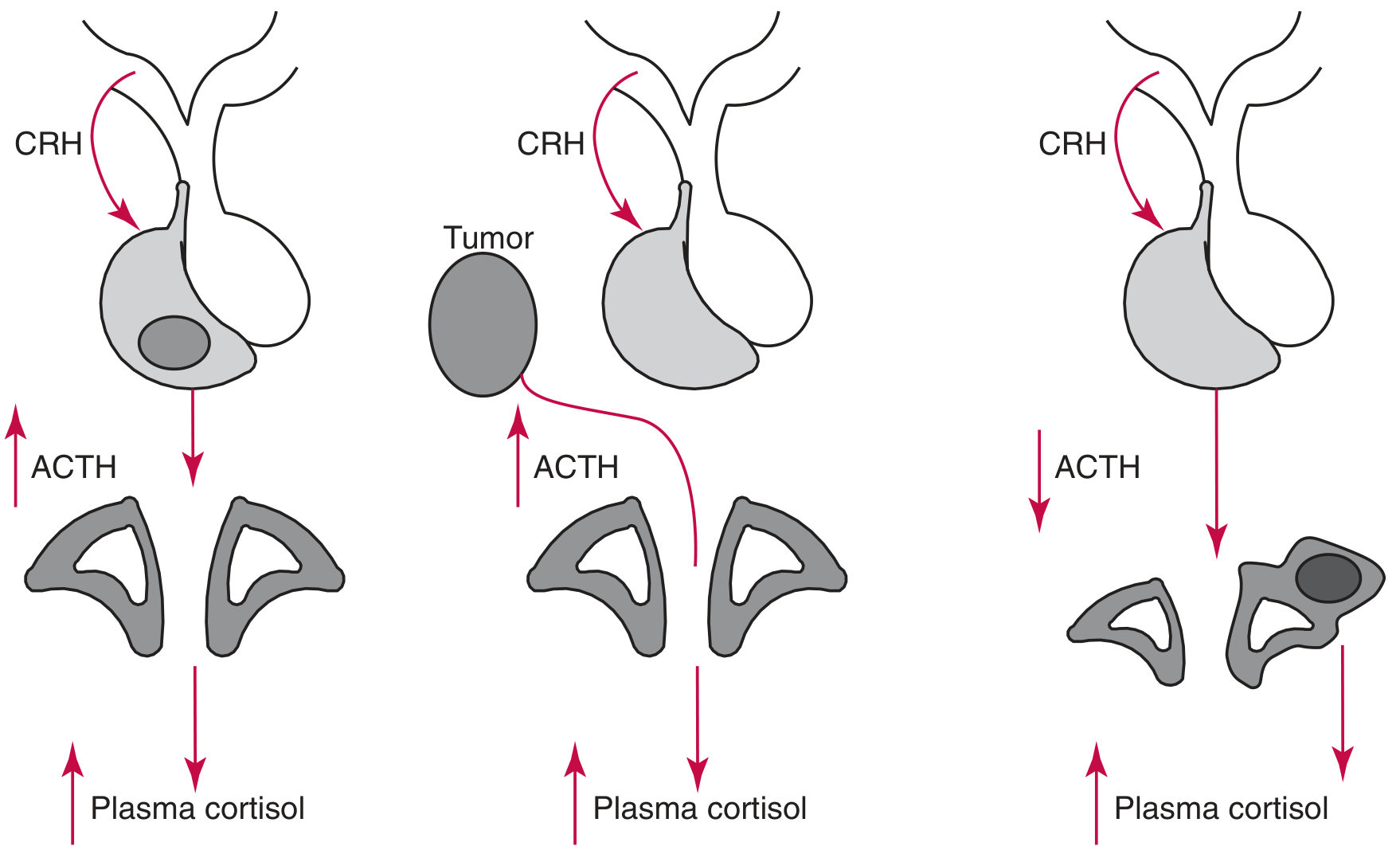
Causes of Cushing Syndrome
| Category | Mechanism | Examples |
|---|---|---|
| Exogenous (iatrogenic) | Exogenous glucocorticoids suppress HPA axis | Long-term steroid therapy (most common overall) |
| ACTH-Dependent | Excess ACTH drives bilateral adrenal cortisol overproduction | Pituitary adenoma (Cushing disease), ectopic ACTH (small cell lung cancer, carcinoid), ectopic CRH-secreting tumor |
| ACTH-Independent | Adrenal autonomously produces cortisol; ACTH is suppressed | Adrenal adenoma (80% of unilateral), adrenocortical carcinoma (ACC), bilateral macronodular hyperplasia (AIMAH), PPNAD |
Rare adrenal causes:
- AIMAH (ACTH-independent bilateral macronodular adrenal hyperplasia): <1% of cases; massive bilateral glands (each >60 g, sometimes >200 g)
- PPNAD (primary pigmented nodular adrenocortical disease): <1% of cases; normal-sized glands with black/brown nodules; half are associated with Carney complex (autosomal dominant)
Clinical Features
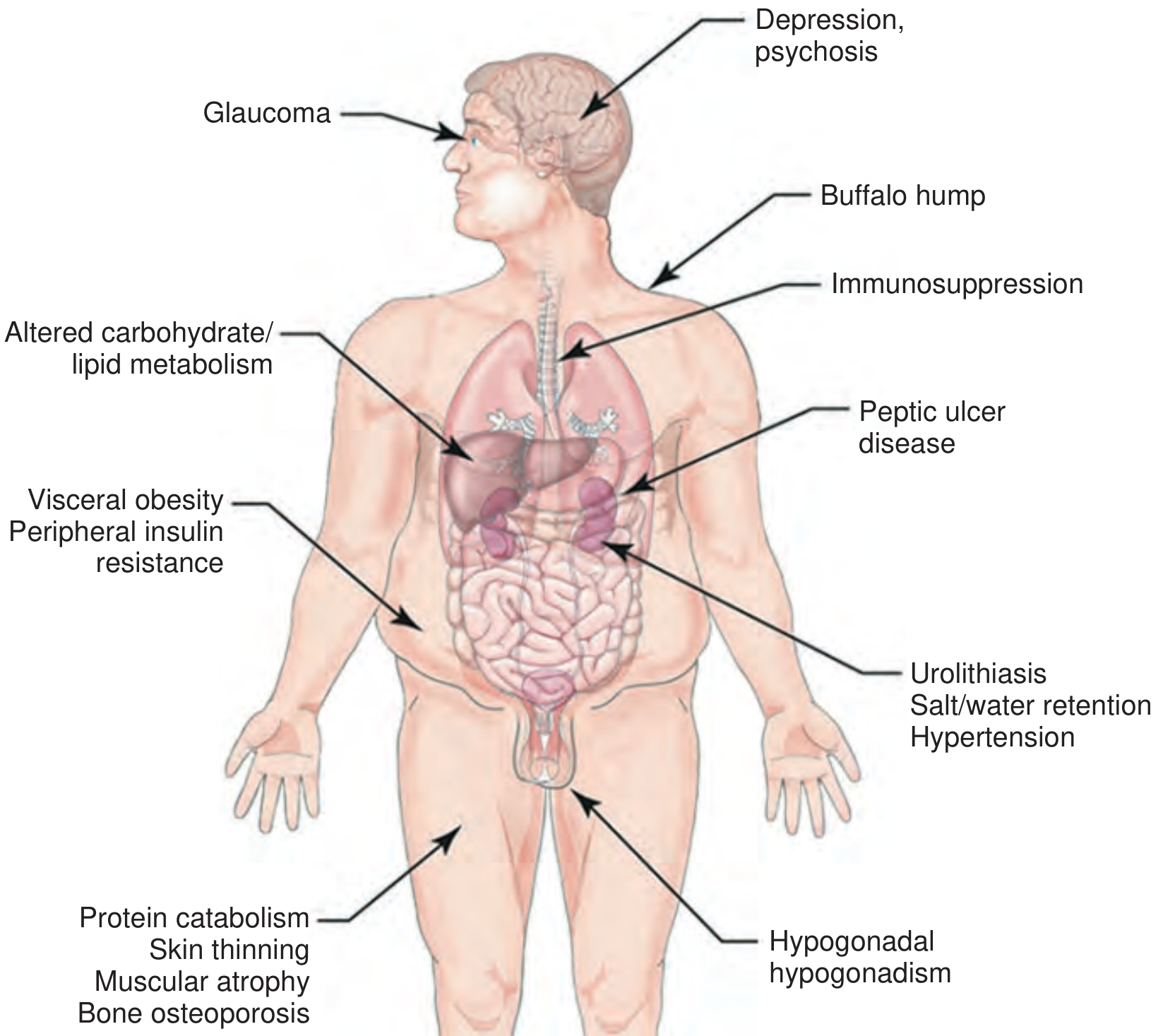
Cardinal Signs and Symptoms
Characteristic features (more specific for Cushing syndrome):
- Central (truncal) obesity with relatively thin extremities
- Moon facies (facial rounding/plethora)
- Buffalo hump (dorsocervical fat pad)
- Purple/violaceous abdominal striae (>1 cm wide)
- Easy bruisability
- Proximal muscle weakness/myopathy
- Thin skin
Metabolic and systemic effects:
- Hypertension (salt and water retention)
- Hyperglycemia / type 2 diabetes (peripheral insulin resistance, gluconeogenesis)
- Dyslipidemia
- Hypokalemia (especially with ectopic ACTH - massive cortisol has mineralocorticoid effect)
- Urolithiasis
- Osteoporosis and pathological fractures
- Increased susceptibility to infections (immunosuppression)
Neuropsychiatric:
- Depression, anxiety, cognitive impairment, psychosis
- Glaucoma
Reproductive:
- Hypogonadism, menstrual irregularity, decreased libido
- Hirsutism and acne (from androgen excess)
Note on ectopic ACTH syndrome: Typically presents with rapid onset, severe hypokalemia, hyperpigmentation (from high ACTH/MSH), and metabolic alkalosis, often without the classic Cushingoid body habitus (because the underlying malignancy causes weight loss).
Pseudo-Cushing Syndrome
Several physiological states mimic Cushing syndrome by activating the HPA axis without a neoplastic source. Important to distinguish clinically:
| With some Cushingoid features | Without Cushingoid features |
|---|---|
| Pregnancy | Physical stress, surgery, pain |
| Depression | Malnutrition / anorexia nervosa |
| Alcohol dependence | Intense chronic exercise |
| Morbid obesity | Hypothalamic amenorrhea |
| Poorly controlled diabetes |
- Campbell Walsh Wein Urology, p. 3138; Tietz Textbook of Laboratory Medicine, p. 2242
Diagnosis
Diagnosis is a two-phase process: screening followed by confirmatory and localizing tests. - Henry's Clinical Diagnosis, p. 1808
Phase 1 - Screening Tests (any one of three)
| Test | Principle | Notes |
|---|---|---|
| 24-hour urinary free cortisol (UFC) | Measures unbound, biologically active cortisol; integrated over 24 hours | Normal upper limit: 110-138 nmol/24h (40-50 µg/24h) with HPLC/mass spec; values >4x ULN are diagnostic; measure creatinine to confirm adequacy; unreliable if GFR <30 mL/min |
| Overnight 1 mg dexamethasone suppression test (DST) | Give 1 mg dexamethasone at 11 PM; measure 8 AM serum cortisol - failure to suppress (<50 nmol/L) is abnormal | Preferred screening for mild/subclinical cases; can be affected by drugs altering CYP3A4 metabolism of dexamethasone |
| Late-night salivary cortisol (LNSC) or midnight plasma cortisol (MSC) | Exploits the key abnormality in ALL types of Cushing syndrome: loss of nocturnal cortisol nadir | Salivary cortisol is practical outpatient test; midnight plasma cortisol requires inpatient testing |
Key diagnostic principle: Even in very mild Cushing syndrome, the hallmark abnormality is the inability to suppress cortisol at night - morning cortisols may still be within normal range. - Campbell Walsh Wein Urology, p. 3137
Laboratory findings in confirmed Cushing syndrome:
- Elevated serum/urinary/salivary cortisol
- Loss of circadian rhythm of ACTH and cortisol
- Failure to suppress cortisol with dexamethasone
- Henry's Clinical Diagnosis, p. 1802
Phase 2 - Confirmatory and Localizing Tests
Once hypercortisolism is confirmed:
Step 1: Measure plasma ACTH
- ACTH suppressed (<10 pg/mL) → ACTH-independent (adrenal source) → CT/MRI adrenal glands
- ACTH elevated or normal → ACTH-dependent → proceed to differentiate pituitary vs. ectopic
Step 2: Differentiate pituitary vs. ectopic ACTH
- High-dose DST (8 mg dexamethasone): Pituitary Cushing disease usually suppresses (>50%); ectopic ACTH typically does not suppress
- CRH stimulation test: Pituitary source shows ACTH and cortisol rise; ectopic source shows no rise
- Bilateral inferior petrosal sinus sampling (IPSS): Gold standard for distinguishing pituitary vs. ectopic; central:peripheral ACTH ratio >2 basal or >3 after CRH = pituitary source
- MRI pituitary: Microadenomas (≤10 mm) may be too small to visualize; 40-50% of pituitary adenomas are radiographically occult
Imaging:
- Pituitary MRI (gadolinium) for Cushing disease
- CT chest/abdomen for ectopic source (small cell lung, bronchial carcinoid, thymic tumors, pancreatic NET, pheochromocytoma)
- CT/MRI adrenal for adrenal causes; adrenal adenomas typically lipid-rich, homogeneous, <4 cm
Treatment
Treatment depends on the underlying etiology. Surgery is first-line for most endogenous causes.
Cushing Disease (Pituitary Adenoma)
- Transsphenoidal pituitary surgery (TSS): First-line; remission rates 65-90% for microadenomas
- Radiation therapy (stereotactic radiosurgery) if TSS fails or is not feasible
- Bilateral adrenalectomy: Used when pituitary treatment fails; risk of Nelson syndrome (expansion of residual ACTH-secreting tumor due to loss of cortisol feedback)
Adrenal Cushing Syndrome
- Unilateral adrenalectomy for adenoma or unilateral ACC (laparoscopic preferred)
- Bilateral adrenalectomy for PPNAD or AIMAH
- Post-adrenalectomy: glucocorticoid replacement is mandatory due to contralateral adrenal suppression (Cushingoid phenotype resolves in 7-9 months typically)
- ACC: multimodal therapy with mitotane (adrenolytic agent)
Ectopic ACTH Syndrome
- Surgical resection of the primary tumor when identified and resectable
- If occult/unresectable: bilateral adrenalectomy to control hypercortisolism
Preoperative Medical Management
Adrenal steroidogenesis inhibitors are used preoperatively (especially in severe cases) or as bridging therapy:
- Metyrapone - inhibits 11β-hydroxylase (most commonly used)
- Ketoconazole - inhibits multiple steroidogenic enzymes (CYP11A1, CYP17A1, CYP11B1)
- Osilodrostat - potent 11β-hydroxylase inhibitor (newer agent)
- Mifepristone - glucocorticoid receptor antagonist (useful when cortisol cannot easily be lowered)
- Pasireotide - somatostatin analog; targets pituitary in Cushing disease
Perioperative Care for Cushing Surgery
| Issue | Management |
|---|---|
| Severe hypercortisolism | Preoperative metyrapone to reduce cortisol burden |
| Hyperglycemia | Tight glycemic control |
| Thromboembolism | High risk - prophylaxis required |
| Infection | Perioperative antibiotics; immunosuppression increases risk |
| Adrenal insufficiency post-op | Intraoperative and postoperative steroid replacement |
| Hypertension/hypokalemia | Correct before surgery |
- Campbell Walsh Wein Urology, p. 3191-3192
Complications of Untreated Cushing Syndrome
- Cardiovascular disease (accelerated atherosclerosis, LVH)
- Osteoporosis and fragility fractures
- Type 2 diabetes and metabolic syndrome
- Opportunistic infections and impaired wound healing
- Thromboembolic events (DVT, PE) - cortisol is prothrombotic
- Psychiatric illness (depression is present in ~50% of patients)
- Increased mortality if untreated
Recent Evidence (2024-2026)
A 2024 systematic review and meta-analysis (Hinojosa-Amaya et al., Pituitary, PMID 38888685) examined the challenge of differentiating true Cushing syndrome from non-neoplastic hypercortisolism (pseudo-Cushing) - a clinically important diagnostic conundrum. A 2025 meta-analysis (Piasecka et al., Eur J Endocrinol, PMID 40455890) reported on survival outcomes specifically in ectopic Cushing syndrome. These papers confirm that diagnostic discrimination and prognosis in ectopic disease remain active areas of research.
Sources: Campbell Walsh Wein Urology (9780323546423); Henry's Clinical Diagnosis and Management by Laboratory Methods (9780323673204); Tietz Textbook of Laboratory Medicine, 7th ed. (9780323775724); Textbook of Family Medicine, 9e (9780323239905)
This is a shared conversation. Sign in to Orris to start your own chat.