
Homeostasis MBBS 1 st prof explanation
Reading File
Now let me search the medical library for homeostasis content relevant to MBBS 1st year.
Finding Sources
Finding Sources
Let me search for physiology textbooks and homeostasis content more specifically.
Finding Sources
Finding Sources
Excellent! Found strong content in Medical Physiology and Ganong's. Let me now read the key sections.
Reading File
Finding Sources
Finding Sources
Reading File
Reading File
Reading File
Excellent content found. Now let me fetch the feedback loop diagram and search for more content on positive feedback and examples.
Loading Image
Loading Image
Finding Sources
Now let me get a few more key details - on intracellular vs extracellular fluid compartments and body fluid composition, which is core MBBS 1st year physiology homeostasis content.
Finding Sources
Finding Sources
Reading File
Reading File
I now have excellent, comprehensive content from multiple physiology textbooks. Let me compile the full MBBS 1st year explanation of Homeostasis.
Homeostasis - MBBS 1st Year (Physiology)
1. Definition and Origin of the Concept
Homeostasis is the ability of the body to maintain a stable internal environment despite constant changes in the external world.
- Claude Bernard (1813-1878), the French physiologist, first described this idea with his concept of the milieu intérieur (the "internal environment"). He wrote: "The constancy of the internal environment is the condition for free, independent life." He recognized that each organ system - cardiovascular, respiratory, renal, gastrointestinal, endocrine - works to preserve the composition of the extracellular fluid that bathes every cell.
- Walter B. Cannon (1871-1945), the American physiologist, later coined the actual term "homeostasis" in the 1930s to describe the mechanisms that restore the normal state once it has been disturbed.
"The body is a social order of about 35-40 trillion cells... Each functional structure contributes its share to maintaining homeostasis in the extracellular fluid, which is called the internal environment." - Guyton & Hall
2. What Does the Body Keep Constant?
The body tightly regulates a long list of vital parameters at two levels:
At the level of the milieu intérieur (whole body):
| Parameter | Normal Range |
|---|---|
| Arterial blood pressure | ~120/80 mmHg |
| Blood volume | ~5 L |
| Body core temperature | 36-37°C (thermal neutral zone) |
| Blood osmolality | 275-299 mOsm |
| Plasma glucose | 70-110 mg/dL |
| Plasma O2 / CO2 | PaO2 ~95 mmHg, PaCO2 ~40 mmHg |
| Plasma K+ | 3.5-5.0 mEq/L |
| Plasma Ca2+ | 8.5-10.5 mg/dL |
| Plasma pH (H+) | 7.35-7.45 |
At the level of the single cell:
- Cell volume, intracellular Na+, Ca2+, H+, and energy (ATP) are all individually regulated by each cell.
3. The Concept of Steady State vs. Equilibrium
A regulated parameter is NOT in equilibrium - that would require no energy. Instead, it is in a steady state: its value is constant because the body precisely balances processes that raise it against processes that lower it.
Example: Blood glucose is constant not because it just sits there, but because glucose absorption from gut + glycogen breakdown is exactly balanced by glucose uptake into cells + glycogen synthesis. Energy is always being spent to maintain this balance.
This is a key exam point: homeostasis is an active, energy-consuming process.
4. Negative Feedback - The Core Mechanism
Negative feedback is the most common mechanism for homeostasis. It requires four essential elements:
SENSOR → detects the vital parameter (or something related to it)
  ↓
COMPARATOR → compares input signal to the SET POINT
  ↓
ERROR SIGNAL → difference between actual value and set point
  ↓
EFFECTOR → acts to OPPOSE the deviation and return to set point
The key rule: The output of the system opposes (is opposite to) the initial change. That is why it is called "negative."
Classic Example: Blood Osmolality Regulation
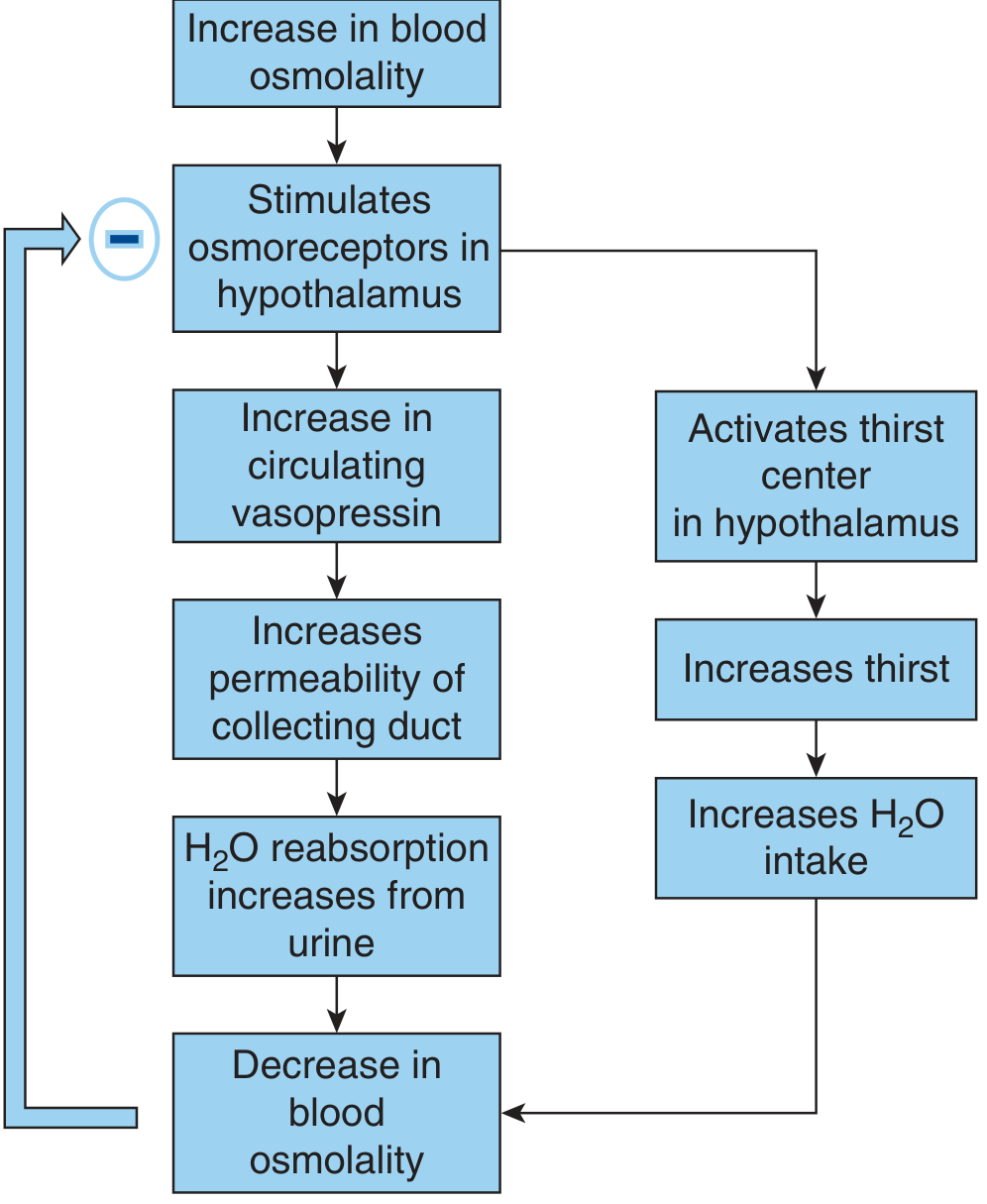
Step by step:
- Dehydration → Blood osmolality rises (>299 mOsm)
- Osmoreceptors in the hypothalamus detect this (sensor)
- Vasopressin (ADH) is released from posterior pituitary
- ADH acts on renal collecting duct → inserts aquaporins → water reabsorption from urine increases
- Simultaneously, the thirst center is activated → water intake increases
- Blood osmolality returns to normal
- The drop in osmolality feeds back to suppress vasopressin release (negative feedback closes the loop)
5. Components of a Feedback Loop (Ganong's)
| Component | Role | Example (temperature) |
|---|---|---|
| Sensor/Receptor | Detects deviation from set point | Thermoreceptors in skin & hypothalamus |
| Afferent pathway | Sends signal to control center | Sensory nerves |
| Control center | Compares with set point, generates error signal | Hypothalamus (preoptic area) |
| Efferent pathway | Sends corrective command | Autonomic nerves / hormones |
| Effector | Carries out corrective action | Sweat glands, blood vessels, muscles |
6. Negative vs. Positive Feedback
| Feature | Negative Feedback | Positive Feedback |
|---|---|---|
| Direction of response | Opposes the initial change | Amplifies the initial change |
| Outcome | Restores set point - stabilizing | Drives system to completion - destabilizing in isolation |
| Purpose | Maintains homeostasis | Drives all-or-nothing events to completion |
| Examples | Blood pressure control, temperature regulation, blood glucose, osmolality | Childbirth (oxytocin surge), blood clotting cascade, LH surge at ovulation, action potential depolarization |
Important: Positive feedback is NOT for homeostasis - it is for completing a biological event that must go all the way (parturition, coagulation cascade). If positive feedback occurs inappropriately, it can be catastrophic (e.g., malignant hyperthermia, septic shock).
7. Hierarchy and Redundancy of Feedback Loops
Two key principles from Medical Physiology (Boron & Boulpaep):
Hierarchy: Feedback loops are organized in tiers.
- Example: Hypothalamus → Anterior Pituitary → Adrenal Cortex → Cortisol → Blood glucose
- Each level controls the one below it, and each level receives negative feedback from downstream hormone levels.
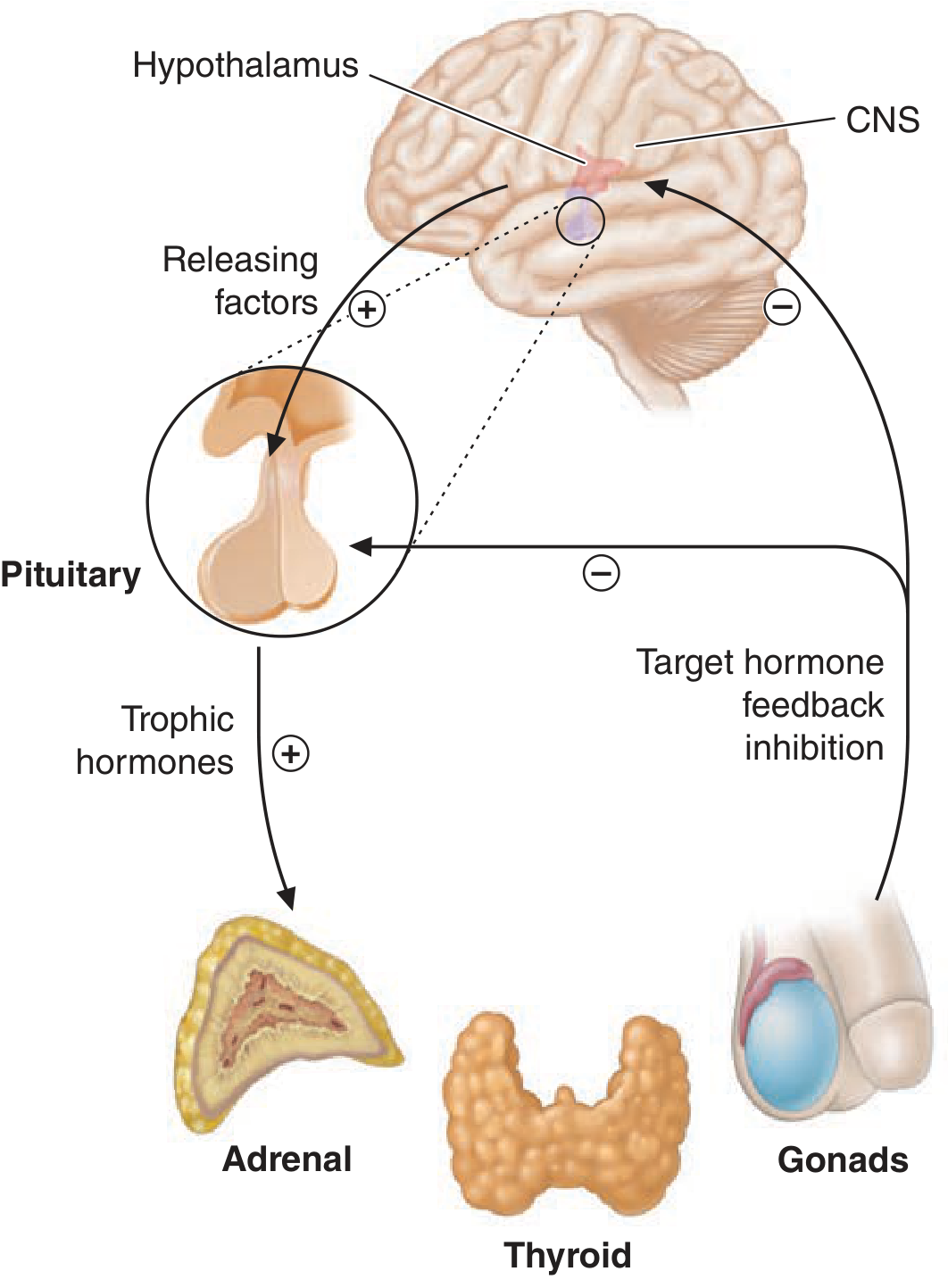
Redundancy: The more vital a parameter, the more systems the body recruits to regulate it. If one system fails, others compensate. Example: Blood pressure is regulated by the nervous system (baroreceptors), the kidneys (renin-angiotensin-aldosterone), hormones (ADH, ANP), and local vascular mechanisms - all simultaneously.
8. Role of the ANS and Endocrine System
The Autonomic Nervous System (ANS) and the endocrine system are the two master integrators of homeostasis:
- ANS regulates: airflow, blood flow, blood gas composition, blood glucose, blood pressure, body temperature, digestion, electrolyte balance, heart rate, and urination (Ganong's)
- Endocrine system: slower but longer-lasting corrections via hormones
Homeostatic imbalance (failure of these systems) leads to disease:
- Loss of temperature regulation → Hyperthermia / Heat stroke / Hypothermia
- Loss of glucose regulation → Diabetes mellitus
- Loss of water/salt balance → Dehydration, Hypertension, Cardiac arrhythmias
- Loss of blood pressure control → Hypertension / Hypotension / Heart failure
9. Homeostasis and Medicine (Guyton & Hall)
"As long as normal conditions are maintained in the internal environment, the body's cells continue to live and function properly. Each cell benefits from homeostasis and, in turn, each cell contributes to the maintenance of homeostasis. This reciprocal interplay provides continuous automaticity of the body until one or more functional systems lose their ability to contribute their share of function."
This is the philosophical foundation of all medicine: disease = homeostatic failure. Understanding physiology (normal homeostasis) is the only way to understand pathology (failure of homeostasis).
10. Quick Summary for Exams
| Concept | Key Point |
|---|---|
| Term coined by | W.B. Cannon (1930s) |
| Original idea by | Claude Bernard ("milieu intérieur") |
| Mechanism | Negative feedback (most common) |
| Components | Sensor → Comparator → Error signal → Effector |
| Set point | The reference value the system defends |
| Negative feedback | Opposes change, restores set point |
| Positive feedback | Amplifies change, drives to completion |
| Steady state vs. equilibrium | Steady state needs energy; equilibrium does not |
| Redundancy | More vital = more backup systems |
| Hierarchy | Feedback loops organized in tiers (e.g., HPT axis) |
| Clinical relevance | All disease = some form of homeostatic failure |
Sources: Medical Physiology (Boron & Boulpaep), Ganong's Review of Medical Physiology 26e, Guyton and Hall Textbook of Medical Physiology, Costanzo Physiology 7e, Principles of Neural Science (Kandel)
This is a shared conversation. Sign in to Orris to start your own chat.