
Teach me lithium as a whole
Reading File
Finding Sources
Finding Sources
Now I'll read the most comprehensive sources in parallel — Katzung (pharmacology), Stahl's (mechanism/psychopharm), Maudsley (prescribing guidelines), and Rosen's (toxicity):
Reading File
Reading File
Reading File
Reading File
Let me read more targeted lithium content from the Maudsley guidelines and Rosen's toxicity section, plus Stahl's mechanism section:
Reading File
Reading File
Finding Sources
Reading File
Reading File
Searching PubMed
lithium bipolar disorder maintenance treatment
Reading File
Reading File
Reading File
Reading File
Loading Image
Reading File
Here is a comprehensive, structured teaching on Lithium — covering everything from its basic chemistry to bedside management.
⚗️ Lithium: A Complete Clinical & Pharmacological Guide
1. Introduction & Historical Context
Lithium (Li⁺) is the lightest metal on the periodic table — a monovalent cation in group IA, atomic number 3. It has been used therapeutically for over 50 years, making it the oldest treatment for bipolar disorder still in widespread use. Despite its long history, much about its mechanism of action remains incompletely understood.
As of 2024, it remains the gold standard treatment for bipolar disorder and is significantly underused, particularly in treatment-resistant depression. — Maudsley Prescribing Guidelines in Psychiatry, 15th ed.
2. Mechanism of Action
Lithium's mechanism is multifactorial and incompletely understood. It does not act on classic neurotransmitter receptors. Instead, it targets downstream signal transduction cascades:
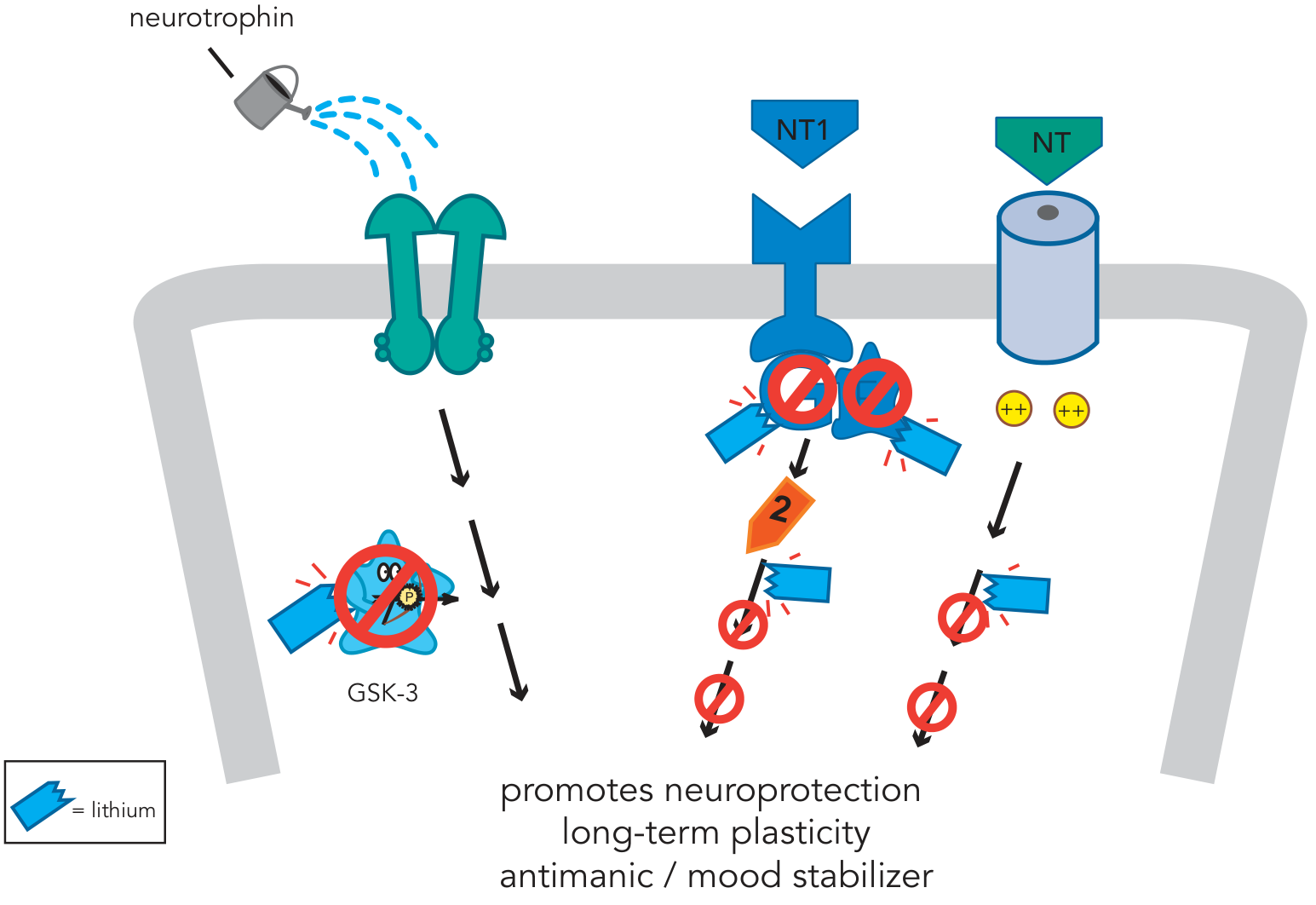
Figure: Lithium inhibits GSK-3, modulates G-protein signaling, and promotes neuroprotection and long-term plasticity — Stahl's Essential Psychopharmacology
Key proposed mechanisms:
| Pathway | Effect |
|---|---|
| Inositol monophosphatase inhibition | Depletes phosphatidylinositol second messengers (PI signaling dampened) |
| GSK-3 (glycogen synthase kinase-3) inhibition | Key downstream kinase; regulates neuronal plasticity, gene expression, circadian rhythms |
| Protein kinase C (PKC) modulation | Downstream signaling cascade modulation |
| G-protein modulation | Dampens receptor-coupled G-protein signaling |
| Na⁺/K⁺-ATPase effects | Reduces elevated intracellular Na⁺ and Ca²⁺ found in bipolar patients |
| Neuroprotection & neurogenesis | Promotes hippocampal neurogenesis; preserves neuronal circuits; may protect against dementia |
| CREB modulation | cAMP response element-binding protein — regulates transcription of plasticity genes |
The net result: lithium acts as an antimanic and mood-stabilizing agent by acting "from above" (stabilizing downward from mania) and, to a lesser degree, "from below" (stabilizing upward from depression). — Stahl's Essential Psychopharmacology; Katzung's Basic & Clinical Pharmacology, 16th ed.
3. Clinical Indications
A. Bipolar Disorder (primary use)
| Indication | Detail |
|---|---|
| Acute mania | Effective; target plasma level 0.8–1.0 mmol/L; may need adjunctive antipsychotic if faster onset needed |
| Maintenance (prophylaxis) | Gold standard; aim for 0.6–0.8 mmol/L (can reduce to 0.4–0.6 if good response/poor tolerance, or increase to 0.8–1.0 if insufficient response) |
| Bipolar depression (acute) | Modest evidence for acute episodes; more compelling evidence for prevention of depressive episodes |
| Bipolar II | Effective; see recent meta-analyses (PMID 40288449, 2025) |
Most effective in classic euphoric mania without psychotic features and without rapid cycling. Modern use often involves lower doses as part of combination therapy.
B. Unipolar/Treatment-Resistant Depression
- Lithium augmentation of antidepressants (SSRIs, SNRIs, TCAs): first-choice augmentation strategy alongside quetiapine at levels 0.6–1.0 mmol/L
- Clinical predictors of good response: severe depressive symptoms, psychomotor retardation, weight loss, family history of MDD, ≥3 prior episodes
- Prophylaxis of unipolar depression: Lithium is superior to antidepressants in preventing hospitalization, with a relative risk of 0.34 — Maudsley Guidelines
C. Antisuicidal Effect
This is one of lithium's most clinically important properties, often overlooked:
- Reduces risk of both attempted and completed suicide by ~80% in bipolar disorder (meta-analysis)
- Also protective against suicide in unipolar depression
- Environmental lithium levels (in drinking water) are inversely related to suicide rates at the population level — Maudsley Prescribing Guidelines
D. Other Uses
- Aggressive and self-mutilating behavior
- Steroid-induced psychosis (prevention and treatment)
- Raising the white blood cell count in patients on clozapine with neutropenia (lithium raises neutrophil count; minimum level ≥0.4 mmol/L required)
4. Pharmacokinetics
| Parameter | Detail |
|---|---|
| Absorption | Rapid GI absorption; fully bioavailable orally |
| Distribution | Wide distribution; long distribution phase; distributes into total body water |
| Metabolism | None — not metabolized by the liver |
| Elimination | Exclusively renal (glomerular filtration; ~80% reabsorbed in proximal tubule alongside Na⁺) |
| Half-life | ~20 hours (longer in elderly or renal impairment) |
| Protein binding | None — unbound ion |
Key pharmacokinetic insight: Lithium is handled by the kidney identically to sodium. Anything that reduces sodium delivery to the proximal tubule (hypovolemia, low-salt diet, thiazides, ACE inhibitors) will increase lithium reabsorption → elevated lithium levels → toxicity.
5. Therapeutic Drug Monitoring (TDM)
Lithium has a narrow therapeutic window — TDM is not optional, it is mandatory.
| Purpose | Target Level |
|---|---|
| Acute mania treatment | 0.8–1.0 mmol/L |
| Maintenance (prophylaxis) | 0.6–0.8 mmol/L |
| Augmentation (depression) | 0.6–1.0 mmol/L |
| Minimum for WBC effect (clozapine) | ≥0.4 mmol/L |
| Toxicity threshold | >1.5 mmol/L (reliable symptoms) |
Sampling rule: Blood must be drawn 10–14 hours (ideally 12 hours) post-dose — typically first thing in the morning if the patient takes lithium at bedtime.
⚠️ Use lithium-free tubes for blood sampling. Lithiated heparin tubes give falsely elevated results (up to 4 mmol/L).
6. Pre-Treatment Workup
Before starting lithium, check:
- Renal: eGFR, urea & electrolytes (U&E), creatinine
- Thyroid: TFTs (TSH, free T4)
- Cardiac: ECG (especially if cardiovascular risk factors)
- Calcium (baseline)
- Pregnancy test in women of childbearing age (lithium is teratogenic — Category D; associated with Ebstein's anomaly)
- Weight / BMI (baseline)
7. On-Treatment Monitoring
| Parameter | Frequency |
|---|---|
| Plasma lithium level | Every 6 months (more frequent if elderly, CKD, interacting drugs) |
| eGFR + U&E | Every 6 months |
| TFTs | Every 6 months |
| Calcium | Periodically (long-term patients) |
| Weight/BMI | Periodically |
8. Adverse Effects
Common (dose-related, often at therapeutic levels)
| System | Effect |
|---|---|
| GI | Nausea, vomiting, diarrhea, metallic taste, dyspepsia |
| Neurological | Fine postural tremor (most common), fatigue, sedation, cognitive blunting |
| Renal | Polyuria, polydipsia (nephrogenic DI — up to 40% of long-term users) |
| Metabolic | Weight gain |
| Dermatological | Acne, psoriasis exacerbation, hair loss |
| Other | Ankle edema |
Long-Term / Chronic Effects
| System | Effect |
|---|---|
| Thyroid | Hypothyroidism (most common endocrine effect; ~6× general population risk; up to 20% in middle-aged women); rarely hyperthyroidism |
| Parathyroid | Hyperparathyroidism → hypercalcemia (~4% of patients); associated with renal stones, osteoporosis, hypertension |
| Renal | Progressive nephropathy (mild ↓ GFR); ~1% absolute risk of eventual renal replacement therapy; incomplete distal RTA |
| Cardiac | QT prolongation, T-wave flattening/inversion, bradycardia |
Maintaining levels <0.8 mmol/L reduces long-term renal damage. Renal effects may become irreversible after >15 years of treatment. — Rosen's Emergency Medicine; Maudsley Guidelines
Tremor management: Propranolol is effective for lithium-induced tremor.
9. Drug Interactions
Because lithium is renally cleared alongside sodium, drugs affecting sodium homeostasis are the most dangerous interactions:
| Drug Class | Interaction | Risk |
|---|---|---|
| Thiazide diuretics | ↑ proximal tubule Na⁺/Li⁺ reabsorption → lithium levels ↑ 25–400% within 10 days | HIGH |
| ACE inhibitors / ARBs | Reduce thirst + increase renal Na⁺ loss → ↑ lithium reabsorption; can cause fourfold increase; 7× hospitalization risk in elderly | HIGH |
| NSAIDs / COX-2 inhibitors | Inhibit renal prostaglandins → ↓ renal blood flow + ↑ Na⁺/Li⁺ reabsorption; 10–400% rise | HIGH |
| Loop diuretics | Less risk than thiazides but still significant; highest risk in first month | MODERATE |
| Antipsychotics | Rare neurotoxicity (myoclonus, ataxia, seizures) with combination | MONITOR |
OTC NSAIDs are particularly dangerous — patients must be explicitly counseled. — Maudsley Prescribing Guidelines
10. Lithium Toxicity
Types of Toxicity
| Type | Mechanism | Features |
|---|---|---|
| Acute | Single large ingestion in a naive patient | Predominantly GI symptoms (nausea, vomiting, diarrhea, abdominal pain); less CNS toxicity early (slow CNS distribution); serum level poorly correlates with severity |
| Chronic | Accumulation during ongoing therapy | Predominantly neurological: tremor, fasciculations, clonus, ataxia, dysarthria, nystagmus, choreoathetoid movements, cognitive slowing, lethargy |
| Acute-on-chronic | Disruption of stable regimen (dehydration, drug interaction, extra dose) | Mixed GI + neurological features; most clinically dangerous because of already-saturated tissue |
Severity Classification
| Severity | Clinical Features |
|---|---|
| Mild | Nausea, vomiting, fatigue, lethargy, fine tremor |
| Moderate | Confusion, agitation, dysarthria, ataxia, hypertonia, hyperreflexia, nystagmus, muscle weakness |
| Severe | Coma, seizures, myoclonus, hyperthermia, ventricular dysrhythmias, AV block, cardiovascular collapse |
SILENT Syndrome
Syndrome of Irreversible Lithium-Effectuated Neurotoxicity (SILENT): Persistent neurological dysfunction lasting >2 months after cessation, even without prior neurologic illness. Key feature: cerebellar dysfunction — truncal ataxia, gait instability, tremor, scanning speech, diffuse incoordination.
Diagnosis
- Serum lithium level (in lithium-free tubes — avoid heparin-lithium tubes)
- Therapeutic range: 0.6–1.2 mmol/L; toxic symptoms usually at >2 mmol/L
- Clinical symptoms, not serum level alone, guide treatment
- Additional: CBC (leukocytosis in toxicity), metabolic panel (renal function), ECG, TFTs (chronic toxicity)
11. Management of Lithium Toxicity
General Principles
- Stop lithium immediately
- Protect airway; respiratory + hemodynamic support
- IV access, cardiac monitoring, ECG
- Establish type (acute vs. chronic vs. acute-on-chronic) and formulation (IR vs. SR)
GI Decontamination
- Activated charcoal: does NOT bind lithium — not useful
- Gastric lavage: no role in most cases
- Whole-bowel irrigation (polyethylene glycol 2 L/h): only useful for acute ingestion of sustained-release formulation, and only if airway is intact and no obstruction
Volume Resuscitation — The cornerstone of treatment
- Normal saline IV bolus 20 mL/kg → continuous infusion at 1.5–2× maintenance
- Restores intravascular volume → normalizes renal lithium elimination
- ⚠️ Diuretics do NOT enhance lithium elimination — loop and thiazide diuretics worsen toxicity
Extracorporeal Removal (Hemodialysis)
| Level | Action |
|---|---|
| >2 mmol/L with severe neurological symptoms | Osmotic or forced alkaline diuresis in hospital |
| >3 mmol/L (or severe toxicity: coma, seizures, refractory to supportive care) | Hemodialysis |
Lithium redistributes from intracellular to extracellular compartments post-dialysis → rebound rise in serum levels after hemodialysis — repeat levels and consider repeated sessions. Impaired renal function is often present in chronic toxicity, making dialysis both more necessary and more complex. — Tintinalli's Emergency Medicine; Comprehensive Clinical Nephrology
12. Special Populations
Pregnancy
- Teratogen (Category D): historically linked to Ebstein's anomaly (tricuspid valve malformation), though absolute risk is low
- Requires careful risk-benefit discussion; contraception counseling mandatory
- See obstetric guidelines for use in pregnancy vs. discontinuation
Elderly
- ↓ GFR → reduced clearance → higher levels for any given dose
- ACE inhibitors increase hospitalization risk 7-fold in elderly
- Lower doses and more frequent monitoring required
Renal Impairment
- Use with extreme caution; dose reduction required
- Monitor very frequently; consider avoiding if severe CKD
13. Discontinuation
Abrupt discontinuation is dangerous:
- Causes a much higher than expected rate of manic relapse in the first few months, even in patients stable for years
- The risk of relapse is significantly higher than predicted by the natural course of the illness
Guidance:
- Taper over at least 1 month
- Avoid decremental plasma reductions of >0.2 mmol/L per step
- Do not start lithium unless there is a clear intention to continue for several years and adherence can be assured
14. Summary: "Must-Know" Lithium Facts
| Fact | Detail |
|---|---|
| Drug class | Mood stabilizer (monovalent cation) |
| Mechanism | GSK-3 inhibition, PI signaling, G-protein modulation, neuroprotection |
| Primary indication | Bipolar disorder (acute mania + maintenance) |
| Special benefit | Antisuicidal (↓ suicide ~80% in bipolar) |
| Route | Oral only |
| Metabolism | None (hepatic) |
| Elimination | Renal (like sodium) |
| Half-life | ~20 hours |
| Therapeutic range | 0.6–1.2 mmol/L (goal varies by indication) |
| Toxic level | >1.5 mmol/L (reliably symptomatic) |
| Dangerous interactions | Thiazides, ACE inhibitors, ARBs, NSAIDs |
| Key chronic toxicities | Hypothyroidism, nephrogenic DI, CKD, hyperparathyroidism |
| Toxicity treatment | Stop drug, IV saline; hemodialysis if severe (>3 mmol/L or coma/seizures) |
| Rebound after dialysis | Yes — post-dialysis redistribution causes level rebound |
| Pregnancy | Teratogen (Category D); Ebstein's anomaly risk |
| Monitoring | Plasma level, eGFR, TFTs, calcium every 6 months |
| Sampling time | 12 hours post-dose |
Sources: Stahl's Essential Psychopharmacology (Neuroscientific Basis); Katzung's Basic & Clinical Pharmacology, 16th ed.; Maudsley Prescribing Guidelines in Psychiatry, 15th ed.; Tintinalli's Emergency Medicine; Rosen's Emergency Medicine; Comprehensive Clinical Nephrology, 7th ed.
*Recent evidence: Lithium vs. lamotrigine in bipolar II — systematic review 2025 (PMID 40288449); lithium in bipolar disorder maintenance (PMID 38750644).*Your credits are exhausted. Your daily credits reset tomorrow, or you can purchase a top-up for more.
This is a shared conversation. Sign in to Orris to start your own chat.