


fc54b11a-3ed3-40a8-a1a5-9e4cf1b4f41e.jpeg
+2 more
Convert into text
Here is the extracted text from all three images:
3.2 Morphology and classification of bacteria
...also paying an important role in identifying the bacteria. Staining techniques is...
Bacteria are classified into 7 groups depending on their shape:
- Cocci - (Kokhos means berry) - These are spherical in shape
- Bacilli - (Baculus means rod) - These are rod shaped cells
- Vibrios - These are comma shaped, curved rods possessing vibratory motility
Paper -II Microbiology and Pathology (Page 149)
- Spirilla - These are rigid spiral forms
- Spirochaetes (Coiled hairs) - These are thin flexuous spiral forms
- Actinomycetes - These are branching filamentous bacteria. When seen in tissues they appear like radiating rays of the sun (sunray appearance). This is due to the rigid cell wall.
- Mycoplasma - These are bacteria with defective cell wall. This may be due to spontaneous mutation or due to penicillin administration. Such cells are called as protoplasts, spheroplasts or L forms.
Arrangement of Bacterial cells
- Cocci in pairs - Diplococci
- Cocci in chains - Streptococci
- Cocci in clusters - Staphylococci
- Cocci in groups of four - Tetrads
- Cocci in pockets of eight - Sarcina
- Bacilli in chains - Streptobacilli
- Bacilli in chinese letter pattern - Coryne bacteria
Paper -II Microbiology and Pathology (Page 151)
Difference between Gram positive and Gram negative bacteria
| Gram positive bacteria | Gram negative bacteria |
|---|---|
| Simple cell wall | More complex cell wall |
| Thick peptidoglycan cell wall layer | Thin peptidoglycan cell wall layer |
| No outer lipopolysaccharide wall layer | Outer lipopolysaccharide wall layer |
| Retain crystal violet/iodine | Retain safranin |
| Appear (Blue/Purple) | Appear (Pink/Red) |
Ribosomes
These are the centers of protein synthesis.
Add images for individually
Here is the text from each image, with the corresponding image displayed above it:
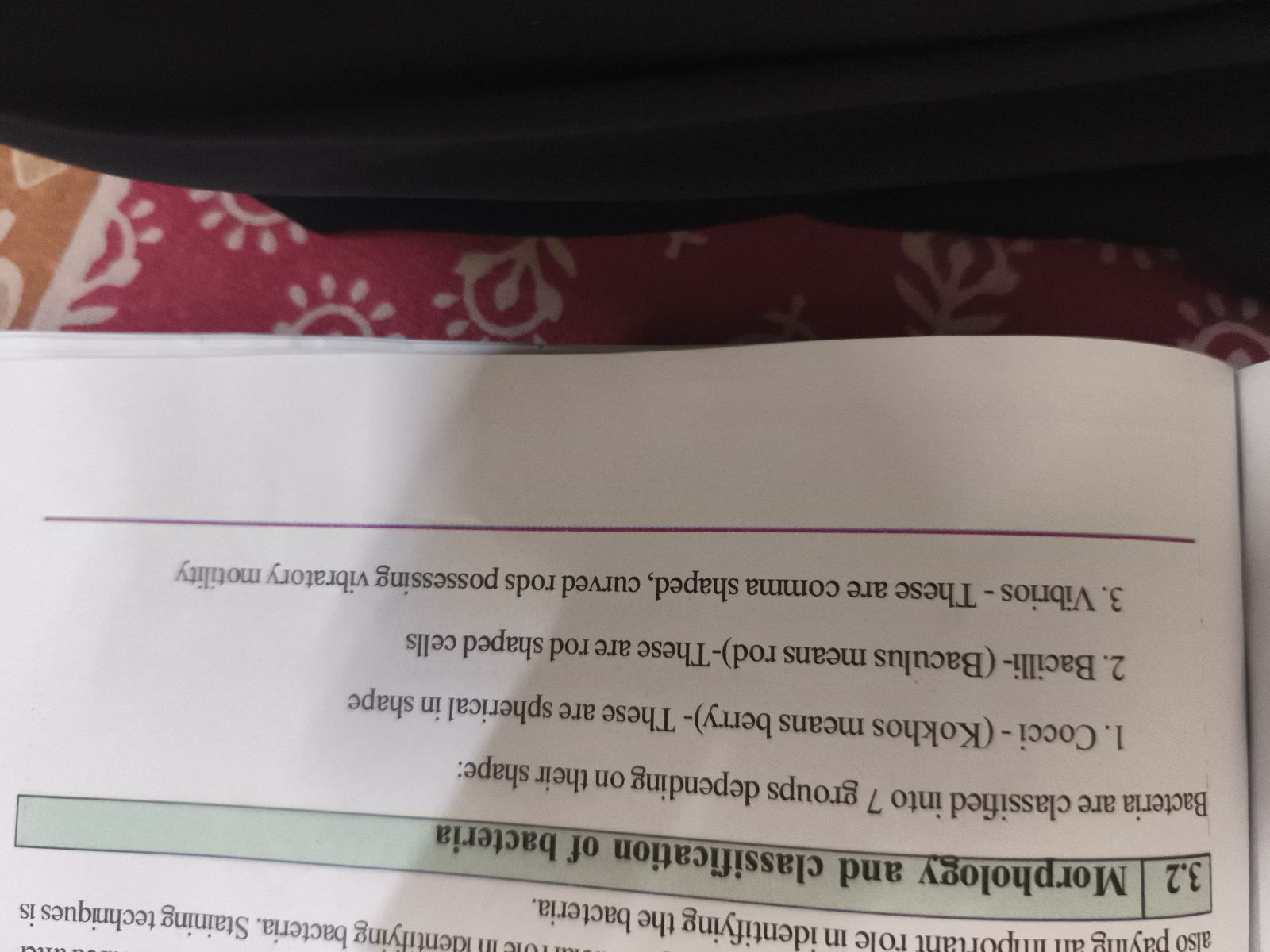
3.2 Morphology and classification of bacteria
...also paying an important role in identifying the bacteria. Staining techniques is...
Bacteria are classified into 7 groups depending on their shape:
- Cocci - (Kokhos means berry) - These are spherical in shape
- Bacilli - (Baculus means rod) - These are rod shaped cells
- Vibrios - These are comma shaped, curved rods possessing vibratory motility
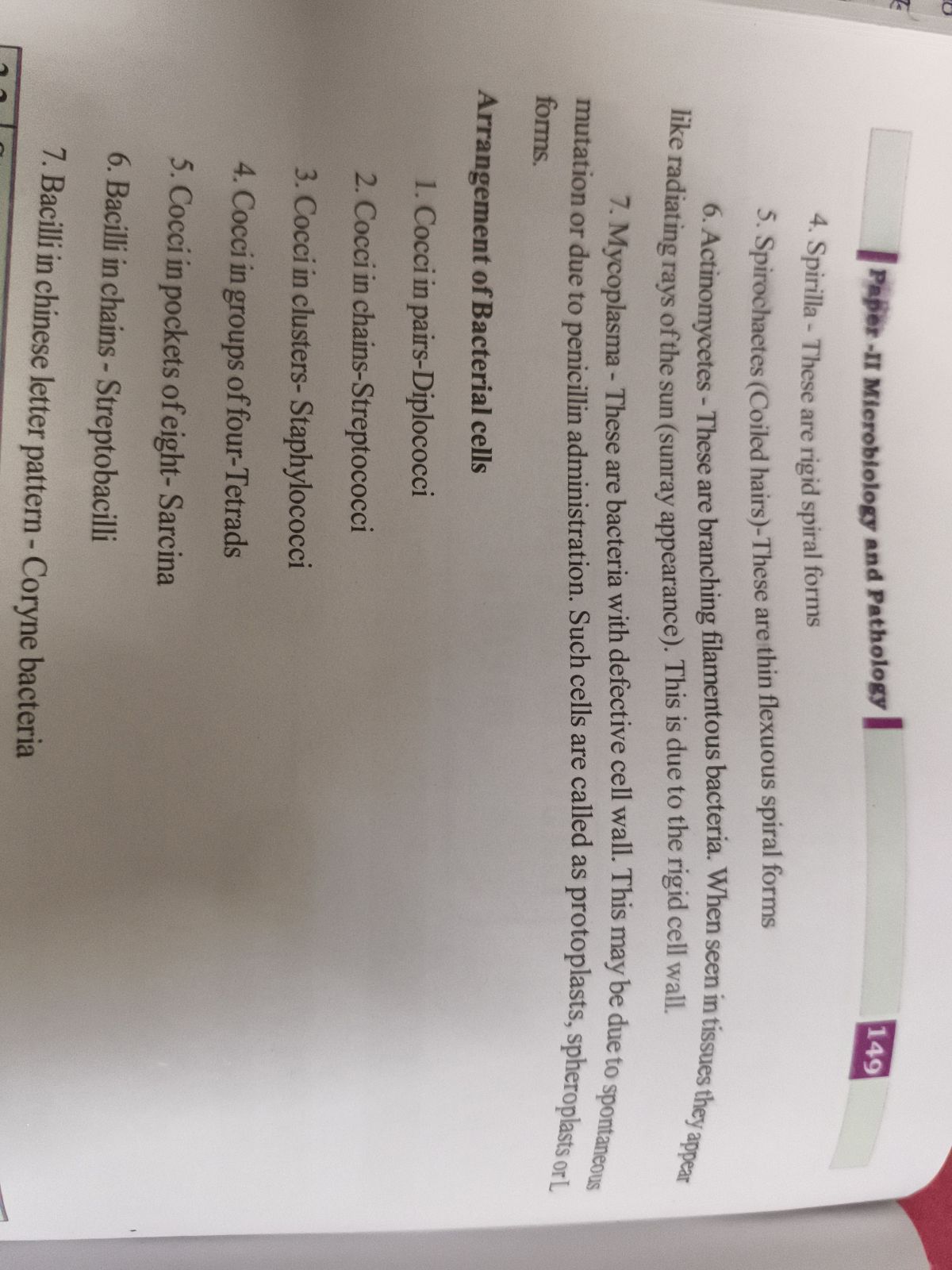
Paper -II Microbiology and Pathology (Page 149)
- Spirilla - These are rigid spiral forms
- Spirochaetes (Coiled hairs) - These are thin flexuous spiral forms
- Actinomycetes - These are branching filamentous bacteria. When seen in tissues they appear like radiating rays of the sun (sunray appearance). This is due to the rigid cell wall.
- Mycoplasma - These are bacteria with defective cell wall. This may be due to spontaneous mutation or due to penicillin administration. Such cells are called as protoplasts, spheroplasts or L forms.
Arrangement of Bacterial cells
- Cocci in pairs - Diplococci
- Cocci in chains - Streptococci
- Cocci in clusters - Staphylococci
- Cocci in groups of four - Tetrads
- Cocci in pockets of eight - Sarcina
- Bacilli in chains - Streptobacilli
- Bacilli in chinese letter pattern - Coryne bacteria
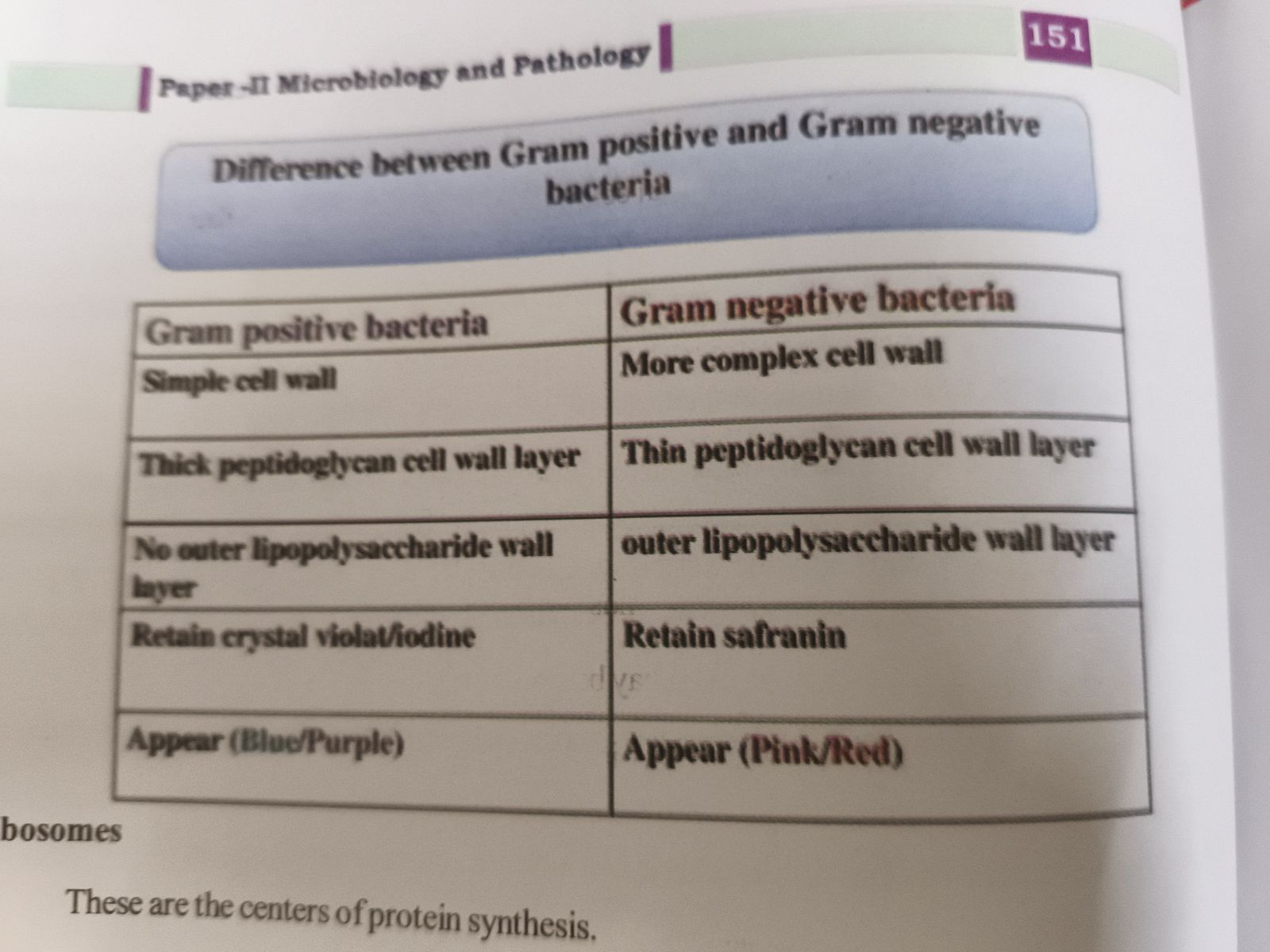
Paper -II Microbiology and Pathology (Page 151)
Difference between Gram positive and Gram negative bacteria
| Gram positive bacteria | Gram negative bacteria |
|---|---|
| Simple cell wall | More complex cell wall |
| Thick peptidoglycan cell wall layer | Thin peptidoglycan cell wall layer |
| No outer lipopolysaccharide wall layer | Outer lipopolysaccharide wall layer |
| Retain crystal violet/iodine | Retain safranin |
| Appear (Blue/Purple) | Appear (Pink/Red) |
Ribosomes
These are the centers of protein synthesis.
No bacterial images based on groups
Generating Image
Cocci bacteria - spherical shaped bacteria cells under microscope, scientific diagram label "Cocci"
Generating Image
Bacilli bacteria - rod shaped bacteria cells under microscope, scientific diagram label "Bacilli"
Generating Image
Vibrio bacteria - comma shaped curved rod bacteria cells under microscope, scientific diagram label "Vibrios"
!
400, message: Got more than 4194304 bytes when reading: b'data: {"candidates": [{"content": {"role": "model","parts": [{"inlineData": {"mimeType": "image/png"...'.
We encountered an error while processing your request. Please try again or reach out to us for help.
This is a shared conversation. Sign in to Orris to start your own chat.