
Phlebitic changes in vessels
Reading File
Searching for phlebitic vessel changes from multiple angles simultaneously.
search_medical_text
phlebitic changes vessels pathology histology
Harrison's Principles of Internal Medicine, Twenty First Edition
Page 6617
search_medical_text
phlebitis thrombophlebitis venous inflammation pathophysiology
Bailey and Love's Short Practice of Surgery 28th Edition
Page 1063
GradeResponse
GradeResponse
GradeResponse
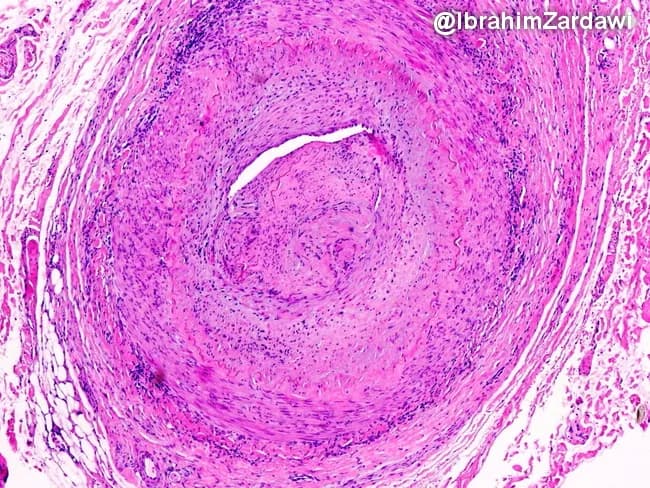
Phlebitic changes in vessels means inflammation of a vein wall, often with associated thrombus (thrombophlebitis).
Main vessel wall changes
- Endothelial injury/activation
- Endothelium becomes pro-inflammatory and pro-thrombotic.
- Inflammatory cell infiltration
- Neutrophils early, then mononuclear cells in/around the venous wall.
- Edema and wall thickening
- Perivascular edema, venous wall induration, tenderness clinically.
- Thrombus formation in lumen
- Common in superficial thrombophlebitis; can propagate into deep veins in some cases.
- Organization/fibrosis (chronic phase)
- Recanalization, residual fibrosis, valvular damage can occur.
- Potential sequelae
- Chronic venous insufficiency and post-thrombotic changes in deeper venous disease.
Clinical context
- Superficial phlebitis/thrombophlebitis: usually localized pain, erythema, palpable cord.
- Deep venous involvement (DVT): more dangerous due to risk of pulmonary embolism and later post-thrombotic syndrome.
According to Bailey and Love’s Short Practice of Surgery (p. 1063), superficial venous thrombosis is often termed thrombophlebitis and deep venous thrombosis carries major morbidity including PE and post-thrombotic complications.
If you want, I can also give a quick comparison table: superficial phlebitis vs DVT vs vasculitis-related venous inflammation.
This is a shared conversation. Sign in to Orris to start your own chat.