
Prompt- Create a super aesthetic, handwritten-style revision note page for the topic ameloblastoma: • Make it look like neat exam notes written on a page (top view, clean layout, colorful headings, underlines, boxes). • Keep it crisp, high-yield, and exam-oriented. • Use clear headings and organize content like this (modify if needed for topic): ○ Definition ○ Etiology ○ Pathogenesis (flow/arrow style) ○ Clinical features ○ Radiographic features (if applicable) ○ Histopathology (if applicable) ○ Key features ○ Differential diagnosis ○ Management ○ Complications ○ Key points / last-minute revision box • Add simple diagrams or labeled sketches wherever helpful. • Highlight important keywords. • Include one memory trick / one-line summary •
ameloblastoma high yield exam notes definition classification histopathology management
A super aesthetic handwritten-style medical revision note page for AMELOBLASTOMA, designed as neat exam notes viewed from top, on cream/off-white lined paper background with subtle blue horizontal lines. The page has colorful headings, underlines, boxes, and annotations in multiple ink colors (dark blue, red, green, purple, orange). Handwritten-style font throughout. Layout organized as follows: TOP HEADER: Large colorful title "AMELOBLASTOMA" in bold decorative handwriting with a double underline in blue/teal, with a small tooth icon sketch nearby. Below it in smaller text: "Benign but Locally Aggressive Odontogenic Tumor" MEMORY TRICK box (top right, orange border dashed box): "Mnemonic: 'AMEN - Always Mandible, Expansile, Not-malignant' | One-liner: 'An AMEN-able tumor - benign but bossy!'" SECTION 1 - DEFINITION (red heading with underline): "- Benign odontogenic epithelial neoplasm - Locally aggressive, high recurrence tendency - Originates from: enamel organ / dental lamina remnants / lining of odontogenic cysts - Most common benign odontogenic tumor (after odontoma)" SECTION 2 - CLASSIFICATION (purple heading): A neat hand-drawn table/box with 4 types: "1. Conventional (solid/multicystic) - 85% 2. Unicystic - 15% 3. Peripheral (extraosseous) - rare 4. Metastasizing - rare (histologically benign but metastasizes)" SECTION 3 - PATHOGENESIS (blue heading, with arrow flow diagram): Flow arrows: "Dental Lamina / Enamel Organ Remnants → Enamel Epithelium → MAPK Pathway Mutation (BRAF V600E - 90%) → Unregulated proliferation → Ameloblastoma" SECTION 4 - CLINICAL FEATURES (green heading): "- Age: >20 yrs (conventional); 2nd-3rd decade (unicystic) - Site: 85% MANDIBLE (molar-ramus region) ★ - Slow, painless jaw expansion / swelling - Egg-shell crackling on palpation (Ping-pong ball sign) - Facial asymmetry, loosening of teeth - Perforation of cortex → soft tissue involvement" SECTION 5 - RADIOGRAPHIC FEATURES (orange heading with small x-ray sketch): "★ Multilocular radiolucency - SOAP BUBBLE / HONEYCOMB appearance - Well-demarcated borders, corticated margins - Unilocular (unicystic type) - mimics dentigerous cyst - Root resorption of adjacent teeth - Cortical bone expansion & thinning" SECTION 6 - HISTOPATHOLOGY (teal heading, with small labeled sketch of follicular pattern): "Peripheral columnar cells with REVERSED NUCLEAR POLARIZATION (nuclei away from BM) = 'Piano Key appearance' Stellate reticulum-like cells in center Subtypes: • Follicular ★ - islands surrounded by columnar cells • Plexiform - interconnected strands • Acanthomatous - squamous metaplasia + keratin pearls • Granular cell - eosinophilic granular cytoplasm • Desmoplastic - dense fibrous stroma • Basal cell variant" SECTION 7 - DIFFERENTIAL DIAGNOSIS (red box): "• Dentigerous cyst • Odontogenic keratocyst (OKC) • Central giant cell granuloma • Odontogenic myxoma • Aneurysmal bone cyst" SECTION 8 - MANAGEMENT (blue heading): "Conservative (unicystic luminal/intraluminal): Enucleation + curettage RADICAL (conventional): Resection with 1 cm bony margin past radiographic extent ★ • Mandible: Segmental/marginal resection • Maxilla: More aggressive (proximity to orbit/pterygoids) BRAF inhibitors (vemurafenib) for recurrent cases with BRAF mutation" SECTION 9 - COMPLICATIONS (orange heading): "• Recurrence (15-35% after conservative tx) ★ • Malignant transformation → Ameloblastic carcinoma • Facial deformity, pathological fracture" LAST MINUTE REVISION BOX (bottom, yellow highlighted box with star): "★ KEY POINTS ★ ✓ Most common site: Posterior MANDIBLE ✓ Radiograph: Multilocular soap bubble radiolucency ✓ Histo hallmark: Reversed nuclear polarization + Piano key ✓ BRAF V600E mutation in 90% ✓ Tx of choice: Wide resection (1cm margin) ✓ Unicystic = better prognosis, younger age" Overall aesthetic: clean, colorful, organized like real handwritten medical student notes, with small doodles (tooth sketch, x-ray sketch, microscope icon), color-coded sections, boxes with rounded corners, arrow diagrams, and highlighted keywords in different colors. Professional medical student handwriting style.
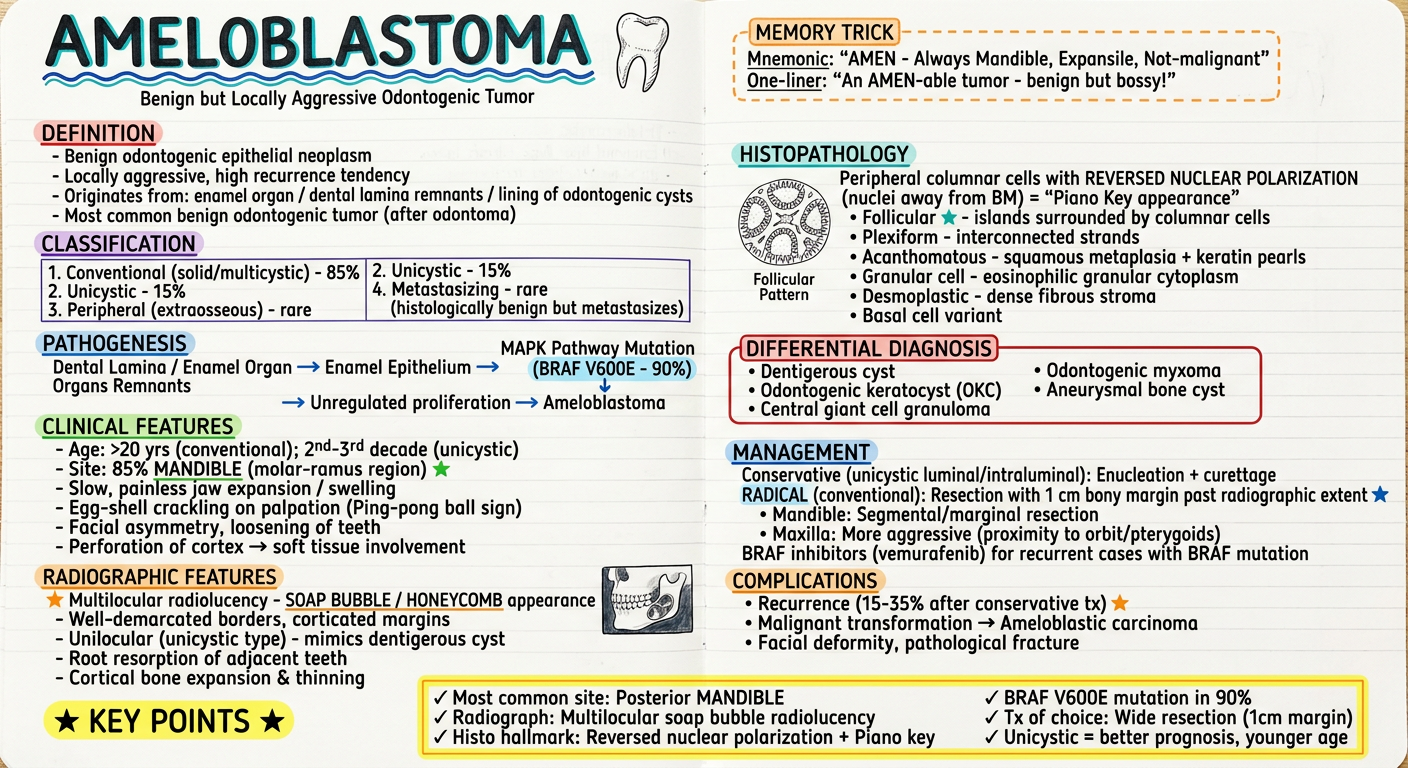
- Conventional (solid/multicystic) - 85% of cases
- Unicystic - 15%, younger patients, better prognosis
- Peripheral (extraosseous) - rare soft tissue variant
- Metastasizing - histologically benign but can metastasize