
Difference between use of creatinine and pah
The key difference between creatinine and PAH (para-aminohippuric acid) in renal physiology is what they measure:
- Creatinine is freely filtered and minimally secreted, so its clearance approximates GFR (glomerular filtration rate).
- PAH is both filtered AND actively secreted by the proximal tubule, so at low plasma concentrations it is almost completely cleared in one pass - its clearance approximates renal plasma flow (RPF).
Searching sources...
Reading File
Finding Sources
Finding Sources
Reading File
Reading File
Reading File
Reading File
Now I have comprehensive textbook content. Let me also fetch the PAH diagram image for visual clarity.
Loading Image
Here is a thorough comparison of creatinine and PAH (para-aminohippuric acid) as renal clearance markers:
Creatinine vs PAH - Renal Clearance Markers
What each one measures
| Feature | Creatinine | PAH |
|---|---|---|
| What it measures | GFR (glomerular filtration rate) | Renal plasma flow (RPF) |
| Normal value | ~125 mL/min | ~650 mL/min |
| Source | Endogenous (muscle metabolism) | Exogenous (must be infused IV) |
| Tubular handling | Freely filtered + small amount secreted | Freely filtered + actively secreted by proximal tubule |
| Practical use | Widely used clinically | Research/specialized testing |
Creatinine - Measures GFR
Creatinine is a by-product of muscle metabolism that is excreted almost entirely by glomerular filtration. Its clearance formula is:
C_cr = (U_cr × V̇) / P_cr
Because it is freely filtered and not significantly reabsorbed, its clearance approximates GFR (~125 mL/min). It does not need to be infused - it is endogenously produced - making it the most practical clinical GFR marker.
Why it slightly overestimates GFR: About 10-40% of urinary creatinine comes from proximal tubular secretion, meaning more is excreted than filtered. However, a corresponding laboratory measurement error (slight overestimation of plasma creatinine) fortuitously cancels this out, giving a reasonable GFR estimate. - Guyton & Hall Medical Physiology
Clinically: Plasma creatinine is inversely proportional to GFR. If GFR halves, plasma creatinine doubles; if GFR falls to 1/4 normal, plasma creatinine rises 4x.
PAH - Measures Renal Plasma Flow
PAH (para-aminohippuric acid) is an organic acid that is both freely filtered AND actively secreted by the proximal tubule. Because of this dual mechanism, ~90% of all PAH in renal arterial blood is excreted in a single pass - almost none leaves in the renal vein.
Effective RPF = C_PAH = (U_PAH × V̇) / P_PAH
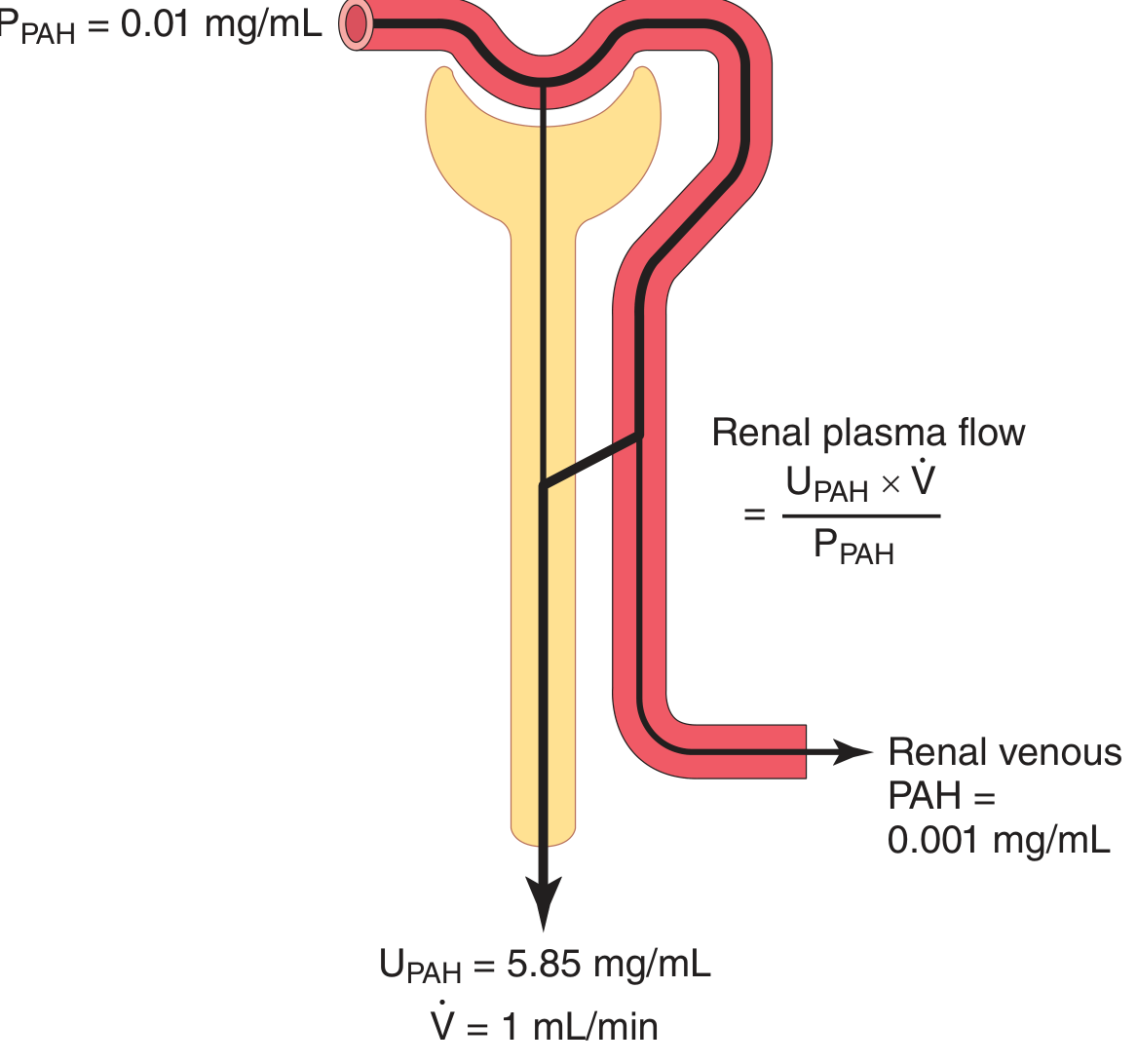
From the diagram: P_PAH in the renal artery = 0.01 mg/mL; after one pass, only 0.001 mg/mL remains in the renal vein - illustrating ~90% extraction.
Why "effective" RPF? True RPF requires sampling renal artery and vein blood (impractical in humans). Instead, we assume [RV]_PAH ≈ 0 and use peripheral venous blood as a proxy for renal arterial blood - this gives "effective RPF," which underestimates true RPF by ~10% because a small portion of renal blood flow perfuses non-filtering tissues (capsule, adipose) where PAH is not extracted. - Costanzo Physiology, 7e
From effective RPF to RBF:
RBF = RPF / (1 - hematocrit)
Key Conceptual Differences
| Creatinine | PAH | |
|---|---|---|
| Tubular secretion | Minimal (small fraction) | Massive (active proximal secretion) |
| Extraction ratio | ~20% (only filtered fraction removed) | ~90% (filtered + secreted) |
| GFR:RPF ratio | GFR is ~20% of RPF (filtration fraction) | PAH clears ~all RPF by definition |
| Formula | Clearance = GFR | Clearance = effective RPF |
| In disease | Secretion increases when GFR falls (overestimates GFR) | Extraction ratio falls when tubules are damaged (underestimates RPF) |
Filtration Fraction
A useful derived value:
Filtration Fraction (FF) = GFR / RPF = C_creatinine / C_PAH ≈ 125/650 ≈ 0.20 (20%)
This means only 20% of plasma entering the glomerulus is actually filtered; the remaining 80% passes into peritubular capillaries. - Morgan & Mikhail's Clinical Anesthesiology, 7e
Summary
- Creatinine clearance = practical surrogate for GFR; filtered only (small secretion); endogenous.
- PAH clearance = practical surrogate for renal plasma flow (effective RPF); filtered + maximally secreted; must be infused; ~90% extraction per pass.
- FF = GFR/RPF = C_cr/C_PAH ≈ 0.20
This is a shared conversation. Sign in to Orris to start your own chat.