
Make a ppt on breif introduction, approach to management , Treatment with dose , complication of viral hepatitis as per harrison
Reading File
Reading File
Reading File
Finding Sources
Now let me search specifically for Harrison's content on viral hepatitis:
Finding Sources
Finding Sources
Reading File
Excellent - I have rich Harrison's content. Now let me gather the management, treatment, and complications sections:
Reading File
Finding Sources
Reading File
Finding Sources
Reading File
Finding Sources
Finding Sources
Now I have all the key sections. Let me read the treatment/dose sections from block38 and block22:
Reading File
Reading File
I now have comprehensive Harrison's content. Let me read the complications section and then build the PPT:
Finding Sources
Reading File
Reading File
I now have all the content I need. Let me create the comprehensive PowerPoint:
Running Command
mkdir -p /home/daytona/workspace/viral-hepatitis-ppt && ls /home/daytona/workspace/
Writing File
~/viral-hepatitis-ppt/viral_hepatitis.js
const pptxgen = require("pptxgenjs");
const pres = new pptxgen();

pres.layout = 'LAYOUT_WIDE';
pres.title = 'Viral Hepatitis';
pres.author = 'Harrison\'s Principles of Internal Medicine 22E';

// ─── COLOR PALETTE ───────────────────────────────────────────────────────────
const C = {
  bg_dark:    '0D1B2A',   // deep navy
  bg_mid:     '1B2E44',   // medium navy
  accent:     'E8A020',   // amber/gold
  accent2:    '3AAFA9',   // teal
  accent3:    'E05A3A',   // coral/red
  accent4:    '4CAF79',   // green
  white:      'FFFFFF',
  light_gray: 'D0D8E4',
  text_dark:  '1A1A2E',
  subtitle:   'A8C0D6',
  card_bg:    '162236',
  card_bg2:   '0F2435',
};

// ─── HELPER FUNCTIONS ─────────────────────────────────────────────────────────
function addSlide(bg) {
  const s = pres.addSlide();
  s.addShape(pres.ShapeType.rect, { x: 0, y: 0, w: '100%', h: '100%', fill: { color: bg || C.bg_dark } });
  return s;
}

function slideHeader(slide, title, subtitle, accentColor) {
  const ac = accentColor || C.accent;
  // accent bar top
  slide.addShape(pres.ShapeType.rect, { x: 0, y: 0, w: '100%', h: 0.08, fill: { color: ac } });
  slide.addText(title, {
    x: 0.5, y: 0.18, w: 12.3, h: 0.7,
    fontSize: 28, bold: true, color: C.white, fontFace: 'Calibri', margin: 0
  });
  if (subtitle) {
    slide.addShape(pres.ShapeType.rect, { x: 0.5, y: 0.92, w: 1.2, h: 0.06, fill: { color: ac } });
    slide.addText(subtitle, {
      x: 0.5, y: 1.0, w: 12.3, h: 0.35,
      fontSize: 13, color: C.subtitle, fontFace: 'Calibri', italic: true, margin: 0
    });
  }
}

function bullet(text, options) {
  return { text, options: { bullet: { type: 'bullet', code: '25B6' }, fontSize: 14, color: C.white, fontFace: 'Calibri', breakLine: true, ...options } };
}

function bulletDot(text, options) {
  return { text, options: { bullet: { type: 'bullet', code: '25CF' }, fontSize: 13, color: C.light_gray, fontFace: 'Calibri', breakLine: true, ...options } };
}

function card(slide, x, y, w, h, title, titleColor, bodyItems, bgColor) {
  slide.addShape(pres.ShapeType.roundRect, { x, y, w, h, fill: { color: bgColor || C.card_bg }, line: { color: titleColor || C.accent, width: 1.5 }, rectRadius: 0.08 });
  slide.addText(title, { x: x + 0.15, y: y + 0.08, w: w - 0.3, h: 0.4, fontSize: 14, bold: true, color: titleColor || C.accent, fontFace: 'Calibri', margin: 0 });
  slide.addText(bodyItems, { x: x + 0.15, y: y + 0.5, w: w - 0.3, h: h - 0.6, fontSize: 12, color: C.white, fontFace: 'Calibri', valign: 'top', margin: 0 });
}


// ══════════════════════════════════════════════════════════════════════════════
// SLIDE 1 — TITLE
// ══════════════════════════════════════════════════════════════════════════════
{
  const s = addSlide(C.bg_dark);
  // large accent rect left
  s.addShape(pres.ShapeType.rect, { x: 0, y: 0, w: 0.4, h: '100%', fill: { color: C.accent } });
  // subtle mid panel
  s.addShape(pres.ShapeType.rect, { x: 0.4, y: 1.8, w: 12.9, h: 3.5, fill: { color: C.bg_mid } });
  s.addText('VIRAL HEPATITIS', {
    x: 0.7, y: 2.0, w: 12, h: 1.2,
    fontSize: 52, bold: true, color: C.white, fontFace: 'Calibri', margin: 0, charSpacing: 3
  });
  s.addText('A Comprehensive Overview', {
    x: 0.7, y: 3.2, w: 10, h: 0.5,
    fontSize: 22, color: C.accent, fontFace: 'Calibri', italic: true, margin: 0
  });
  s.addShape(pres.ShapeType.rect, { x: 0.7, y: 3.85, w: 4, h: 0.05, fill: { color: C.accent2 } });
  s.addText("Harrison's Principles of Internal Medicine, 22nd Edition (2025)", {
    x: 0.7, y: 4.0, w: 10, h: 0.4,
    fontSize: 14, color: C.subtitle, fontFace: 'Calibri', margin: 0
  });
  s.addText('Chapter 350 & 352 | Schaefer, Chung, Dienstag', {
    x: 0.7, y: 4.5, w: 10, h: 0.35,
    fontSize: 12, color: C.light_gray, fontFace: 'Calibri', margin: 0, italic: true
  });
  // decorative circles
  s.addShape(pres.ShapeType.ellipse, { x: 11.0, y: 0.3, w: 2.5, h: 2.5, fill: { color: C.accent, alpha: 85 } });
  s.addShape(pres.ShapeType.ellipse, { x: 11.8, y: 1.2, w: 1.4, h: 1.4, fill: { color: C.accent2, alpha: 80 } });
}

// ══════════════════════════════════════════════════════════════════════════════
// SLIDE 2 — OVERVIEW OUTLINE
// ══════════════════════════════════════════════════════════════════════════════
{
  const s = addSlide(C.bg_dark);
  slideHeader(s, 'PRESENTATION OUTLINE', 'Topics covered in this presentation', C.accent);

  const topics = [
    { num: '01', title: 'Introduction & Virology', desc: 'HAV, HBV, HCV, HDV, HEV — structure, epidemiology, pathogenesis' },
    { num: '02', title: 'Clinical Features & Diagnosis', desc: 'Symptoms, signs, incubation, lab findings, serologic markers' },
    { num: '03', title: 'Approach to Management', desc: 'General measures, indications for hospitalization, monitoring' },
    { num: '04', title: 'Treatment with Doses', desc: 'Antivirals for HBV and HCV — regimens, doses, duration' },
    { num: '05', title: 'Complications', desc: 'Fulminant hepatitis, chronicity, cirrhosis, HCC, extrahepatic' },
  ];

  const colors = [C.accent, C.accent2, C.accent3, C.accent4, 'B07FD4'];
  topics.forEach((t, i) => {
    const col = i < 3 ? 0 : (i === 3 ? 0 : 0);
    const x = 0.5 + (i % 3) * 4.3;
    const y = i < 3 ? 1.55 : 3.45;
    const xOff = i === 3 ? 2.15 : (i === 4 ? 6.45 : x);
    const yOff = i < 3 ? y : y;

    s.addShape(pres.ShapeType.roundRect, { x: xOff, y: yOff, w: 3.9, h: 1.65, fill: { color: C.card_bg }, line: { color: colors[i], width: 1.5 }, rectRadius: 0.08 });
    s.addText(t.num, { x: xOff + 0.15, y: yOff + 0.1, w: 0.6, h: 0.5, fontSize: 22, bold: true, color: colors[i], fontFace: 'Calibri', margin: 0 });
    s.addText(t.title, { x: xOff + 0.15, y: yOff + 0.55, w: 3.6, h: 0.45, fontSize: 15, bold: true, color: C.white, fontFace: 'Calibri', margin: 0 });
    s.addText(t.desc, { x: xOff + 0.15, y: yOff + 1.0, w: 3.6, h: 0.5, fontSize: 11, color: C.subtitle, fontFace: 'Calibri', margin: 0 });
  });
}

// ══════════════════════════════════════════════════════════════════════════════
// SLIDE 3 — INTRODUCTION (ETIOLOGY)
// ══════════════════════════════════════════════════════════════════════════════
{
  const s = addSlide(C.bg_dark);
  slideHeader(s, 'INTRODUCTION — VIROLOGY & ETIOLOGY', 'Five primary hepatotropic viruses', C.accent);

  const viruses = [
    { name: 'HAV', color: C.accent,  type: 'RNA', family: 'Picornavirus / Hepatovirus', genome: 'ssRNA (+), 7500 nt', route: 'Fecal-oral', incub: '15–45 days (mean 4 wks)', chronic: 'No' },
    { name: 'HBV', color: C.accent2, type: 'DNA', family: 'Hepadnavirus', genome: 'Partially dsDNA', route: 'Parenteral / Sexual / Perinatal', incub: '30–180 days (mean 8–12 wks)', chronic: 'Yes (1–90%)' },
    { name: 'HCV', color: C.accent3, type: 'RNA', family: 'Flavivirus / Hepacivirus', genome: 'ssRNA (+), 6 genotypes', route: 'Parenteral (IDU)', incub: '15–160 days (mean 7 wks)', chronic: 'Yes (~80%)' },
    { name: 'HDV', color: 'B07FD4', type: 'RNA', family: 'Deltavirus (satellite)', genome: 'Circular ssRNA, HDV Ag', route: 'Co-/Super-infection with HBV', incub: '30–60 days', chronic: 'If superinfection: 70–80%' },
    { name: 'HEV', color: C.accent4, type: 'RNA', family: 'Hepeviridae', genome: 'ssRNA (+), 4 genotypes', route: 'Fecal-oral (waterborne)', incub: '14–60 days (mean 5–6 wks)', chronic: 'Rare (immunosuppressed)' },
  ];

  viruses.forEach((v, i) => {
    const x = 0.3 + i * 2.56;
    const y = 1.55;
    s.addShape(pres.ShapeType.roundRect, { x, y, w: 2.45, h: 4.0, fill: { color: C.card_bg }, line: { color: v.color, width: 2 }, rectRadius: 0.1 });
    s.addShape(pres.ShapeType.roundRect, { x, y, w: 2.45, h: 0.65, fill: { color: v.color }, rectRadius: 0.1 });
    s.addText(v.name, { x: x + 0.05, y: y + 0.08, w: 2.35, h: 0.5, fontSize: 22, bold: true, color: C.white, fontFace: 'Calibri', align: 'center', margin: 0 });

    const rows = [
      [v.type + ' virus', v.family],
      ['Incubation:', v.incub],
      ['Route:', v.route],
      ['Chronicity:', v.chronic],
    ];
    rows.forEach((r, ri) => {
      s.addText(r[0], { x: x + 0.1, y: y + 0.8 + ri * 0.78, w: 2.25, h: 0.32, fontSize: 10.5, bold: true, color: v.color, fontFace: 'Calibri', margin: 0 });
      s.addText(r[1], { x: x + 0.1, y: y + 1.08 + ri * 0.78, w: 2.25, h: 0.38, fontSize: 10, color: C.light_gray, fontFace: 'Calibri', margin: 0, wrap: true });
    });
  });

  s.addText('* HBV is the only DNA virus; replicates like a retrovirus. All others are RNA viruses. HAV/HEV = enteric; HBV/HCV/HDV = parenteral transmission.', {
    x: 0.3, y: 5.65, w: 12.9, h: 0.3, fontSize: 10, color: C.subtitle, fontFace: 'Calibri', italic: true, margin: 0
  });
}

// ══════════════════════════════════════════════════════════════════════════════
// SLIDE 4 — CLINICAL FEATURES
// ══════════════════════════════════════════════════════════════════════════════
{
  const s = addSlide(C.bg_dark);
  slideHeader(s, 'CLINICAL FEATURES & DIAGNOSIS', 'Symptoms, signs, and serologic markers', C.accent2);

  // Left column – Phases
  s.addShape(pres.ShapeType.roundRect, { x: 0.4, y: 1.55, w: 4.0, h: 4.1, fill: { color: C.card_bg }, line: { color: C.accent2, width: 1.5 }, rectRadius: 0.08 });
  s.addText('CLINICAL PHASES', { x: 0.55, y: 1.65, w: 3.7, h: 0.4, fontSize: 14, bold: true, color: C.accent2, fontFace: 'Calibri', margin: 0 });

  const phases = [
    ['Incubation', 'Asymptomatic; viremia present'],
    ['Prodrome\n(pre-icteric)', 'Anorexia, nausea, vomiting, fatigue, myalgia, fever 38–39°C, RUQ pain, aversion to cigarettes/alcohol'],
    ['Icteric Phase', 'Jaundice, dark urine, pale stools, hepatomegaly, splenomegaly (~20%), pruritus'],
    ['Recovery', 'Fatigue may persist weeks to months'],
  ];
  const phaseColors = [C.accent, C.accent2, C.accent3, C.accent4];
  phases.forEach((p, i) => {
    s.addShape(pres.ShapeType.rect, { x: 0.55, y: 2.1 + i * 0.88, w: 0.1, h: 0.7, fill: { color: phaseColors[i] } });
    s.addText(p[0], { x: 0.75, y: 2.1 + i * 0.88, w: 3.5, h: 0.28, fontSize: 12, bold: true, color: phaseColors[i], fontFace: 'Calibri', margin: 0 });
    s.addText(p[1], { x: 0.75, y: 2.38 + i * 0.88, w: 3.5, h: 0.4, fontSize: 10.5, color: C.white, fontFace: 'Calibri', margin: 0, wrap: true });
  });

  // Middle column – Labs
  s.addShape(pres.ShapeType.roundRect, { x: 4.7, y: 1.55, w: 4.0, h: 4.1, fill: { color: C.card_bg }, line: { color: C.accent, width: 1.5 }, rectRadius: 0.08 });
  s.addText('LABORATORY FINDINGS', { x: 4.85, y: 1.65, w: 3.7, h: 0.4, fontSize: 14, bold: true, color: C.accent, fontFace: 'Calibri', margin: 0 });

  const labs = [
    ['ALT / AST', 'Elevated 400–4000 IU/L; ALT > AST in viral hepatitis'],
    ['Bilirubin', 'Total Tbili >3 mg/dL with jaundice; both conjugated & unconjugated'],
    ['PT / INR', 'Prolonged in severe disease; best indicator of hepatic synthesis'],
    ['Alkaline\nPhosphatase', 'Modestly elevated; >3× normal suggests cholestasis'],
    ['CBC', 'Atypical lymphocytes; relative leukopenia'],
    ['Serology', 'Type-specific markers (see next column)'],
  ];
  labs.forEach((l, i) => {
    s.addText('▸  ' + l[0], { x: 4.85, y: 2.12 + i * 0.57, w: 3.7, h: 0.25, fontSize: 12, bold: true, color: C.accent, fontFace: 'Calibri', margin: 0 });
    s.addText(l[1], { x: 4.85, y: 2.37 + i * 0.57, w: 3.7, h: 0.22, fontSize: 10.5, color: C.white, fontFace: 'Calibri', margin: 0, wrap: true });
  });

  // Right column – Serologic markers
  s.addShape(pres.ShapeType.roundRect, { x: 9.0, y: 1.55, w: 4.2, h: 4.1, fill: { color: C.card_bg }, line: { color: C.accent3, width: 1.5 }, rectRadius: 0.08 });
  s.addText('KEY SEROLOGIC MARKERS', { x: 9.15, y: 1.65, w: 3.9, h: 0.4, fontSize: 14, bold: true, color: C.accent3, fontFace: 'Calibri', margin: 0 });

  const sero = [
    ['HAV', 'IgM anti-HAV = acute; IgG anti-HAV = past/immunity'],
    ['HBV acute', 'HBsAg (+), IgM anti-HBc (+), HBeAg reflects high replication'],
    ['HBV window', 'HBsAg(-), anti-HBs(-) → only IgM anti-HBc (+)'],
    ['HBV chronic', 'HBsAg >6 months; HBV DNA, HBeAg/anti-HBe, LFTs'],
    ['HCV', 'Anti-HCV ± HCV RNA (RNA confirms viremia)'],
    ['HDV', 'HDAg, anti-HDV; only in HBsAg(+) patients'],
    ['HEV', 'IgM/IgG anti-HEV; HEV RNA in stool/serum'],
  ];
  sero.forEach((r, i) => {
    s.addText('▸  ' + r[0], { x: 9.15, y: 2.12 + i * 0.49, w: 3.9, h: 0.22, fontSize: 12, bold: true, color: C.accent3, fontFace: 'Calibri', margin: 0 });
    s.addText(r[1], { x: 9.15, y: 2.34 + i * 0.49, w: 3.9, h: 0.2, fontSize: 10, color: C.white, fontFace: 'Calibri', margin: 0, wrap: true });
  });
}

// ══════════════════════════════════════════════════════════════════════════════
// SLIDE 5 — APPROACH TO MANAGEMENT (ACUTE)
// ══════════════════════════════════════════════════════════════════════════════
{
  const s = addSlide(C.bg_dark);
  slideHeader(s, 'APPROACH TO MANAGEMENT', 'Acute viral hepatitis — general principles', C.accent4);

  // Box: General measures
  s.addShape(pres.ShapeType.roundRect, { x: 0.4, y: 1.55, w: 6.1, h: 4.1, fill: { color: C.card_bg }, line: { color: C.accent4, width: 1.5 }, rectRadius: 0.08 });
  s.addText('GENERAL MEASURES', { x: 0.55, y: 1.65, w: 5.8, h: 0.4, fontSize: 15, bold: true, color: C.accent4, fontFace: 'Calibri', margin: 0 });

  const general = [
    ['Activity', 'Rest as needed; bed rest is not essential. Restrict strenuous physical activity. Resume activity as tolerated.'],
    ['Diet', 'High-calorie diet preferred. Nausea often worst in afternoon, so major caloric intake in morning. IV fluids if persistent vomiting.'],
    ['Drugs to Avoid', 'All drugs metabolized by liver; hepatotoxic agents; cholestatic drugs. Glucocorticoids have NO role — may worsen chronicity.'],
    ['Pruritus', 'Cholestyramine (bile salt resin) for severe pruritus.'],
    ['Alcohol', 'Abstain completely during acute illness.'],
    ['Isolation', 'No isolation needed for bloodborne types (HBV/HCV/HDV). Enteric precautions for HAV/HEV (hand hygiene, gloves for stool).'],
  ];
  general.forEach((g, i) => {
    s.addText('▸  ' + g[0], { x: 0.55, y: 2.12 + i * 0.57, w: 5.8, h: 0.24, fontSize: 12.5, bold: true, color: C.accent4, fontFace: 'Calibri', margin: 0 });
    s.addText(g[1], { x: 0.55, y: 2.36 + i * 0.57, w: 5.8, h: 0.22, fontSize: 10.5, color: C.white, fontFace: 'Calibri', margin: 0, wrap: true });
  });

  // Box: Hospitalization indications
  s.addShape(pres.ShapeType.roundRect, { x: 6.8, y: 1.55, w: 6.1, h: 2.0, fill: { color: C.card_bg }, line: { color: C.accent3, width: 1.5 }, rectRadius: 0.08 });
  s.addText('INDICATIONS FOR HOSPITALIZATION', { x: 6.95, y: 1.65, w: 5.8, h: 0.4, fontSize: 13, bold: true, color: C.accent3, fontFace: 'Calibri', margin: 0 });
  const hosp = ['Prolonged PT / coagulopathy', 'Encephalopathy / altered sensorium', 'Hypoglycemia', 'Persistent vomiting / inability to maintain hydration', 'Serum bilirubin >10 mg/dL or rapidly rising', 'Elderly or immunocompromised patient'];
  s.addText(hosp.map(h => '• ' + h).join('\n'), { x: 6.95, y: 2.1, w: 5.8, h: 1.35, fontSize: 11.5, color: C.white, fontFace: 'Calibri', valign: 'top', margin: 0 });

  // Box: Monitoring
  s.addShape(pres.ShapeType.roundRect, { x: 6.8, y: 3.75, w: 6.1, h: 1.9, fill: { color: C.card_bg }, line: { color: C.accent, width: 1.5 }, rectRadius: 0.08 });
  s.addText('MONITORING PARAMETERS', { x: 6.95, y: 3.85, w: 5.8, h: 0.4, fontSize: 13, bold: true, color: C.accent, fontFace: 'Calibri', margin: 0 });
  const monitor = ['LFTs (ALT/AST) every 1–2 weeks until normalization', 'PT/INR — key marker of hepatic synthetic function', 'Serum bilirubin (total + direct)', 'Serology: HBsAg, HBeAg, anti-HBe, HBV DNA', 'Abdominal ultrasound if prolonged jaundice or fever'];
  s.addText(monitor.map(m => '• ' + m).join('\n'), { x: 6.95, y: 4.28, w: 5.8, h: 1.3, fontSize: 11.5, color: C.white, fontFace: 'Calibri', valign: 'top', margin: 0 });
}

// ══════════════════════════════════════════════════════════════════════════════
// SLIDE 6 — MANAGEMENT: SPECIFIC ANTIVIRALS (HBV)
// ══════════════════════════════════════════════════════════════════════════════
{
  const s = addSlide(C.bg_dark);
  slideHeader(s, 'TREATMENT — CHRONIC HEPATITIS B', 'Eight approved agents: goals and first-line recommendations', C.accent2);

  // Header bar
  s.addShape(pres.ShapeType.rect, { x: 0.4, y: 1.55, w: 12.5, h: 0.45, fill: { color: C.bg_mid } });
  ['Drug', 'Route & Dose', 'Resistance', 'Key Points'].forEach((h, i) => {
    const xs = [0.5, 3.0, 6.7, 9.3];
    s.addText(h, { x: xs[i], y: 1.6, w: i === 0 ? 2.4 : (i === 1 ? 3.5 : (i === 2 ? 2.5 : 3.5)), h: 0.35, fontSize: 12.5, bold: true, color: C.accent2, fontFace: 'Calibri', margin: 0 });
  });

  const drugs = [
    ['PEG-IFN α-2a\n(First-line)', 'SC 100 µg/week × 48 wks', 'Not described', 'Finite duration; response better in Genotype A/B; avoid in decompensated cirrhosis & pregnancy'],
    ['Entecavir\n★ First-line', 'Oral 0.5 mg/day\n(1 mg/day if LAM-R)', '1–2% @ 5 yr (naïve)\n50% @ 5 yr (LAM-R)', 'High potency, high barrier to resistance; preferred oral agent'],
    ['Tenofovir DF\n★ First-line', 'Oral 300 mg/day', 'None reported', 'Potent; preferred in pregnancy (Category B); monitor renal function & bone density'],
    ['Tenofovir AF\n★ First-line', 'Oral 25 mg/day', 'None reported', 'Renal/bone-safer TAF formulation; not for CrCl <15 mL/min'],
    ['Lamivudine\n(Historical)', 'Oral 100 mg/day', '23% @ 1 yr; 70% @ 5 yr', 'High resistance; only for prophylaxis if short course needed'],
    ['Adefovir\n(Historical)', 'Oral 10 mg/day', '20–29% @ 5 yr', 'Renal toxicity at higher doses; active against LAM-R strains'],
    ['Telbivudine\n(Historical)', 'Oral 600 mg/day', '11–25% @ 2 yr', 'Cross-resistance with lamivudine; myopathy risk'],
  ];

  const rowColors = [C.bg_mid, C.card_bg];
  drugs.forEach((d, i) => {
    const y = 2.1 + i * 0.5;
    s.addShape(pres.ShapeType.rect, { x: 0.4, y, w: 12.5, h: 0.48, fill: { color: rowColors[i % 2] } });
    s.addText(d[0], { x: 0.5, y: y + 0.05, w: 2.4, h: 0.38, fontSize: 11, bold: true, color: d[0].includes('★') ? C.accent4 : C.white, fontFace: 'Calibri', margin: 0, wrap: true });
    s.addText(d[1], { x: 3.0, y: y + 0.05, w: 3.5, h: 0.38, fontSize: 11, color: C.accent, fontFace: 'Calibri', margin: 0, wrap: true });
    s.addText(d[2], { x: 6.7, y: y + 0.05, w: 2.5, h: 0.38, fontSize: 10.5, color: C.white, fontFace: 'Calibri', margin: 0, wrap: true });
    s.addText(d[3], { x: 9.3, y: y + 0.05, w: 3.5, h: 0.38, fontSize: 10, color: C.light_gray, fontFace: 'Calibri', margin: 0, wrap: true });
  });

  s.addText('Treatment endpoint: HBsAg seroconversion OR HBeAg seroconversion (continue 6 months after). In acute severe HBV: entecavir or TDF until 3 months after HBsAg loss.', {
    x: 0.4, y: 5.6, w: 12.5, h: 0.35, fontSize: 10.5, color: C.subtitle, fontFace: 'Calibri', italic: true, margin: 0
  });
}

// ══════════════════════════════════════════════════════════════════════════════
// SLIDE 7 — TREATMENT: CHRONIC HEPATITIS C (DAA REGIMENS)
// ══════════════════════════════════════════════════════════════════════════════
{
  const s = addSlide(C.bg_dark);
  slideHeader(s, 'TREATMENT — CHRONIC HEPATITIS C', 'Direct-acting antivirals (DAAs) — current first-line combinations', C.accent3);

  // Mechanism bar
  s.addShape(pres.ShapeType.roundRect, { x: 0.4, y: 1.55, w: 12.5, h: 0.55, fill: { color: C.card_bg }, line: { color: C.accent3, width: 1 }, rectRadius: 0.06 });
  s.addText('DAA Classes: NS3/4A Protease inhibitors ("-previr") | NS5A inhibitors ("-asvir") | NS5B Polymerase inhibitors ("-buvir") | Goal: SVR12 (undetectable HCV RNA 12 wks post-treatment) ≥ 95–99%', {
    x: 0.55, y: 1.62, w: 12.2, h: 0.42, fontSize: 11.5, color: C.white, fontFace: 'Calibri', margin: 0
  });

  // Table header
  s.addShape(pres.ShapeType.rect, { x: 0.4, y: 2.2, w: 12.5, h: 0.4, fill: { color: C.bg_mid } });
  ['Regimen (Brand)', 'Dose', 'Duration', 'Genotype', 'SVR12 / Notes'].forEach((h, i) => {
    const xs = [0.5, 4.3, 6.4, 7.9, 9.3];
    const ws = [3.7, 2.0, 1.4, 1.3, 3.5];
    s.addText(h, { x: xs[i], y: 2.25, w: ws[i], h: 0.3, fontSize: 12, bold: true, color: C.accent3, fontFace: 'Calibri', margin: 0 });
  });

  const regimens = [
    ['Sofosbuvir/Ledipasvir\n(Harvoni)', '90/400 mg once daily', '8–12 wks', '1, 4, 5, 6', '95–99% SVR12; 8 wks if treatment-naïve, no cirrhosis, VL <6M IU/mL'],
    ['Sofosbuvir/Velpatasvir\n(Epclusa)', '400/100 mg once daily', '12 wks', 'Pangenotypic\n1–6', '95–99%; ribavirin added for compensated cirrhosis GT3'],
    ['Glecaprevir/Pibrentasvir\n(Mavyret) ★', '300/120 mg once daily', '8 wks (naïve, no cirr.)\n12 wks (cirrhosis)', 'Pangenotypic', '97–99%; approved 8 wks for all genotypes; CONTRAINDICATED in decompensated cirrhosis'],
    ['Sofosbuvir/Velpatasvir/\nVoxilaprevir (Vosevi)', '400/100/100 mg once daily', '12 wks', 'Pangenotypic\n(salvage)', 'For DAA-experienced or NS5A-resistant patients; CONTRAINDICATED in decompensated cirrhosis'],
    ['Elbasvir/Grazoprevir\n(Zepatier)', '50/100 mg once daily', '12–16 wks', '1a, 1b, 4', '95–99%; add ribavirin for GT1a with NS5A RAVs; avoid in decompensated cirrhosis'],
  ];

  const rowC = [C.bg_mid, C.card_bg];
  regimens.forEach((r, i) => {
    const y = 2.65 + i * 0.57;
    s.addShape(pres.ShapeType.rect, { x: 0.4, y, w: 12.5, h: 0.55, fill: { color: rowC[i % 2] } });
    const xs = [0.5, 4.3, 6.4, 7.9, 9.3];
    const ws = [3.7, 2.0, 1.4, 1.3, 3.5];
    const colors = [C.white, C.accent, C.white, C.white, C.light_gray];
    [r[0], r[1], r[2], r[3], r[4]].forEach((cell, ci) => {
      s.addText(cell, { x: xs[ci], y: y + 0.04, w: ws[ci], h: 0.48, fontSize: r[0].includes('★') ? 10.5 : 10, color: r[0].includes('★') && ci === 0 ? C.accent4 : colors[ci], fontFace: 'Calibri', margin: 0, wrap: true, bold: ci === 0 && r[0].includes('★') });
    });
  });

  s.addText('Acute HCV: Early treatment with standard 8–12 wk DAA course recommended (no longer "watch and wait"). Ribavirin rarely needed in modern DAA era.', {
    x: 0.4, y: 5.6, w: 12.5, h: 0.32, fontSize: 10, color: C.subtitle, fontFace: 'Calibri', italic: true, margin: 0
  });
}

// ══════════════════════════════════════════════════════════════════════════════
// SLIDE 8 — COMPLICATIONS
// ══════════════════════════════════════════════════════════════════════════════
{
  const s = addSlide(C.bg_dark);
  slideHeader(s, 'COMPLICATIONS OF VIRAL HEPATITIS', 'Acute and chronic sequelae', C.accent3);

  const comps = [
    {
      title: 'Fulminant Hepatic\nFailure (FHF)',
      color: C.accent3,
      icon: '⚡',
      items: [
        'Rare but life-threatening (<1% acute HBV; HEV in pregnancy up to 20–25%)',
        'Massive hepatic necrosis → hepatic encephalopathy within 2 weeks of jaundice',
        'Features: shrinking liver, coagulopathy, hypoglycemia, ascites, cerebral edema',
        'HBV: treat with entecavir/TDF; refer for liver transplantation',
      ]
    },
    {
      title: 'Chronic Hepatitis\n& Chronicity',
      color: C.accent2,
      icon: '🔄',
      items: [
        'HAV/HEV: no chronicity (self-limited)',
        'HBV: 1% (adult); 90% (neonatal); 25–30% (age 1–5 yrs)',
        'HCV: ~75–85% progress to chronic infection',
        'HDV superinfection: 70–80% chronic; co-infection 1–3%',
      ]
    },
    {
      title: 'Cirrhosis',
      color: C.accent,
      icon: '🫀',
      items: [
        'End-stage of chronic HBV and HCV',
        'Characterized by fibrosis, regenerative nodules, portal hypertension',
        'Complications: variceal bleeding, ascites, SBP, hepatic encephalopathy',
        'HBV cirrhosis: antiviral therapy shown to cause fibrosis regression',
      ]
    },
    {
      title: 'Hepatocellular\nCarcinoma (HCC)',
      color: 'B07FD4',
      icon: '🔴',
      items: [
        'HBV: independent risk even without cirrhosis; HBsAg(+) = 100× risk',
        'HCV: HCC occurs almost exclusively in setting of cirrhosis',
        'Surveillance: AFP + ultrasound every 6 months in high-risk groups',
        'HBV treatment reduces but does not eliminate HCC risk',
      ]
    },
    {
      title: 'Extrahepatic\nManifestations',
      color: C.accent4,
      icon: '🌐',
      items: [
        'HBV: serum-sickness–like illness, polyarteritis nodosa, membranous GN, essential mixed cryoglobulinemia',
        'HCV: Mixed cryoglobulinemia, membranoproliferative GN, lichen planus, porphyria cutanea tarda, non-Hodgkin lymphoma',
        'HAV: Relapsing hepatitis (rare), cholestatic hepatitis, autoimmune hepatitis trigger',
        'HEV: Neurologic complications — Guillain-Barré, Bell palsy, encephalitis',
      ]
    },
    {
      title: 'Cholestatic &\nOther Variants',
      color: 'F0A500',
      icon: '💛',
      items: [
        'Cholestatic hepatitis A: prolonged jaundice + pruritis, intense but self-limited',
        'Relapsing hepatitis A: 2–3 relapses before final recovery; ~10–20%',
        'HBV reactivation: in immunosuppressed — can be fulminant; prophylaxis required',
        'HEV in immunocompromised (transplant recipients): chronic HEV infection with rapid fibrosis',
      ]
    },
  ];

  const cols = [0.3, 4.55, 8.8];
  const rows = [1.55, 3.7];
  comps.forEach((c, i) => {
    const col = i % 3;
    const row = Math.floor(i / 3);
    const x = cols[col];
    const y = rows[row];
    const w = 4.1;
    const h = 1.95;

    s.addShape(pres.ShapeType.roundRect, { x, y, w, h, fill: { color: C.card_bg }, line: { color: c.color, width: 1.5 }, rectRadius: 0.08 });
    s.addShape(pres.ShapeType.rect, { x, y, w, h: 0.42, fill: { color: c.color }, rectRadius: 0.08 });
    s.addText(c.title, { x: x + 0.12, y: y + 0.05, w: w - 0.25, h: 0.34, fontSize: 12.5, bold: true, color: C.white, fontFace: 'Calibri', margin: 0 });
    s.addText(c.items.map(it => '• ' + it).join('\n'), {
      x: x + 0.12, y: y + 0.48, w: w - 0.25, h: h - 0.6,
      fontSize: 9.5, color: C.white, fontFace: 'Calibri', valign: 'top', margin: 0, wrap: true
    });
  });
}

// ══════════════════════════════════════════════════════════════════════════════
// SLIDE 9 — PREVENTION
// ══════════════════════════════════════════════════════════════════════════════
{
  const s = addSlide(C.bg_dark);
  slideHeader(s, 'PREVENTION & PROPHYLAXIS', 'Vaccines, passive immunity, and public health measures', C.accent4);

  const prevData = [
    {
      title: 'HAV Prevention',
      color: C.accent,
      lines: [
        'Active: Inactivated HAV vaccine (Havrix, Vaqta) — 2 doses at 0 & 6–12 months → 95–100% protection',
        'Passive: IG 0.02 mL/kg within 2 weeks of exposure (pre-exposure travel)',
        'HAV immune globulin + vaccine for post-exposure prophylaxis',
        'Environmental: hand hygiene, safe water & food handling',
      ]
    },
    {
      title: 'HBV Prevention',
      color: C.accent2,
      lines: [
        'Active: Recombinant HBsAg vaccine — 3 doses (0, 1, 6 months); >90% seroconversion',
        'Perinatal: Newborns of HBsAg(+) mothers: vaccine + HBIG (0.5 mL) within 12 h of birth → 85–90% prevention',
        'Post-exposure (needle-stick): HBIG (0.06 mL/kg) + vaccine series within 24 h',
        'Universal precautions, safe injection practices',
      ]
    },
    {
      title: 'HCV Prevention',
      color: C.accent3,
      lines: [
        'No vaccine available',
        'Reduce needle sharing; harm reduction programs for IDUs',
        'Blood product screening (anti-HCV + HCV RNA)',
        'No effective post-exposure prophylaxis — monitor HCV RNA at 4–6 weeks',
      ]
    },
    {
      title: 'HEV Prevention',
      color: C.accent4,
      lines: [
        'HEV 239 vaccine (Hecolin) — approved in China; 3 doses, 95.5% efficacy',
        'Not widely available outside China',
        'Safe water supply; sanitation infrastructure; avoid raw pork in endemic areas',
        'High-risk group: pregnant women (mortality 15–25% in endemic areas)',
      ]
    },
  ];

  prevData.forEach((p, i) => {
    const x = 0.4 + (i % 2) * 6.55;
    const y = 1.55 + Math.floor(i / 2) * 2.2;
    s.addShape(pres.ShapeType.roundRect, { x, y, w: 6.2, h: 2.0, fill: { color: C.card_bg }, line: { color: p.color, width: 1.5 }, rectRadius: 0.08 });
    s.addShape(pres.ShapeType.rect, { x, y, w: 6.2, h: 0.42, fill: { color: p.color }, rectRadius: 0.08 });
    s.addText(p.title, { x: x + 0.15, y: y + 0.06, w: 5.9, h: 0.32, fontSize: 14, bold: true, color: C.white, fontFace: 'Calibri', margin: 0 });
    s.addText(p.lines.map(l => '• ' + l).join('\n'), {
      x: x + 0.15, y: y + 0.5, w: 5.9, h: 1.4,
      fontSize: 10.5, color: C.white, fontFace: 'Calibri', valign: 'top', margin: 0, wrap: true
    });
  });

  s.addText('HDV: No specific HDV vaccine — HBV vaccination prevents HDV co-infection. For chronic HDV: Bulevirtide (approved in EU 2020) — 2 mg SC daily; PEG-IFN α as alternative.', {
    x: 0.4, y: 5.62, w: 12.5, h: 0.3, fontSize: 10.5, color: C.subtitle, fontFace: 'Calibri', italic: true, margin: 0
  });
}

// ══════════════════════════════════════════════════════════════════════════════
// SLIDE 10 — SPECIAL SITUATIONS / MANAGEMENT ALGORITHM
// ══════════════════════════════════════════════════════════════════════════════
{
  const s = addSlide(C.bg_dark);
  slideHeader(s, 'MANAGEMENT ALGORITHM — SPECIAL SITUATIONS', 'Pregnancy, immunosuppression, decompensated cirrhosis', C.accent);

  const boxes = [
    {
      title: 'HBV in Pregnancy',
      color: 'F9A8D4',
      content: [
        'Screen all pregnant women for HBsAg',
        'TDF (Tenofovir DF) — safest antiviral in pregnancy (Cat. B)',
        'High viral load (HBV DNA >200,000 IU/mL): start TDF at 28–32 wks to prevent MTCT',
        'Newborn: HBV vaccine + HBIG within 12 hours',
        'Avoid entecavir, PEG-IFN in pregnancy',
      ]
    },
    {
      title: 'HBV Reactivation\n(Immunosuppression)',
      color: 'FCA5A5',
      content: [
        'Risk: chemotherapy, biologics (anti-TNF, rituximab), steroids, transplant',
        'Screen all patients for HBsAg and anti-HBc before immunosuppression',
        'HBsAg(+): start prophylactic entecavir or TDF before chemotherapy',
        'Anti-HBc(+)/HBsAg(-): monitor HBV DNA monthly; treat if DNA detectable',
        'Prophylaxis duration: until 6–12 months post-immunosuppression',
      ]
    },
    {
      title: 'Decompensated\nCirrhosis (HBV)',
      color: C.accent3,
      content: [
        'Entecavir 1 mg/day or TDF — even in compensated cirrhosis',
        'Avoid PEG-IFN (risk of decompensation)',
        'Refer for liver transplantation evaluation',
        'Continuous viral suppression indefinitely',
        'Monitor MELD score, serum albumin, PT/INR',
      ]
    },
    {
      title: 'Decompensated\nCirrhosis (HCV)',
      color: 'FBBF24',
      content: [
        'CONTRAINDICATED: all protease inhibitors (glecaprevir, grazoprevir, voxilaprevir)',
        'Use: Sofosbuvir/Velpatasvir ± ribavirin for 24 weeks',
        'Ribavirin: weight-based (600–1200 mg/day); reduce dose per Hb',
        'Sustained virologic response may allow downlisting from transplant waitlist',
        'Monitor for HCV reinfection post-transplant',
      ]
    },
  ];

  boxes.forEach((b, i) => {
    const x = 0.4 + (i % 2) * 6.55;
    const y = 1.55 + Math.floor(i / 2) * 2.2;
    s.addShape(pres.ShapeType.roundRect, { x, y, w: 6.2, h: 2.0, fill: { color: C.card_bg }, line: { color: b.color, width: 1.5 }, rectRadius: 0.08 });
    s.addShape(pres.ShapeType.rect, { x, y, w: 6.2, h: 0.42, fill: { color: b.color, alpha: b.color.length === 6 ? 0 : 0 }, rectRadius: 0.08 });
    s.addText(b.title, { x: x + 0.15, y: y + 0.06, w: 5.9, h: 0.34, fontSize: 13.5, bold: true, color: C.text_dark, fontFace: 'Calibri', margin: 0 });
    s.addText(b.content.map(l => '• ' + l).join('\n'), {
      x: x + 0.15, y: y + 0.5, w: 5.9, h: 1.4,
      fontSize: 10.5, color: C.white, fontFace: 'Calibri', valign: 'top', margin: 0, wrap: true
    });
  });

  s.addText("Source: Harrison's Principles of Internal Medicine 22E (2025) | Chapters 350 & 352", {
    x: 0.4, y: 5.62, w: 12.5, h: 0.3, fontSize: 10, color: C.subtitle, fontFace: 'Calibri', italic: true, align: 'right', margin: 0
  });
}

// ══════════════════════════════════════════════════════════════════════════════
// SLIDE 11 — SUMMARY / KEY TAKEAWAYS
// ══════════════════════════════════════════════════════════════════════════════
{
  const s = addSlide(C.bg_dark);
  // accent bar
  s.addShape(pres.ShapeType.rect, { x: 0, y: 0, w: '100%', h: 0.08, fill: { color: C.accent } });
  s.addShape(pres.ShapeType.rect, { x: 0, y: 5.54, w: '100%', h: 0.08, fill: { color: C.accent } });

  s.addText('KEY TAKEAWAYS', { x: 0.5, y: 0.18, w: 12.3, h: 0.65, fontSize: 30, bold: true, color: C.white, fontFace: 'Calibri', margin: 0 });
  s.addShape(pres.ShapeType.rect, { x: 0.5, y: 0.88, w: 1.8, h: 0.06, fill: { color: C.accent } });

  const takes = [
    { num: '1', color: C.accent, text: 'Five hepatotropic viruses: HAV & HEV (enteric, self-limited) vs HBV, HCV, HDV (parenteral, risk of chronicity).' },
    { num: '2', color: C.accent2, text: 'Most acute hepatitis is self-limited. General supportive care is the cornerstone; avoid hepatotoxic drugs & glucocorticoids.' },
    { num: '3', color: C.accent3, text: 'Severe acute HBV (fulminant or prolonged >4 wks): treat with entecavir or TDF until 3–6 months after seroconversion.' },
    { num: '4', color: C.accent4, text: 'Acute HCV: initiate full 8–12 week DAA therapy early (no longer wait for spontaneous resolution).' },
    { num: '5', color: 'B07FD4', text: 'Chronic HBV: first-line = Entecavir 0.5 mg/day, TDF 300 mg/day, or TAF 25 mg/day. Lifelong therapy often required. Goal: undetectable HBV DNA.' },
    { num: '6', color: C.accent, text: 'Chronic HCV: pangenotypic DAAs (glecaprevir/pibrentasvir or sofosbuvir/velpatasvir) achieve SVR12 >95–99% in 8–12 weeks.' },
    { num: '7', color: C.accent3, text: 'Complications: fulminant hepatic failure, chronicity, cirrhosis, HCC, and extrahepatic manifestations (cryoglobulinemia, GN, lymphoma).' },
    { num: '8', color: C.accent2, text: 'Prevention: HBV vaccine is highly effective. No HCV or HDV vaccine — harm reduction key. HAV/HEV: sanitation + HAV vaccine.' },
  ];

  takes.forEach((t, i) => {
    const x = i < 4 ? 0.4 : 6.8;
    const y = 1.0 + (i % 4) * 1.1;
    s.addShape(pres.ShapeType.ellipse, { x, y: y + 0.08, w: 0.45, h: 0.45, fill: { color: t.color } });
    s.addText(t.num, { x, y: y + 0.08, w: 0.45, h: 0.45, fontSize: 16, bold: true, color: C.white, fontFace: 'Calibri', align: 'center', valign: 'middle', margin: 0 });
    s.addText(t.text, { x: x + 0.6, y, w: 5.7, h: 0.68, fontSize: 11.5, color: C.white, fontFace: 'Calibri', valign: 'middle', margin: 0, wrap: true });
  });
}

// ═══════════════════════════════════════
// WRITE FILE
// ═══════════════════════════════════════
pres.writeFile({ fileName: '/home/daytona/workspace/viral-hepatitis-ppt/Viral_Hepatitis_Harrisons.pptx' })
  .then(() => console.log('PPT created successfully!'))
  .catch(e => console.error('Error:', e));
Running Command
cd /home/daytona/workspace/viral-hepatitis-ppt && node viral_hepatitis.js 2>&1
Running Command
ls -lh /home/daytona/workspace/viral-hepatitis-ppt/
Your presentation is ready!
Viral Hepatitis Harrisons
Presentation · PPTX
What's inside (11 slides, wide 16:9 format)
The deck uses a deep navy + amber/teal color scheme with card-based layouts. All content is drawn directly from Harrison's Principles of Internal Medicine, 22nd Edition (2025), Chapters 350 & 352.
| # | Slide | Highlights |
|---|---|---|
| 1 | Title | Visual cover with authorship |
| 2 | Outline | 5 numbered topic cards |
| 3 | Introduction & Virology | 5-column virus comparison (HAV/HBV/HCV/HDV/HEV) — type, family, route, incubation, chronicity |
| 4 | Clinical Features & Diagnosis | Phases of illness, lab findings, serologic markers per virus |
| 5 | Approach to Management | General measures, hospitalization indications, monitoring parameters |
| 6 | Treatment — Chronic HBV | Full drug table: 7 agents with dose, route, resistance, key points (first-line marked) |
| 7 | Treatment — Chronic HCV | DAA regimens table: Harvoni, Epclusa, Mavyret, Vosevi, Zepatier — dose, duration, genotype, SVR12 |
| 8 | Complications | 6 cards: FHF, chronicity, cirrhosis, HCC, extrahepatic manifestations, cholestatic variants |
| 9 | Prevention & Prophylaxis | Vaccines and post-exposure measures for HAV, HBV, HCV, HEV |
| 10 | Special Situations | HBV in pregnancy, HBV reactivation, decompensated cirrhosis (HBV & HCV) |
| 11 | Key Takeaways | 8 summary bullets covering all major points |
Pathophysiology of viral hepatitis
Reading File
Quick answer: Viral hepatitis pathophysiology centers on immune-mediated hepatocyte injury rather than direct cytopathic damage (except HCV which has some direct effect). The hepatitis viruses infect hepatocytes, triggering CD8+ cytotoxic T lymphocyte responses, innate immune activation, and cytokine cascades (TNF-α, IFN-γ) that cause hepatocellular necrosis and apoptosis. This results in elevated transaminases, impaired bilirubin conjugation, coagulopathy, and — in severe cases — massive necrosis.
Searching sources...
Finding Sources
Finding Sources
Finding Sources
Finding Sources
Excellent - I found the key sections. Let me read them all in parallel:
Reading File
Reading File
Reading File
Reading File
Excellent content on HBV. Now let me get the HCV pathogenesis and also look for images:
Reading File
Finding Sources
Finding Sources
Now I have comprehensive pathophysiology content. Let me also look for any relevant images and get the HCV-specific pathogenesis section:
Finding Sources
Finding Sources
Reading File
Reading File
I found an image of bilirubin transport. Let me fetch it and also look for hepatitis-specific pathology images:
Loading Image
Finding Sources
I now have comprehensive content from Harrison's. Let me also look for the HBV life cycle / replication image:
Finding Sources
I now have all the material I need from Harrison's. Let me compose a comprehensive, structured answer:
Pathophysiology of Viral Hepatitis
Based on Harrison's Principles of Internal Medicine, 22nd Edition (2025), Chapter 350
1. Core Principle: Immune-Mediated, Not Directly Cytopathic
The most important concept in viral hepatitis pathophysiology is that none of the five hepatitis viruses (HAV, HBV, HCV, HDV, HEV) are directly cytopathic to hepatocytes under ordinary circumstances. The liver injury is primarily determined by the immunological response of the host to the infected hepatocytes.
The clearest proof of this is the "immune tolerant" HBV carrier: high viral replication, yet minimal liver damage — because the immune system fails to mount a cytotoxic response.
2. HBV Pathogenesis (Most Extensively Studied)
2a. Adaptive Immune Response (Central Mechanism)
The dominant model involves HLA-restricted cytolytic CD8+ T lymphocytes (CTLs) that recognize viral antigen-MHC class I complexes on infected hepatocytes:
- HBV nucleocapsid proteins - HBcAg and HBeAg - are expressed in minute quantities on the hepatocyte cell membrane
- Viral T-cell epitopes present alongside host (HLA class I) antigens on the cell surface
- HBV-specific CD8+ CTLs are sensitized to these complexes and destroy infected hepatocytes
- CD4+ helper T cells amplify and sustain this CTL response
The breadth and polyclonality of the CD8+ response determines outcome:
- Robust, broad CTL response → viral clearance + acute hepatitis → recovery
- Weak, narrowed, exhausted CTL response → failure to clear → chronic hepatitis
- Massive, overwhelmingly rapid CTL response → fulminant hepatic failure
2b. Innate Immune Response (Early Phase)
Interestingly, >90% of HBV DNA disappears from the liver before maximal T-cell infiltration in experimentally infected chimpanzees. This means innate immunity acts first:
- Natural killer (NK) cells provide early cytotoxicity against HBV-infected hepatocytes
- NK cell activation is triggered by reduced inhibitory MHC signals and increased activating receptor expression on infected cells
- NK cells eliminate HBV replicative intermediates from the hepatocyte cytoplasm and covalently closed circular DNA (cccDNA) from the nucleus
- IL-10 and TGF-β (immunosuppressive cytokines) can blunt NK activity, allowing viral persistence
- NK cells also reduce CD4+ helper T cells → reduces CD8+ effector function → T-cell exhaustion
2c. Immunologic Tolerance and Age-Dependent Outcome
This explains why outcome differs dramatically by age of infection:
| Age of Infection | Immune Response | Outcome |
|---|---|---|
| Neonatal (perinatal) | Tolerogenic - HBeAg crosses placenta, induces T-cell tolerance in utero | 90% chronic infection; later cirrhosis/HCC |
| Childhood (1–5 yrs) | Partial tolerance | 25–30% chronicity |
| Adulthood | Robust CTL response | ~1% chronicity; acute hepatitis typical |
The key mechanism: in utero exposure to HBeAg (which is small enough to cross the placenta) induces clonal T-cell tolerance to both nucleocapsid proteins in the neonate, preventing cytolytic clearance.
2d. Viral Factors in Pathogenicity
- Precore (HBeAg-negative) HBV mutants: associated with more severe chronic and fulminant hepatitis - suggesting that under certain circumstances, the virus itself contributes to pathogenicity
- HDV superinfection: HDV antigen transfected cells become necrotic even without immunologic input, indicating a direct cytopathic effect of HDV
- HBV reactivation (in immunosuppressed hosts): rapid, often fulminant liver injury when immune suppression is lifted or viral replication surges unchecked
3. HCV Pathogenesis
HCV is a master immune evader. The pathogenesis involves both immune-mediated and limited direct cytopathic mechanisms:
3a. Pattern Recognition and Innate Response
After HCV entry into hepatocytes, the host identifies viral motifs via pattern recognition receptors (PRRs), triggering interferon (IFN) production:
- Type I and Type III interferons are produced
- Interferon-stimulated genes (ISGs) activate antiviral effectors
- HCV counteracts this by blocking type I IFN responses and inhibiting IFN signaling at multiple levels (NS3/4A protease cleaves MAVS and TRIF - key innate signaling adapters)
3b. Adaptive Immune Evasion
- HLA class I-restricted CD8+ CTLs directed against HCV nucleocapsid and envelope proteins are generated, but are weak and narrowed
- NK cell cytotoxicity is dysfunctional in persistent infection (reduced IFN-γ secretion, loss of activating receptors)
- The rapid mutation rate of HCV generates vast quasispecies diversity - allowing viral escape from both humoral and cellular immune containment
- HCV core, NS4B, and NS5B suppress the NF-κB pathway → reduces antiapoptotic proteins → increased vulnerability to TNF-α-mediated hepatocyte death
3c. Role of IL28B Polymorphism
A chromosome 19 frameshift variant creates IFN-λ4 (interferon lambda-4):
- The ΔG polymorphism of IFN-λ4 (non-CC IL28B haplotype) is associated with impaired HCV clearance
- The favorable CC haplotype supports efficient innate antiviral defense → spontaneous clearance in ~15–20% of acute infections
4. HAV and HEV Pathogenesis
Though simpler, these follow the same immune-mediated logic:
- Viral shedding pre-dates clinical liver injury - confirming that viral replication per se does not cause damage
- CD8+ CTL response is the primary instrument of hepatocyte injury
- CD4+ helper T cells and IFN-γ-secreting cells participate
- In acute HAV: expansion of CD8+ T cells reactive against non-HAV viruses (bystander activation) also correlates with liver injury
- HEV also interferes with IFN signaling and downregulates IFN-stimulated genes
- HEV in pregnancy: mortality 15–25% in endemic areas - mechanisms not fully explained but include enhanced immune reactivity and hormonal modulation
5. Histopathology of Liver Injury
Acute Viral Hepatitis (All Types - Similar Morphology)
- Panlobular mononuclear infiltration (predominantly small lymphocytes, occasional plasma cells and eosinophils)
- Hepatocyte necrosis: cell dropout, ballooning degeneration, acidophilic degeneration
- Councilman (apoptotic) bodies: shrunken eosinophilic hepatocytes with pyknotic nuclei - hallmark of apoptotic cell death
- Kupffer cell hyperplasia
- Hepatic regeneration: mitotic figures, multinucleated cells, rosette/pseudoacinar formation
- The reticulin framework is preserved in uncomplicated acute hepatitis
Virus-Specific Histologic Features
| Virus | Distinctive Feature |
|---|---|
| HBV (chronic) | Ground-glass hepatocytes (HBsAg in cytoplasm); stain with orcein or aldehyde fuchsin |
| HCV | Paucity of inflammation; sinusoidal lining cell activation; lymphoid aggregates; fat (steatosis especially genotype 3); bile duct lesions |
| HDV | Microvesicular steatosis |
| HEV | Marked cholestasis |
| HAV (cholestatic variant) | Cholestatic picture with slow resolution |
Severe Acute Hepatitis
- Bridging necrosis (subacute/confluent necrosis, interface hepatitis): large areas of hepatocyte dropout with collapse of reticulin, forming "bridges" between portal tracts, portal to central, or central to central
- Fulminant hepatitis ("acute yellow atrophy"): massive necrosis of most lobules; small, shrunken, soft liver; complete collapse of reticulin framework
6. Antigen Localization in Infected Hepatocytes
| Antigen | Location |
|---|---|
| HBsAg | Cytoplasm and plasma membrane |
| HBcAg | Predominantly nucleus; traces in cytoplasm and membrane |
| HDV antigen | Hepatocyte nucleus |
| HAV antigen | Cytoplasm |
| HCV antigen | Cytoplasm |
| HEV ORF-2 protein | Both cytoplasmic and nuclear |
7. How Liver Injury Produces Clinical Features
| Mechanism | Clinical/Lab Consequence |
|---|---|
| Hepatocyte necrosis and inflammation | Elevated ALT/AST (released from damaged cells); ALT > AST in viral hepatitis |
| Impaired bilirubin conjugation (UGT1A1 dysfunction) + hepatocyte uptake failure + cholestasis | Hyperbilirubinemia (both conjugated + unconjugated) → jaundice, dark urine, pale stools |
| Impaired hepatic synthesis (albumin, clotting factors II, V, VII, X) | Hypoalbuminemia, prolonged PT/INR, coagulopathy |
| Kupffer cell activation + cytokine release (TNF-α, IL-1, IL-6) | Constitutional symptoms: fever, malaise, myalgia, anorexia |
| Portal inflammation + bile duct involvement | Cholestasis, pruritus (bile salt accumulation) |
| Loss of hepatic metabolic mass | Hypoglycemia (failure of gluconeogenesis) in fulminant disease |
Bilirubin pathway in hepatitis (per Fig. 349-1, Harrison's):
Unconjugated bilirubin (ALB-bound from sinusoidal blood) → uptake by hepatocyte via BT/OATP1B → intracellular binding by GST → conjugation by UGT1A1 to mono/diglucuronides → secretion into bile via MRP2. In hepatitis, steps 1 (uptake), 3 (conjugation), and 4 (secretion) are all impaired.
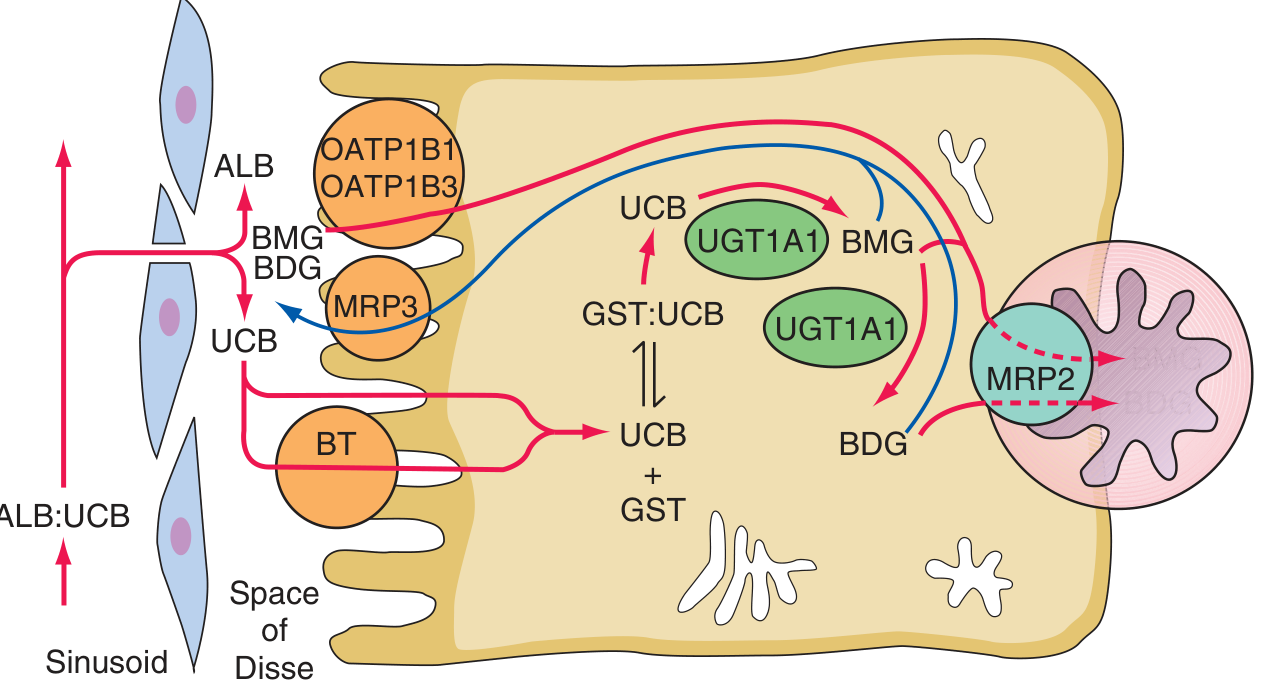
8. Extrahepatic Manifestations — Immunopathogenesis
The extrahepatic features of viral hepatitis are mediated by circulating immune complexes, not direct viral infection of extrahepatic tissues:
- HBV: The prodromal serum-sickness–like illness (fever, rash, arthralgia) results from deposition of HBsAg-anti-HBs immune complexes in blood vessel walls → complement activation → depressed serum complement levels
- Chronic HBV: Polyarteritis nodosa, membranous glomerulonephritis, cryoglobulinemia
- HCV: Mixed (type II) cryoglobulinemia (RF + IgM-IgG complexes), membranoproliferative GN, lichen planus, porphyria cutanea tarda, non-Hodgkin lymphoma
- HEV: Guillain-Barré syndrome, Bell's palsy, encephalitis — postulated to result from both immunologic mechanisms and direct extrahepatic viral infection
9. Pathogenesis of Chronicity
| Virus | Why Chronicity Occurs |
|---|---|
| HBV | T-cell exhaustion; HBeAg-induced neonatal tolerance; viral escape mutations evading CTL; NK cell dysfunction; failure to eliminate cccDNA |
| HCV | Rapid quasispecies mutation; potent innate IFN pathway blockade; NK cell dysfunction; weak polyclonal CTL response; unfavorable IL28B genotype |
| HDV | Requires HBV for envelope proteins; chronicity linked to degree of HBV chronicity; direct cytopathic contribution |
| HAV/HEV | Almost never chronic — robust innate + adaptive clearance (exception: HEV in immunosuppressed transplant recipients) |
Source: Harrison's Principles of Internal Medicine, 22nd Edition (2025), Chapters 350 (Acute Viral Hepatitis) and 352 (Chronic Viral Hepatitis) — Schaefer, Chung, Dienstag.
Management of viral hepatitis as per harrison for presentation at MD level
Reading File
Reading File
This is an MD-level presentation request - I need deep, detailed Harrison's content on management. Let me do parallel searches across all the key management sections.
Finding Sources
Reading File
Reading File
Reading File
Reading File
Your credits are exhausted. You can purchase a top-up or subscribe to a plan to continue using Orris. If you're already subscribed, your daily credits will reset tomorrow.
This is a shared conversation. Sign in to Orris to start your own chat.