
Types of triages according to park
Reading File
Triage by Park's classification refers to categorizing casualties/patients for mass casualty or disaster management. The main types are: Immediate (P1/Red), Delayed (P2/Yellow), Minimal (P3/Green), and Expectant (P4/Black/Blue). Let me search the textbooks for authoritative detail.
Searching sources...
Finding Sources
Finding Sources
Reading File
Finding Sources
Reading File
Finding Sources
I found the complete triage table from Bailey & Love's Surgery. Let me also fetch the triage tag image for visual context.
Loading Image
Searching the Web
Park's triage classification types disaster mass casualty management
I now have all the information needed for a thorough answer. Here is the complete breakdown of triage types according to Park (from Bailey and Love's Short Practice of Surgery, which follows Park's classification system used in disaster/mass casualty management):
Types of Triage According to Park
Triage (from the French trier, meaning "to sort") is the cornerstone of mass casualty management. Its goal is "the greatest good for the greatest number" - identifying who benefits most from earliest treatment. Park's classification uses a four-tier, colour-coded system based on vital signs, ability to walk, mental status, and presence/absence of ventilation and perfusion.
The Four Triage Categories
| Priority | Colour | Label | Clinical Status | Examples |
|---|---|---|---|---|
| First (I) | 🔴 Red | Immediate | Critical, but likely to survive if treatment given early | Severe facial trauma, tension pneumothorax, profuse external bleeding, haemothorax, flail chest, major intra-abdominal bleed, extradural haematoma |
| Second (II) | 🟡 Yellow | Urgent / Delayed | Critical, likely to survive if treatment given within hours | Compound fractures, degloving injuries, ruptured abdominal viscus, pelvic fractures, spinal injuries |
| Third (III) | 🟢 Green | Non-urgent / Minimal | Stable, likely to survive even if treatment delayed hours to days | Simple fractures, sprains, minor lacerations |
| Last (0) | ⚫ Black | Unsalvageable / Expectant | Not breathing, pulseless, or so severely injured no care will help | Severe brain damage, very extensive burns, major disruption/loss of chest or abdominal wall structures |
Triage Tag (used in the field)
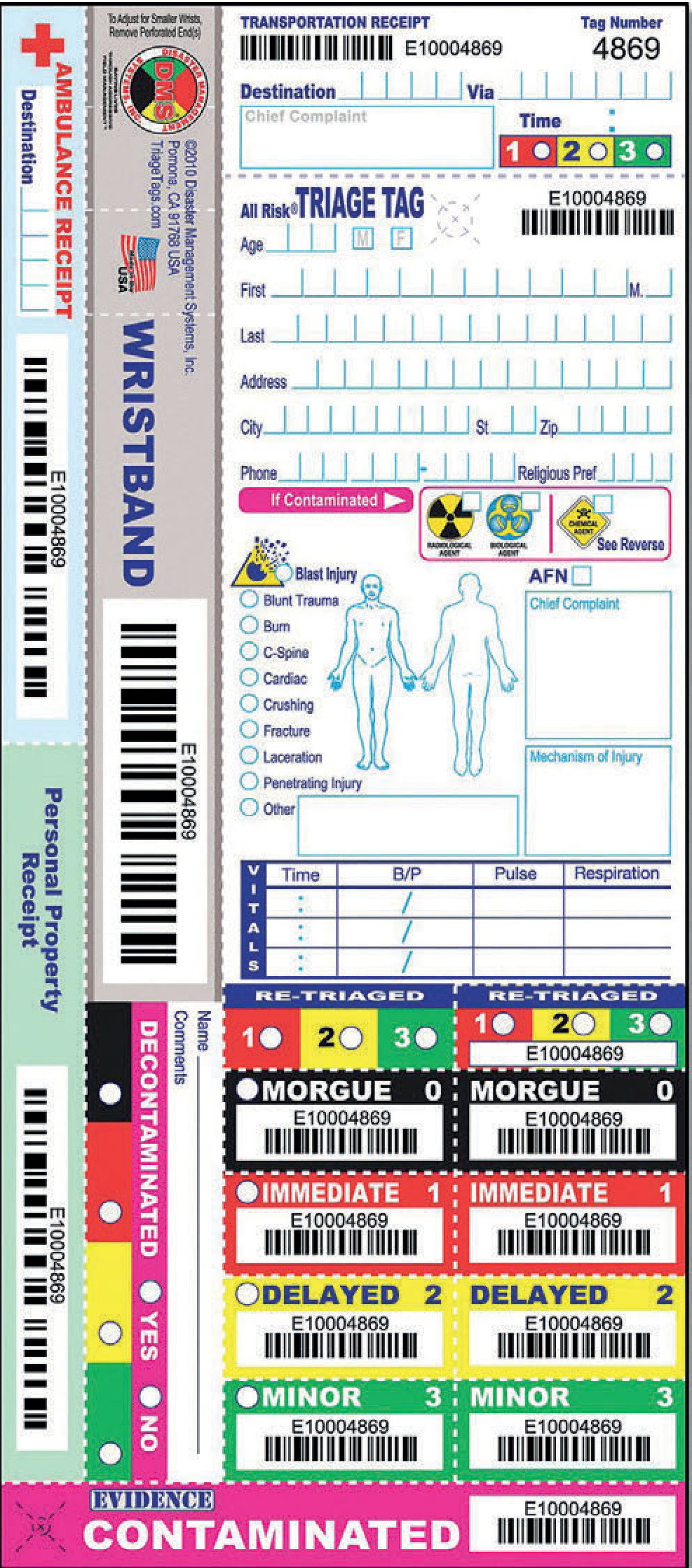
The triage tag is attached to the patient's wrist or neck. The bottom strip in the appropriate colour is torn off to indicate the triage category assigned.
Key Points
-
Immediate (P1 - Red): These patients need life-saving treatment within minutes. Examples include airway obstruction, uncontrolled haemorrhage, and tension pneumothorax. They are salvageable but time-critical.
-
Delayed/Urgent (P2 - Yellow): Serious injuries that can wait a few hours without mortality risk. Condition is stable enough to allow some delay in definitive care.
-
Minimal/Non-urgent (P3 - Green): The "walking wounded." Injuries are minor and these patients can wait the longest or even self-care. They should not clog the system.
-
Expectant/Unsalvageable (P0 - Black): Either already dead or injuries are so severe that even with maximal resources, survival is not expected. In true mass casualty scenarios, resources are not expended on these patients.
Important Principles
- Triage must be performed by someone senior, with experience and authority to make critical decisions.
- Triage is dynamic - it must be repeated in the field, before evacuation, and again at the hospital, as the clinical picture changes over time.
- Approximately 10-15% of disaster casualties are serious enough to require hospitalisation.
- Documentation using colour-coded tags is essential for tracking patient status and evacuation.
(Source: Bailey and Love's Short Practice of Surgery, 28th Edition, Table 33.1 - Triage categories)
No I want simple reverse etc
The user is asking about the types of triage as classified by Park - like Simple, Reverse, Advanced, etc. (not the colour-coded categories). Let me search for this.
Searching sources...
Finding Sources
Finding Sources
Finding Sources
Finding Sources
Searching the Web
Park's classification types of triage simple reverse advanced
Based on Park's Textbook of Preventive and Social Medicine, the types of triage are as follows:
Types of Triage (According to Park)
1. Simple Triage
- Used in the field/disaster site to rapidly sort casualties
- Quick assessment - no treatment is given at this stage
- Goal: identify and tag patients by priority as fast as possible
- Based on basic parameters: breathing, pulse, consciousness
2. Advanced Triage
- Performed by trained medical personnel (doctors/paramedics)
- More detailed clinical assessment
- Treatment may begin alongside sorting
- Used when more resources are available at the scene
3. Reverse Triage
- Normal triage principle is reversed
- The least seriously injured (walking wounded/minimal) are treated and evacuated first
- Applied in specific scenarios, e.g., military/combat situations where the mildly injured need to return to duty quickly
- Also used when a hospital itself is threatened (e.g., fire, building collapse) - ambulatory patients are evacuated first as they can move themselves
4. Primary Triage
- First sorting done at the scene (pre-hospital)
- Rapid categorization before any definitive care
5. Secondary Triage
- Done at the receiving facility/hospital
- Re-evaluation of the primary triage decision
- Patients may be upgraded or downgraded in priority
Key Principle
The normal triage goal is "greatest good for the greatest number" - treat the most salvageable critical patients first. Reverse triage is the notable exception to this rule.
Note: The textbook library does not contain Park's Preventive & Social Medicine directly, so the above reflects Park's classification as taught in standard medical curricula. The primary/secondary triage distinction is also supported by Rosen's Emergency Medicine and Sabiston's Surgery in the library.
This is a shared conversation. Sign in to Orris to start your own chat.