
Explain the pathogenesis of endometriod endometrial carcinoma in flow chart from ROBBINS AND COTRANS PATHOGENESIS OF DISEASES
Reading File
Now let me search the library for endometrioid endometrial carcinoma pathogenesis from Robbins.
Finding Sources
Finding Sources
Found it. Let me read the Robbins & Cotran section on Endometrioid Endometrial Carcinoma and also the Basic Pathology section.
Reading File
Reading File
I now have comprehensive content from both Robbins & Cotran (Pathologic Basis of Disease) and Robbins & Kumar Basic Pathology. Let me also fetch the histology image to include.
Loading Image
I now have everything I need. Here is the complete pathogenesis of endometrioid endometrial carcinoma as a detailed flowchart, drawn directly from Robbins & Cotran Pathologic Basis of Disease and Robbins & Kumar Basic Pathology.
Pathogenesis of Endometrioid Endometrial Carcinoma
(Robbins & Cotran Pathologic Basis of Disease + Robbins & Kumar Basic Pathology)
FLOWCHART
┌─────────────────────────────────────────────────────────────────────┐
│               PREDISPOSING / RISK FACTORS                           │
│                                                                     │
│  Obesity ──► ↑ Peripheral conversion of androgens to ESTROGENS     │
│  Anovulatory cycles / Estrogen-secreting ovarian tumors             │
│  Exogenous unopposed estrogen therapy                               │
│  Hypertension · Type 2 Diabetes (co-occur with obesity)            │
│  Germ-line mutations: PTEN (Cowden syndrome), MMR (Lynch syndrome)  │
└──────────────────────────┬──────────────────────────────────────────┘
                           │
                           ▼
┌─────────────────────────────────────────────────────────────────────┐
│            UNOPPOSED ESTROGENIC STIMULATION                         │
│                                                                     │
│  Estrogen (E2) binds estrogen receptor (ER) in endometrial cells   │
│         ▼                                                           │
│  PI3K/AKT pathway activated by estrogen receptor signaling         │
│         ▼                                                           │
│  ↑ Cell proliferation · ↑ Expression of ER-dependent target genes  │
└──────────────────────────┬──────────────────────────────────────────┘
                           │
                           ▼
┌─────────────────────────────────────────────────────────────────────┐
│            ENDOMETRIAL HYPERPLASIA (Precursor Lesion)               │
│                                                                     │
│  Hyperplasia WITHOUT atypia                                         │
│     - Architectural crowding, cystic gland dilation                │
│     - Low risk of progression                                       │
│          │                                                          │
│          ▼  (additional mutations)                                  │
│  Hyperplasia WITH ATYPIA (Atypical Hyperplasia / EIN)               │
│     - Glandular crowding + cellular atypia                          │
│     - Rounded, vesicular nuclei with prominent nucleoli             │
│     - High risk of progression → CARCINOMA                         │
│     - Shares identical mutations with co-existing carcinoma        │
│       (PTEN, ARID1A, PIK3CA, KRAS) → confirms precursor role       │
└──────────────────────────┬──────────────────────────────────────────┘
                           │
          ┌────────────────┼────────────────────────────┐
          │ EARLY MUTATIONS│                            │
          ▼                ▼                            ▼
┌──────────────┐  ┌──────────────────┐      ┌───────────────────────┐
│ PTEN mutation│  │ MMR gene defects │      │ ARID1A mutation        │
│ (30%–80%)    │  │ (~20% sporadic;  │      │ (~1/3 of tumors)       │
│ Tumor supp.  │  │ MLH1 silenced by │      │ Chromatin regulator;  │
│ gene → loss  │  │ promoter hyper-  │      │ loss enhances PI3K/   │
│ of PTEN →   │  │ methylation;     │      │ AKT pro-oncogenic     │
│ ↑↑ PI3K/AKT │  │ Lynch → germ-line│      │ gene expression       │
│ signaling    │  │ MMR mutations)   │      └───────────────────────┘
└──────┬───────┘  └────────┬─────────┘
       │                   │
       └─────────┬─────────┘
                 ▼
┌─────────────────────────────────────────────────────────────────────┐
│           CENTRAL HALLMARK: ↑↑ PI3K / AKT SIGNALING                │
│                                                                     │
│  Multiple mutations act in concert to amplify PI3K/AKT pathway:   │
│                                                                     │
│  ① PTEN loss-of-function (30%–80%)                                 │
│      PTEN is the phosphatase that degrades PIP3                    │
│      → loss → unopposed PIP3 accumulation → ↑ AKT activation      │
│                                                                     │
│  ② PIK3CA activating mutations (~40%)                              │
│      Encodes catalytic subunit of PI3K                             │
│      → gain-of-function → ↑ PI3K activity → ↑ AKT signaling       │
│                                                                     │
│  ③ KRAS activating mutations (~25%)                                │
│      KRAS stimulates PI3K/AKT signaling                           │
│      → further amplification of pathway                            │
│                                                                     │
│  ④ ARID1A loss (~33%)                                              │
│      Enhances PI3K/AKT-mediated pro-oncogenic gene expression      │
│                                                                     │
│  Endometrial carcinomas are UNIQUE in that single tumors may        │
│  harbor MULTIPLE mutations all converging on PI3K/AKT pathway     │
│  → successive increases in signal strength drive progression       │
└──────────────────────────┬──────────────────────────────────────────┘
                           │
                           ▼
┌─────────────────────────────────────────────────────────────────────┐
│        GENOMIC INSTABILITY (creates "Mutator Phenotype")            │
│                                                                     │
│  A) MMR gene defects (MLH1, MSH2, MSH6, PMS2)                     │
│     → Microsatellite instability (MSI)                             │
│     → Accelerated accumulation of mutations in oncogenes/TSGs      │
│     → Particularly common in Lynch syndrome-associated tumors      │
│                                                                     │
│  B) DNA polymerase ε (POLE) proofreading mutations (<10%)          │
│     → Ultra-mutated phenotype (highest somatic mutation burden     │
│       of any cancer type)                                          │
│     → Paradoxically, POLE-mutated tumors have BETTER prognosis    │
│       (high neoantigen load → immune recognition)                  │
│                                                                     │
│  TP53 mutations: rare in endometrioid type (contrast to serous);   │
│  when present, they are late events                                │
└──────────────────────────┬──────────────────────────────────────────┘
                           │
                           ▼
┌─────────────────────────────────────────────────────────────────────┐
│              ENDOMETRIOID ENDOMETRIAL CARCINOMA                     │
│                                                                     │
│  - Well differentiated; mimics proliferative endometrial glands    │
│  - Exophytic or infiltrative growth                                │
│  - Graded 1 to 3 by degree of differentiation                     │
│  - Spreads by: myometrial invasion → direct extension →            │
│    regional lymph node metastasis                                  │
│  - ~80%–85% of all endometrial carcinomas                          │
│  - Generally better prognosis than serous type                     │
└─────────────────────────────────────────────────────────────────────┘
Summary Table: Key Molecular Alterations
| Gene / Pathway | Type | Frequency | Role |
|---|---|---|---|
| PTEN | Tumor suppressor | 30%–80% | Loss → ↑ PI3K/AKT |
| PIK3CA | Oncogene | ~40% | Activating mutation → ↑ PI3K |
| KRAS | Oncogene | ~25% | Activating mutation → ↑ PI3K/AKT |
| ARID1A | Chromatin regulator | ~33% | Loss → enhances PI3K/AKT signaling |
| MMR genes (MLH1, etc.) | DNA repair | ~20% | Methylation/mutation → MSI, mutator phenotype |
| POLE | DNA polymerase ε | <10% | Proofreading loss → ultramutated; better prognosis |
| TP53 | Tumor suppressor | Rare (late) | Late event; mainly in serous type |
Histology of Precursor Lesions (Robbins & Kumar)
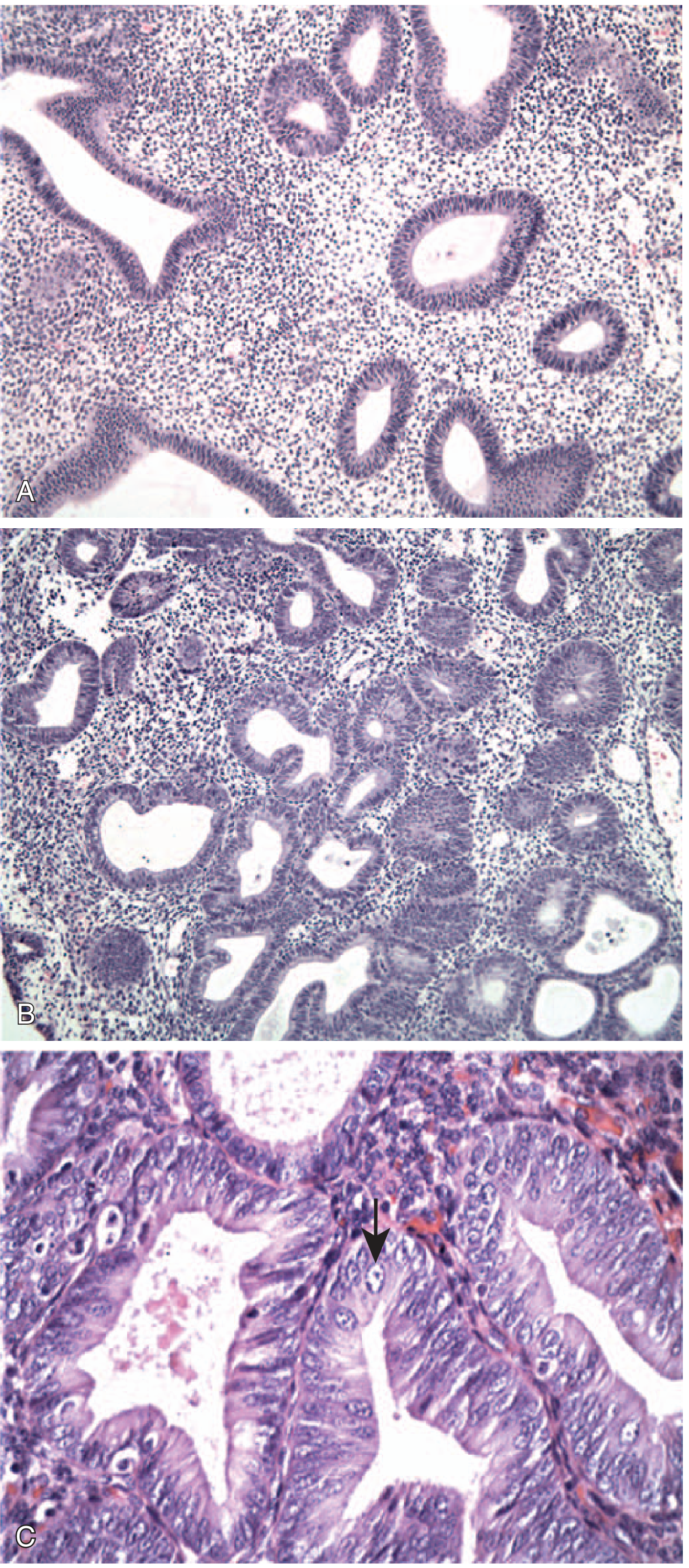
Fig. Endometrial hyperplasia. (A) Hyperplasia without atypia - mild glandular crowding and cystic dilation. (B) Hyperplasia with atypia - marked glandular crowding. (C) High magnification of atypical hyperplasia - rounded, vesicular nuclei with prominent nucleoli (arrow), the direct precursor to endometrioid carcinoma.
Key Concepts to Remember
-
Estrogen-driven pathway - This is the hallmark distinguishing endometrioid (Type I) from serous (Type II) carcinoma. Type I arises with estrogen excess; Type II arises in atrophic endometrium with TP53 mutations.
-
PI3K/AKT is the central node - Multiple mutations converge on this single pathway, which is unique to endometrial carcinomas. Estrogen receptor signaling itself augments this pathway.
-
Stepwise progression confirmed - Identical mutations (PTEN, ARID1A, KRAS, PIK3CA) found in both atypical hyperplasia and co-existing carcinoma in hysterectomy specimens confirm the hyperplasia → carcinoma sequence.
-
Genomic instability as accelerator - MMR defects (Lynch syndrome or somatic MLH1 methylation) and POLE mutations do not initiate cancer but accelerate mutation accumulation.
-
POLE paradox - Despite creating the highest mutation burden of any cancer, POLE-mutant endometrial carcinomas have better prognosis due to heightened immune recognition.
Sources: Robbins, Cotran & Kumar Pathologic Basis of Disease, Chapter on Female Genital Tract (p. 933); Robbins & Kumar Basic Pathology, Chapter 17 (p. 691)
This is a shared conversation. Sign in to Orris to start your own chat.