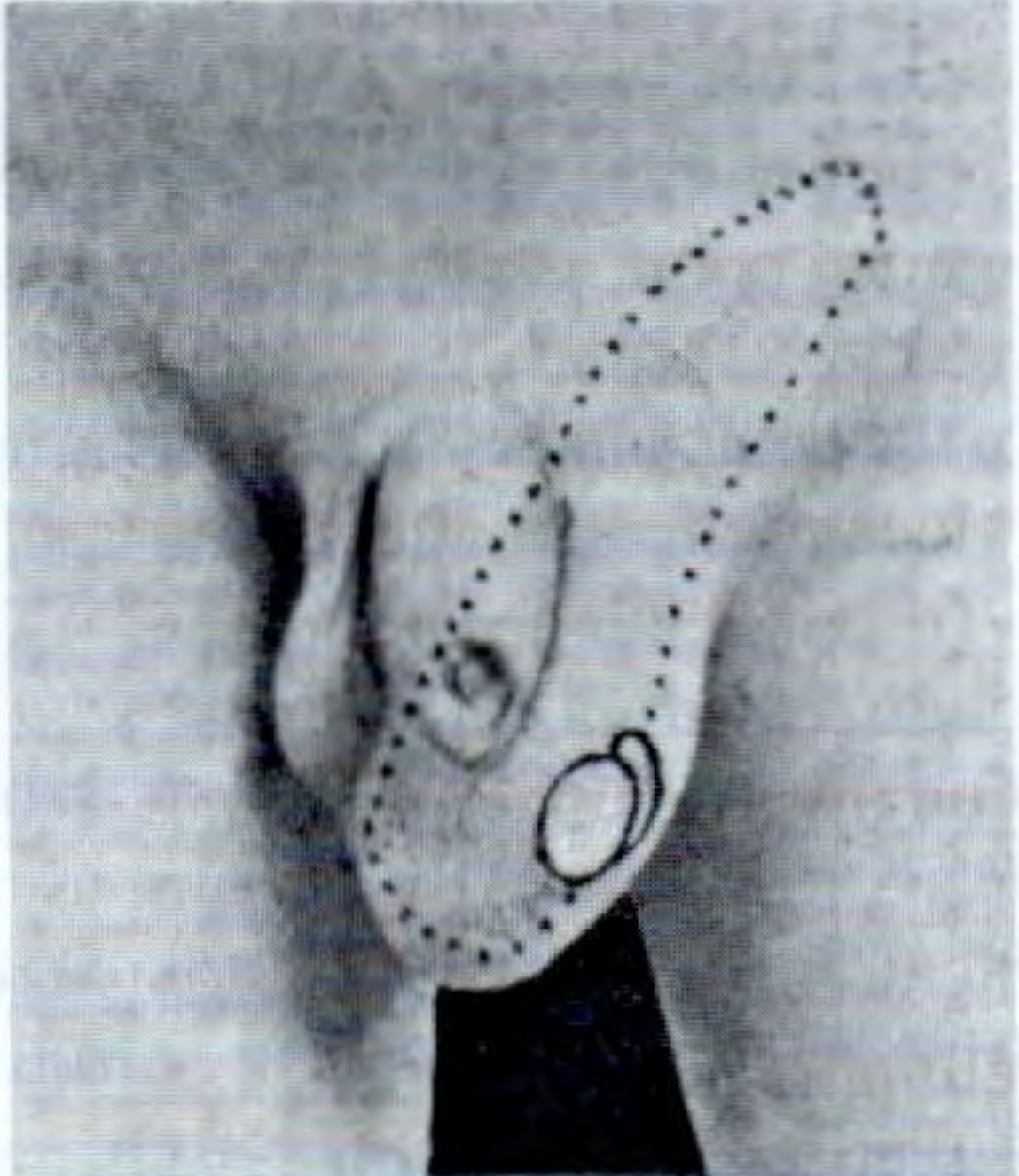
the patient gets no history of obstructive symptoms such as colic abdominal pain, nausea, vomiting, constipation, obstipation or abdominal distension. The patient gets no history of persistent chronic cough, constipation or any other disease. Coming to the past history, the patient gets history of similar complaints on the left side for which he had undergone open mesh hernioplasty. The patient gets history of similar complaints on the left side when he was 2 years back at that time he was diagnosed as a case of left inguinal hernia and has undergone open hernioplasty at our centre itself and he is also a known case of hypothyroidism for the last 2 years on regular medications. Coming to his personal history, the patient consumes a mixed diet, has a normal sleep cycle, has a normal bowel and bladder movements. He gives history of consuming tobacco in the form of tobacco of around 10 grams per day for the last 10 to 15 years. History of consuming around 120 ml of alcohol, hard liquor 3 to 4 times a day for the last 10 to 15 years. Coming to the family history, there is no significant family history, no known allergies and his treatment history was nil. Coming to the summary of my case, a 53 year old male, known case of hypothyroidism, presented with a gradual progressive swelling in the right inguinal region which increases in size on standing, straining or coughing and reduces on lying down, associated with dull dragging character pain with history of operated left inguinal hernia. Coming to the examination, so probable diagnosis is a right sided inguinal hernia. Sir differential diagnosis could be a femoral hernia, sir, of the right side, maybe lipoma of the cord. Sir, coming to the examination, my patient was examined in a very well after two verbal counseling with adequate exposure from the umbilicus to the mid-thigh. Coming to the general physical examination, he is oriented, alert and conscious. His pulse is 68 beats per minute, BP of 134 by 78 mmHg. Coming to the local examination, the patient was examined in a standing as well as in the lying down position. On inspection, a solitary swelling is seen in the right inguinal region measuring around 5 into 5 centimeters, which is globular in shape, smooth surface and rounded margins. The overlying skin was normal and impulse on coughing was present with no visible peristalsis. A well-healed surgical scar of around 7 centimeters is seen over the left inguinal region. The penis is central in position and both the testes are seen in the scrotum. Coming to the palpation, the inspectory findings were confirmed. A 5 into 5 centimeter solitary swelling is palpable in the right inguinal region, which is with no local rise in temperature and non-tender, which is dull in consistency and the abdomen is unable to get over the swelling with impulse on coughing was present. What do you mean by get over the swelling here? Sir, get over the swelling means, sir, it is basically done to sort of differentiate between an inguinal and an inguinal scrotal, between a scrotal and an inguinal scrotal swelling, sir. Sir, then why do you want to differentiate between the two? You need to differentiate whether it is inguinal, sir, it's a big inguinal scrotal, not scrotal versus inguinal scrotal. Sir, the swelling could reduce spontaneously with lying down. On examination, the test impulse was spread over the middle finger.
"Cannot Get Over the Swelling" - Explained
What the Maneuver Is
What "Cannot Get Over the Swelling" Means and Why It Matters
| Type of Swelling | Result of Maneuver | Reason |
|---|---|---|
| Pure scrotal swelling (e.g., hydrocele, epididymal cyst) | Can get above/over it - fingers feel only spermatic cord structures above the swelling | The swelling is entirely within the scrotum; there is a definite upper limit palpable at the neck |
| Inguinoscrotal hernia | Cannot get over the swelling - fingers cannot reach a free upper border | The hernial sac extends from the inguinal canal into the scrotum, with no free upper limit - the swelling passes through the superficial inguinal ring and continues into the abdomen |
| Femoral hernia | This test is not applicable | Femoral hernia does not produce a scrotal swelling |
"In case of inguinal hernia one cannot get above the swelling, whereas in case of the pure scrotal swelling one can feel nothing between the fingers except the structures within the spermatic cord."
- S. Das, A Manual on Clinical Surgery, 13th Edition (p. 602)
Why It Is Clinically Important in This Case
- The swelling is in the right inguinal region, 5 x 5 cm, globular, with impulse on coughing
- The examiner could not get over the swelling - this confirms it is inguinoscrotal in nature, meaning the hernial sac extends from the inguinal canal, not purely within the scrotum
- This effectively rules out a primary scrotal swelling (hydrocele, epididymal cyst, testicular swelling) as the primary diagnosis
Why Differentiate Between Inguinal and Inguinoscrotal Swellings?
- Confirms origin: An inguinoscrotal swelling traces its path through the inguinal canal - confirming an indirect inguinal hernia descending into the scrotum (especially relevant in adults)
- Operative approach: If it were a pure scrotal swelling, the surgical approach would be scrotal. An inguinoscrotal hernia demands an inguinal approach (as in hernioplasty/herniorrhaphy via the inguinal canal)
- Avoids misdiagnosis: Without this test, a large hydrocele communicating with the peritoneum (congenital type) or an inguinoscrotal hernia can be mistaken for a purely scrotal pathology
- Reducibility planning: Understanding the proximal extent of the swelling helps predict how easily it can be reduced and whether manual reduction will decompress the inguinal canal completely
Additional Context in This Specific Case
- Direct inguinal hernia - spherical, does not tend to descend into the scrotum, neck at Hesselbach's triangle
- Fits with the patient's age (53 years, male), bilateral involvement pattern, and prior mesh repair on the left