
obesity and its health effect
Reading File
Now let me search the medical library and PubMed in parallel for a comprehensive answer on obesity and its health effects.
Finding Sources
Searching PubMed
"obesity"[MeSH Terms] AND "comorbidity"[MeSH Terms]
Searching the Web
obesity health effects complications 2025 overview
Now let me read the most relevant textbook sections in parallel:
Reading File
Reading File
Finding Sources
Let me now read content from the most comprehensive sources - Tietz Lab Medicine (on obesity definition/classification), Harrison's (for pathophysiology), and Braunwald's (cardiovascular effects):
Reading File
Finding Sources
Finding Sources
Now let me read the Harrison's classification table and Sleisenger's comprehensive complications section, plus the Park's preventive medicine risk table:
Reading File
Reading File
Reading File
Let me now read the Harrison's complications table and the Sleisenger GI complications section for additional detail:
Reading File
Reading File
I now have excellent, comprehensive content from multiple authoritative textbooks. Let me also fetch the food intake regulation diagram for visual enrichment and read the rest of the Sleisenger complications section:
Reading File
Loading Image
I now have comprehensive, multi-source content to write a thorough answer. Let me also quickly read the complications section from Sleisenger:
Reading File
I now have very rich content from multiple authoritative textbooks. Let me compile the comprehensive answer.
Obesity and Its Health Effects
Definition and Classification
Obesity is a chronic disease defined as an excess of body fat or adipose tissue sufficient to cause harm. The most widely used measure is Body Mass Index (BMI) = weight (kg) / height (m²).
| Classification | BMI (kg/m²) | Obesity Class | Disease Risk |
|---|---|---|---|
| Underweight | < 18.5 | - | - |
| Normal weight | 18.5 - 24.9 | - | Average |
| Overweight / Pre-obese | 25.0 - 29.9 | - | Increased |
| Obesity | 30.0 - 34.9 | I | High |
| Obesity | 35.0 - 39.9 | II | Very High |
| Severe/Extreme Obesity | ≥ 40 | III | Extremely High |
Source: Harrison's Principles of Internal Medicine 22E (2025), WHO Classification
BMI has limitations - it does not distinguish muscle from fat, does not capture body fat distribution, and misses risk in certain ethnic groups. Waist circumference is an important supplement: visceral (abdominal) fat independently drives metabolic and cardiovascular risk. Lower thresholds apply for South Asian, Chinese, and Japanese populations. Obesity is also sometimes defined as body fat >25% in men or >33% in women.
Epidemiology
Obesity has reached global epidemic proportions. The worldwide prevalence has nearly tripled since 1975. By 2016, more than 1.9 billion adults were overweight, of whom 650 million were obese. Over 340 million children and adolescents were overweight or obese. Obesity is linked to more than 200 medical conditions and is the second leading cause of preventable death. In the USA alone, the annual medical cost of obesity exceeds $147 billion.
- Tietz Textbook of Laboratory Medicine, 7th Ed.
- Sleisenger and Fordtran's Gastrointestinal and Liver Disease
Pathophysiology - Why Obesity Causes Disease
Energy dysregulation sits at the core. The hypothalamus coordinates appetite signals from peripheral organs:
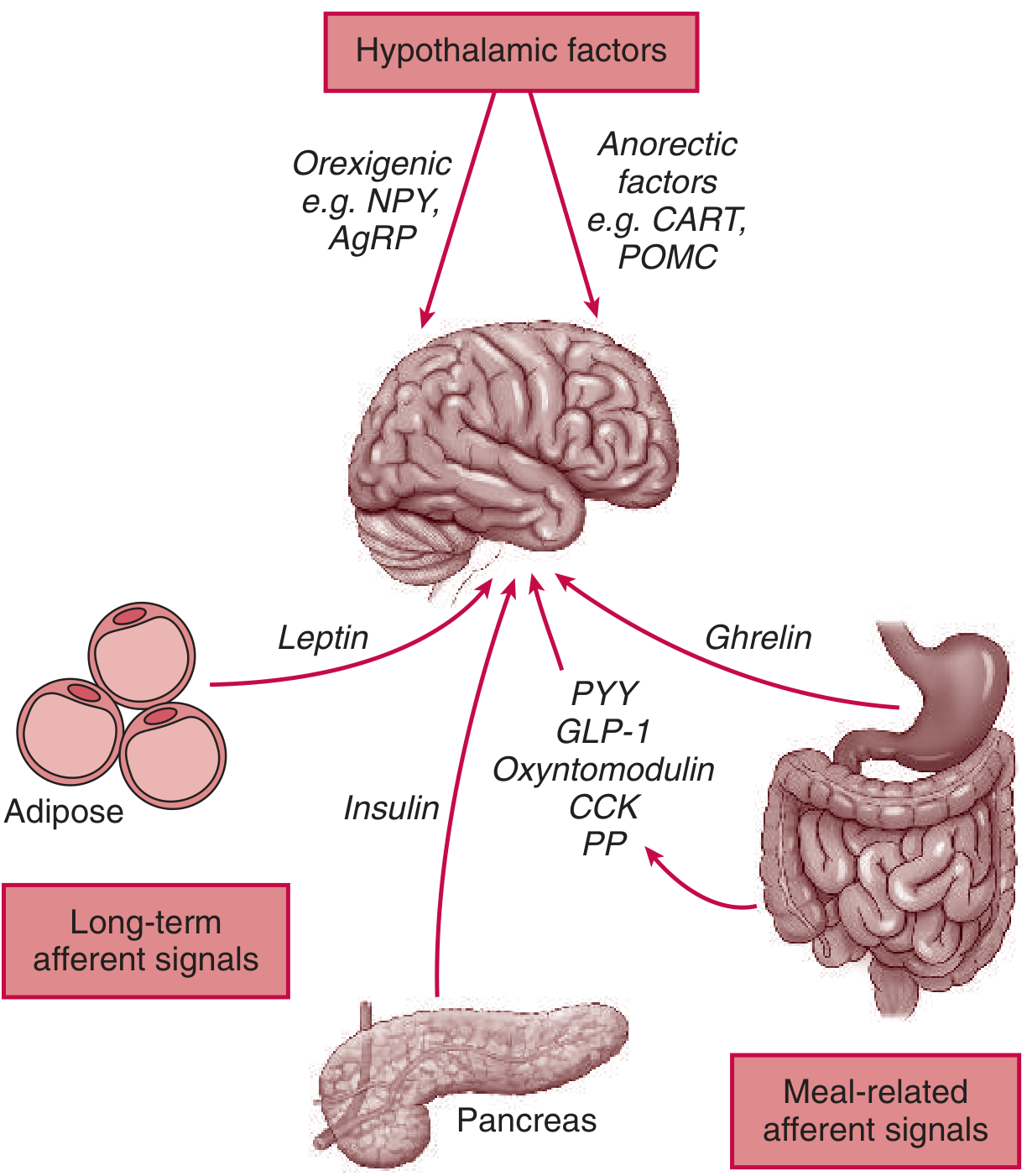
FIGURE: Regulation of food intake. CART, cocaine-and-amphetamine-regulated transcript; GLP, glucagon-like peptide; POMC, pro-opiomelanocortin; PYY, peptide YY - Tietz Textbook of Laboratory Medicine
Beyond energy dysregulation, visceral adipocytes generate a pro-inflammatory state by secreting cytokines including IL-6, TNF-α, and CRP - directly driving atherosclerosis. Dysfunctional adipose tissue also releases free fatty acids, causing oxidative stress, insulin resistance, and endothelial dysfunction. This explains why liposuction (removing subcutaneous but not visceral fat) does not lower cardiovascular risk.
Health Effects by Organ System
1. Cardiovascular System
Obesity is a major independent cardiovascular risk factor.
- An increase in BMI of just 1.1 kg/m² raises the risk of major cardiovascular disease by 6%
- Obesity increases risk of: hypertension, coronary artery disease, congestive heart failure, atrial fibrillation, cor pulmonale, pulmonary embolism, and varicose veins
- Abdominal adiposity alone accounts for 20% of the population-attributable risk for a first myocardial infarction (INTERHEART study, >29,000 patients, 52 countries)
- A meta-analysis of 21 cohort studies showed that obesity's adverse effects on blood pressure and lipids account for roughly half of its excess coronary heart disease risk
Sleisenger and Fordtran's GI and Liver Disease; Textbook of Family Medicine 9e
2. Metabolic / Endocrine Effects
- Type 2 Diabetes: Risk rises steeply when BMI exceeds 30. Weight gain in middle age independently increases glucose intolerance. Blood pressure rises linearly with BMI, and hypertension is present in approximately half of severely obese individuals at initial evaluation.
- Dyslipidemia: Characterized by low HDL cholesterol and high triglycerides, particularly with central adiposity. This triad (with hypertension and elevated glucose) constitutes metabolic syndrome.
- Polycystic ovarian syndrome (PCOS): Obesity drives insulin resistance that worsens PCOS, increasing risk of anovulation and infertility.
- Hypogonadism in males: excess adipose tissue aromatizes androgens to estrogens.
3. Respiratory / Sleep Effects
- Obstructive sleep apnea (OSA): One of the most common obesity complications; excess peripharyngeal fat collapses the upper airway during sleep
- Obesity hypoventilation syndrome (Pickwickian syndrome): Elevated BMI impairs chest wall mechanics
- Asthma and exercise-related dyspnea are significantly more common
4. Gastrointestinal and Hepatic Effects
- Non-alcoholic fatty liver disease (NAFLD/MASLD): Now renamed metabolic dysfunction-associated steatotic liver disease; directly caused by excess hepatic lipid accumulation; can progress to cirrhosis
- Cholelithiasis (gallstones): Obesity increases biliary cholesterol saturation
- Gastroesophageal reflux disease (GERD): Increased intraabdominal pressure
- Hernias (abdominal wall)
Sleisenger and Fordtran's GI and Liver Disease
5. Renal Effects
- Obesity-related glomerulopathy: Characterized by glomerulomegaly ± focal segmental glomerulosclerosis on biopsy. Its incidence rose from 0.2% (1986-1990) to 2.7% (2001-2015).
- Increased risk of uric acid and calcium oxalate kidney stones (due to altered acid-base metabolism)
- Higher BMI is a progressive independent risk factor for end-stage renal disease, even after adjusting for diabetes and hypertension
Sleisenger and Fordtran's GI and Liver Disease; Brenner & Rector's The Kidney
6. Musculoskeletal Effects
- Osteoarthritis of knees and hips: mechanical load plus low-grade inflammation accelerate cartilage destruction
- Low back pain and intervertebral disc disease
- Hyperuricemia and gout
- Carpal tunnel syndrome
- Obese patients have a 48% increased risk of trauma including fractures, and higher perioperative mortality (Rockwood and Green's Fractures in Adults 10th ed., 2025)
7. Cancer
Obesity is linked to at least 13 types of cancer, including:
- Colorectal, breast, and uterine/endometrial cancer (most strongly linked)
- Esophageal, kidney, pancreatic, liver, thyroid, and ovarian cancer
- The American Diabetes Association notes obesity is linked to over 200 medical conditions including several cancers
8. Genitourinary
- Urinary stress incontinence (pelvic floor overload)
- Breast and uterine cancer risk (excess estrogen from adipose aromatization)
- Erectile dysfunction and male hypogonadism
9. Neurological / Psychological
- Depression and anxiety: Bidirectional relationship; stigma and chronic inflammation both contribute
- Pseudotumor cerebri (idiopathic intracranial hypertension)
- Dementia risk is increased with central obesity
- Sleep deprivation from OSA further worsens metabolic dysregulation via sympathetic overactivity and altered circadian rhythms
10. Dermatological
- Acanthosis nigricans (dark velvety skin in body folds, marker of insulin resistance)
- Skin tags (acrochordons)
- Fungal skin infections (intertrigo) in skin folds
- Stretch marks (striae)
Fitzpatrick's Dermatology; Sleisenger and Fordtran's GI and Liver Disease
Childhood Obesity - Special Concern
Children with obesity face:
- Sleep apnea, increased fracture risk, hypertension, early cardiovascular disease markers
- Insulin resistance and type 2 diabetes even in childhood
- Higher probability of obesity, premature death, and disability in adulthood
- Psychological impacts including bullying-related mental health effects
Schwartz's Principles of Surgery, 11th Ed.
Summary: Organ-System Table (from Harrison's 22E, 2025)
| System | Key Conditions |
|---|---|
| Cardiovascular | Hypertension, coronary artery disease, heart failure, atrial fibrillation, pulmonary embolism |
| Endocrine | Type 2 diabetes, metabolic syndrome, dyslipidemia, PCOS, hypogonadism |
| Respiratory | Obstructive sleep apnea, hypoventilation syndrome, asthma |
| Gastrointestinal | NAFLD/MASLD, GERD, cholelithiasis, colorectal cancer |
| Renal | Glomerulopathy, nephrolithiasis, end-stage renal disease |
| Musculoskeletal | Osteoarthritis, low back pain, gout, carpal tunnel |
| Genitourinary | Stress incontinence, uterine/breast cancer |
| Neuropsychiatric | Depression, pseudotumor cerebri |
| Dermatological | Acanthosis nigricans, skin tags, intertrigo |
Recent Evidence (2024-2025)
A 2024 dose-response meta-analysis (PMID 38604087) confirmed that increasing BMI is directly and dose-dependently associated with multimorbidity risk - meaning higher BMI predicts accumulation of multiple simultaneous diseases. A 2025 systematic review (PMID 39920373) confirmed that bariatric surgery substantially reduces obesity-related comorbidities, reinforcing how weight reduction reverses many of these complications.
Key Takeaway
Obesity is not simply a cosmetic or lifestyle issue - it is a chronic, systemic disease that impairs virtually every organ system. The underlying mechanisms - chronic inflammation, insulin resistance, mechanical overload, and hormonal dysregulation from dysfunctional adipose tissue - explain its wide-ranging consequences. Early intervention (lifestyle modification, pharmacotherapy, or bariatric surgery for eligible patients) can prevent and even reverse many of these complications.
This is a shared conversation. Sign in to Orris to start your own chat.