
Penial gland tumor clinical features, invesrigation, managemwnt , dd
I'll read the medical library skill first, then search for pineal gland tumor content in parallel.
Reading File
Now I'll search the library and PubMed in parallel for pineal gland tumors.
Finding Sources
Finding Sources
Searching PubMed
pineal gland tumor management
Excellent findings. Now I'll read the most relevant textbook sections in parallel.
Reading File
Reading File
Reading File
Let me read more content from Adams & Victor (management/investigations) and fetch the histology image.
Reading File
Loading Image
Loading Image
I now have comprehensive content from multiple authoritative textbooks. Let me compile the full answer.
Pineal Gland Tumors - Complete Clinical Review
Classification
Pineal region tumors are grouped into four broad categories:
| Category | Examples | WHO Grade |
|---|---|---|
| Pineal parenchymal | Pineocytoma | I |
| PPTID (pineal parenchymal tumor of intermediate differentiation) | II-III | |
| Pineoblastoma | IV | |
| Germ cell tumors | Germinoma (most common ~50%), embryonal CA, choriocarcinoma, yolk sac tumor, teratoma | Varies |
| Glial tumors | Astrocytoma | Varies |
| Miscellaneous | Papillary tumor of pineal region (PTPR), meningioma, metastasis | Varies |
Epidemiology: Children, adolescents, and young adults are primarily affected; males > females. Germinomas account for ~50% of all pineal region tumors. Pineal tumors after age 30 are uncommon.
Clinical Features
1. Raised Intracranial Pressure (most common presentation)
- Headache (often severe)
- Nausea and vomiting
- Papilloedema
- The tumor compresses the cerebral aqueduct (Sylvius), causing obstructive hydrocephalus
2. Parinaud's Syndrome (dorsal midbrain syndrome) - pathognomonic
Compression of the superior colliculi/pretectal area causes:
- Loss of upward gaze (most characteristic)
- Loss of convergence
- Pupils: large, react to accommodation but NOT to light (light-near dissociation)
- Retractatory nystagmus on attempted upgaze
- Convergence-retraction nystagmus
3. Endocrine Features
- Precocious puberty in males with germinomas (HCG secretion stimulates Leydig cells)
- Diabetes insipidus if hypothalamus involved
- Sleep disturbance (melatonin disruption, though usually mild)
4. Pineal Apoplexy (rare)
- Sudden hemorrhage into the tumor
- Presents with sudden severe headache + depressed consciousness - mimics subarachnoid hemorrhage
- CT/MRI distinguishes it
5. Late/Additional Features
- Cerebellar ataxia (compression of superior cerebellar surface)
- Spastic weakness
- Diplopia (CN VI or III compression)
- Seizures (uncommon)
Histopathology (H&E)
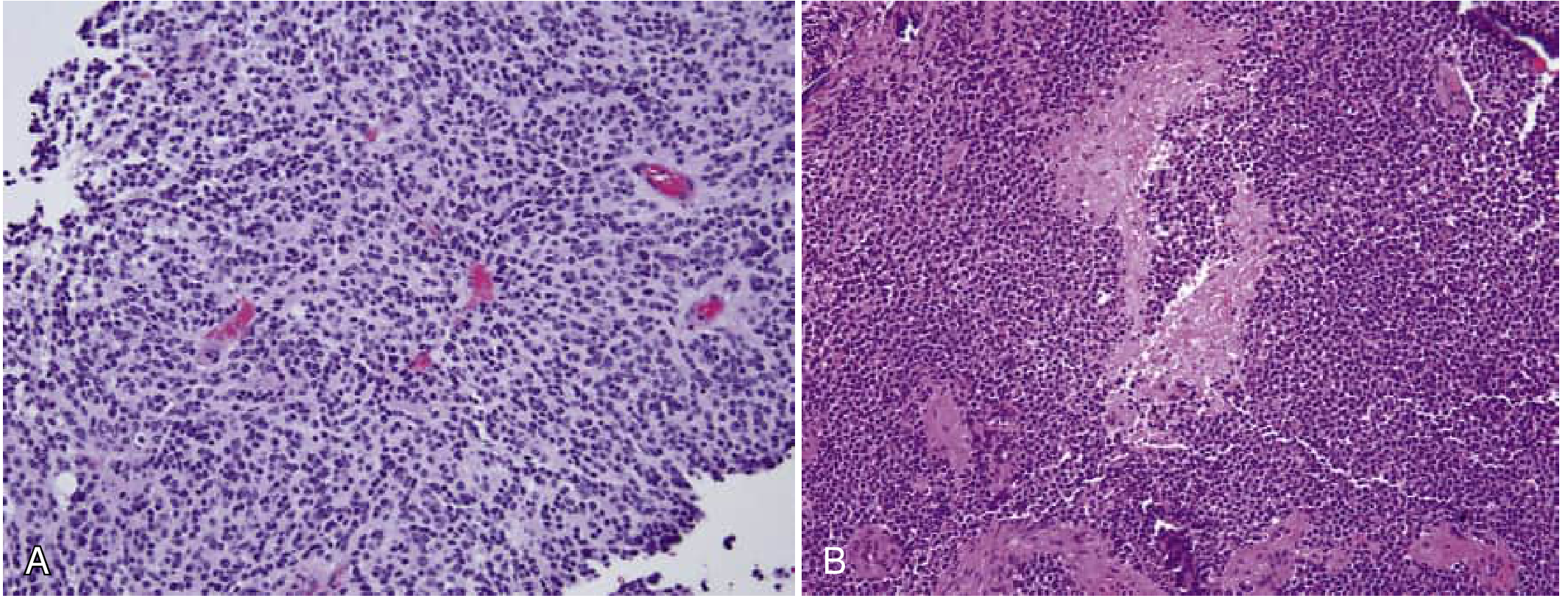
A: PPTID - cellular sheets with minimal pleomorphism. B: Pineoblastoma - dense cellularity with necrosis. (H&E x100)
Key histological features:
- Pineocytoma: Lobular architecture, pineocytomatous rosettes (tumor cells around acellular neuropil center), rare mitoses, synaptophysin+
- PPTID: Sheets of cells, minimal pleomorphism, rosettes absent or rare
- Pineoblastoma: Dense cellularity, nuclear molding, numerous mitoses, necrosis, apoptotic bodies - resembles medulloblastoma; DROSHA mutations common
- Germinoma: Large spherical epithelial cells with reticular connective tissue + many lymphocytes
- PTPR: Papillary architecture with cuboidal/columnar cells on fibrovascular cores; keratin+ and S100+; PTEN mutations, loss of chromosome 10
Investigations
Neuroimaging (primary investigation)
- MRI brain with contrast - investigation of choice
- Shows tumor, compresses tectum and aqueduct
- T2-FLAIR: shows hydrocephalus and transependymal CSF flow
- Sagittal view best for demonstrating tectal compression
- CT head - initial; detects calcification (pineal calcification displaced/enlarged), hemorrhage
Tumour Markers (serum AND CSF)
| Marker | Tumor |
|---|---|
| Beta-hCG (β-hCG) | Germinoma (mild), choriocarcinoma (high) |
| Alpha-fetoprotein (AFP) | Endodermal sinus (yolk sac) tumor, immature teratoma |
| Melatonin (serum/CSF) | Mainly useful for detecting recurrence post-resection |
| Placental alkaline phosphatase (PLAP) | Germinoma |
- Typical germinomas show little elevation of either AFP or β-hCG; significant elevations suggest complex mixed germ cell tumors.
CSF Analysis
- Lumbar puncture (after safe imaging - exclude raised ICP)
- May show tumor cells, lymphocytes, or be entirely normal
- Cytology important for staging (neuraxis seeding)
Histopathology / Biopsy
- Stereotactic biopsy or open surgical biopsy
- Required because each tumor type requires different management
- Endoscopic biopsy via ETV (endoscopic third ventriculostomy) is common in pediatric practice
Management
Step 1 - Treat Hydrocephalus
- External ventricular drain (EVD) - emergency
- Endoscopic Third Ventriculostomy (ETV) - preferred definitive treatment for hydrocephalus; can be combined with biopsy
- VP shunt (if ETV not feasible)
Step 2 - Histological Diagnosis
Surgery is now advised for ALL pineal tumors due to improved microsurgical techniques. Approaches:
- Supracerebellar infratentorial approach - most common
- Occipital transtentorial approach
- Occasionally, if markers are diagnostic (high AFP or β-hCG), empirical treatment may be initiated
Step 3 - Tumor-Specific Treatment
| Tumor | Surgery | Radiotherapy | Chemotherapy |
|---|---|---|---|
| Pineocytoma (WHO I) | Complete resection - often curative | Adjuvant if incomplete | Usually not needed |
| PPTID (WHO II-III) | Maximal safe resection | Focal RT + consider craniospinal | Platinum-based considered |
| Pineoblastoma (WHO IV) | Maximal resection | Craniospinal irradiation | Multiagent chemo (carboplatin, vincristine, etoposide) |
| Germinoma | Biopsy/debulking | Ventricular/focal field RT (highly radiosensitive, excellent prognosis) | Neoadjuvant chemo to reduce RT dose |
| Non-germinomatous GCT | Maximal resection | Whole neuraxis RT | Cisplatin-based chemo (BEP) |
| Glial tumors | Resection | Per grade | Per grade |
| PTPR | Resection | Adjuvant RT if high grade | Under evaluation |
Prognosis:
- Germinoma: >90% 5-year survival with RT
- Pineocytoma: excellent after resection
- Pineoblastoma: poor despite combined therapy
Differential Diagnosis
| Condition | Distinguishing Features |
|---|---|
| Pineal cyst | Common incidental finding, benign, no enhancement, stable on follow-up |
| Tectal glioma | Arising from tectum itself, slow-growing, T2-hyperintense on MRI |
| Tentorial meningioma | Older adults, dural tail on MRI, no calcification pattern of pineal |
| Vein of Galen malformation | Neonates/infants, flow voids on MRI, arteriovenous shunting |
| Epidermoid/dermoid cyst | DWI restriction (epidermoid), fat signal (dermoid) |
| Craniopharyngioma | Suprasellar, calcification, bitemporal hemianopia |
| Arachnoid cyst | Follows CSF signal on all sequences, no enhancement |
| Metastasis | Known primary, multiple lesions, ring enhancement |
| Subarachnoid hemorrhage | Pineal apoplexy may mimic; CT distinguishes |
Key Points Summary
- The pineal gland lies in the epithalamus overlying the pretectal area and rostral midbrain, technically outside the brain parenchyma.
- Germinoma is the most common pineal region tumor (~50%); highly radiosensitive with excellent prognosis.
- The classic triad is: raised ICP + Parinaud syndrome + endocrine disturbance.
- Pineal parenchymal tumors express synaptophysin; DROSHA mutations are common in pineoblastoma.
- All pineal tumors should be biopsied/resected when feasible because management differs dramatically by histotype.
- MRI with gadolinium is the cornerstone imaging tool.
Recent Evidence: A 2024 SNO-EANO-EURACAN consensus statement (PMID: 39073785) provides updated management guidelines specifically for pineal parenchymal tumors. A 2026 review "Pineal Tumors and Pineal Region Tumors" (PMID: 42115465) provides the most current surgical and oncological perspective.
Sources: Bradley & Daroff's Neurology in Clinical Practice; Adams & Victor's Principles of Neurology, 12th Ed.; Plum & Posner's Diagnosis and Treatment of Stupor and Coma; Robbins & Cotran Pathologic Basis of Disease
This is a shared conversation. Sign in to Orris to start your own chat.