
Occular examination in clinical posting
Reading File
Now let me search the library for ocular examination content.
Finding Sources
Finding Sources
Now let me read the most comprehensive sources - the Wills Eye Manual and Rosen's Emergency Medicine for practical ocular examination, plus the Family Medicine textbook:
Reading File
Reading File
Reading File
Good content found. Let me read more from Tintinalli's for the detailed examination steps, and also get the Wills Eye Manual content:
Reading File
Reading File
Let me get more detailed content from Tintinalli's (pupillary exam, slit lamp, fundoscopy) and also fetch the key anatomical images:
Reading File
Loading Image
Let me get more content on pupillary exam and fundoscopy from Tintinalli's, and also fetch the swinging flashlight test image:
Reading File
Loading Image
Excellent! I now have comprehensive content. Let me read the last section on IOP and fundoscopy:
Reading File
I now have comprehensive content from authoritative sources. Let me compile the full, well-structured answer.
Ocular Examination in Clinical Posting
Anatomy Overview
Before beginning the exam, familiarity with ocular anatomy is essential.
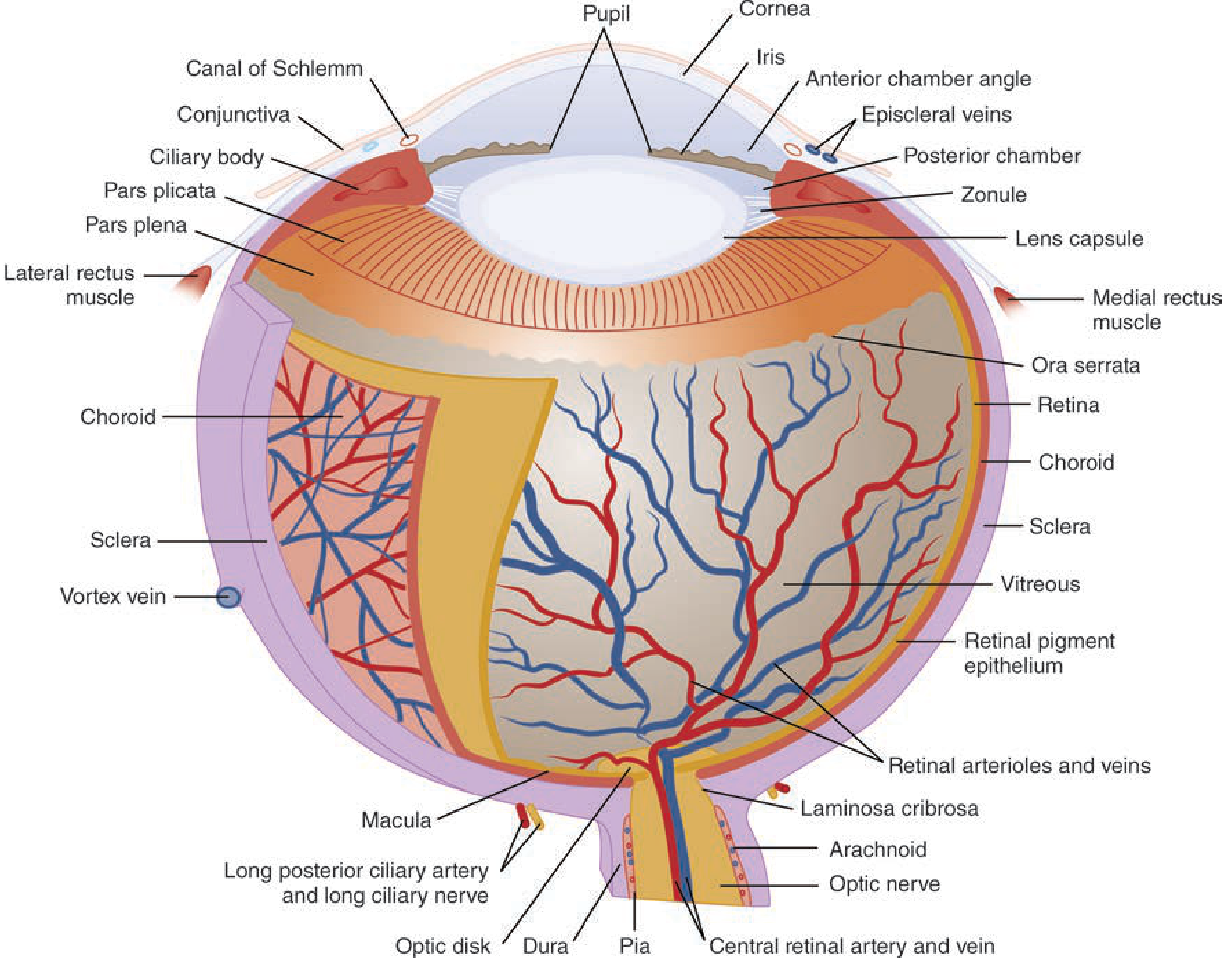
Order of Examination
The standard ocular examination proceeds in a fixed sequence. This order is not arbitrary - each step informs the next, and more invasive steps (like tonometry) come last.
"Full examination should include the following, generally in the order listed: visual acuity, confrontational visual fields, extraocular movements, pupillary reactions, lids and adnexa, conjunctiva and sclerae, cornea, anterior chamber, iris, lenses, vitreous, intraocular pressure, and fundoscopic examination."
- Tintinalli's Emergency Medicine
Exception: For chemical ocular burns, irrigation takes absolute priority before any assessment of visual acuity.
1. History
Before the physical exam, a structured history is taken:
- Symptom category: Vision loss, change in appearance, eye pain/discomfort, or trauma
- Onset: Sudden vs. gradual; duration; circumstances
- Character of discomfort: Aching/throbbing (pain), itching (allergy), foreign body sensation (corneal abrasion/ulcer)
- Specific symptoms: "Flashing lights" and a "curtain/veil" suggest retinal detachment; "floaters" suggest vitreous pathology
- Trauma mechanism: Hammering, grinding, or high-speed machinery can cause globe penetration
- PMH: Diabetes, hypertension, previous eye surgery, contact lens use (especially extended wear - associated with bacterial corneal ulcers), current medications
2. Visual Acuity
Visual acuity is the vital sign of the eye - it is always tested first, even before shining a light (bright light can temporarily reduce acuity).
Methods:
| Situation | Tool | Distance |
|---|---|---|
| Standard | Snellen chart | 20 ft (6 m) |
| Near | Rosenbaum chart | 14 inches (36 cm) |
| Children (pre-literacy) | Allen chart (pictures) | Variable |
- Test each eye separately with the opposite eye covered
- Use corrective lenses/contacts if available
- If lenses unavailable: use pinhole testing - the pinhole allows only parallel rays to fall on the macula, correcting most refractive errors
- Record as 20/x (e.g., 20/40-2 means 2 letters missed on the 20/40 line)
If chart reading is not possible, record qualitatively:
- CF - Counting fingers
- HM - Hand motion
- LP - Light perception
- NLP - No light perception
3. Visual Field Testing (Confrontation)
- Patient covers one eye; examiner covers their own opposite eye
- Examiner holds fingers in four quadrants and asks the patient to indicate when they see movement
- Confrontation is the bedside method - it is unreliable for subtle defects but can detect gross field loss
- Scotoma = retinal problem
- Glaucoma - may cause crescent-shaped scotomata, binasal field loss, or loss of all peripheral vision
- Hemi/quadrantanopia = neural pathway problem (optic tract, cortex)
4. External Examination
Inspect both eyes simultaneously for gross abnormalities - compare sides.
Lids and Adnexa:
- Ptosis (CN III palsy, Horner syndrome, myasthenia)
- Periorbital edema, erythema (cellulitis, allergy)
- Lagophthalmos (inability to close the lid - risk of exposure keratopathy)
- Crepitus = subcutaneous emphysema (suggests blow-out fracture of the medial orbital wall/ethmoid)
- Evert the upper eyelid to check for foreign bodies
Globe Position:
- Exophthalmos (proptosis): Forward displacement - causes include thyroid eye disease, orbital cellulitis, tumors, retrobulbar hemorrhage
- Enophthalmos: Posterior displacement - may follow blow-out fracture
- Orbital compartment syndrome - most dangerous cause of exophthalmos; stretches optic nerve + retinal artery; may cause RAPD and limited eye movement
Conjunctiva and Sclera:
- Injection (redness), chemosis (subconjunctival oedema), discharge
- Follicles = allergic or viral conjunctivitis
- Hypopyon (pus in anterior chamber), hyphema (blood in anterior chamber)
- Subconjunctival hemorrhage
5. Extraocular Movements (EOM)
- Ask patient to follow your finger in an "H" pattern (tests all 6 EOMs)
- Note any limitation of movement or diplopia
| Muscle | Nerve | Action |
|---|---|---|
| Medial rectus | CN III | Adduction |
| Superior rectus | CN III | Elevation in abduction |
| Inferior rectus | CN III | Depression in abduction |
| Inferior oblique | CN III | Elevation in adduction |
| Superior oblique | CN IV | Depression in adduction |
| Lateral rectus | CN VI | Abduction |
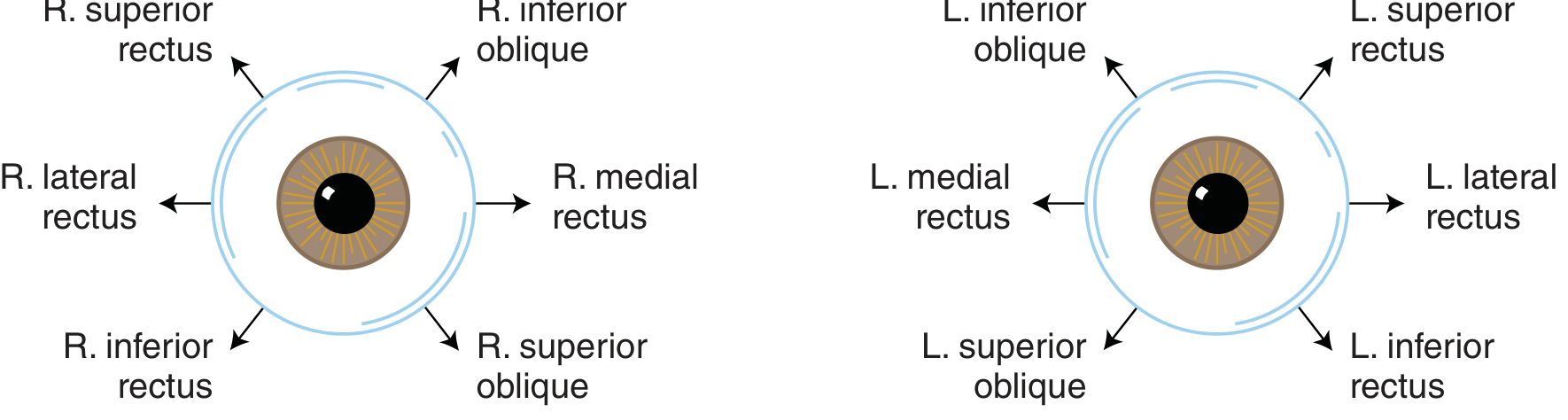
- CN VI palsy - inability to abduct (lateral gaze palsy) - most common isolated cranial nerve palsy in diabetes/hypertension
- CN III palsy - ptosis, "down and out" eye, dilated pupil (if compressive, e.g., PComA aneurysm)
6. Pupillary Examination
Examine in both dim and bright light.
Normal findings:
- Equal size (isocoria), round, regular
- Direct and consensual light reflex present
- Accommodation reflex present (miosis when looking at a near object)
Anisocoria:
- Physiological - slight difference (<1 mm), equal in light and dark
- Horner syndrome - miosis + ptosis + anhidrosis (ipsilateral)
- CN III palsy - dilated, unreactive pupil (surgical cause = PComA aneurysm)
- Pharmacological - atropine drops, etc.
Swinging Flashlight Test (Marcus-Gunn Pupil / RAPD):
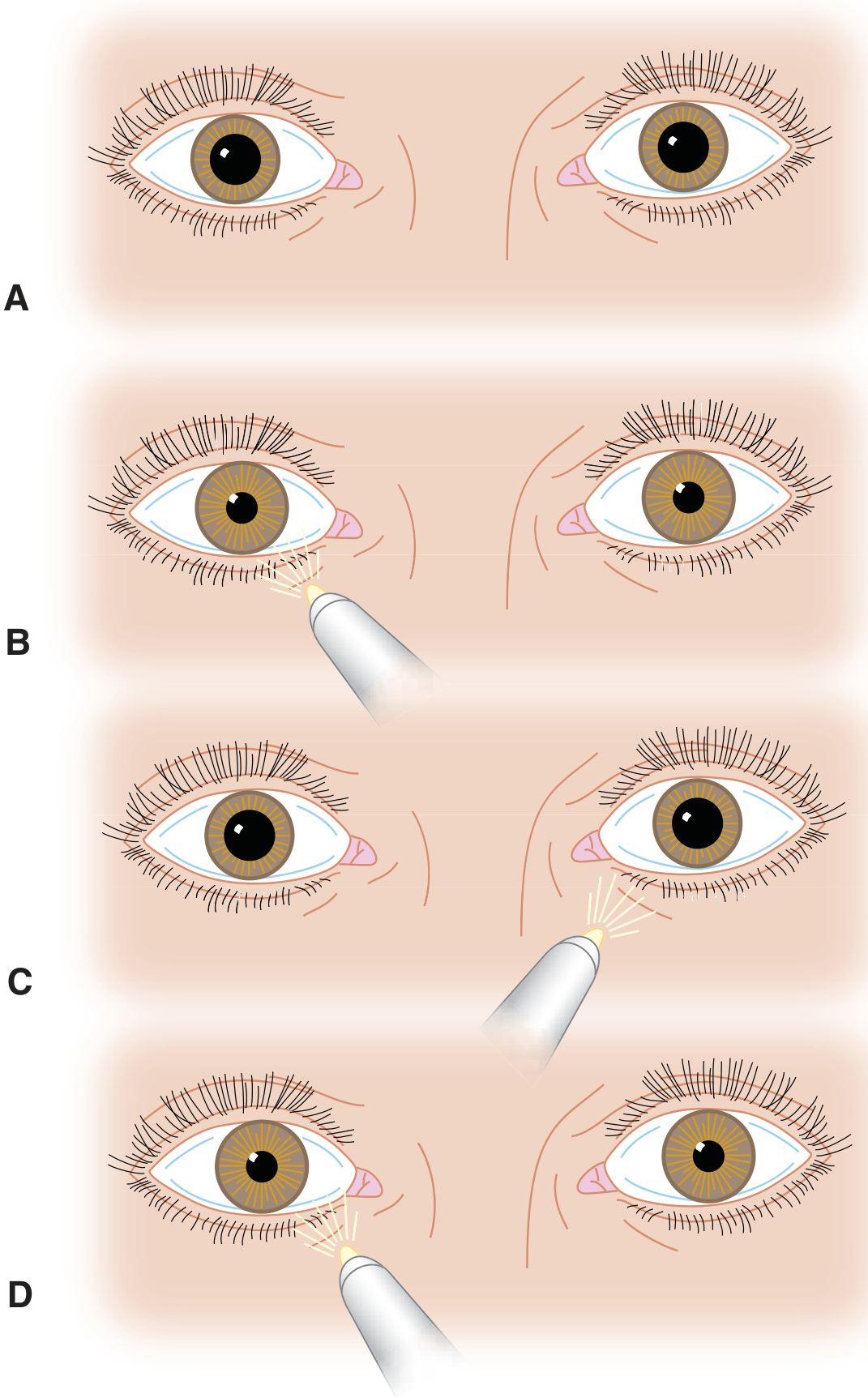
- Shine a bright light rapidly from one eye to the other
- Normal: both pupils constrict equally
- RAPD (Afferent Pupillary Defect): When light moves to the affected eye, the affected pupil dilates (paradoxical dilation)
- Seen in: optic neuritis, central retinal artery occlusion, severe retinal disease
- Important: RAPD is the only pupillary test that can diagnose unilateral optic nerve disease at the bedside
7. Corneal Examination
- Inspect for clarity, ulcers, foreign bodies, abrasions
- Apply topical anaesthetic (proxymetacaine 0.5%) if painful
- Apply fluorescein dye - fluoresces green under cobalt blue light or Wood's lamp
- Corneal abrasion = bright green uptake
- Seidel test - fluorescein streaming = aqueous humor leak through a full-thickness corneal laceration (globe rupture)
- Slit-lamp examination provides magnified view of the cornea, anterior chamber, iris, and lens
8. Anterior Chamber
- Assess depth - shallow chamber = risk of angle-closure glaucoma
- Look for:
- Hyphema - blood in anterior chamber (trauma, bleeding disorders)
- Hypopyon - pus layer in anterior chamber (severe infection/uveitis)
- Flare and cells - seen with slit lamp; indicates uveitis (iritis)
- Penlight oblique illumination can give a rough assessment of depth
9. Lens
- Look for opacities (cataracts) - appear as dark/grey areas in the red reflex or black spots on ophthalmoscopy
- Note clarity and position (lens dislocation after trauma)
10. Intraocular Pressure (IOP) - Tonometry
- Performed near the end (touching the cornea is more irritating)
- Normal IOP: 10-21 mmHg
- Methods:
- Goldmann applanation tonometry - gold standard (requires slit lamp)
- Non-contact (air-puff) tonometry - screening tool
- Tono-Pen - handheld, useful in ED
- Finger palpation - crude bedside method only
- Elevated IOP (>21 mmHg): Acute angle-closure glaucoma, hyphema
- IOP measurement is contraindicated if globe rupture is suspected
11. Fundoscopic Examination
Direct Ophthalmoscopy:
- Dim the room
- Remove your glasses and the patient's glasses
- Approach the patient from 15-20 degrees to the temporal side
- Locate the red reflex first, then advance
- Absent red reflex = cataract, vitreous hemorrhage, retinal detachment, or retinoblastoma (in children)
What to assess on fundoscopy:
| Structure | Normal Findings | Abnormal Findings |
|---|---|---|
| Optic disc | Sharp margins, pink, cup:disc ratio <0.5 | Papilledema (blurred margins, elevated disc), optic atrophy (pale disc), glaucoma (increased C:D ratio) |
| Arteries:Veins ratio | 2:3 | Reduced in hypertension, occlusions |
| AV nicking | None | Hypertensive retinopathy |
| Retina | Uniform, no lesions | Hemorrhages (flame = HTN; dot/blot = DM), exudates (hard = DM; soft/cotton wool = ischemia) |
| Macula | Bright foveal reflex | Macular degeneration, cherry-red spot (CRAO) |
Papilledema:
- Bilateral disc oedema due to raised ICP
- Blurred disc margins, diminished cup, venous engorgement, splinter hemorrhages
- Seen in: malignant hypertension, pseudotumor cerebri, intracranial tumors, hydrocephalus
Pharmacological dilation for better fundoscopy:
- 1% tropicamide (Caucasian patients)
- 1% tropicamide + 2.5% phenylephrine (others)
- Warn patient about blurred vision and photophobia for 4-6 hours
- Contraindicated if acute angle-closure glaucoma is suspected
Summary: RAPD vs Efferent Defect
| Feature | RAPD (Afferent) | Efferent defect (CN III) |
|---|---|---|
| Affected pathway | Optic nerve / retina | Oculomotor nerve (pupilloconstrictor) |
| Swinging flashlight | Paradoxical dilation of affected eye | N/A (test not affected) |
| Direct reflex | Reduced | Absent (fixed dilated pupil) |
| Consensual reflex | Intact in the opposite eye | Absent in affected eye |
Quick Reference: Complete Ocular Exam Checklist
- Visual acuity (Snellen chart / Rosenbaum / Allen)
- Visual fields (confrontation)
- External examination (lids, adnexa, globe position)
- Extraocular movements (H-pattern)
- Pupillary reactions (direct, consensual, RAPD/swinging flashlight test)
- Cornea (fluorescein, slit lamp)
- Anterior chamber (depth, hyphema, hypopyon, flare)
- Iris (pupil shape, synechiae)
- Lens (clarity, position)
- Intraocular pressure (tonometry)
- Fundoscopy (disc, macula, vessels, retina)
Sources: Tintinalli's Emergency Medicine (9th ed.), Rosen's Emergency Medicine, Textbook of Family Medicine (9th ed.)
This is a shared conversation. Sign in to Orris to start your own chat.