
How measure eye sight by using snells chart
Reading File
Finding Sources
Searching the Web
Snellen chart visual acuity measurement procedure
Finding Sources
Reading Web Page
https://pmc.ncbi.nlm.nih.gov/articles/PMC2040251
Reading File
Loading Image
Here is a full explanation of how eyesight is measured using the Snellen chart (note: the correct spelling is "Snellen," named after Dutch ophthalmologist Hermann Snellen, 1862).
The Snellen Chart
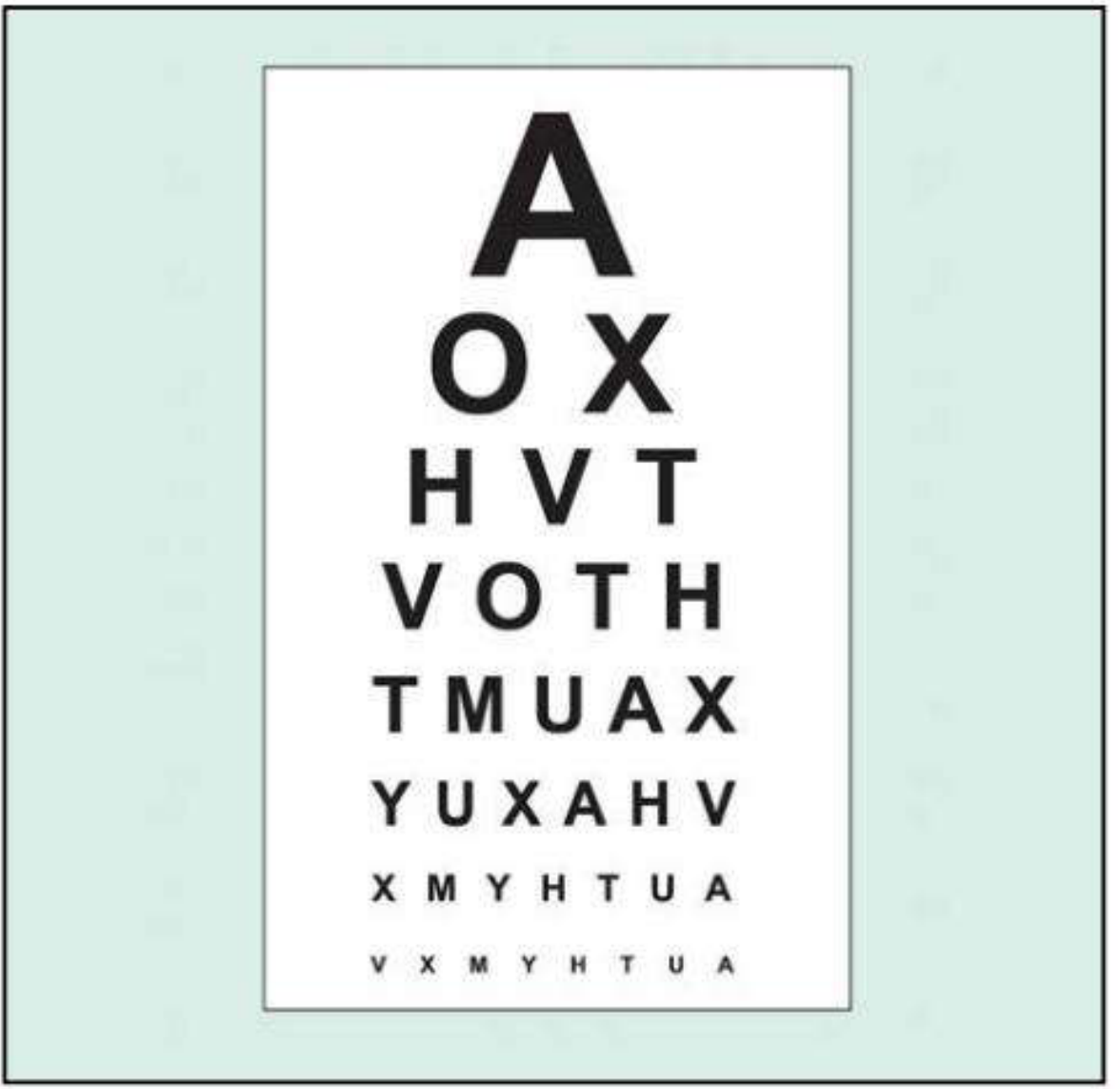
Fig. 1.1 Snellen visual acuity chart - Kanski's Clinical Ophthalmology
The chart displays black letters (called optotypes) on a white background in progressively smaller rows from top to bottom. Each row corresponds to the smallest letter size a person with normal vision can read from a specific distance.
What It Measures
Visual acuity (VA) is the ability to distinguish fine detail - specifically, the minimum angle of separation between two objects that allows them to be perceived as distinct. Each letter on the chart subtends 5 minutes of visual angle at the designated test distance, with each stroke of the letter subtending 1 minute.
Step-by-Step Procedure
1. Setup
- Mount the chart on a well-lit wall with good, consistent illumination
- Patient stands or sits 6 metres (20 feet) away from the chart
- The patient wears their current distance glasses or contact lenses (if they use them)
2. Test Each Eye Separately
- Test the worse eye first, with the other eye fully covered using an occluder or the patient's clean hand
- Ask the patient to read the letters starting from the top (largest) row and work down to the smallest row they can read
- Encourage the patient to attempt every letter - push them to read as far down as possible
3. Record the Result
Results are written as a fraction:
- Numerator = the test distance (6 m or 20 ft)
- Denominator = the distance at which a person with normal vision could read that same line
| Result | Meaning |
|---|---|
| 6/6 (or 20/20) | Normal vision - reads at 6 m what a normal person reads at 6 m |
| 6/12 (or 20/40) | Reads at 6 m what a normal person reads at 12 m (reduced acuity) |
| 6/60 (or 20/200) | Legal threshold for blindness in most countries |
4. Pinhole Test (if VA is less than 6/6)
- If the patient cannot reach 6/6, repeat the test using a pinhole occluder (an opaque disc with a ~1 mm hole)
- The pinhole eliminates the effect of refractive error
- If VA improves with pinhole → the problem is a refractive error (short/long sight, astigmatism), correctable with glasses
- If VA does not improve → suggests a structural eye problem (e.g. macular disease, optic nerve disease)
5. Near Vision
- For near vision, a Rosenbaum card (a pocket-sized version) is held 14 inches (35 cm) from the patient's eyes and read in the same way
When Vision Is Very Poor
If the patient cannot read even the top letter at 6 m, use these graded tests:
| Finding | What to do | How to record |
|---|---|---|
| Can't read top letter at 6 m | Move patient closer (5 m, 4 m...) | 5/60, 4/60, etc. |
| Can't read at 1 m | Hold up fingers at various distances | CF (Counting Fingers) |
| Can't count fingers | Wave your hand in front of the eye | HM (Hand Movements) |
| Can't see hand movement | Shine a torch from 4 directions | PL (Perception of Light) or NPL (No Perception of Light) |
Important Notes
- 20/20 is not "perfect" vision - it is the normal reference standard. Many young adults achieve better than 6/6 with correction
- The Snellen chart tests distance, high-contrast vision only - it does not assess colour vision, peripheral vision, depth perception, or contrast sensitivity
- Consistent lighting is critical - the same eye tested in dim vs. good light can give misleadingly different results
- Results are written as: RE (right eye): 6/9, LE (left eye): 6/6 (or using abbreviations OD/OS)
Sources: Kanski's Clinical Ophthalmology 10th ed., p.17; Tintinalli's Emergency Medicine; StatPearls - Snellen Chart (NCBI); PMC2040251 - Clinical procedure guide
This is a shared conversation. Sign in to Orris to start your own chat.