
Csf analysis and it's interpretation paediatric sq
Reading File
Searching for CSF analysis and interpretation in paediatrics across multiple aspects simultaneously.
search_medical_text
CSF cerebrospinal fluid analysis normal values paediatric children
Sexually Transmitted Infections
Page 54
search_medical_text
CSF interpretation bacterial viral fungal tuberculous meningitis children
Harrison's Principles of Internal Medicine, Twenty First Edition
Page 4155
search_medical_image
CSF analysis interpretation table meningitis comparison
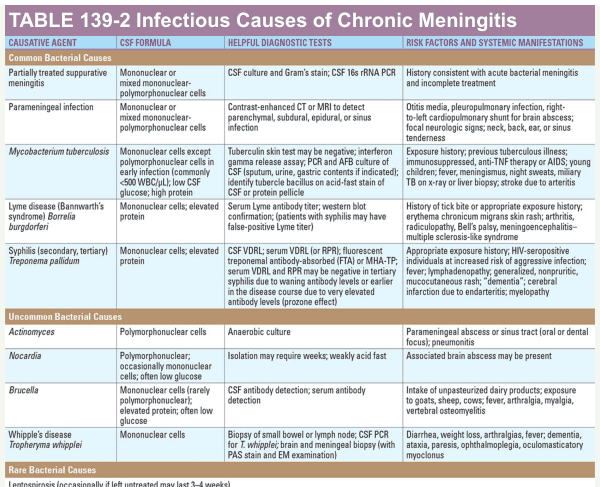
Harrison's Principles of Internal Medicine, Twenty First Edition
Page 4187
GradeResponse
GradeResponse
GradeResponse
Here is a comprehensive, exam-oriented (SQ) summary of CSF Analysis and Interpretation in Paediatrics:
CSF Analysis and Interpretation in Paediatrics
1. Indications for Lumbar Puncture (LP) in Children
- Suspected meningitis / encephalitis
- Febrile seizures (complex, or age < 12 months)
- Unexplained altered consciousness
- Suspected subarachnoid haemorrhage
- Raised ICP evaluation (after excluding contraindications)
- Intrathecal drug administration
Contraindications: raised ICP with papilloedema, focal neurological signs, haemodynamic instability, coagulopathy, local infection at LP site.
2. Normal CSF Values in Children (Age-Dependent)
| Parameter | Neonates (term) | Infants (1–3 months) | Children (>3 months) |
|---|---|---|---|
| Appearance | Clear/xanthochromic | Clear | Clear, colourless |
| Opening pressure | 8–10 cmH₂O | 10–15 cmH₂O | 10–20 cmH₂O |
| WBC count | ≤16–19 cells/mm³ | ≤9–11 cells/mm³ | ≤5 cells/mm³ |
| Differential | PMNs may be present | Lymphocytes predominate | Lymphocytes >70% |
| Protein | ≤115–118 mg/dL | ≤89–91 mg/dL | 15–45 mg/dL |
| Glucose | 50–80% of blood glucose | 50–80% of blood glucose | >50% of blood glucose |
| CSF:serum glucose ratio | ≥0.6 | ≥0.6 | ≥0.6 |
Key note (STI Guidelines, p. 54): Neonatal CSF values are difficult to interpret; normal ranges differ by gestational age and are higher in preterm infants. By the second month, 95% of healthy infants have ≤9–11 WBCs/mm³ and protein ≤89–91 mg/dL.
3. CSF Parameters Assessed
| Parameter | What It Reflects |
|---|---|
| Appearance | Turbidity, blood, xanthochromia |
| Opening pressure | ICP, hydrocephalus |
| Cell count + differential | Infection, inflammation type |
| Protein | BBB integrity, inflammation |
| Glucose (+ simultaneous blood glucose) | Metabolic consumption by organisms |
| Gram stain + Culture | Bacterial aetiology |
| India ink / Cryptococcal Ag | Fungal meningitis |
| AFB smear/culture/ADA | Tuberculous meningitis |
| PCR | Viral (HSV, enterovirus), TB |
| VDRL | Neurosyphilis / congenital syphilis |
| Lactate | Bacterial vs. viral differentiation |
| Opening pressure | Raised in bacterial/fungal/TBM |
4. Differential Diagnosis by CSF Profile
| Feature | Bacterial | Viral (Aseptic) | Tuberculous (TBM) | Fungal |
|---|---|---|---|---|
| Appearance | Turbid/purulent | Clear | Clear/viscous (cobweb clot) | Clear/hazy |
| Pressure | Raised | Normal/mildly raised | Raised | Raised |
| WBC count | 100–10,000+ | 10–500 | 100–500 | 20–500 |
| Predominant cell | Neutrophils (PMN) | Lymphocytes | Lymphocytes | Lymphocytes |
| Protein | Markedly raised (>100 mg/dL) | Mildly raised (50–100 mg/dL) | Moderately raised (100–500 mg/dL) | Raised |
| Glucose | Very low (<40 mg/dL) or zero | Normal | Low | Low |
| CSF:serum glucose | <0.4 (highly suggestive of bacterial) | >0.6 | <0.5 | <0.5 |
| Gram stain | Positive (60–90%) | Negative | Negative (AFB positive in <40%) | Negative |
| Special tests | Culture, CRP, procalcitonin | PCR (enterovirus, HSV) | ADA, AFB, MTB PCR | India ink, CrAg, culture |
Harrison's (p. 4155): A CSF glucose <40 mg/dL is abnormal; a CSF:serum glucose ratio <0.4 is highly suggestive of bacterial meningitis but can also be seen in fungal, tuberculous, and carcinomatous meningitis.
5. Key Differentiating Points (SQ High-Yield)
Bacterial Meningitis
- Predominant cell: Polymorphonuclear (neutrophils)
- Glucose: Very low or zero (organisms consume glucose)
- Protein: Markedly elevated
- Gram stain positivity: ~60–90% (reduced if partially treated)
- Common organisms by age:
- Neonates (<1 month): E. coli, GBS, Listeria
- 1–3 months: GBS, H. influenzae, S. pneumoniae
- >3 months–5 years: S. pneumoniae, N. meningitidis, H. influenzae (unvaccinated)
- >5 years: S. pneumoniae, N. meningitidis
Viral (Aseptic) Meningitis
- Predominantly lymphocytic pleocytosis
- Glucose normal; protein mildly raised
- Common causes: Enterovirus, HSV (neonates), EBV, mumps, arboviruses
- In early viral meningitis, there may be a transient neutrophilic phase (first 24–48 h)
Tuberculous Meningitis (TBM)
- Cobweb clot on standing (fibrin pellicle) — characteristic
- Lymphocytic pleocytosis (100–500 cells)
- Protein markedly elevated; glucose low
- ADA (adenosine deaminase) >10 U/L — supportive
- AFB smear: sensitivity low; PCR preferred
- Strongly positive Mantoux, +/− basal exudates on CT
Fungal Meningitis (Cryptococcus neoformans)
- Seen in immunocompromised (HIV, post-transplant)
- India ink: Encapsulated budding yeast (positive ~80%)
- Cryptococcal antigen (CrAg): most sensitive (>95%)
6. Traumatic Tap vs. True Subarachnoid Haemorrhage (SAH)
| Feature | Traumatic Tap | SAH |
|---|---|---|
| Appearance | Clears as collection proceeds (tube 1 vs. tube 4) | Uniformly bloody in all tubes |
| Xanthochromia | Absent (if fresh) | Present (after 2–4 h) |
| Supernatant colour | Clear | Yellow (xanthochromic) |
| RBC count | Decreases from tube 1 to 4 | Equal in all tubes |
Rule of thumb to correct WBC for traumatic tap: For every 700 RBCs/mm³, subtract 1 WBC from the count.
7. Partially Treated Meningitis
- CSF may show mixed mononuclear/PMN pleocytosis (Harrison's, p. 4187)
- Gram stain and culture may be negative
- Glucose may be normal or near-normal
- CSF 16S rRNA PCR is invaluable in this setting
8. Other Conditions
| Condition | CSF Finding |
|---|---|
| Guillain-Barré Syndrome | Albumino-cytological dissociation (high protein, normal/near-normal cells) |
| Brain abscess (ruptured) | Purulent, high WBC, very high protein |
| Cryptococcal meningitis | India ink positive, CrAg positive, low glucose |
| Herpes encephalitis | Lymphocytic pleocytosis, RBCs, HSV PCR positive, elevated protein |
| Neonatal HSV | RBCs + lymphocytes; HSV-2 PCR positive |
| Lead encephalopathy | Increased pressure, mildly elevated protein |
| Malignant meningitis | Atypical/malignant cells on cytology |
9. CSF Findings Summary Table (SQ Mnemonics)
"BNT-VFM" — Bacterial → Neutrophils → Turbid; Viral → Few → Mildly raised; TBM → Moderate lymphocytes → Cobweb"
| Bacterial | Viral | TBM | Fungal | |
|---|---|---|---|---|
| Cells | ↑↑↑ PMN | ↑ Lymph | ↑ Lymph | ↑ Lymph |
| Protein | ↑↑↑ | ↑ | ↑↑ | ↑↑ |
| Glucose | ↓↓↓ | Normal | ↓ | ↓ |
| Special | Gram/culture | PCR | ADA/AFB | India ink/CrAg |
10. Practical Approach (Exam Algorithm)
LP performed → Send:
 Tube 1 → Biochemistry (glucose, protein)
 Tube 2 → Microbiology (Gram stain, C&S, AFB, India ink)
 Tube 3 → Cytology (cell count + differential)
 Tube 4 → Virology (PCR – HSV, enterovirus)
 Simultaneously → Blood glucose (for CSF:blood ratio)
Key SQ Points to Remember:
- Neonatal CSF has higher normal WBC (up to 16–19/mm³) and protein (up to 115 mg/dL) than older children.
- CSF:serum glucose <0.4 = highly suggestive of bacterial meningitis.
- Cobweb clot = TBM until proven otherwise.
- Albumino-cytological dissociation = GBS.
- In traumatic tap, RBC count decreases from tube 1 to 4; in SAH it is uniform.
- ADA >10 U/L in CSF supports TBM.
- Partially treated meningitis: use CSF 16S rRNA PCR.
- India ink / CrAg for cryptococcal meningitis in immunocompromised.
This is a shared conversation. Sign in to Orris to start your own chat.