
Define health and its dimensions and determinants
Reading File
Now let me search the medical library for content on health definition, dimensions, and determinants.
Finding Sources
Finding Sources
Park's Textbook of Preventive and Social Medicine is the key source. Let me read the relevant sections now.
Reading File
Finding Sources
Reading File
Reading File
Reading File
Reading File
Reading File
Reading File
Now I have all the content needed. Let me also fetch the determinants diagram image and read the remaining determinants section.
Loading Image
Reading File
I now have comprehensive content. Let me also quickly check the remaining determinants (health services continued, and any additional determinants like ageing, science/technology etc.) and the dimensions section I may have missed (physical dimension).
Reading File
Reading File
I now have all the content needed for a thorough answer. Here is the comprehensive response:
Health: Definition, Dimensions, and Determinants
(Based on Park's Textbook of Preventive and Social Medicine)
Definition of Health
"Health" is a term most people feel confident about yet find difficult to define precisely. Many definitions have been offered over time, shaped by evolving concepts of disease and society.
Concepts of Health
Before the formal definition, it helps to trace the conceptual evolution:
-
Biomedical concept - The oldest view. Health is the absence of disease or infirmity; the body as a machine that either functions or breaks down. This concept was criticized as inadequate because it ignored social, psychological, and economic forces.
-
Ecological concept - Health as a dynamic equilibrium between man and his environment. Dubos defined health as: "the relative absence of pain and discomfort and a continuous adaptation and adjustment to the environment to ensure optimal function."
-
Psychosocial concept - Recognizes that health is influenced not only by biology but by social, psychological, cultural, economic, and political factors.
-
Holistic concept - A synthesis of all the above. Recognizes social, economic, political, and environmental influences on health together. Corresponds to the ancient ideal of "a sound mind, in a sound body, in a sound family, in a sound environment."
WHO Definition (1948)
The most widely accepted definition, from the preamble to the WHO Constitution:
"Health is a state of complete physical, mental and social well-being and not merely an absence of disease or infirmity."
This has since been amplified to include the ability to lead a "socially and economically productive life."
Criticisms of the WHO definition:
- Too broad and idealistic - "complete" well-being is arguably unattainable.
- Health cannot be a static "state" - it is a dynamic, ongoing process of adjustment to changing demands of living.
- Not operational - it does not lend itself to direct measurement.
Despite these criticisms, the WHO definition sets a positive standard and symbolizes the aspirations of people worldwide.
New Philosophy of Health
- Health is a fundamental human right.
- Health is the essence of productive life, not merely the product of medical expenditure.
- Health is intersectoral - all societal sectors contribute to it.
- Health is central to the concept of quality of life and is a worldwide social goal.
Dimensions of Health
Health is multidimensional. The WHO definition specifies three dimensions (physical, mental, social), but many more are recognized. These dimensions interact with each other while each retains its own character.
1. Physical Dimension
The most readily understood dimension. Physical health is a state in which every cell and organ is functioning at optimum capacity and in perfect harmony with the rest of the body.
Signs of physical health include: good complexion, bright eyes, firm flesh, sound sleep, good appetite, regular bodily functions, and vital signs within normal range for age and sex.
Evaluation tools: self-assessment, inquiry into symptoms and activity levels, clinical examination, biochemical investigations, standardized questionnaires, and community-level indicators (death rate, infant mortality rate, life expectancy).
2. Mental Dimension
Mental health is not the mere absence of mental illness. It is defined as "a state of balance between the individual and the surrounding world - a state of harmony between oneself and others, a coexistence between the realities of the self and that of other people and that of the environment."
Attributes of a mentally healthy person include:
- Free from internal conflict; not at war with himself
- Well-adjusted; gets along with others; accepts criticism
- Strong sense of self-esteem and self-actualization
- Good self-control; balances rationality and emotionality
- Copes effectively with stress and anxiety
Psychological factors can induce physical illness (e.g., essential hypertension, peptic ulcer, bronchial asthma). Mental health is assessed at the population level via standardized mental status questionnaires.
3. Social Dimension
Social well-being implies harmony and integration within the individual, between individuals and other members of society, and between individuals and the world in which they live. It has been defined as "the quantity and quality of an individual's interpersonal ties and the extent of involvement with the community."
Social health encompasses:
- Social skills and functioning
- Seeing oneself as a member of a larger society
- Material environment (financial and residential well-being)
- Human environment (social network quality)
4. Spiritual Dimension
Spiritual health refers to that part of the individual which reaches out and strives for meaning and purpose in life. It transcends physiology and psychology and includes integrity, principles, ethics, a purpose in life, and commitment to a higher being or belief system. It is a relatively newer concept that defies concrete definition.
5. Emotional Dimension
Increasingly recognized as distinct from mental health. Mental health relates to "knowing" (cognition), while emotional health relates to "feeling." Research in psychobiology has helped isolate these two separate dimensions.
6. Vocational Dimension
A newer dimension of health. Work that is adapted to human goals, capacities, and limitations promotes both physical and mental health - physical work improves physical capacity, while goal achievement and self-realization at work enhance self-esteem. The significance of this dimension is starkly revealed when individuals lose jobs or face forced retirement.
7. Other Dimensions
Several additional dimensions have been proposed:
- Philosophical, cultural, socio-economic, environmental
- Educational, nutritional, curative, and preventive dimensions
Determinants of Health
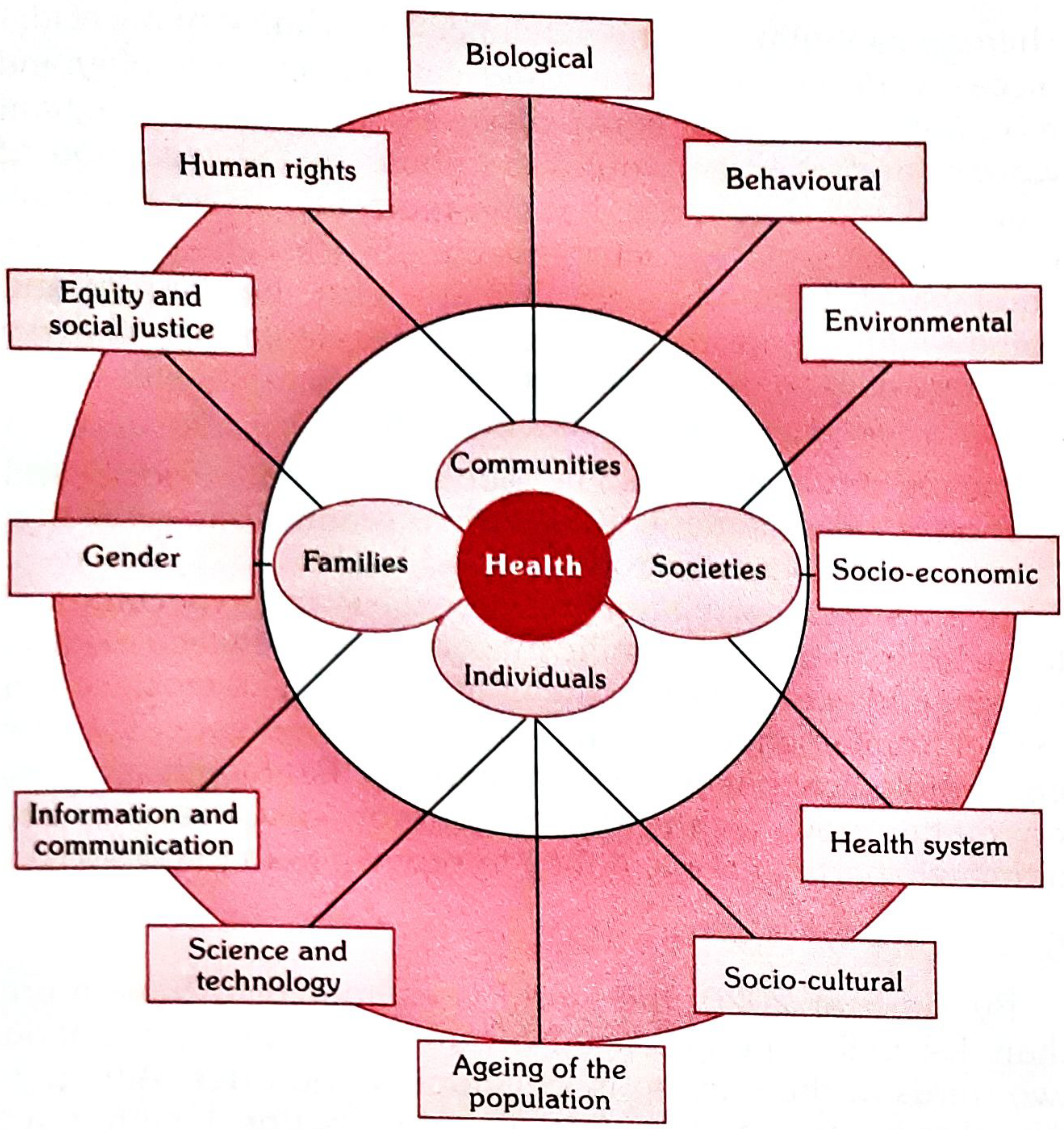
Health is multifactorial. What a person is, and what diseases they may fall victim to, depends on two broad sets of factors: genetic (internal) and environmental (external), and their interactions. The diagram below (Fig. 3 from Park's) illustrates the major determinants:
1. Biological Determinants
The physical and mental traits of every human being are, to some extent, determined by genes. The genetic make-up is unique and cannot be altered after conception. A range of diseases are of genetic origin: chromosomal anomalies, errors of metabolism, mental retardation, certain types of diabetes, etc.
From a genetic standpoint, health is defined as the absence from the genetic constitution of genes corresponding to serious defects, and the presence of genes corresponding to normal characterization. Medical genetics now offers hope through genetic screening and gene therapy.
2. Behavioural and Socio-cultural Conditions (Lifestyle)
"Lifestyle" denotes the way people live - reflecting social values, attitudes, and activities. It is composed of cultural and behavioural patterns and lifelong personal habits (smoking, alcoholism) shaped through social interaction with family, peer groups, schools, and mass media.
- In developed countries, lifestyle factors drive major diseases: coronary heart disease, obesity, lung cancer, drug addiction.
- In developing countries, traditional lifestyle risks include poor sanitation, inadequate nutrition, and personal hygiene failures.
- Not all lifestyle factors are harmful - adequate nutrition, physical activity, and sufficient sleep promote health.
"Health is both a consequence of an individual's lifestyle and a factor in determining it."
3. Environment
Environment is classified as internal (every tissue, organ, and organ-system and their harmonious functioning) and external (all that is external to the individual human host). The external environment has three components:
- Physical: housing, climate, water supply, sanitation
- Biological: infectious agents, vectors, zoonoses
- Psychosocial: stress, family structure, social support systems
These three components are inextricably linked. A favourable environment allows the individual to make full use of their physical and mental capabilities.
4. Socio-economic Conditions
For most people worldwide, health is determined primarily by socio-economic development. Key factors:
| Factor | Role in Health |
|---|---|
| Economic status | Determines purchasing power, standard of living, family size, and disease patterns. Affluence can paradoxically also contribute to disease (CHD, diabetes, obesity). |
| Education | Especially female literacy; compensates for poverty's effect on health. Kerala, India's low infant mortality (10/1000) vs. national average (34/1000) is attributed largely to its 97.9% female literacy rate. |
| Occupation | Productive employment promotes health; unemployment raises morbidity and mortality. |
| Political system | Shapes resource allocation, health service access, and manpower policy. Political commitment and leadership oriented toward social development is essential. |
5. Health Services
Health and family welfare services cover treatment, prevention, and health promotion. Effective health services must be:
- Reaching the social periphery
- Equitably distributed
- Accessible at affordable cost
- Socially acceptable
These are the ingredients of primary health care. It is important to note, however, that "health care does not produce good health" by itself - health services are only one contributor among many determinants.
6. Ageing of the Population
Rapid population ageing leads to increased prevalence of chronic diseases and disabilities. By 2020, an estimated 1.4 billion people worldwide were aged 60+, with more than two-thirds in developing countries. Ageing presents unique health challenges that require special programmatic attention.
7. Gender
Gender is a significant health determinant. Women face specific health risks related to nutrition, reproductive health, violence, and occupational environments. The Global Commission on Women's Health (established 1993) brought these issues to the forefront of policy planning.
8. Other Factors
- Information and communication technology: Offers instant access to medical information and supports health research and public education.
- Intersectoral contributions: Food and agriculture, education, industry, social welfare, rural development, and economic policies all contribute to health beyond the formal health sector.
- Science and technology: Advances in medical and social sciences open new avenues for prevention and treatment.
- Equity and social justice / Human rights: Recognized as foundational to health outcomes.
Summary Table: Determinants of Health at a Glance
| Category | Key Elements |
|---|---|
| Biological | Genetic make-up, chromosomal constitution, hereditary diseases |
| Behavioural/Socio-cultural | Lifestyle, personal habits, cultural patterns |
| Environmental | Physical, biological, and psychosocial environments |
| Socio-economic | Income, education, occupation, political system |
| Health services | Accessibility, availability, equity, primary health care |
| Ageing | Chronic disease burden in elderly populations |
| Gender | Women's specific health vulnerabilities |
| Other | ICT, science & technology, equity, intersectoral action |
- Park's Textbook of Preventive and Social Medicine, pp. 17-25
Determinants of Health - Park's Textbook](
Here is the Determinants of Health diagram from Park's Textbook of Preventive and Social Medicine:
Loading Image
This is Fig. 3 from Park's Textbook of Preventive and Social Medicine. The diagram uses a concentric wheel model to show that health sits at the center, influenced at successive layers by:
Inner ring - Who is affected:
- Individuals
- Families
- Communities
- Societies
Outer ring - The determinants acting on all of them:
| Determinant | Description |
|---|---|
| Biological | Genetic make-up, hereditary constitution |
| Behavioural | Lifestyle, personal habits, cultural patterns |
| Environmental | Physical, biological, and psychosocial surroundings |
| Socio-economic | Income, employment, standard of living |
| Socio-cultural | Cultural norms, beliefs, traditions |
| Health system | Access to and quality of healthcare services |
| Ageing of the population | Chronic disease burden associated with elderly populations |
| Gender | Sex-based differences in health vulnerability and access |
| Information and communication | Access to health information and technology |
| Science and technology | Medical advances, diagnostics, therapeutics |
| Equity and social justice | Fair distribution of resources and opportunities |
| Human rights | Legal and ethical protections that underpin health access |
The key message of the diagram is that health is multifactorial and intersectoral - it is not determined by biology or healthcare alone, but by a broad web of forces operating at the individual, family, community, and societal levels simultaneously.
- Park's Textbook of Preventive and Social Medicine, p. 23 (Fig. 3)
This is a shared conversation. Sign in to Orris to start your own chat.