
non specific strange weakness in upper limb of young female patient , no red flag signs of CVA
Reading File
Researching non-specific upper limb weakness in a young female with no CVA red flags — covering differentials, diagnosis, and management in parallel.
search_medical_text
upper limb weakness young female differential diagnosis non-vascular
Harrison's Principles of Internal Medicine, Twenty First Edition
Page 742
search_medical_text
functional neurological disorder conversion disorder weakness upper limb
Harrison's Principles of Internal Medicine, Twenty First Edition
Page 12391
search_medical_image
upper limb weakness neurological examination diagram
Hugging Face pmc clinical VQA raw
Page 0
GradeResponse
GradeResponse
GradeResponse
Here is a structured clinical approach to non-specific, non-vascular upper limb weakness in a young female:
Differential Diagnosis Framework
The key is to localize the lesion first. As Harrison's (p. 742) notes:
"The distribution of weakness helps to localize the underlying lesion. Upper motor neuron weakness occurs particularly in extensors/abductors of the upper limb. Lower motor neuron weakness depends on the level — anterior horn, nerve root, plexus, or peripheral nerve. Myopathic weakness is most marked proximally."
Top Differentials by Category
🔴 Neurological — Central (UMN)
| Condition | Clues |
|---|---|
| Multiple Sclerosis | Young female, episodic, sensory symptoms, visual changes, Lhermitte's sign |
| Cervical cord lesion | Myelopathy signs, hyperreflexia, spasticity |
| Space-occupying lesion | Progressive, headache, papilledema (red flag) |
🟠 Neurological — Peripheral (LMN)
| Condition | Clues |
|---|---|
| Cervical radiculopathy | Dermatomal pattern (C5–C8), neck pain, positive Spurling's |
| Brachial plexopathy (neuralgic amyotrophy) | Acute onset, severe pain preceding weakness |
| Peripheral neuropathy | Distal pattern, glove distribution, sensory loss |
| Carpal/cubital tunnel | Focal hand weakness, nocturnal symptoms |
🟡 Neuromuscular Junction / Muscle
| Condition | Clues |
|---|---|
| Myasthenia Gravis | Fatigable weakness, ptosis, diplopia — very common in young females |
| Inflammatory myopathy (polymyositis/dermatomyositis) | Proximal weakness, elevated CK, skin rash |
| Muscular dystrophy | Family history, slowly progressive |
| Thyroid myopathy | Hyperthyroidism/hypothyroidism, proximal weakness |
🟢 Functional / Psychogenic
| Condition | Clues |
|---|---|
| Functional Neurological Disorder (FND) | Inconsistent on exam, Hoover's sign equivalent in upper limb, give-way weakness, no objective neurological signs, psychosocial stressors — highly relevant in young females |
As Harrison's (p. 12391) states:
"A diagnosis [of FND] can be made by identifying neurologic signs specific to FNDs without reliance on psychological stressors... Functional movement disorders are relatively common — estimated at 2–3% of patients seen in movement disorders clinics."
🔵 Systemic / Other
| Condition | Clues |
|---|---|
| Autoimmune (SLE, vasculitis) | Multisystem involvement, ANA, young female |
| Hypokalemia / electrolyte disturbance | Episodic, precipitated by carbs, family history |
| Anaemia / deconditioning | Generalized fatigue, not true neurological weakness |
Clinical Examination Checklist
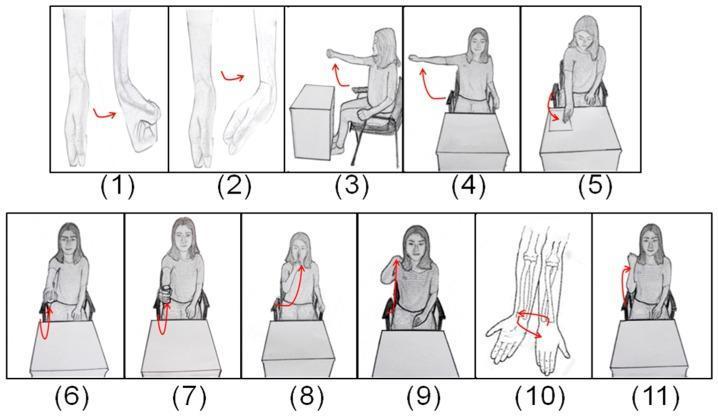
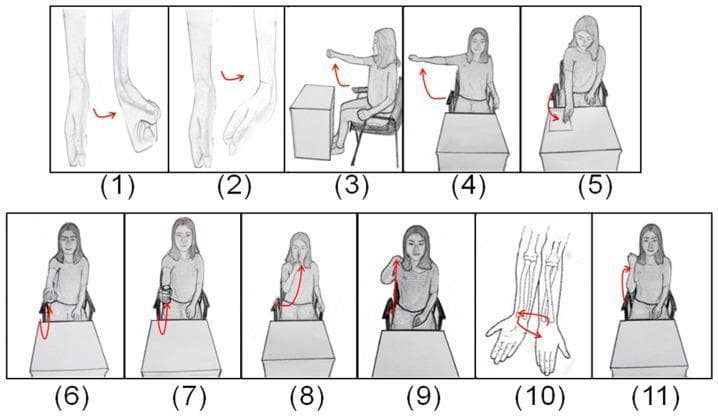
Assess systematically:
- Pattern — proximal vs. distal, focal vs. diffuse, dermatomal vs. myotomal
- Tone — spasticity (UMN) vs. flaccidity (LMN) vs. normal
- Reflexes — hyperreflexia + Babinski (UMN) vs. hyporeflexia (LMN/muscle)
- Sensory — dermatomal pattern suggests radiculopathy; dissociated loss suggests cord
- Fatigability — ask patient to sustain arm elevation for 2 minutes (Myasthenia)
- Functional signs — Hoover's equivalent, give-way weakness, variability on distraction
Suggested Workup
| Investigation | Targeting |
|---|---|
| MRI brain + spine (cervical) | MS, cord lesion, structural cause |
| EMG/NCS | Radiculopathy, plexopathy, peripheral neuropathy, myopathy |
| Anti-AChR / Anti-MuSK antibodies | Myasthenia gravis |
| CK, LDH, aldolase | Inflammatory myopathy |
| TFTs | Thyroid myopathy |
| ANA, anti-dsDNA, complement | Autoimmune (SLE) |
| CBC, ferritin, B12, electrolytes | Metabolic/nutritional causes |
| Repetitive nerve stimulation / Single-fiber EMG | Neuromuscular junction disease |
Key Clinical Pearl
In a young woman with non-specific, non-dermatomal weakness and no hard neurological signs, the top two conditions to actively exclude are:
- Multiple Sclerosis — most common demyelinating disease in young females
- Functional Neurological Disorder — diagnosis of positive signs, not exclusion alone
- Myasthenia Gravis — the great mimicker, especially with fluctuating symptoms
This is a shared conversation. Sign in to Orris to start your own chat.