
Make a detailed note on Vancomycin-resistant enterococci (VRE) infection or colonisation on ICU. Make sure to use current guidelines & referrences
"vancomycin-resistant enterococci" AND "intensive care unit"
VRE vancomycin-resistant enterococci ICU guidelines 2024 2025 management infection control
"vancomycin-resistant enterococci" AND treatment
"VRE" AND "infection control" AND screening
PMID: 37734679
PMID: 36731484
PMID: 38943133
PMID: 39111343
https://ipac-canada.org/wp-content/uploads/2025/10/2025Sept_…
Vancomycin-Resistant Enterococci (VRE): Infection and Colonisation in the ICU
1. Background and Microbiology
Resistance Mechanisms
| Gene | Resistance level | MIC to vancomycin | MIC to teicoplanin | Common species | Epidemiologic concern |
|---|---|---|---|---|---|
| vanA | High | ≥64 mg/L | ≥16 mg/L | E. faecium, E. faecalis | High (plasmid, transmissible); predominates in USA |
| vanB | Variable (moderate-high) | 4-1024 mg/L | Susceptible | E. faecium, E. faecalis | High (plasmid, transmissible); predominates in Europe |
| vanC | Intrinsic, low-level | 2-32 mg/L | Susceptible | E. gallinarum, E. casseliflavus | Low (chromosomal, non-transmissible) |
- Tietz Textbook of Laboratory Medicine, 7th Ed.
- Henry's Clinical Diagnosis and Management by Laboratory Methods
2. Epidemiology in the ICU
- MDRO gut acquisition in ICU patients: pooled incidence 5% (range 1-43%), with an incidence rate of 12.2 per 1000 patient-days (95% CI 8.1-18.6). Colonisation increases quasi-linearly at ~1.41% per day through 30 days of ICU stay. (Heath et al., Critical Care, 2024 - PMID 38943133)
- Among VRE gut carriers, the pooled 30-day cumulative incidence of infection is 8% (95% CI 5-13). (Willems et al., Lancet Infect Dis, 2023 - PMID 36731484)
- VRE bloodstream infection (BSI) is associated with 46% higher mortality compared to vancomycin-susceptible E. faecium BSI (RR 1.46, 95% CI 1.17-1.82). (Eichel et al., J Hosp Infect, 2023 - PMID 37734679)
- VRE bacteraemia carries an in-hospital mortality of ≥20%, approximately twice that of VSE bacteraemia. (Goldman-Cecil Medicine, 2-Vol Set)
- The proportion of VRE among hospitalised patients can be as high as 30% in some settings. (Red Book 2021)
3. Risk Factors for VRE Colonisation and Infection in the ICU
Patient-level Risk Factors
- Prolonged ICU / hospital stay (colonisation pressure rises ~1.4% per day)
- Prior broad-spectrum antibiotic exposure - especially multi-drug regimens with antianaerobic activity: clindamycin, metronidazole, piperacillin-tazobactam
- Hematological malignancy / bone marrow transplant / HSCT
- Solid organ transplantation (especially liver transplant)
- Chronic renal insufficiency / dialysis
- HIV infection
- Neutropenia / immunosuppression
- Pre-existing urethral catheters or intravascular lines
- Recent surgery (especially abdominal/hepatobiliary)
- Prior VRE colonisation or infection
- Age ≥60 years
- Uncontained body fluids, need for toileting assistance (IPAC Canada, 2025)
Environmental / ICU-Level Risk Factors
- High colonisation pressure in the unit (prevalence of colonised patients is the strongest independent predictor of new acquisition)
- Inadequate hand hygiene compliance
- Shared or inadequately cleaned equipment
- Prolonged environmental survival - VRE can persist on dry surfaces for weeks to months
4. Clinical Presentations
| Syndrome | Key Features |
|---|---|
| Bacteraemia | Most serious; often polymicrobial; may present as septic shock; sources: urinary tract, hepatobiliary, IVAD. Mortality ≥20% |
| Urinary tract infection | Most common; often catheter-associated; may be asymptomatic. Less likely to cause bacteraemia |
| Intra-abdominal / biliary infection | Polymicrobial; post-operative; liver transplant-associated; hepatic abscess. High mortality |
| Endocarditis | E. faecalis predominates; left-sided; subacute presentation; requires synergistic therapy |
| Skin / soft tissue / wound | Usually mixed; post-surgical site infections; diabetic foot; decubitus ulcers |
| Meningitis (rare) | Mostly post-neurosurgical; linezolid considered (Goldman-Cecil) |
5. Diagnosis
Microbiological
- Blood cultures (2 sets minimum): isolate from sterile site confirms true bacteraemia vs. contamination (clinical judgement required for single-positive bottles from catheter hubs)
- Urine culture: catheter-associated vs. symptomatic UTI distinction is important
- Wound / tissue / fluid cultures: sterile site cultures guide directed therapy
- Rectal swab / PCR screening: rapid detection of vanA/vanB genes; selective agar available; PCR is faster and more sensitive for active surveillance
- Species identification: MALDI-TOF increasingly used. E. faecium and E. faecalis must be reliably differentiated
- Susceptibility testing: ampicillin MIC, vancomycin MIC (to distinguish vanA/B/C), linezolid, daptomycin, tigecycline
- High-level aminoglycoside resistance (HLAR) testing mandatory before planning synergistic therapy
Molecular / Rapid Diagnostics
- PCR-based assays (BD GeneOhm VanR) detect vanA and vanB from rectal swabs and blood specimens
- Rapid ID from positive blood cultures (MALDI-TOF, multiplex PCR panels) can reduce time-to-effective therapy
- Red Book 2021; Henry's Clinical Diagnosis; Tietz Textbook of Laboratory Medicine
6. Treatment
6a. Antibiotic Treatment by Site
VRE Bacteraemia
| Agent | Dose | Notes |
|---|---|---|
| Linezolid | 600 mg IV/PO q12h | Drug of choice for non-bacteraemia infections; bacteriostatic; good outcomes in bacteraemia, though not FDA-approved for this indication. Risk of myelosuppression (esp. thrombocytopenia with >2 weeks use) |
| Daptomycin | 6-10 mg/kg IV q24h (higher doses 10-12 mg/kg often used in VRE BSI) | Bactericidal; not FDA-approved for VRE; good outcomes in BSI and soft tissue. Monitor CPK |
| Tigecycline | 50-100 mg IV q12h | FDA-approved for complicated SSTI and IAI caused by VSE E. faecalis only; black-box warning for increased mortality limits use in BSI |
| Tedizolid | 200 mg PO/IV q24h | Newest oxazolidinone; covers some linezolid-resistant strains; approved for SSTI only |
| Quinupristin-dalfopristin | 7.5 mg/kg IV q8h | Active against E. faecium only (not E. faecalis); second-line |
VRE Endocarditis
- Optimal therapy for VRE endocarditis resistant to ampicillin is not established
- Options include linezolid (not FDA-approved for endocarditis) and daptomycin (not FDA-approved for enterococcal infections) if susceptible
- Combination therapy (e.g., daptomycin + ampicillin, or daptomycin + linezolid) considered for refractory cases
- Goldman-Cecil Medicine
VRE Urinary Tract Infection
- Nitrofurantoin: most VRE strains remain susceptible even with vancomycin resistance (not for upper UTI / bacteraemia risk)
- Fosfomycin: effective for susceptible E. faecalis UTI
- Linezolid: reserved for symptomatic infections not responding to first-line agents
- Goldman-Cecil Medicine; Katzung Pharmacology
VRE Intra-abdominal / Health-care Associated Infection
- For patients at high risk or known VRE colonisation: daptomycin or linezolid as empiric therapy
- Fischer's Mastery of Surgery, 8th Ed
6b. Agents Not to Use for VRE
| Agent | Reason |
|---|---|
| Vancomycin | By definition - VRE is resistant |
| Teicoplanin | Inactive against vanA (high-level resistance) |
| Cephalosporins | Intrinsic resistance |
| Clindamycin | Intrinsic resistance |
| TMP-SMX | Clinical failures despite in vitro susceptibility (enterococci scavenge exogenous folate) |
| Tobramycin / kanamycin | No synergistic activity against enterococci |
| Quinupristin-dalfopristin | Inactive against E. faecalis; only for E. faecium |
6c. Toxicity Monitoring for Key Agents
| Agent | Key Toxicities | Monitoring |
|---|---|---|
| Linezolid | Thrombocytopenia, peripheral neuropathy, optic neuropathy, lactic acidosis, serotonin syndrome (with SSRIs/fentanyl/meperidine) | Weekly CBC; avoid with serotonergic agents |
| Tedizolid | Similar to linezolid (possibly less severe); interacts with serotonergic agents | CBC; caution with MAOIs |
| Daptomycin | Myopathy, rhabdomyolysis, eosinophilic pneumonia | Serial CPK; hold statins; avoid if CrCl <30 without dose adjustment |
| Tigecycline | Nausea/vomiting, elevated LFTs, increased mortality in BSI | Not recommended for BSI |
7. Infection Prevention and Control in the ICU
7a. Hand Hygiene
- Alcohol-based hand rub and soap-and-water compliance is the single most effective measure
- Note: Alcohol-based products are generally effective against VRE (non-spore former)
7b. Contact Precautions
- Standard of care for known or suspected VRE patients: private room, dedicated equipment (stethoscopes, BP cuffs), gloves and gown on entry
- IPAC Canada's 2025 Position Statement recognises that in endemic (non-outbreak) settings, several studies show no significant increase in VRE infection rates when routine isolation is discontinued (RR 0.93; 95% CI 0.68-1.26; p=0.62 for HA-VRE; RR 0.68; 95% CI 0.44-1.07 for HA-VRE BSI - Pan et al., AJIC, 2024 - PMID 39111343)
- However: Any reduction in precautions must be:
- Guided by regional/provincial requirements and local epidemiology
- Risk-based (facility VRE burden, patient vulnerability)
- Accompanied by close HAI monitoring with readiness to reinstate full precautions
- Resources saved from reduced screening reinvested in hand hygiene, environmental cleaning, and antimicrobial stewardship
7c. Active Surveillance Cultures (ASC)
- Rectal swab PCR or culture at ICU admission for high-risk patients:
- Prior VRE history
- Transfer from long-term care / another hospital
- Hematology/oncology, transplant patients
- Prolonged prior hospitalisation / antibiotic exposure
- Identifies asymptomatic colonised patients who are the primary reservoir for nosocomial transmission
- Surveillance cultures or PCR-based screening recommended; colonised patients placed on contact precautions
- Goldman-Cecil Medicine; IPAC Canada 2025
7d. Environmental Cleaning
- VRE survives on dry surfaces for extended periods - environmental decontamination is particularly important
- Routine terminal cleaning with EPA-registered disinfectants (hypochlorite-based for high-risk areas)
- Pulsed-xenon ultraviolet (PX-UV) decontamination as adjunct to manual cleaning: recent meta-analysis shows significant reduction in HAI burden (Ma et al., J Infect Chemother, 2025 - PMID 40373975)
- Dedicated equipment per patient where possible; shared equipment must be cleaned between patients
7e. Chlorhexidine Gluconate (CHG) Bathing
- Daily bathing with CHG-saturated cloths in ICU patients reduces VRE colonisation and infection
- A randomised trial in 8 adult ICUs + 1 BMT unit showed 23% reduction in combined MRSA and VRE acquisition with daily CHG bathing
- "Colonisation pressure" (prevalence of colonised patients in the unit) is the strongest predictor of new acquisition - CHG bathing as source control directly reduces this
- Goldman-Cecil Medicine (Grade A reference: Frost et al., Crit Care, 2019)
7f. Antimicrobial Stewardship
- Antibiotic selection pressure is a primary driver of VRE emergence
- Minimise use of glycopeptides, broad-spectrum antibiotics with anti-anaerobic activity (clindamycin, metronidazole, pip-tazo), and cephalosporins
- Multidisciplinary, physician-led stewardship programmes are mandated by WHO and ECDC
- Timely de-escalation, short courses, and protocol-driven empiric therapy all reduce VRE colonisation pressure
7g. Device Management
- Timely removal of urinary catheters and intravascular lines - prolonged device use is an independent risk factor for enterococcal BSI
- Catheter care bundles (CAUTI/CLABSI prevention) directly reduce VRE infection risk
8. Cohorting and Outbreak Management
- Cohorting of VRE-colonised or infected patients in dedicated bays/rooms with dedicated nursing staff is recommended during outbreaks
- Consider screening of roommates / contact patients when a new VRE case is identified
- Incident outbreak team notification; enhanced environmental sampling
- Reinstate full contact precautions and active surveillance if incidence rises above baseline
9. Prognosis
| Outcome | VRE | VSE (comparison) |
|---|---|---|
| In-hospital mortality (bacteraemia) | ≥20% | ~10% |
| Relative mortality risk (VRE faecium BSI vs VSE faecium) | RR 1.46 (95% CI 1.17-1.82) | - |
| Length of stay | Prolonged vs matched controls | - |
| Delayed adequate therapy | Associated with worse outcomes | - |
| 30-day infection risk for gut carriers | 8% (5-13%) | - |
- Goldman-Cecil Medicine; Eichel et al. 2023 (J Hosp Infect); Willems et al. 2023 (Lancet Infect Dis)
10. Special Populations in the ICU
- Solid organ transplant / HSCT patients: highest risk for VRE BSI; mortality very high; screening protocols essential (Nabavi et al., BMC Infect Dis, 2024 - PMID 39438823)
- Hematological malignancy: VRE a dominant pathogen in febrile neutropenia workup; empiric VRE coverage in colonised patients
- Liver transplant: hepatobiliary source most common; polymicrobial BSI; need for ID consultation
- Pre-operative screening: ESCMID/EUCIC 2024 guidelines recommend pre-operative decolonisation strategies for patients colonised with multidrug-resistant Gram-positive bacteria before surgery (Righi et al., Clin Microbiol Infect, 2024 - PMID 39154859)
11. Summary - ICU Practice Bundle
VRE ICU MANAGEMENT BUNDLE
══════════════════════════════════════════════
SCREENING        | Rectal swab PCR on admission for high-risk patients
ISOLATION        | Contact precautions (private room, gloves, gown)
                 | Risk-based in endemic settings (IPAC Canada 2025)
DECOLONISATION   | Daily CHG bathing in all ICU patients
ENVIRONMENT      | Enhanced cleaning + PX-UV adjunct
STEWARDSHIP      | Minimise broad-spectrum/anti-anaerobic antibiotics
DEVICES          | Early removal of IVAD + urinary catheters
HAND HYGIENE     | Alcohol gel + soap-and-water compliance audits
TREATMENT (BSI)  | Linezolid 600 mg q12h OR daptomycin 8-10 mg/kg q24h
                 | ID consultation for all severe VRE infections
MONITORING       | Weekly CBC on linezolid; CPK on daptomycin
══════════════════════════════════════════════
Key References
- Eichel VM et al. Epidemiology and outcomes of VRE infections: systematic review and meta-analysis. J Hosp Infect 2023. [PMID 37734679] - VRE faecium BSI mortality RR 1.46 vs VSE
- Willems RPJ et al. Incidence of infection in MDR carriers: systematic review and meta-regression. Lancet Infect Dis 2023. [PMID 36731484] - 8% 30-day infection rate in VRE carriers
- Heath MR et al. Gut colonisation with MDRO in ICU: systematic review and meta-analysis. Crit Care 2024. [PMID 38943133] - 12.2/1000 patient-days acquisition rate in ICU
- Pan H et al. Removal of isolation for VRE: systematic review and meta-analysis. Am J Infect Control 2024. [PMID 39111343] - No increased HAI rate on discontinuing isolation in endemic settings
- Righi E et al. ESCMID/EUCIC guidelines on pre-operative decolonisation for MDR Gram-positive colonised patients. Clin Microbiol Infect 2024. [PMID 39154859]
- Ma L et al. Pulsed-xenon UV and HAI prevention: updated meta-analysis. J Infect Chemother 2025. [PMID 40373975]
- IPAC Canada. Position Statement: VRE Screening and Contact Precautions. September 2025.
- Goldman-Cecil Medicine, International Edition (2-Volume Set). Elsevier.
- Red Book 2021, Committee on Infectious Diseases, AAP.
- Tietz Textbook of Laboratory Medicine, 7th Edition. Elsevier.
- The Washington Manual of Medical Therapeutics. Wolters Kluwer.
- Katzung's Basic and Clinical Pharmacology, 16th Edition. McGraw-Hill.
- Fischer's Mastery of Surgery, 8th Edition.
can you explain Resistance Mechanisms via a infographic ?
Medical infographic explaining Vancomycin-Resistant Enterococci (VRE) resistance mechanisms. Clean, professional clinical style with dark navy blue background and white/colored text. Title at top: "VRE Resistance Mechanisms" with subtitle "How Enterococci Evade Vancomycin" SECTION 1 - Normal Vancomycin Action (left side): Show a bacterial cell wall diagram. Label: "Normal Target: D-Ala–D-Ala terminus" with an icon of vancomycin binding and blocking cell wall synthesis. Caption: "Vancomycin binds D-Ala-D-Ala → blocks peptidoglycan cross-linking → cell death" SECTION 2 - VAN Gene Resistance Mechanism (center, large): Show a bacterial cell with a plasmid circle labeled "Mobile Plasmid". Arrow showing "van gene cluster" on plasmid. Then show modified terminus: "D-Ala–D-Lac" with an X through vancomycin attempting to bind. Caption: "Van enzymes substitute D-Lac for D-Ala → 1000x reduced vancomycin affinity → resistance" SECTION 3 - Van Gene Comparison Table (right side / bottom): A clear color-coded table with 3 rows: Row 1 (Red): vanA | High-level resistance | MIC ≥64 mg/L | Resistant to vancomycin AND teicoplanin | Plasmid-encoded (transmissible) | E. faecium, E. faecalis | HIGH epidemiologic risk Row 2 (Orange): vanB | Variable resistance | MIC 4–1024 mg/L | Resistant to vancomycin ONLY (teicoplanin susceptible) | Plasmid-encoded (transmissible) | E. faecium, E. faecalis | HIGH epidemiologic risk Row 3 (Green): vanC | Low-level intrinsic | MIC 2–32 mg/L | Low-level vancomycin only | Chromosomal (NOT transmissible) | E. gallinarum, E. casseliflavus | LOW epidemiologic risk SECTION 4 - Transmission Warning box (bottom): Icon of two bacteria with arrow between them and a plasmid transfer. Text: "vanA and vanB are PLASMID-BORNE → horizontal gene transfer between patients is an active infection control threat. vanC is chromosomal → NOT transmissible between species." Additional intrinsic resistance box: "Enterococci are ALSO intrinsically resistant to: Cephalosporins | Clindamycin | TMP-SMX | Aminoglycosides (low-level)" Color scheme: Navy background, white text, red for vanA, orange for vanB, green for vanC, yellow for warnings. Clean icons. Professional medical infographic style.
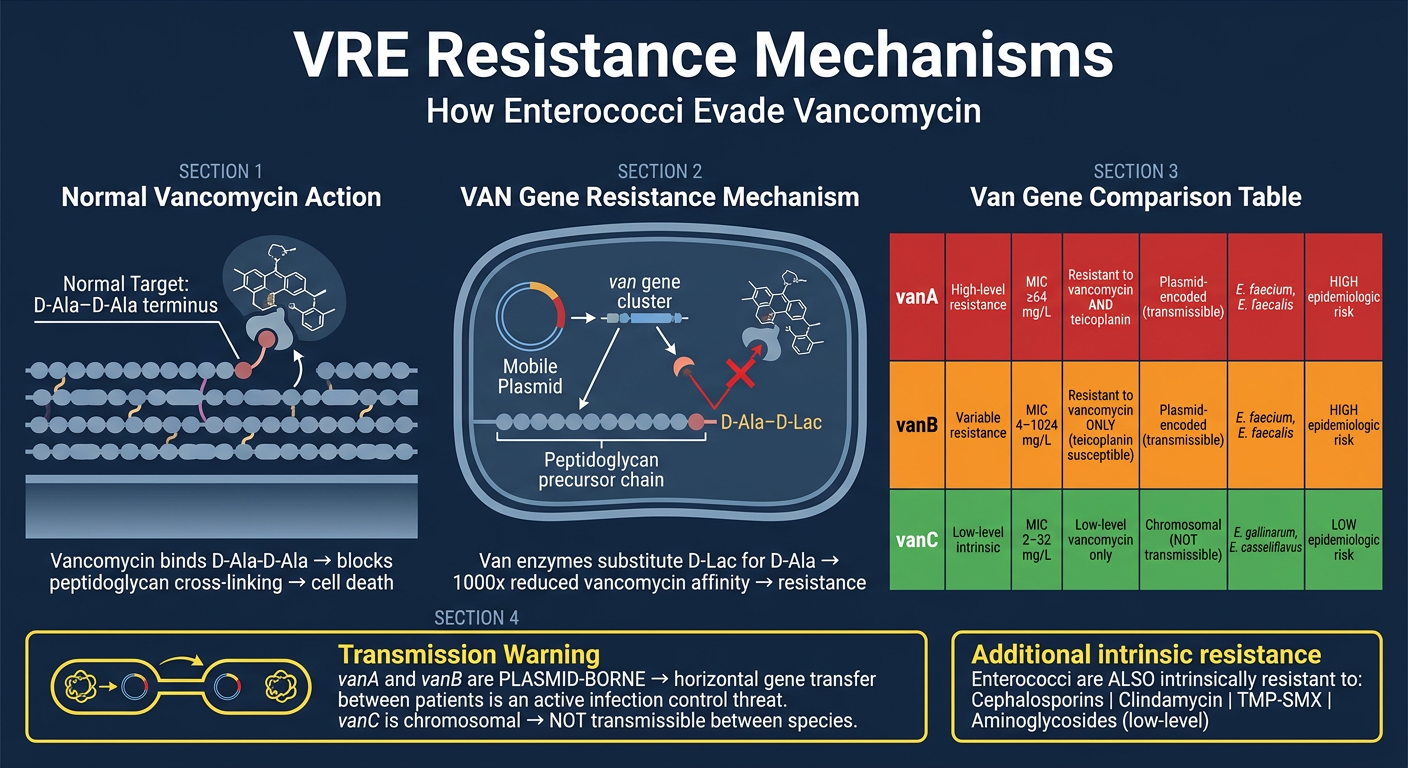
- vanA (red): High-level resistance to both vancomycin and teicoplanin. Plasmid-borne, so it spreads between bacteria and between patients. The dominant type in the USA.
- vanB (orange): Variable resistance to vancomycin, but teicoplanin remains active. Also plasmid-borne and transmissible. Predominates in Europe (though vanA is rising there too).
- vanC (green): Low-level, intrinsic resistance in E. gallinarum and E. casseliflavus. Chromosomal - cannot be transferred to other species. Much lower clinical/epidemiological concern.
can you explain Resistance Mechanisms via a infographic ? Make sure to point out each & every thing from the defination you have mentioned so that i can understand by looking at easily
Detailed, comprehensive medical education infographic on VRE (Vancomycin-Resistant Enterococci) Resistance Mechanisms. Dark navy blue background. Professional clinical teaching style. Very detailed with clear labels and annotations. Include ALL the following content organized in clear sections: ━━━ TOP BANNER ━━━ Large bold white title: "VRE Resistance Mechanisms — Complete Guide" Subtitle in yellow: "How Enterococci Evade Vancomycin | Microbiology & Infection Control" ━━━ LEFT COLUMN: "HOW VANCOMYCIN NORMALLY WORKS" ━━━ Header in bright green: "✓ NORMAL — Vancomycin-SENSITIVE Enterococcus (VSE)" Draw a simple bacterial cell wall cross-section showing: - Peptidoglycan layer labeled - Precursor terminus labeled: "D-Ala — D-Ala (normal target)" - Vancomycin molecule (blue Y-shape) binding tightly to D-Ala–D-Ala - Green checkmark with text: "Strong binding → blocks peptidoglycan cross-linking → cell wall weakens → BACTERIAL DEATH" - Small label: "Vancomycin MIC: LOW (susceptible)" ━━━ CENTER COLUMN: "HOW VRE DEFEATS VANCOMYCIN" ━━━ Header in red: "✗ RESISTANT — Vancomycin-Resistant Enterococcus (VRE)" Draw same bacterial cell wall with: - Modified terminus labeled: "D-Ala — D-Lac (MODIFIED target)" - Red annotation: "Van enzymes swap D-Alanine → D-Lactate" - Vancomycin molecule attempting to bind but bouncing off with red X - Red text: "1000× REDUCED binding affinity → Vancomycin FAILS" - Plasmid circle nearby labeled: "van gene cluster on mobile plasmid" - Arrow from plasmid to cell wall: "Van enzymes produced" ━━━ RIGHT COLUMN: "VAN GENE TYPES" ━━━ Three clearly separated colored boxes: RED BOX — vanA: Title: "vanA — HIGH-LEVEL RESISTANCE" • MIC vancomycin: ≥ 64 mg/L • MIC teicoplanin: ≥ 16 mg/L (ALSO RESISTANT) • Location: PLASMID (mobile, transferable!) • Species: E. faecium, E. faecalis • Geography: Dominant in USA; rising in Europe • Epidemiologic risk: ⚠ VERY HIGH — can spread between patients via plasmid transfer • Icon: two bacteria with a plasmid arrow between them ORANGE BOX — vanB: Title: "vanB — VARIABLE RESISTANCE" • MIC vancomycin: 4–1024 mg/L (variable) • MIC teicoplanin: SUSCEPTIBLE ← important clinical note • Location: PLASMID (mobile, transferable!) • Species: E. faecium, E. faecalis • Geography: Predominates in Europe • Epidemiologic risk: ⚠ HIGH — plasmid-borne, transmissible • Note: "Teicoplanin may still work!" GREEN BOX — vanC: Title: "vanC — LOW-LEVEL INTRINSIC" • MIC vancomycin: 2–32 mg/L (low) • MIC teicoplanin: SUSCEPTIBLE • Location: CHROMOSOME (fixed, NOT transferable) • Species: E. gallinarum, E. casseliflavus ONLY • Epidemiologic risk: ✓ LOW — chromosomal, cannot spread between species • Note: "NOT an infection control concern" ━━━ BOTTOM LEFT: "INTRINSIC RESISTANCE" ━━━ Yellow warning box: Header: "⚠ Enterococci Are ALSO Intrinsically Resistant To:" List with red X icons: ✗ Cephalosporins (all generations) ✗ Clindamycin ✗ TMP-SMX (despite in-vitro susceptibility — clinical failures!) ✗ Aminoglycosides (low-level — but synergy possible with cell-wall agents) ✗ Tobramycin / Kanamycin — NO synergy at all ━━━ BOTTOM CENTER: "PLASMID TRANSMISSION DANGER" ━━━ Orange danger box: Header: "⚠ WHY PLASMID-BORNE GENES ARE AN ICU THREAT" Diagram: Patient A (VRE colonized) → plasmid arrow → Patient B (newly colonized) Text: "vanA and vanB are on MOBILE PLASMIDS → horizontal gene transfer between bacteria → spreads on ICU surfaces, hands, equipment" "vanC = chromosomal = CANNOT transfer → low risk" ━━━ BOTTOM RIGHT: "ADDITIONAL ACQUIRED RESISTANCE" ━━━ Purple box: Header: "Acquired Resistance (Beyond van genes)" • High-level aminoglycoside resistance (HLAR) — aminoglycoside-inactivating enzymes → Eliminates synergy with penicillin/vancomycin for endocarditis • High-level penicillin/ampicillin resistance — PBP overexpression or mutation • Linezolid resistance — increasingly reported (23S rRNA mutations / cfr gene) • Daptomycin resistance — emerging; related to cell membrane changes Color scheme: Dark navy background, white body text, green for normal/susceptible, red for vanA/resistant, orange for vanB/warnings, green for vanC/low risk, yellow for intrinsic resistance, purple for acquired resistance. Very clean, readable fonts. Professional medical infographic. All text clearly legible.