
What are scapular dissociation exercises
Reading File
Finding Sources
Searching the Web
scapular dissociation exercises physical therapy
Finding Sources
Searching PubMed
scapular dissociation exercises rehabilitation
Finding Sources
Searching PubMed
scapular stabilization exercise shoulder rehabilitation
Reading File
Reading File
Finding Sources
Searching Images
scapular stabilization exercises serratus anterior trapezius
First, a note on terminology: "scapular dissociation exercises" is not a standard clinical term in orthopedic or physical therapy literature. The concept you're likely asking about is scapular stabilization exercises — a well-established category of therapeutic exercise targeting the muscles that control the scapula (shoulder blade) independently of arm and glenohumeral motion. "Dissociation" in this context refers to learning to move and control the scapula separately from the rest of the shoulder and trunk.
Here is a comprehensive overview based on orthopedic textbooks and recent systematic reviews:
What They Are
Scapular stabilization (dissociation) exercises train the muscles that anchor and move the scapula against the rib cage — primarily the serratus anterior, lower and middle trapezius, and rhomboids — to work independently and in proper coordination with arm motion. The goal is to restore normal scapulothoracic kinematics, which are often disrupted in conditions such as:
- Shoulder impingement / subacromial pain syndrome
- Multidirectional glenohumeral instability
- Rotator cuff tears or tendinopathy
- Scapular dyskinesis
- Neck pain
- Thoracic outlet syndrome
Per Miller's Review of Orthopaedics (9th ed), multidirectional instability should be treated with extended rehabilitation focused on scapular stabilization before any operative intervention, with closed kinetic chain exercises emphasized.
Key Muscles Targeted
| Muscle | Role |
|---|---|
| Serratus anterior | Scapular protraction, upward rotation, keeps scapula flush on rib cage |
| Lower trapezius | Depression and upward rotation of scapula |
| Middle trapezius | Retraction |
| Rhomboids | Retraction and downward rotation |
| Upper trapezius | Elevation (often overactive — exercises aim to inhibit it) |
Exercise Progression
Phase 1 — Isolated Scapular Control (low load)
- Scapular clock / retractions and protractions: Consciously squeeze the shoulder blades together (retraction) then push them apart (protraction) without moving the arms significantly
- Scapular depression: Actively pull shoulder blades downward away from ears
Phase 2 — Prone / Side-Lying Strengthening
- Prone Y, T, W exercises: Lying face-down, raise arms in Y (overhead), T (90° abduction), and W (elbows bent, externally rotated) positions — targets lower and middle trapezius
- Side-lying external rotation: With a dumbbell, targets posterior rotator cuff and reinforces scapular position
- Side-lying arm elevation: Performed with a towel roll in the axilla to pre-set scapular position
Phase 3 — Serratus Anterior Activation
- Knee push-up plus (KPUP): Standard push-up with an extra "plus" phase of maximal scapular protraction at the top — the most evidence-supported exercise for serratus anterior
- Wall push-up plus: Same concept against a wall (lower load, good for early rehab)
- Modified Vojta's 3-point support: Quadruped position, weight on elbows and knees, with active wrist extension to drive serratus activation
Phase 4 — Functional / Closed Kinetic Chain
- Lawnmower exercise: Multi-joint movement integrating trunk rotation and scapular retraction — simulates pulling motion
- Resistance band rows: Resisted scapular retraction using an elastic band anchored at chest height
- Diagonal band pulls: Band pulls in scaption (30–45° from the sagittal plane) to mimic functional overhead patterns
Clinical Images
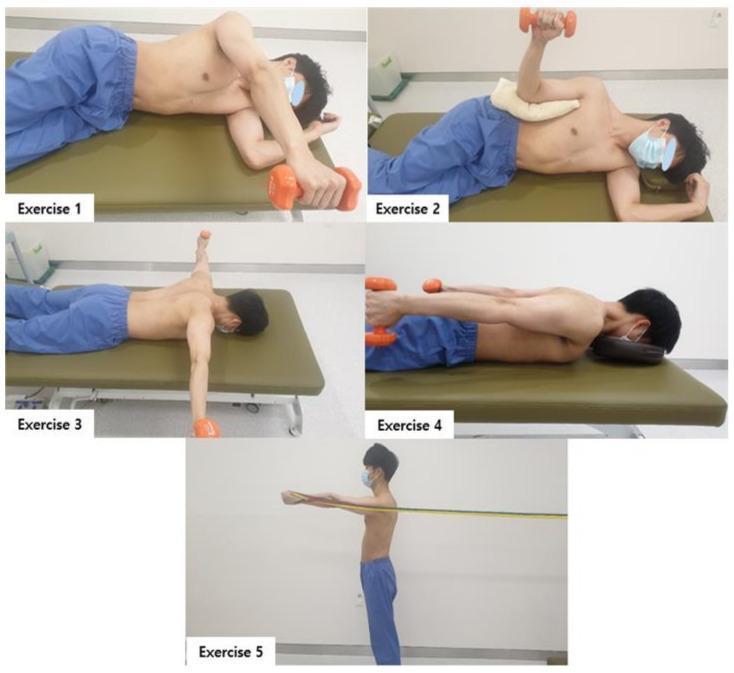
Muscle balance exercises targeting upper/middle/lower trapezius, serratus anterior. Note the standing protraction exercise against elastic band resistance (right panel).
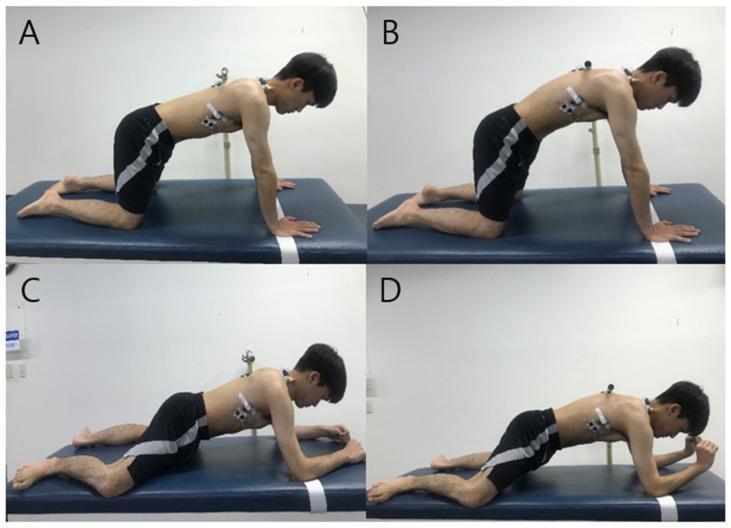
Knee Push-Up Plus (A,B) and Modified Vojta's 3-Point Support (C,D) — both monitored by EMG to confirm serratus anterior and trapezius recruitment.
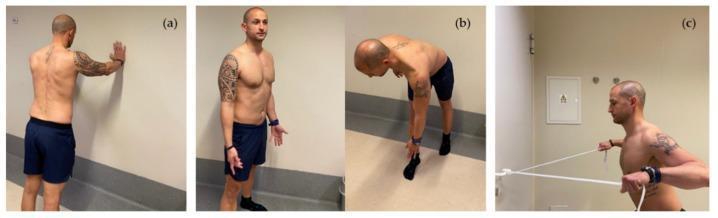
Wall push-up for serratus anterior (a), lawnmower exercise for kinetic chain integration (b), and resisted band retraction (c).
Evidence Base (Recent Systematic Reviews)
- Zhong et al., 2024 (PMID 38497039): Scapular stabilization exercises significantly reduce pain and improve function in subacromial pain syndrome.
- Brasileiro et al., 2025 (PMID 39983700): Meta-analysis confirms benefit for pain and functional recovery in shoulder impingement.
- Solana-Tramunt et al., 2026 (PMID 41961840): Scapular-focused movement exercises improve sports performance in athletes with scapular dyskinesis.
- Gutiérrez-Espinoza et al., 2025 (PMID 39755484): Scapular exercise programs benefit functional outcomes even in hand, wrist, and elbow disorders — reflecting the kinetic chain importance of the scapula.
Key Principles
- Proximal before distal: Establish scapular control before loading the glenohumeral joint
- Closed kinetic chain emphasis: Body-weight and resistance band exercises (not open-chain isolated movements) are preferred early on
- EMG-guided selection: Lower trapezius-targeted exercises (prone Y/T/W) and the push-up plus are the most muscle-specific per EMG studies
- Avoid upper trapezius dominance: Many patients over-recruit upper trapezius; exercises should specifically cue lower and middle trapezius activation
This is a shared conversation. Sign in to Orris to start your own chat.