

1778463445573608556463057366255.jpg
Notes
The note appears to contain the following questions (the handwriting is slightly difficult to read, but here is my best interpretation):
Q1. Functions of myoparasangium along with diagram
Q2. Find and detail the process of myoparasangium formation
Q3. Explain in detail the process of juxtaglomerular development
These questions relate to renal (kidney) histology and physiology — specifically the mesangium and juxtaglomerular apparatus (JGA). Let me answer them properly.
Reading File
Now let me search the medical library for mesangium and juxtaglomerular apparatus content in parallel:
Finding Sources
Finding Sources
Good — found key sources. Let me now read the detailed content from the best sources in parallel:
Reading File
Reading File
Finding Sources
Now let me read the JGA sections and fetch the mesangium diagram:
Reading File
Reading File
Loading Image
Excellent! Now let me get the JGA diagram and read more of the JGA section:
Loading Image
Loading Image
Reading File
I now have comprehensive content from authoritative textbooks. Let me compile the full answer.
Renal Histology Notes: Mesangium & Juxtaglomerular Apparatus
Q1. Functions of the Mesangium (with Diagram)
The mesangium consists of mesangial cells (from Gr. mesos = in the midst + angion = vessel) and their surrounding extracellular matrix. They fill the interstices between glomerular capillaries where podocyte processes are absent, and are enclosed within the glomerular basement membrane (GBM).
Diagram of the Mesangium
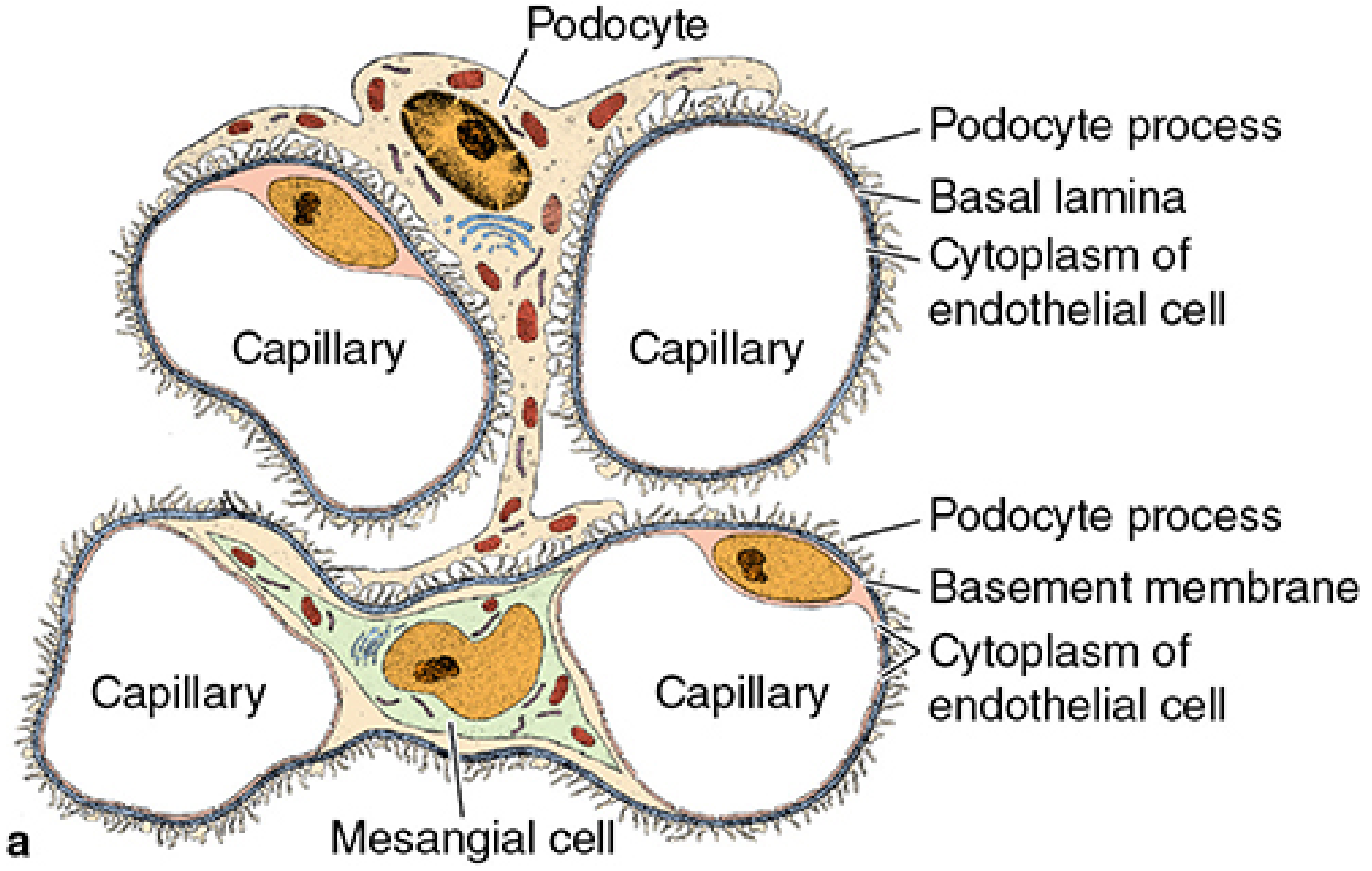
Functions of Mesangial Cells
| Function | Details |
|---|---|
| 1. Phagocytosis & Endocytosis | Remove trapped residues, aggregated proteins, and immune complexes from the GBM and filtration slit diaphragm — keeping the glomerular filter free of debris |
| 2. Structural Support | Produce mesangial extracellular matrix that supports podocytes in areas where the GBM is absent or incomplete; mesangial matrix allows larger molecules to pass from capillary lumen into the mesangium |
| 3. Secretion | Synthesize and secrete cytokines including IL-1, PGE₂, and PDGF — playing a central role in the response to glomerular injury |
| 4. Modulation of Glomerular Distension | Have contractile properties; regulate glomerular distension in response to increased blood pressure and help regulate glomerular filtration rate (GFR) by adjusting hydraulic filtration pressure |
| 5. Immune Processing | Endocytose and process plasma proteins including immune complexes — maintaining the structure and function of the glomerular barrier |
Clinical note: In diseases such as IgA nephropathy and lupus nephritis, mesangial cells proliferate abnormally due to trapping of immune complexes in the GBM. — Histology: A Text and Atlas (Ross & Pawlina), 9e
Q2. Process of Mesangium Formation
The mesangium forms through the following steps:
Structure
- Mesangial cells reside within the renal corpuscle, enclosed by the GBM shared among several capillaries
- They are most prominent at the vascular stalk of the glomerulus and at the interstices of adjoining glomerular capillaries
- The mesangial cells are not confined entirely to the renal corpuscle — some extend outside at the vascular pole, where they are called lacis cells (extraglomerular mesangial cells), forming part of the juxtaglomerular apparatus
Cellular Characteristics
- Resemble vascular pericytes — they have contractile properties and produce components of an external lamina
- In routine sections, mesangial cells are difficult to distinguish from podocytes but often stain more darkly
- PAS stain (Periodic Acid-Schiff) clearly visualizes the GBM and positions mesangial nuclei between capillary loops, more toward the center of the glomerulus
Formation Process
- Mesangial matrix is produced by the mesangial cells themselves — it differs substantially in composition from the GBM and allows larger molecules to pass
- Mesangial cells extend contractile processes along capillaries — some processes pass between endothelial cells into the capillary lumen, where they endocytose adherent protein aggregates
- The matrix provides scaffolding where the GBM is not present, bridging multiple capillary loops into a functional filtration unit
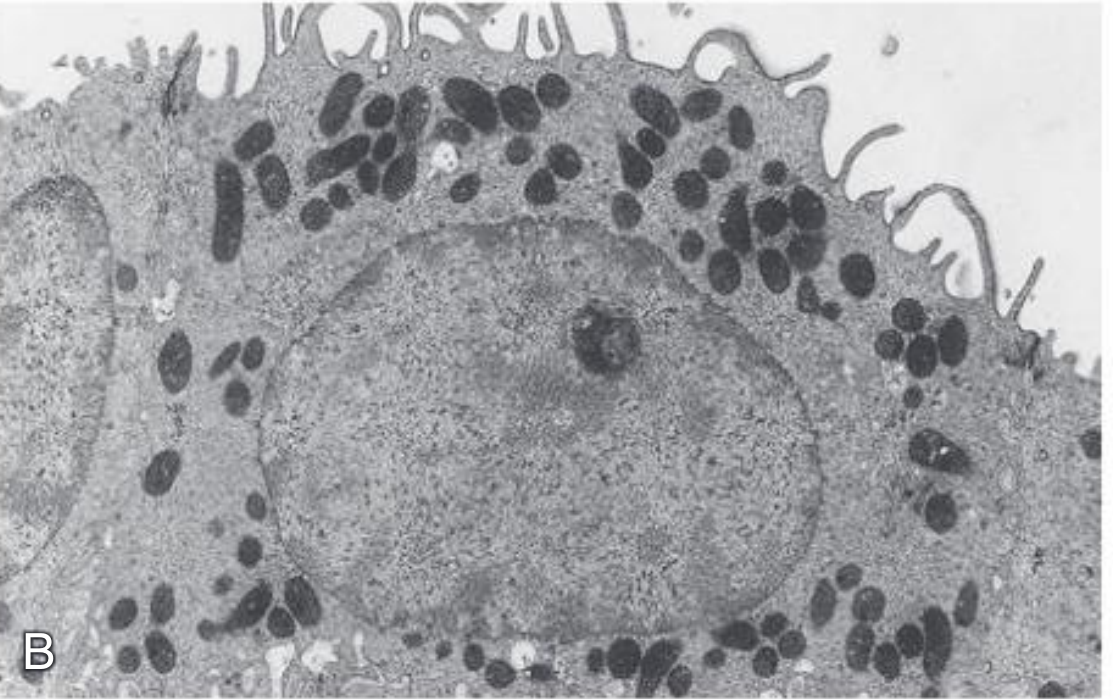
Q3. Juxtaglomerular Apparatus (JGA) — Structure & Development
Components of the JGA
The juxtaglomerular apparatus is located at the vascular pole of the renal corpuscle and consists of three cell types:
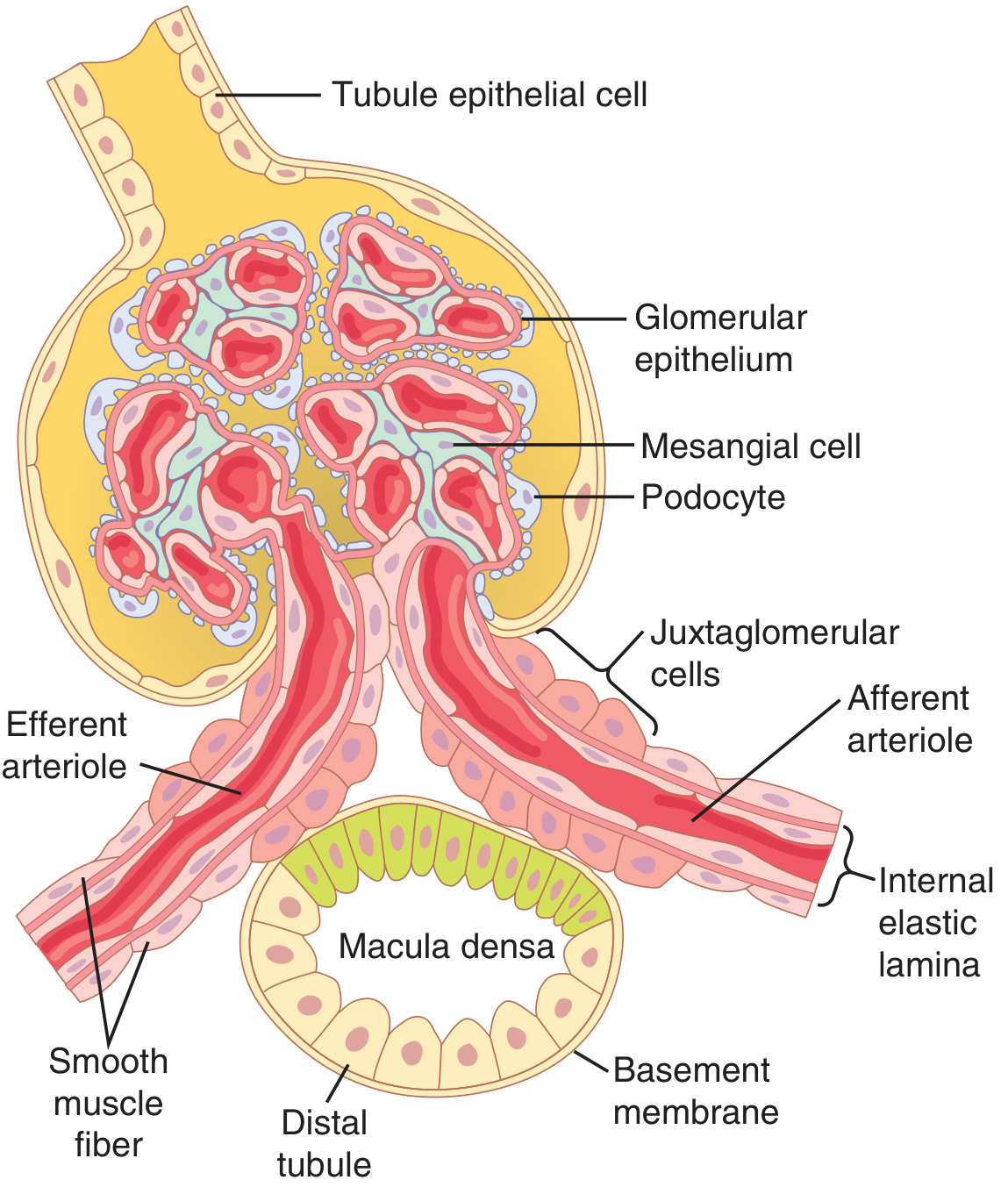
| Component | Location | Key Feature |
|---|---|---|
| Macula densa | Wall of thick ascending limb of Henle / early distal tubule | Specialized epithelial cells with closely packed large nuclei; contain nNOS and COX-2; detect NaCl concentration in tubular fluid |
| Granular (juxtaglomerular) cells | Terminal afferent arteriole wall | Modified smooth muscle cells; contain cytoplasmic granules storing renin (and prorenin); densely innervated by sympathetic fibers |
| Extraglomerular mesangium (Lacis cells) | Between macula densa and arterioles | Heavily branched cells; interconnected by gap junctions; connect all structures at the glomerular entrance |
Detailed Development of Each Component
1. Macula Densa
- A plaque of specialized epithelial cells in the wall of the thick ascending limb of Henle where it attaches to the extraglomerular mesangium of the parent glomerulus
- Cells are narrowly packed with large nuclei (hence "macula densa" = dense spot)
- Anchored to a basement membrane that blends with the extraglomerular mesangial matrix
- Cells are joined by tight junctions with very low permeability and have prominent lateral intercellular spaces whose width varies under different functional conditions
- Contain high amounts of nNOS (neuronal nitric oxide synthase) and COX-2 (cyclooxygenase-2)
2. Granular Cells
- Assembled in clusters within the terminal portion of the afferent arteriole, replacing ordinary smooth muscle cells
- Store renin in specific cytoplasmic granules; renin is released by exocytosis into surrounding interstitium
- Connected to extraglomerular mesangial cells, adjacent smooth muscle cells, and endothelium via gap junctions
- Under conditions of volume depletion or renal artery stenosis, additional upstream smooth muscle cells transform into granular cells to increase renin synthesis
3. Extraglomerular Mesangium (Lacis/Goormaghtigh cells)
- Firmly attached to the basal aspect of the macula densa
- Solid complex of cells and matrix penetrated by neither blood vessels nor lymphatic capillaries
- Processes interconnected by gap junctions; contain prominent bundles of microfilaments
- Connected to Bowman's capsule basement membrane and walls of both arterioles
- Interconnects all structures of the glomerular entrance as a signaling intermediary
Functions of the JGA
-
Tubuloglomerular Feedback (TGF):
- Increased GFR → increased NaCl delivery to macula densa → activates Na⁺/K⁺/2Cl⁻ cotransporter → depolarization → ATP release → converted to adenosine → afferent arteriole constriction → decreased GFR (negative feedback loop)
- Also suppresses renin release when NaCl is high
-
Renin-Angiotensin-Aldosterone System (RAAS):
- Decreased GFR or blood pressure → decreased NaCl at macula densa → renin release from granular cells → angiotensin I → angiotensin II → systemic vasoconstriction + aldosterone release → increases blood pressure and extracellular fluid volume
-
Autoregulation of GFR — maintains relatively constant GFR despite fluctuations in systemic blood pressure, through both the TGF mechanism and myogenic responses of the afferent arteriole.
Sources:
- Junqueira's Basic Histology: Text and Atlas, 17e, pp. 962–964
- Histology: A Text and Atlas (Ross & Pawlina), 9e, pp. 1885–1886
- Comprehensive Clinical Nephrology, 7e, pp. 31–32
- Guyton and Hall Textbook of Medical Physiology, 14e, pp. 3819–3831
This is a shared conversation. Sign in to Orris to start your own chat.