
Give flowchart of this
python3 -c " import pdfplumber with pdfplumber.open('/home/daytona/workspace/attachments/92cb2126-ba4e-4e06-b927-afaf0dddaa8d/200806supplementdiarrhoea.pdf') as pdf: print(f'Pages: {len(pdf.pages)}') for i, page in enumerate(pdf.pages): text = page.extract_text() print(f'--- PAGE {i+1} ---') print(text) print() "
A detailed clinical management flowchart titled "Management of Diarrhoea with or without Vomiting in Children" based on an evidence-based guideline. The flowchart should have the following structure: START: Child presents with acute diarrhoea (less than 7 days) with or without vomiting EXCLUSION BOX (red border): Check exclusion criteria - Child unconscious or under 3 months, Cause other than gastroenteritis (UTI, appendicitis, intussusception, antibiotic toxicity, chronic causes) STEP 1: Initial Assessment - Assess degree of dehydration using: Capillary refill time, Skin turgor, Respiratory pattern, Conscious state, Drinking ability, Urine output THREE BRANCHES based on dehydration severity: BRANCH 1 - NONE/MINIMAL (green box, less than 5% body weight): - Normal capillary refill, skin pinch retracts immediately, normal respiratory pattern, normal conscious state, normal drinking, normal urine output - Treatment: Increase frequency and volume of usual drinks - Give: breast milk, ORS, unsweetened fruit juice diluted 1:4, or cordial diluted 1:10 - Avoid: soft drinks, sports drinks, undiluted juice - Allow normal foods if hungry - Give parent written information - Reassess as required BRANCH 2 - MODERATE (yellow/orange box, 5-10% body weight): - Delayed capillary refill 3-4 seconds, skin pinch retracts slowly 1-2 seconds, increased respiratory rate, restless/irritable, drinks eagerly with increased thirst, tachycardia - Treatment: Rehydrate with ORS 10-20 mL/kg/hr over 1 hour - Give 5 mL/kg every 15 minutes in small amounts - Sub-decision: Can child tolerate oral fluids? - YES: Continue for further 3 hours, reassess hourly - NO (after 1 hour): Try nasogastric rehydration - Nasogastric fails (persistent vomiting/worsening): SEND TO HOSPITAL - IV rehydration BRANCH 3 - SEVERE (red box, more than 10% body weight): - Very delayed capillary refill >4 seconds, mottled skin, skin pinch retracts very slowly >2 seconds, deep acidotic breathing, lethargic/unconscious, unable to drink, deeply sunken eyes, hypotension - SEND TO HOSPITAL immediately (red arrow) HIGH RISK FLAGS (yellow warning box): Special care if: infant under 6 months, more than 8 diarrhoeal stools in 24 hours, more than 4 vomits in 24 hours, comorbid conditions (short gut, developmental delay, metabolic illness), refusal of oral fluids RESPONSE TO TREATMENT (bottom): - RESPONDING: Child tolerating oral fluids, parent able to supervise - DISCHARGE HOME with instructions - NOT RESPONDING: Reconsider diagnosis, continue rehydration, consult paediatrician or emergency physician - SEND TO HOSPITAL PHARMACOLOGICAL NOTES (side box): - No antidiarrhoeals (loperamide NOT recommended) - No antiemetics (metoclopramide NOT recommended) - Probiotics: useful adjunct but proven formulations not available in Australia DIET NOTES (side box): - Continue breastfeeding throughout - Restart age-appropriate diet after initial rehydration - Full strength lactose-containing milk is fine - If diarrhoea persists over 7 days: consider lactose intolerance Use color coding: green for mild/minimal, orange/yellow for moderate, red for severe/send to hospital. Include clear arrows showing decision flow. Professional medical flowchart style with clean boxes and readable text.
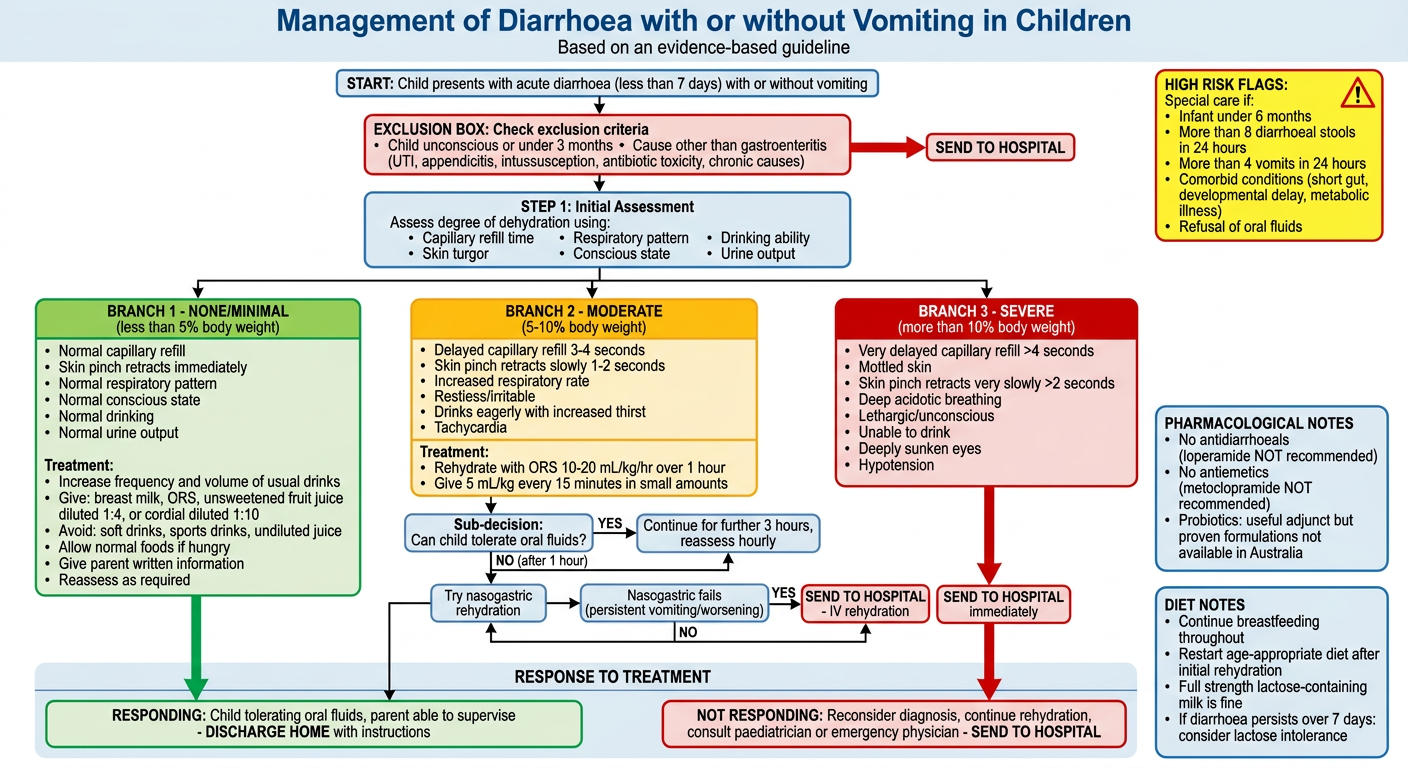
| Severity | Signs | % Body Weight Lost |
|---|---|---|
| None/Minimal | Normal refill, immediate skin pinch retraction | <5% |
| Moderate | Refill 3-4 sec, slow skin pinch, restless, tachycardia | 5-10% |
| Severe | Refill >4 sec, mottled, lethargic, hypotension | >10% |
- Mild: Increase usual fluids; avoid soft drinks/sports drinks
- Moderate: ORS 10-20 mL/kg/hr in small aliquots (5 mL/kg every 15 min); if oral fails - nasogastric; if nasogastric fails - send to hospital for IV
- Severe: Send to hospital immediately
- No loperamide, no antidiarrhoeals, no metoclopramide
- No routine stool culture or blood biochemistry
- Continue breastfeeding throughout