
Basal ganglia
Reading File
Now let me search the library for basal ganglia content in parallel:
Finding Sources
Finding Sources
Excellent results. Now let me read the most comprehensive sources in parallel:
Reading File
Reading File
Reading File
Great content. Let me now read deeper into the neuroanatomy and pathways, plus fetch key images:
Reading File
Reading File
Excellent. Now let me fetch key images and read more on basal ganglia disorders:
Loading Image
Loading Image
Loading Image
Reading File
I now have comprehensive content. Let me fetch one more key image (the direct pathway diagram) and read the indirect pathway content:
Reading File
Loading Image
Let me fetch the direct+indirect pathway diagram:
Loading Image
I now have all the content I need. Here is the comprehensive answer:
Basal Ganglia
Overview
The basal ganglia are a collection of gray matter nuclei located deep within the white matter of the cerebral hemispheres. Within the motor control hierarchy, they sit at the highest level alongside association cortex and are concerned with strategy - deciding the goal of a movement and the type of movement needed to achieve it. - Neuroscience: Exploring the Brain, 5th Ed.
Anatomy and Components
The main components are:
| Structure | Notes |
|---|---|
| Caudate nucleus | C-shaped, divided into head/body/tail; closely follows the lateral ventricle |
| Putamen | Large nucleus forming the lateral portion; fuses anteriorly with caudate head |
| Globus pallidus (GP) | Divided into GPi (internal) and GPe (external); main output nucleus |
| Subthalamic nucleus (STN) | Diencephalon; key node of the indirect pathway |
| Substantia nigra (SN) | Midbrain; pars compacta (SNc) provides dopaminergic input; pars reticulata (SNr) is an output nucleus |
| Nucleus accumbens | Ventral striatum; limbic circuitry; reward and motivation |
The caudate + putamen = striatum (neostriatum) - the primary input structure of the basal ganglia. They are separated by fibers of the internal capsule but connected by cellular bridges (giving the "striated" appearance). The lenticular nucleus = putamen + globus pallidus.
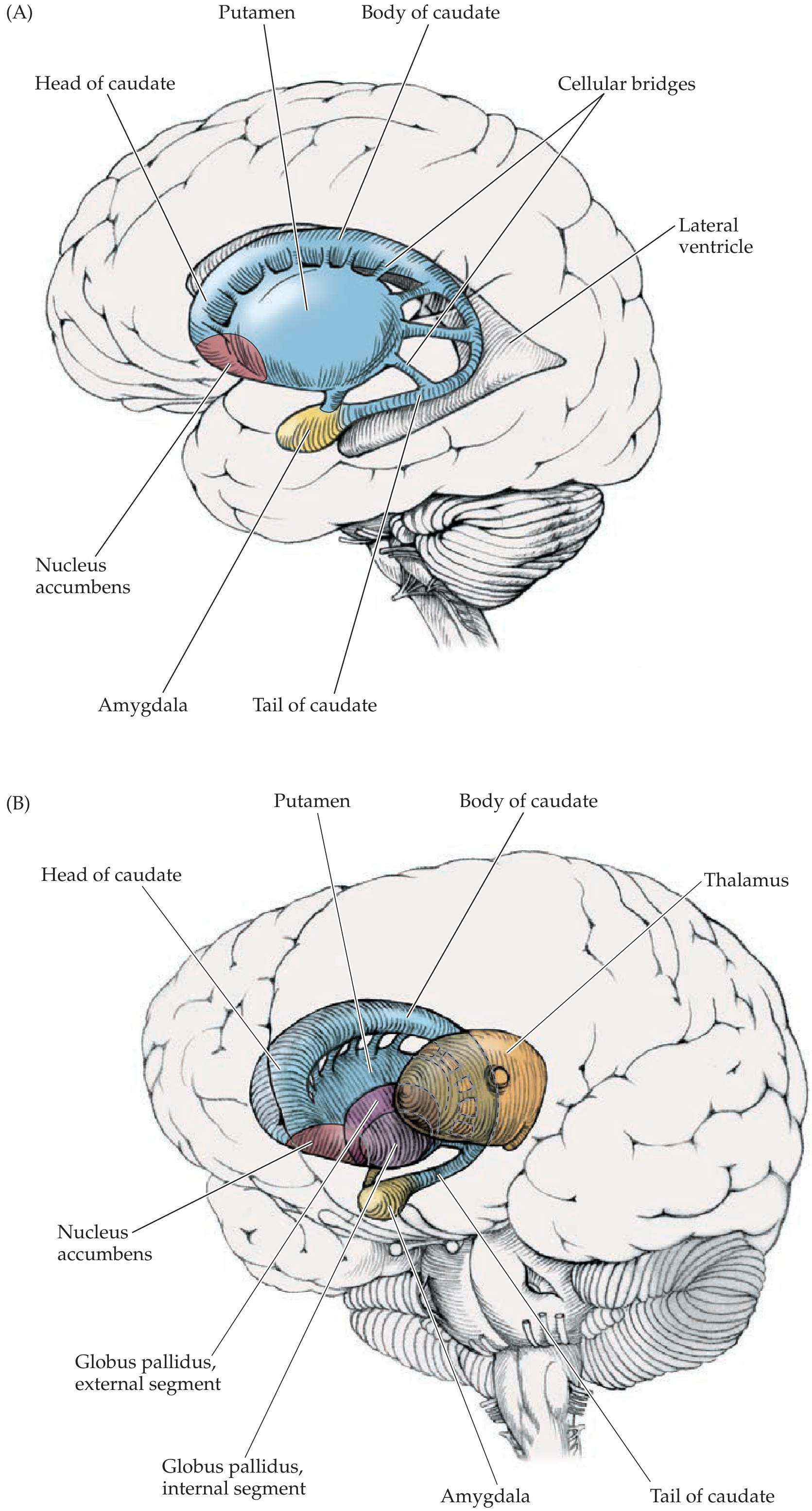
Lateral (A) and anterolateral (B) views of the basal ganglia, thalamus, and amygdala - Neuroanatomy through Clinical Cases, 3rd Ed.
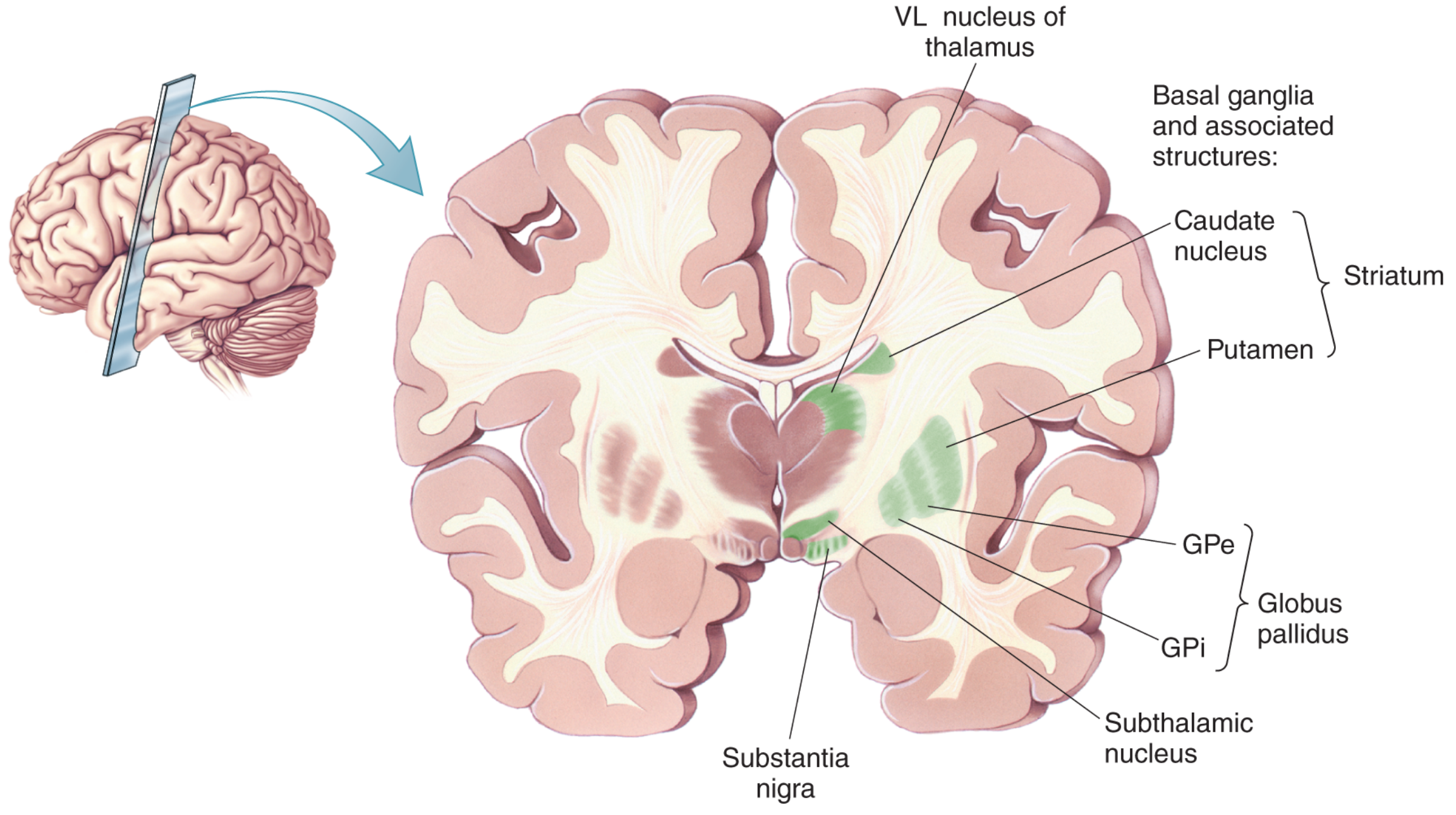
Coronal section showing the striatum, globus pallidus (GPe/GPi), subthalamic nucleus, and substantia nigra - Neuroscience: Exploring the Brain, 5th Ed.
Circuitry: The Direct and Indirect Pathways
Almost all areas of the cerebral cortex project topographically onto the striatum. Information then flows via two parallel pathways that have opposing effects on the motor thalamus (VL nucleus), which in turn connects back to the cortex (especially supplementary motor area, SMA).
Direct Pathway (Net excitatory effect on cortex)
Cortex (+) → Striatum (-) → GPi/SNr (-) → VL Thalamus (+) → Cortex (SMA)
- The striatum inhibits GPi neurons (which are tonically active and constitutively inhibit VL)
- Inhibiting GPi disinhibits VL thalamus, boosting cortical/SMA activity
- Net effect: facilitates desired movement - acts as a "go" signal
- Dopamine (D1 receptors in striatum) is excitatory here, facilitating this pathway
Indirect Pathway (Net inhibitory effect on cortex)
Cortex (+) → Striatum (-) → GPe (-) → STN (+) → GPi (-) → VL Thalamus (+) → Cortex
- Striatum inhibits GPe → disinhibits STN
- Active STN excites GPi → GPi inhibits VL thalamus more strongly
- Net effect: suppresses competing/unwanted movements
- Dopamine (D2 receptors) is inhibitory in the indirect pathway, reducing this suppressive output
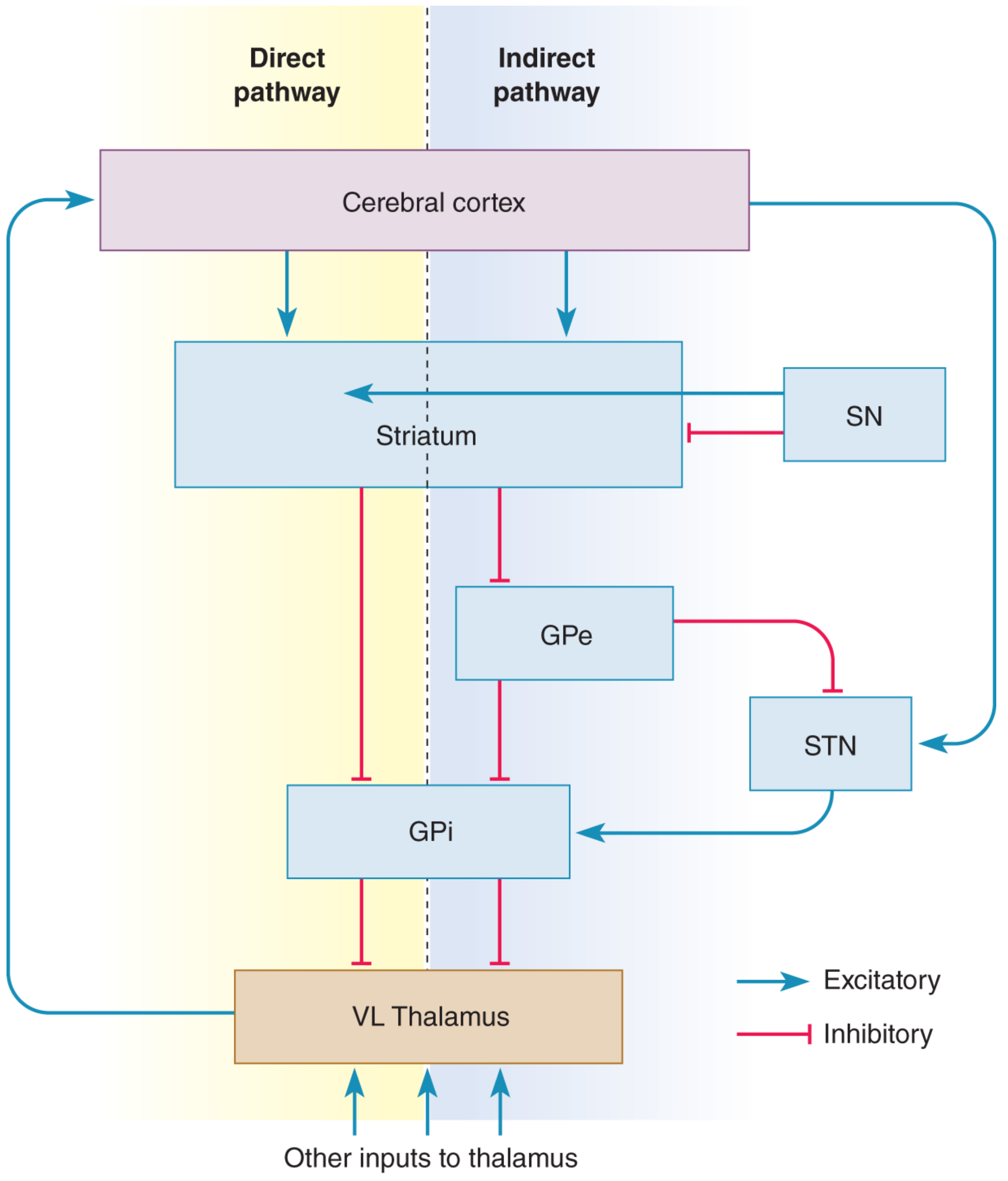
The direct (yellow) and indirect (blue) pathways. SN = substantia nigra, STN = subthalamic nucleus, GPe/GPi = globus pallidus external/internal, VL = ventrolateral thalamus - Neuroscience: Exploring the Brain, 5th Ed.
The balance between these two pathways is key: the direct pathway selects certain motor programs while the indirect pathway simultaneously suppresses competing, inappropriate ones.
Neurotransmitters
| Connection | Neurotransmitter | Effect |
|---|---|---|
| Cortex → Striatum | Glutamate | Excitatory |
| Striatum → GPi/SNr (direct) | GABA | Inhibitory |
| Striatum → GPe (indirect) | GABA | Inhibitory |
| GPe → STN | GABA | Inhibitory |
| STN → GPi | Glutamate | Excitatory |
| GPi/SNr → Thalamus | GABA | Inhibitory |
| Thalamus → Cortex | Glutamate | Excitatory |
| SNc → Striatum | Dopamine | D1 (excitatory, direct); D2 (inhibitory, indirect) |
Functions Beyond Motor Control
The basal ganglia participate in multiple parallel circuits:
- Motor: movement initiation, sequencing, habit learning
- Cognitive: working memory, decision-making, action selection
- Affective/limbic: emotion regulation, motivation, reward (via nucleus accumbens)
- Oculomotor: saccadic eye movements (via caudate-SNr-superior colliculus loop)
- Neuroanatomy through Clinical Cases, 3rd Ed.; Kaplan & Sadock's Comprehensive Textbook of Psychiatry
Diseases of the Basal Ganglia
Disruption of the direct/indirect balance produces either hypokinetic or hyperkinetic movement disorders.
Parkinson's Disease (Hypokinetic)
- Pathology: Degeneration of dopaminergic neurons in the SNc (pars compacta)
- Mechanism: Loss of dopamine → D1 under-stimulation reduces direct pathway; D2 under-stimulation removes brake from indirect pathway → net excessive GPi inhibition of thalamus → reduced cortical excitation
- Clinical features: Bradykinesia, akinesia, cogwheel rigidity, resting tremor ("pill-rolling"), shuffling gait, postural instability
- Treatment: L-DOPA (dopamine precursor), dopamine agonists (e.g., bromocriptine), deep brain stimulation (DBS) of STN or GPi
- MPTP model: MPTP is converted to MPP+, selectively taken up by dopamine transporters, disrupts mitochondrial energy production in SNc neurons - a key toxin model for research
Huntington's Disease (Hyperkinetic)
- Pathology: Autosomal dominant mutation in the HTT gene - expanded CAG repeat (>36 repeats) in the huntingtin protein; aggregation of abnormal huntingtin triggers neurodegeneration in the caudate nucleus and putamen (GABAergic/cholinergic neurons)
- Mechanism: Loss of striatal neurons reduces inhibitory output → GPe is disinhibited, over-inhibits STN → reduced GPi activity → reduced thalamic inhibition → excess cortical excitation
- Clinical features: Choreiform (writhing, jerky) involuntary movements, psychiatric symptoms (personality change, depression), dementia
- No cure; symptomatic management only
Hemiballismus
- Caused by lesion of the subthalamic nucleus (e.g., stroke)
- Loss of STN excitation on GPi → reduced GPi output → thalamic disinhibition → wild, flinging (ballistic) movements of contralateral limbs
Summary Mnemonic
"Direct = Go, Indirect = No-Go"
- Direct pathway: Cortex → Striatum → inhibits GPi → releases thalamus → movement facilitated
- Indirect pathway: Cortex → Striatum → inhibits GPe → releases STN → excites GPi → inhibits thalamus → movement suppressed
- Dopamine tips the balance toward Go (excites direct via D1, inhibits indirect via D2)
Sources: Neuroscience: Exploring the Brain 5th Ed. | Neuroanatomy through Clinical Cases 3rd Ed. | Costanzo Physiology 7th Ed. | Bradley and Daroff's Neurology in Clinical Practice | Kaplan & Sadock's Comprehensive Textbook of Psychiatry
This is a shared conversation. Sign in to Orris to start your own chat.