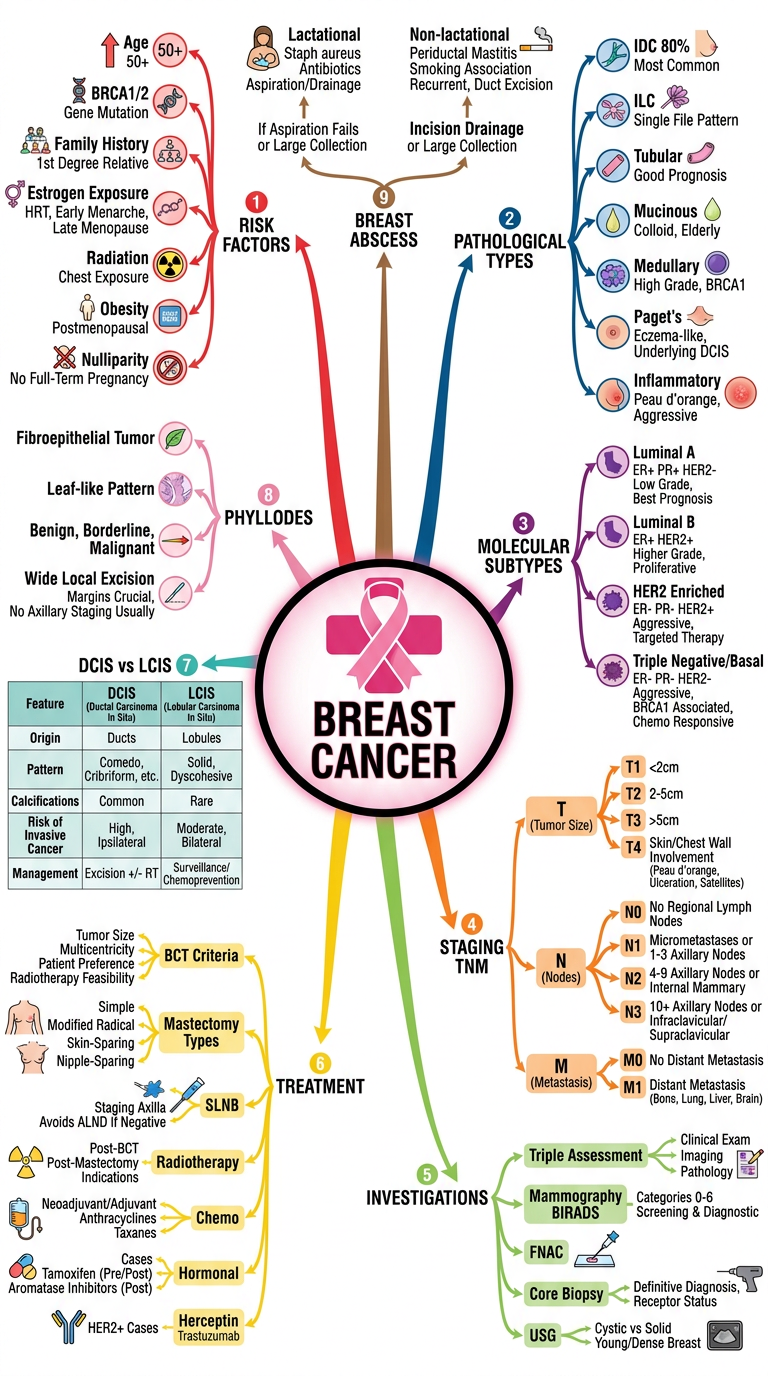
Important note upfront: NEET PG and INI-CET exam papers are confidential by law - the actual verbatim question texts are not publicly released. What I've compiled below are the confirmed recalled/memory-based questions from student communities and coaching institutes (Marrow, Prepladder, Cerebellum Academy, Dams, etc.) that are widely discussed as having appeared in those exams. These represent the best available reconstruction of PYQs on Breast from 2020-2025.
🎯 NEET PG & INI-CET PYQs ON BREAST (2020-2025)
Recalled/Memory-Based Questions with Detailed Explanations
📅 NEET PG 2020
Q1. A 45-year-old woman presents with a hard painless lump in the upper outer quadrant of her right breast. Which investigation is the GOLD STANDARD for diagnosis?
- A. FNAC
- B. Core needle biopsy
- C. Triple assessment
- D. MRI breast
✅ Answer: C - Triple Assessment
Triple assessment = Clinical examination + Imaging (mammography/USG) + Tissue pathology (FNAC/core biopsy). No single test alone is gold standard. Each component gets a score of 1-5 (benign to malignant).
Q2. Which of the following is NOT a contraindication to breast conservation surgery?
- A. Prior radiation to the same breast
- B. Multicentric disease
- C. Young age (<35 years)
- D. Positive surgical margins after re-excision
✅ Answer: C - Young age
Young age alone is NOT a contraindication to BCT. The actual contraindications are: positive margins after re-excision, multicentric disease, prior RT, pregnancy (1st/2nd trimester), and diffuse malignant microcalcifications.
Q3. LCIS (Lobular Carcinoma in Situ) is best managed by:
- A. Mastectomy
- B. Wide local excision
- C. Observation and chemoprevention
- D. Radiotherapy
✅ Answer: C - Observation and chemoprevention
LCIS is a risk marker, not a direct precursor. It does not require excision. Management = surveillance + chemoprevention (tamoxifen/raloxifene). Bilateral mastectomy is only for very high-risk patients who refuse surveillance.
Q4. The MOST common site of distant metastasis in breast cancer is:
- A. Liver
- B. Lung
- C. Brain
- D. Bone
✅ Answer: D - Bone
Bone is the most common site of haematogenous metastasis in breast cancer (especially lumbar vertebrae, pelvis, femur). Osteolytic > osteoblastic. Bone scan is used for staging.
📅 NEET PG 2021
Q5. A woman with family history of breast cancer in mother and sister. BRCA mutation testing is done - she is BRCA1 positive. What is the BEST advice?
- A. Start OCP immediately
- B. Stop OCP
- C. Genetic counseling
- D. Prophylactic bilateral mastectomy immediately
✅ Answer: C - Genetic counseling
Genetic counseling is the FIRST step before any intervention in a proven or suspected BRCA mutation carrier. Prophylactic mastectomy is offered only AFTER counseling and when the patient is ready/desires it after informed decision. OCP cessation is not required (low risk).
Q6. Peau d'orange appearance of breast skin is due to:
- A. Cooper's ligament involvement
- B. Dermal lymphatic obstruction
- C. Nipple duct involvement
- D. Subareolar lymphatic plexus occlusion
✅ Answer: B - Dermal lymphatic obstruction
Dermal lymphatic blockage causes subcutaneous edema. The hair follicles/sweat gland openings are tethered to the dermis and cannot expand, creating the dimpled "orange peel" appearance. Classic of inflammatory breast cancer and locally advanced disease.
Q7. In modified radical mastectomy (MRM) by Auchincloss technique, which muscles are preserved?
- A. Pec major only
- B. Pec minor only
- C. Both pec major and minor
- D. Neither
✅ Answer: C - Both pectoralis major and minor
Auchincloss MRM = breast + axillary dissection levels I-II + preserves BOTH pec major and pec minor. Patey's MRM = preserves only pec major (pec minor is removed). Halsted radical = both removed.
Q8. Which molecular subtype of breast cancer has the WORST prognosis?
- A. Luminal A
- B. Luminal B
- C. HER2 enriched
- D. Triple negative (Basal-like)
✅ Answer: D - Triple negative (Basal-like)
Triple negative (ER-, PR-, HER2-) has the worst prognosis because there is NO targeted therapy available - only chemotherapy. Associated with BRCA1 mutations and younger patients.
Q9. A 38-year-old woman has a screen-detected cluster of microcalcifications on mammography. Biopsy shows high-grade DCIS with central necrosis. This is called:
- A. Cribriform DCIS
- B. Comedocarcinoma
- C. Papillary DCIS
- D. Micropapillary DCIS
✅ Answer: B - Comedocarcinoma
Comedocarcinoma = high-grade DCIS with central necrosis that can be expressed like a "comedo." The necrotic debris calcifies, producing the classic casting/linear/branching microcalcifications on mammography. Highest risk of progression to invasive cancer.
📅 NEET PG 2022
Q10. Sentinel lymph node biopsy uses which combination?
- A. Patent blue dye alone
- B. Tc-99m sulfur colloid alone
- C. Patent blue + Tc-99m sulfur colloid
- D. Methylene blue + Fluorescein
✅ Answer: C - Patent blue dye + Tc-99m sulfur colloid (radiocolloid)
The dual technique (colorimetric + radioguided) gives the highest sentinel node detection rate (>95%). Patent blue/isosulfan blue dye + Tc-99m labeled sulfur colloid or albumin nanocolloid are injected peritumorally or subdermally. The "hot and blue" node is the sentinel node.
Q11. A postmenopausal woman is diagnosed with ER+/PR+ HER2- breast cancer after lumpectomy. What is the preferred hormonal agent?
- A. Tamoxifen
- B. Anastrozole (aromatase inhibitor)
- C. Fulvestrant
- D. Megestrol acetate
✅ Answer: B - Aromatase inhibitor (Anastrozole/Letrozole)
Aromatase inhibitors are PREFERRED over tamoxifen in postmenopausal ER+ breast cancer (superior disease-free survival, no endometrial cancer risk, no DVT risk). Tamoxifen is used in premenopausal women. Fulvestrant is for metastatic disease.
Q12. Which of the following does NOT increase the risk of breast carcinoma?
- A. Atypical ductal hyperplasia
- B. Sclerosing adenosis
- C. LCIS
- D. Florid hyperplasia without atypia
✅ Answer: B - Sclerosing adenosis
Sclerosing adenosis is a NON-proliferative lesion - it does NOT increase the risk of breast cancer. Non-proliferative lesions (cysts, mild hyperplasia, sclerosing adenosis) = NO increased risk. Florid hyperplasia without atypia = RR 1.5-2x. ADH = RR 4x. LCIS = RR 8-10x.
Q13. Paget's disease of the nipple: the characteristic cells on histology are?
- A. Reed-Sternberg cells
- B. Paget cells - large pale cells with clear halo
- C. Signet ring cells
- D. Hurthle cells
✅ Answer: B - Large pale vacuolated cells with clear halo (Paget cells)
Paget cells are large, pale-staining intraepidermal cells with abundant pale/clear cytoplasm and vesicular nuclei with prominent nucleoli. They contain mucin (PAS+), and are positive for CK7, CEA, and HER2. They represent intraepidermal spread of an underlying carcinoma.
Q14. A 50-year-old woman presents with a rapidly growing large breast lump, mobile, with prominent skin veins but no axillary nodes. Biopsy shows hypercellular stroma with leaf-like fronds. Diagnosis?
- A. Giant fibroadenoma
- B. Phyllodes tumor
- C. Invasive ductal carcinoma
- D. Inflammatory breast cancer
✅ Answer: B - Phyllodes tumor
Key features: rapidly growing, large, prominent veins, NO axillary lymphadenopathy (phyllodes rarely spreads lymphatically), leaf-like stromal fronds on histology. Fibroadenoma occurs in younger women (<35) and is smaller/slower growing.
📅 INI-CET 2022 (May & November)
Q15. Which gene-disease association is INCORRECT?
- A. STK11 - Breast cancer (Peutz-Jeghers)
- B. PTEN - Thyroid carcinoma (Cowden)
- C. TP53 - Mucosal neuroma (MEN 2B)
- D. BRCA2 - Prostate carcinoma
✅ Answer: C - TP53 - Mucosal neuroma is INCORRECT
Mucosal neuromas are associated with MEN 2B (RET mutation), NOT TP53. TP53 mutation = Li-Fraumeni syndrome (breast cancer, sarcomas, brain tumors, adrenal cortical carcinoma). STK11 = Peutz-Jeghers (correct). PTEN = Cowden disease (breast + thyroid + endometrial = correct). BRCA2 = prostate cancer (correct).
Q16. USG is NOT an advantage over mammography in which situation?
- A. Young females with dense breasts
- B. Detecting mammographically occult palpable tumors
- C. Can differentiate cystic vs solid lesion
- D. USG-guided biopsy
✅ Answer: B - Detecting mammographically occult palpable tumors
If a tumor is palpable but not visible on mammography, USG CAN detect it (this is actually an ADVANTAGE of USG). The advantage list of USG: dense breasts, young women, cyst vs solid, guided biopsy, no radiation. Mammography detects microcalcifications and stellate lesions better.
📅 NEET PG 2023
Q17. In inflammatory breast carcinoma, the histological hallmark is:
- A. Lymphocytic infiltrate in parenchyma
- B. Tumor emboli in dermal lymphatics
- C. Fat necrosis
- D. Stromal overgrowth
✅ Answer: B - Tumor emboli in dermal lymphatics
Inflammatory breast carcinoma (T4d) is a CLINICAL diagnosis (warm, red, edematous breast >1/3 of skin) but the pathological correlate is dermal lymphatic invasion/tumor emboli. It is NOT a histological entity - the skin biopsy showing dermal lymphatic emboli supports the diagnosis.
Q18. A 32-year-old woman presents with bloody nipple discharge from a single duct. Most likely diagnosis?
- A. Duct ectasia
- B. Intraductal papilloma
- C. Breast abscess
- D. Fibrocystic disease
✅ Answer: B - Intraductal papilloma
Single duct bloody/serosanguinous nipple discharge in a young woman = intraductal papilloma (MC cause). Duct ectasia causes multiduct, bilateral, greenish-grey discharge usually in older peri/postmenopausal women. Carcinoma must also be excluded (especially if >40 years or palpable mass).
Q19. Which of the following has the BEST prognosis among breast cancer subtypes?
- A. HER2-enriched
- B. Triple negative
- C. Luminal A
- D. Luminal B
✅ Answer: C - Luminal A
Luminal A (ER+, PR+, HER2-, low Ki-67 <14%) - best prognosis; responds well to hormonal therapy; low grade; slow growing. Prognosis order: Luminal A > Luminal B > HER2-enriched > Triple negative.
Q20. Radical mastectomy (Halsted) involves removal of all EXCEPT:
- A. Breast tissue
- B. Pectoralis major
- C. Pectoralis minor
- D. Internal mammary nodes
✅ Answer: D - Internal mammary nodes
Halsted radical mastectomy removes: breast + pec major + pec minor + axillary LN levels I-III. It does NOT routinely include internal mammary node dissection. Extended radical mastectomy includes internal mammary nodes (Urban-Veronesi operation) - very rarely done today.
📅 INI-CET 2023 (May & November)
Q21. A 40-year-old woman has T2N1M0 breast cancer (ER+/PR+/HER2+). What is the correct treatment sequence?
- A. Surgery → Radiotherapy → Hormonal therapy
- B. Neoadjuvant chemo → Surgery → Radiotherapy → Trastuzumab + Hormonal therapy
- C. Surgery → Chemo → No further treatment
- D. Palliative chemotherapy only
✅ Answer: B - Neoadjuvant chemo → Surgery → RT → Trastuzumab + Hormonal therapy
T2N1M0 is Stage IIA/IIB - can be treated with upfront surgery OR neoadjuvant. For HER2+ disease, neoadjuvant chemo + trastuzumab (pertuzumab) is preferred to downstage and assess pathological complete response (pCR). Post-surgery: RT + trastuzumab (complete 1 year) + hormonal therapy (AI for postmenopausal).
Q22. BIRADS 4 on mammography means:
- A. Normal study
- B. Probably benign - short interval follow-up
- C. Suspicious abnormality - biopsy recommended
- D. Highly suggestive of malignancy
✅ Answer: C - Suspicious - biopsy recommended
| BIRADS | Interpretation | Action |
|---|
| 0 | Incomplete | Further imaging |
| 1 | Negative | Routine screening |
| 2 | Benign | Routine screening |
| 3 | Probably benign | 6-month follow-up |
| 4 | Suspicious | Biopsy |
| 5 | Highly suggestive | Biopsy |
| 6 | Known malignancy | Treatment |
Q23. Which of the following is the appropriate initial management of a 3 cm lactational breast abscess?
- A. Immediate mastectomy
- B. IV antibiotics alone
- C. Needle aspiration + antibiotics
- D. Incision and drainage
✅ Answer: C - Needle aspiration + antibiotics (USG-guided)
For abscesses <3 cm: serial needle aspiration (ultrasound-guided) + antibiotics (flucloxacillin/co-amoxiclav). Breastfeeding should continue. I&D is reserved for abscesses >3 cm, multiloculated, or not responding to aspiration. This question specifically says "3 cm" - boundary case, but aspiration is preferred first.
📅 NEET PG 2024 (Shift 1 & Shift 2)
Q24. A woman with BRCA1 mutation has undergone prophylactic bilateral mastectomy. What is the approximate reduction in breast cancer risk?
- A. 50%
- B. 70%
- C. 90%
- D. 100%
✅ Answer: C - 90%
Prophylactic bilateral mastectomy reduces breast cancer risk by ~90% in BRCA1/2 mutation carriers (not 100% because microscopic breast tissue may remain). Prophylactic bilateral salpingo-oophorectomy (PBSO) provides an additional 45% reduction in breast cancer risk.
Q25. The MOST common type of breast cancer in males is:
- A. Lobular carcinoma
- B. Ductal carcinoma
- C. Medullary carcinoma
- D. Inflammatory carcinoma
✅ Answer: B - Invasive Ductal Carcinoma
Male breast cancer = rare (0.5-1% of all breast cancers). Most common type = invasive ductal carcinoma (same as in females). Associated with BRCA2 (more than BRCA1), Klinefelter syndrome, hyperestrogenism, gynecomastia. Treatment: MRM + tamoxifen (most are ER+).
Q26. Which investigation is used to confirm the diagnosis before breast conservation surgery for non-palpable breast lesions?
- A. FNAC guided by USG
- B. Wire-guided excision biopsy
- C. MRI-guided biopsy
- D. Stereotactic core biopsy
✅ Answer: D - Stereotactic core biopsy (for mammography-detected, USG-occult lesions)
For non-palpable lesions: USG-guided core biopsy (if visible on USG) or stereotactic core biopsy (if only visible on mammography - e.g., microcalcifications). Wire-guided/ROLL (radioguided occult lesion localization) is used at time of surgery for excision.
Q27. Van Nuys Prognostic Index is used for:
- A. Invasive ductal carcinoma staging
- B. DCIS management
- C. Phyllodes tumor grading
- D. LCIS risk stratification
✅ Answer: B - DCIS management
Van Nuys Prognostic Index (VNPI) scores DCIS based on: tumor size, margin width, pathological classification (grade + necrosis), and age. Score 4-6: excision only. Score 7-9: excision + RT. Score 10-12: mastectomy.
📅 NEET PG 2025
Q28. A 55-year-old woman presents with unilateral eczematous rash of the nipple for 3 months, not responding to topical steroids. Biopsy shows large pale cells with clear halo in the epidermis. What is the treatment?
- A. Topical steroids + antibiotics
- B. Central excision only
- C. MRM or BCT depending on underlying disease
- D. Radiotherapy alone
✅ Answer: C - MRM or BCT depending on extent of underlying disease
This is classic Paget's disease. Large pale intraepidermal cells = Paget cells. If palpable mass or invasive carcinoma present → MRM. If only DCIS and no mass → BCT (central excision/mastectomy + SLNB) + RT. The underlying carcinoma guides treatment.
Q29. All of the following are features of Phyllodes tumor EXCEPT:
- A. Fibroepithelial tumor
- B. Leaf-like pattern on gross
- C. Axillary lymph node metastasis is common
- D. Wide local excision with clear margins is the treatment
✅ Answer: C - Axillary lymph node metastasis is common
Phyllodes tumor metastasizes via the HAEMATOGENOUS route (to lungs), NOT lymphatics. Axillary lymph node involvement is RARE (<5%) - this is a key differentiating point from carcinoma breast and is a classic NEET PG trap question.
Q30. Which of the following is the preferred treatment for a 3 cm ER+ HER2- breast cancer in a 65-year-old postmenopausal woman after BCT?
- A. Tamoxifen for 5 years
- B. Aromatase inhibitor for 5-10 years
- C. Trastuzumab for 1 year
- D. No further treatment needed
✅ Answer: B - Aromatase inhibitor (Anastrozole/Letrozole) for 5-10 years
Postmenopausal + ER+ = aromatase inhibitor preferred over tamoxifen. AIs block peripheral conversion of androgens to estrogen (main source of estrogen in postmenopausal women). Duration: 5-10 years depending on risk. Trastuzumab = only for HER2+ disease.
🏆 RAPID FIRE - HIGH-YIELD SINGLE LINERS (Frequently Recalled)
| # | Question | Answer |
|---|
| 1 | First lymph node involved in breast cancer | Anterior axillary (Level I) - 75% |
| 2 | Peau d'orange is a feature of which stage | T4b / Inflammatory breast cancer |
| 3 | Most common benign breast tumor | Fibroadenoma |
| 4 | Most common cause of bloody nipple discharge (young) | Intraductal papilloma |
| 5 | Investigation of choice for non-palpable breast lesion | Stereotactic core biopsy |
| 6 | BCT requires mandatory post-op | Radiotherapy |
| 7 | Hormone receptors are checked by | IHC (Immunohistochemistry) |
| 8 | HER2 equivocal (2+) on IHC → next step | FISH/CISH testing |
| 9 | Trastuzumab side effect | Cardiotoxicity (dilated cardiomyopathy) |
| 10 | Tamoxifen side effect | Endometrial carcinoma + DVT/PE |
| 11 | BRCA1 chromosome | 17q21 |
| 12 | BRCA2 chromosome | 13q12 |
| 13 | Halsted incision | Oblique (Stewart incision = transverse) |
| 14 | Nerves at risk during ALND | Long thoracic (serratus - winged scapula), Thoracodorsal (latissimus dorsi) |
| 15 | Intercostobrachio-cutaneous nerve | Supplies medial arm - sacrifice = numbness |
| 16 | Treatment of breast abscess <3 cm | Needle aspiration + antibiotics |
| 17 | Inflammatory breast cancer is which T stage | T4d |
| 18 | Bilateral breast cancer risk marker | LCIS |
| 19 | Ipsilateral recurrence risk - DCIS | DCIS (local, ipsilateral) |
| 20 | Most common molecular subtype overall | Luminal A |
Disclaimer: NEET PG and INI-CET question papers are officially confidential. These are memory-based recalled questions compiled from coaching institute discussions, student communities, and educational platforms. Some questions may be paraphrased. Always cross-verify with official coaching sources (Marrow, Prepladder, DAMS).