
Inj. Atropine with picture in MD Anaesthesia
atropine injection pharmacology anaesthesia
atropine structure mechanism action anticholinergic muscarinic
atropine chemical structure tertiary amine pharmacology drug
Injection Atropine — MD Anaesthesia
Physical Structure
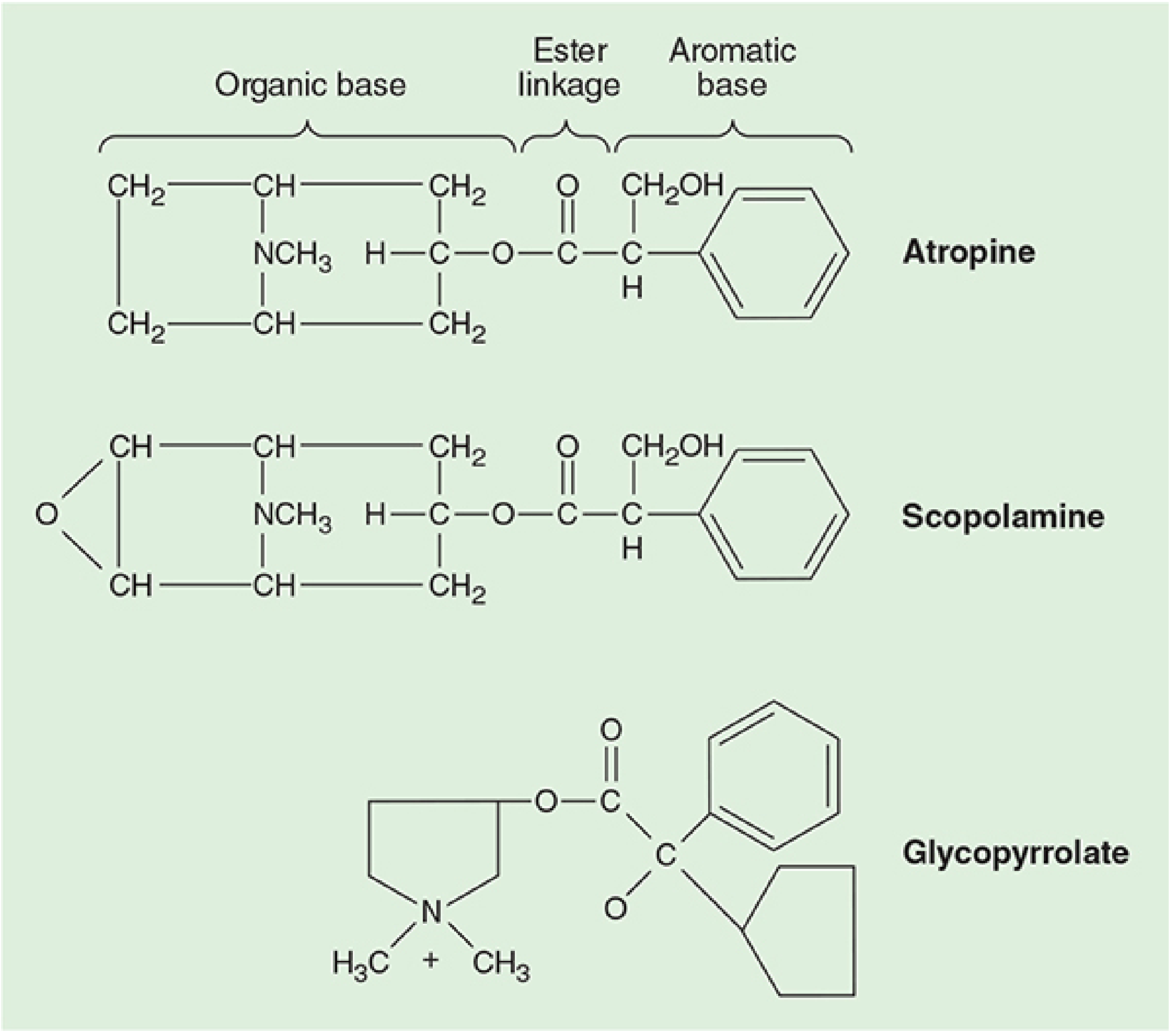
Mechanism of Action
| Subtype | Location |
|---|---|
| M1 | CNS, autonomic ganglia, gastric parietal cells |
| M2 | Cardiac tissue |
| M3 | Smooth muscle, glands |
Dosage & Packaging
| Indication | Dose |
|---|---|
| Premedication (IM/IV) | 0.01–0.02 mg/kg (adult: 0.4–0.6 mg) |
| Antisialogogue (IM) | 0.01–0.02 mg/kg |
| Severe bradycardia (IV) | Up to 2 mg |
| Pediatric (vagal/bradycardia) | 20 mcg/kg |
Comparative Pharmacology (Table 13–1)
| Effect | Atropine | Scopolamine | Glycopyrrolate |
|---|---|---|---|
| Tachycardia | +++ | + | ++ |
| Bronchodilatation | ++ | + | ++ |
| Sedation | + | +++ | 0 |
| Antisialagogue | ++ | +++ | +++ |
| Crosses BBB | Yes (tertiary) | Yes (tertiary) | No (quaternary) |
Clinical Pharmacology: Organ System Effects
A. Cardiovascular
- Blockade of M2 receptors at the sinoatrial node → tachycardia
- Most efficacious anticholinergic for treating bradyarrhythmia
- Promotes conduction through the AV node → shortens P-R interval; antagonizes vagal heart block
- ⚠️ Paradoxical bradycardia can occur with small IV doses (<0.4 mg) — mechanism unclear
- Atropine flush: cutaneous vasodilation with large doses
- Caution in coronary artery disease — tachycardia increases myocardial O₂ demand and decreases supply
B. Respiratory
- Inhibits secretions from nose to bronchi → useful during airway procedures
- Relaxes bronchial smooth muscle → reduces airway resistance, increases dead space
- Particularly useful in COPD and asthma patients
- Ipratropium bromide (quaternary derivative) — available as MDI/nebulizer for bronchospasm
C. CNS
- Minimal CNS effects at usual doses despite crossing the BBB
- May cause mild postoperative memory deficits
- Toxic doses: excitatory reactions (agitation, hallucinations, delirium)
- Central anticholinergic syndrome: unconsciousness to hallucinations
D. Gastrointestinal
- Markedly reduces salivation (antisialogogue effect)
- Decreases gastric secretions (larger doses)
- Decreases intestinal motility → prolongs gastric emptying time
- Reduces lower esophageal sphincter pressure
- ⚠️ Does NOT prevent aspiration pneumonia
E. Ophthalmic
- Mydriasis (pupil dilation) and cycloplegia (loss of accommodation)
- ⚠️ Contraindicated/used cautiously in narrow-angle (closed-angle) glaucoma
F. Genitourinary
- May cause urinary retention
- ⚠️ Use cautiously in prostatic hypertrophy or bladder-neck obstruction
Indications in Anaesthesia
- Premedication — antisialogogue before airway procedures or awake intubation
- Bradycardia — most potent anticholinergic for vagal-induced bradycardia (oculocardiac reflex, peritoneal traction, baroreceptor reflex)
- Prevention of succinylcholine-induced bradycardia (especially in children — 20 mcg/kg)
- Strabismus surgery — prevents oculocardiac reflex
- Organophosphate / nerve gas poisoning — reverses muscarinic effects (bronchorrhea, bradycardia); does NOT reverse nicotinic (muscle weakness) effects. Pralidoxime (1–2 g IV) to reactivate AChE.
- Reversal of neuromuscular blockade — given with neostigmine to blunt muscarinic side effects
Overdose / Toxicity
- Dry mouth, tachycardia, atropine flush (red skin), atropine fever, dilated pupils, hallucinations/delirium
- Potentiated by: tricyclic antidepressants, antihistamines, antipsychotics
Renal Considerations
Make a ppt
Make a ppt
ls /home/daytona/workspace/ 2>/dev/null && mkdir -p /home/daytona/workspace/atropine-ppt
~/atropine-ppt/create_ppt.js
const pptxgen = require("pptxgenjs");
const { execSync } = require("child_process");

// ── Fetch the atropine structure image ──────────────────────────────────────
const imageUrl = "https://cdn.orris.care/cdss_images/6a8c6e4109a278ae41994c5e29922db67dcb64162d49c677199d49d4577574fe.png";
let structureImg = null;
try {
  const result = JSON.parse(
    execSync(
      `node /home/daytona/skills/shared/scripts/fetch_images.js "${imageUrl}"`
    ).toString()
  );
  if (result[0] && !result[0].error) {
    structureImg = result[0].base64;
  }
} catch (e) {
  console.log("Image fetch failed:", e.message);
}

// ── Palette ─────────────────────────────────────────────────────────────────
const C = {
  navy:    "0B1F4B",   // dominant dark background
  teal:    "0E7C7B",   // accent / section headers
  gold:    "F4A012",   // highlight / labels
  white:   "FFFFFF",
  light:   "E8F4F8",   // card background
  gray:    "B0C4CE",
  darkGray:"334155",
  red:     "E63946",
};

// ── Presentation ─────────────────────────────────────────────────────────────
const pres = new pptxgen();
pres.layout = "LAYOUT_16x9";
pres.title = "Injection Atropine – MD Anaesthesia";
pres.author = "MD Anaesthesia";

// ────────────────────────────────────────────────────────────────────────────
// HELPERS
// ────────────────────────────────────────────────────────────────────────────
function addBg(slide) {
  slide.addShape(pres.shapes.RECTANGLE, { x: 0, y: 0, w: 10, h: 5.625, fill: { color: C.navy }, line: { color: C.navy } });
}

function sectionHeader(slide, text) {
  // Top accent bar
  slide.addShape(pres.shapes.RECTANGLE, { x: 0, y: 0, w: 10, h: 0.55, fill: { color: C.teal }, line: { color: C.teal } });
  slide.addText(text.toUpperCase(), {
    x: 0.4, y: 0, w: 9.2, h: 0.55,
    fontSize: 15, bold: true, color: C.white, valign: "middle", charSpacing: 3, margin: 0
  });
}

function card(slide, x, y, w, h, opts = {}) {
  slide.addShape(pres.shapes.RECTANGLE, {
    x, y, w, h,
    fill: { color: opts.fill || "0D2B55" },
    line: { color: opts.border || C.teal, pt: 1.5 },
    shadow: { type: "outer", color: "000000", blur: 8, offset: 2, angle: 135, opacity: 0.25 }
  });
}

function cardTitle(slide, text, x, y, w) {
  slide.addShape(pres.shapes.RECTANGLE, { x, y, w, h: 0.33, fill: { color: C.teal }, line: { color: C.teal } });
  slide.addText(text, { x: x + 0.1, y, w: w - 0.1, h: 0.33, fontSize: 10, bold: true, color: C.white, valign: "middle", margin: 0 });
}

function dot(color) { return { text: "● ", options: { color, bold: true } }; }

// ────────────────────────────────────────────────────────────────────────────
// SLIDE 1 — TITLE
// ────────────────────────────────────────────────────────────────────────────
{
  const s = pres.addSlide();
  addBg(s);

  // Left decorative bar
  s.addShape(pres.shapes.RECTANGLE, { x: 0, y: 0, w: 0.2, h: 5.625, fill: { color: C.gold }, line: { color: C.gold } });
  // Teal accent band
  s.addShape(pres.shapes.RECTANGLE, { x: 0.2, y: 1.8, w: 9.8, h: 2.1, fill: { color: "0D2B55" }, line: { color: "0D2B55" } });

  s.addText("INJECTION ATROPINE", {
    x: 0.5, y: 1.85, w: 9.2, h: 0.9,
    fontSize: 36, bold: true, color: C.gold, align: "center", valign: "middle", charSpacing: 4
  });
  s.addText("Anticholinergic Drug in Anaesthesia Practice", {
    x: 0.5, y: 2.7, w: 9.2, h: 0.55,
    fontSize: 16, color: C.light, align: "center", italic: true
  });

  // Bottom info strip
  s.addShape(pres.shapes.RECTANGLE, { x: 0, y: 5.0, w: 10, h: 0.625, fill: { color: C.teal }, line: { color: C.teal } });
  s.addText("MD Anaesthesia  |  Morgan & Mikhail's Clinical Anesthesiology, 7e", {
    x: 0.3, y: 5.0, w: 9.4, h: 0.625,
    fontSize: 10, color: C.white, align: "center", valign: "middle"
  });

  // Decorative circles
  s.addShape(pres.shapes.OVAL, { x: 7.5, y: 0.2, w: 2.2, h: 2.2, fill: { color: "0E3A6E" }, line: { color: "0E3A6E" } });
  s.addShape(pres.shapes.OVAL, { x: 0.3, y: 3.5, w: 1.4, h: 1.4, fill: { color: "0E3A6E" }, line: { color: "0E3A6E" } });
}

// ────────────────────────────────────────────────────────────────────────────
// SLIDE 2 — OVERVIEW / KEY CONCEPTS
// ────────────────────────────────────────────────────────────────────────────
{
  const s = pres.addSlide();
  addBg(s);
  sectionHeader(s, "Overview & Key Concepts");

  const items = [
    ["Drug Class",      "Anticholinergic (Antimuscarinic)"],
    ["Structure",       "Tertiary amine — crosses blood-brain barrier"],
    ["Isomer",          "Racemic mixture; levorotatory form is active"],
    ["MOA",             "Competitive antagonist at muscarinic ACh receptors"],
    ["Receptor Subtypes","M1 (CNS/ganglia), M2 (cardiac), M3 (smooth muscle)"],
    ["Key Property",    "Most efficacious anticholinergic for treating bradyarrhythmia"],
  ];

  items.forEach(([label, val], i) => {
    const row = i % 3;
    const col = Math.floor(i / 3);
    const x = 0.3 + col * 4.9;
    const y = 0.8 + row * 1.5;
    card(s, x, y, 4.5, 1.3);
    s.addText(label.toUpperCase(), { x: x + 0.15, y: y + 0.1, w: 4.2, h: 0.35, fontSize: 9, color: C.gold, bold: true, margin: 0 });
    s.addText(val, { x: x + 0.15, y: y + 0.42, w: 4.2, h: 0.75, fontSize: 11, color: C.white, margin: 0, wrap: true });
  });
}

// ────────────────────────────────────────────────────────────────────────────
// SLIDE 3 — CHEMICAL STRUCTURE IMAGE
// ────────────────────────────────────────────────────────────────────────────
{
  const s = pres.addSlide();
  addBg(s);
  sectionHeader(s, "Physical Structure");

  // Left text column
  card(s, 0.25, 0.7, 3.5, 4.7);
  cardTitle(s, "Structure Notes", 0.25, 0.7, 3.5);
  s.addText([
    { text: "Atropine\n", options: { bold: true, color: C.gold, fontSize: 12 } },
    { text: "• Tertiary amine\n• Ester of aromatic acid + organic base\n• Ester linkage = essential for binding\n• Lipid soluble → crosses BBB\n\n", options: { color: C.white, fontSize: 10 } },
    { text: "Scopolamine\n", options: { bold: true, color: C.gray, fontSize: 12 } },
    { text: "• Differs by epoxide on ring\n• More potent antisialogogue\n• Greater CNS effects\n\n", options: { color: C.white, fontSize: 10 } },
    { text: "Glycopyrrolate\n", options: { bold: true, color: C.gray, fontSize: 12 } },
    { text: "• Quaternary ammonium\n• Cannot cross BBB\n• No CNS/ophthalmic effects", options: { color: C.white, fontSize: 10 } },
  ], { x: 0.4, y: 1.1, w: 3.2, h: 4.1, valign: "top", margin: 0 });

  // Right image
  if (structureImg) {
    s.addImage({ data: structureImg, x: 4.0, y: 0.7, w: 5.7, h: 4.6 });
    s.addText("FIGURE 13–1  Physical structures of anticholinergic drugs", {
      x: 4.0, y: 5.25, w: 5.7, h: 0.3,
      fontSize: 8, color: C.gray, italic: true, align: "center"
    });
  } else {
    card(s, 4.0, 0.7, 5.7, 4.6, { fill: "0D2B55" });
    s.addText("Chemical Structure Diagram\n(Figure 13–1, Morgan & Mikhail)", {
      x: 4.0, y: 2.5, w: 5.7, h: 1.0, fontSize: 14, color: C.gray, align: "center"
    });
  }
}

// ────────────────────────────────────────────────────────────────────────────
// SLIDE 4 — DOSAGE
// ────────────────────────────────────────────────────────────────────────────
{
  const s = pres.addSlide();
  addBg(s);
  sectionHeader(s, "Dosage & Administration");

  const doses = [
    { label: "Premedication", dose: "0.01–0.02 mg/kg", route: "IV / IM", note: "Adult: 0.4–0.6 mg" },
    { label: "Severe Bradycardia", dose: "Up to 2 mg", route: "IV", note: "Complete vagal blockade" },
    { label: "Antisialogogue", dose: "0.01–0.02 mg/kg", route: "IM", note: "Reliable effect" },
    { label: "Pediatric (Vagal)", dose: "20 mcg/kg", route: "IV", note: "Strabismus / sux bradycardia" },
    { label: "OP Poisoning", dose: "2–4 mg (repeat PRN)", route: "IV", note: "Until secretions dry" },
  ];

  doses.forEach((d, i) => {
    const col = i % 2;
    const row = Math.floor(i / 2);
    const extra = i === 4 ? 0 : 0; // last card centered
    const x = i === 4 ? 2.6 : 0.3 + col * 4.85;
    const y = 0.75 + row * 1.65;
    const w = 4.5;
    card(s, x, y, w, 1.5);
    s.addShape(pres.shapes.RECTANGLE, { x, y, w: 0.12, h: 1.5, fill: { color: C.gold }, line: { color: C.gold } });
    s.addText(d.label.toUpperCase(), { x: x + 0.2, y: y + 0.1, w: w - 0.3, h: 0.3, fontSize: 9, color: C.gold, bold: true, margin: 0 });
    s.addText(d.dose, { x: x + 0.2, y: y + 0.38, w: w - 0.3, h: 0.45, fontSize: 18, color: C.white, bold: true, margin: 0 });
    s.addText(`Route: ${d.route}  |  ${d.note}`, { x: x + 0.2, y: y + 0.85, w: w - 0.3, h: 0.5, fontSize: 9.5, color: C.gray, margin: 0 });
  });
}

// ────────────────────────────────────────────────────────────────────────────
// SLIDE 5 — COMPARISON TABLE
// ────────────────────────────────────────────────────────────────────────────
{
  const s = pres.addSlide();
  addBg(s);
  sectionHeader(s, "Comparative Pharmacology — Table 13-1");

  const tableData = [
    [
      { text: "EFFECT", options: { bold: true, color: C.gold, align: "center" } },
      { text: "ATROPINE", options: { bold: true, color: C.gold, align: "center" } },
      { text: "SCOPOLAMINE", options: { bold: true, color: C.gray, align: "center" } },
      { text: "GLYCOPYRROLATE", options: { bold: true, color: C.gray, align: "center" } },
    ],
    [
      { text: "Tachycardia", options: { color: C.white, align: "left" } },
      { text: "+++", options: { color: C.gold, bold: true, align: "center" } },
      { text: "+", options: { color: C.gray, align: "center" } },
      { text: "++", options: { color: C.light, align: "center" } },
    ],
    [
      { text: "Bronchodilatation", options: { color: C.white, align: "left" } },
      { text: "++", options: { color: C.gold, bold: true, align: "center" } },
      { text: "+", options: { color: C.gray, align: "center" } },
      { text: "++", options: { color: C.light, align: "center" } },
    ],
    [
      { text: "Sedation", options: { color: C.white, align: "left" } },
      { text: "+", options: { color: C.gray, align: "center" } },
      { text: "+++", options: { color: C.gold, bold: true, align: "center" } },
      { text: "0", options: { color: C.gray, align: "center" } },
    ],
    [
      { text: "Antisialagogue", options: { color: C.white, align: "left" } },
      { text: "++", options: { color: C.gold, bold: true, align: "center" } },
      { text: "+++", options: { color: C.gold, bold: true, align: "center" } },
      { text: "+++", options: { color: C.gold, bold: true, align: "center" } },
    ],
    [
      { text: "Crosses BBB", options: { color: C.white, align: "left" } },
      { text: "YES", options: { color: C.red, bold: true, align: "center" } },
      { text: "YES", options: { color: C.red, bold: true, align: "center" } },
      { text: "NO", options: { color: "3DDC84", bold: true, align: "center" } },
    ],
  ];

  s.addTable(tableData, {
    x: 0.5, y: 0.75, w: 9.0,
    rowH: 0.72,
    fontSize: 13,
    fontFace: "Calibri",
    border: { type: "solid", color: C.teal, pt: 1 },
    fill: { color: "0D2B55" },
    colW: [3.0, 2.0, 2.0, 2.0],
  });

  s.addText("0 = no effect  |  + = minimal  |  ++ = moderate  |  +++ = marked", {
    x: 0.5, y: 5.2, w: 9.0, h: 0.3,
    fontSize: 9, color: C.gray, align: "center", italic: true
  });
}

// ────────────────────────────────────────────────────────────────────────────
// SLIDE 6 — CARDIOVASCULAR & RESPIRATORY EFFECTS
// ────────────────────────────────────────────────────────────────────────────
{
  const s = pres.addSlide();
  addBg(s);
  sectionHeader(s, "Organ System Effects — CVS & Respiratory");

  // CVS card
  card(s, 0.25, 0.7, 4.55, 4.7);
  cardTitle(s, "A. Cardiovascular", 0.25, 0.7, 4.55);
  s.addText([
    { text: "• ", options: { color: C.gold } },
    { text: "Blocks M2 at SA node → ", options: { color: C.white } },
    { text: "Tachycardia +++\n", options: { color: C.gold, bold: true } },
    { text: "• Best drug for ", options: { color: C.white } },
    { text: "vagal bradyarrhythmia\n", options: { color: C.gold, bold: true } },
    { text: "• Promotes AV conduction → shortens P-R interval\n", options: { color: C.white } },
    { text: "• ", options: { color: C.red } },
    { text: "Paradoxical bradycardia", options: { color: C.red, bold: true } },
    { text: " with small IV doses (<0.4 mg)\n", options: { color: C.white } },
    { text: "• Atropine ", options: { color: C.white } },
    { text: "flush", options: { color: C.gold } },
    { text: ": cutaneous vasodilation at high doses\n", options: { color: C.white } },
    { text: "• ", options: { color: C.red } },
    { text: "Caution in CAD", options: { color: C.red, bold: true } },
    { text: " — ↑ MVO₂, ↓ supply\n", options: { color: C.white } },
    { text: "• Atrial arrhythmias, nodal rhythms possible\n", options: { color: C.white } },
    { text: "• Enhances sympathetic activity via presynaptic M receptor block", options: { color: C.white } },
  ], { x: 0.4, y: 1.08, w: 4.25, h: 4.1, fontSize: 10, valign: "top", margin: 0 });

  // Respiratory card
  card(s, 5.1, 0.7, 4.55, 4.7);
  cardTitle(s, "B. Respiratory", 5.1, 0.7, 4.55);
  s.addText([
    { text: "• Inhibits secretions ", options: { color: C.white } },
    { text: "nose → bronchi\n", options: { color: C.gold, bold: true } },
    { text: "  (valuable for airway procedures)\n", options: { color: C.gray } },
    { text: "• Relaxes bronchial smooth muscle →\n  ", options: { color: C.white } },
    { text: "↓ Airway resistance\n", options: { color: C.gold, bold: true } },
    { text: "  ↑ Anatomical dead space\n", options: { color: C.white } },
    { text: "• Useful in ", options: { color: C.white } },
    { text: "COPD & asthma\n\n", options: { color: C.gold, bold: true } },
    { text: "Ipratropium Bromide:\n", options: { color: C.gold, bold: true, fontSize: 11 } },
    { text: "• Quaternary derivative of atropine\n", options: { color: C.white } },
    { text: "• MDI for bronchospasm\n", options: { color: C.white } },
    { text: "• Limited systemic absorption\n", options: { color: C.white } },
    { text: "• 0.5 mg in 2.5 mL nebuliser\n", options: { color: C.white } },
    { text: "• Combined with β-agonist (albuterol) for acute COPD", options: { color: C.white } },
  ], { x: 5.25, y: 1.08, w: 4.25, h: 4.1, fontSize: 10, valign: "top", margin: 0 });
}

// ────────────────────────────────────────────────────────────────────────────
// SLIDE 7 — CNS, GI, OPHTHALMIC, GU EFFECTS
// ────────────────────────────────────────────────────────────────────────────
{
  const s = pres.addSlide();
  addBg(s);
  sectionHeader(s, "Organ System Effects — CNS, GI, Ophthalmic, GU");

  const panels = [
    {
      title: "C. CNS",
      x: 0.25, y: 0.7, w: 4.55, h: 2.2,
      items: [
        ["Tertiary amine → crosses BBB", C.white],
        ["Minimal CNS effects at clinical doses", C.white],
        ["High doses → excitation, hallucinations", C.red],
        ["Post-op memory deficits possible", C.white],
        ["Central Anticholinergic Syndrome (toxic)", C.red],
      ]
    },
    {
      title: "D. Gastrointestinal",
      x: 5.1, y: 0.7, w: 4.55, h: 2.2,
      items: [
        ["↓↓ Salivation (antisialogogue)", C.gold],
        ["↓ Gastric secretions (large doses)", C.white],
        ["↓ GI motility → prolonged gastric emptying", C.white],
        ["↓ Lower oesophageal sphincter pressure", C.white],
        ["Does NOT prevent aspiration pneumonia ⚠️", C.red],
      ]
    },
    {
      title: "E. Ophthalmic",
      x: 0.25, y: 3.1, w: 4.55, h: 2.2,
      items: [
        ["Mydriasis (pupillary dilation)", C.white],
        ["Cycloplegia (loss of accommodation)", C.white],
        ["⚠️ AVOID in narrow-angle glaucoma", C.red],
        ["Risk of acute angle-closure glaucoma", C.red],
      ]
    },
    {
      title: "F. Genitourinary",
      x: 5.1, y: 3.1, w: 4.55, h: 2.2,
      items: [
        ["May cause urinary retention", C.white],
        ["⚠️ Caution: BPH / bladder-neck obstruction", C.red],
        ["Renal impairment: accumulation risk (50% renal excretion)", C.white],
      ]
    }
  ];

  panels.forEach(p => {
    card(s, p.x, p.y, p.w, p.h);
    cardTitle(s, p.title, p.x, p.y, p.w);
    const bullets = p.items.map((item, idx) => ([
      { text: "• ", options: { color: C.teal, bold: true } },
      { text: item[0] + (idx < p.items.length - 1 ? "\n" : ""), options: { color: item[1], fontSize: 9.5 } }
    ])).flat();
    s.addText(bullets, { x: p.x + 0.15, y: p.y + 0.38, w: p.w - 0.25, h: p.h - 0.45, valign: "top", margin: 0, fontSize: 9.5 });
  });
}

// ────────────────────────────────────────────────────────────────────────────
// SLIDE 8 — CLINICAL USES IN ANAESTHESIA
// ────────────────────────────────────────────────────────────────────────────
{
  const s = pres.addSlide();
  addBg(s);
  sectionHeader(s, "Clinical Uses in Anaesthesia");

  const uses = [
    { num: "01", title: "Premedication", body: "Antisialogogue before airway procedures, FOB, awake intubation (0.01–0.02 mg/kg IM)" },
    { num: "02", title: "Bradycardia", body: "Vagally-mediated: oculocardiac reflex, peritoneal traction, baroreceptor reflex (up to 2 mg IV)" },
    { num: "03", title: "Succinylcholine Bradycardia", body: "Prevents bradycardia in children; dose 20 mcg/kg IV before succinylcholine" },
    { num: "04", title: "Strabismus Surgery", body: "Prevents oculocardiac reflex during traction on extraocular muscles (20 mcg/kg)" },
    { num: "05", title: "NMB Reversal", body: "Co-administered with neostigmine to blunt muscarinic side effects (bradycardia, secretions)" },
    { num: "06", title: "OP / Nerve Gas Poisoning", body: "Reverses muscarinic effects (bronchorrhea, bradycardia). Does NOT reverse nicotinic effects. Repeat IV doses until dry" },
  ];

  uses.forEach((u, i) => {
    const col = i % 3;
    const row = Math.floor(i / 3);
    const x = 0.25 + col * 3.25;
    const y = 0.75 + row * 2.3;
    card(s, x, y, 3.1, 2.1);
    // Number badge
    s.addShape(pres.shapes.OVAL, { x: x + 0.1, y: y + 0.1, w: 0.5, h: 0.5, fill: { color: C.teal }, line: { color: C.teal } });
    s.addText(u.num, { x: x + 0.1, y: y + 0.1, w: 0.5, h: 0.5, fontSize: 9, bold: true, color: C.white, align: "center", valign: "middle", margin: 0 });
    s.addText(u.title, { x: x + 0.7, y: y + 0.12, w: 2.3, h: 0.4, fontSize: 11, bold: true, color: C.gold, margin: 0 });
    s.addText(u.body, { x: x + 0.15, y: y + 0.6, w: 2.85, h: 1.35, fontSize: 9.5, color: C.white, margin: 0, wrap: true, valign: "top" });
  });
}

// ────────────────────────────────────────────────────────────────────────────
// SLIDE 9 — CONTRAINDICATIONS & OVERDOSE
// ────────────────────────────────────────────────────────────────────────────
{
  const s = pres.addSlide();
  addBg(s);
  sectionHeader(s, "Contraindications, Overdose & Antidote");

  // Contraindications
  card(s, 0.25, 0.7, 4.55, 2.6);
  cardTitle(s, "⚠️  Contraindications / Cautions", 0.25, 0.7, 4.55);
  s.addText([
    { text: "• Narrow-angle (closed-angle) glaucoma\n", options: { color: C.red } },
    { text: "• Prostatic hypertrophy\n", options: { color: C.red } },
    { text: "• Bladder-neck obstruction\n", options: { color: C.red } },
    { text: "• Coronary artery disease (tachycardia → ↑MVO₂)\n", options: { color: C.red } },
    { text: "• Renal impairment: risk of accumulation", options: { color: C.gold } },
  ], { x: 0.4, y: 1.1, w: 4.25, h: 2.1, fontSize: 10.5, valign: "top", margin: 0 });

  // Overdose mnemonic
  card(s, 5.1, 0.7, 4.55, 2.6);
  cardTitle(s, "Anticholinergic Toxidrome Mnemonic", 5.1, 0.7, 4.55);
  s.addText([
    { text: "\"Dry as a bone\" ", options: { color: C.gold, bold: true } },
    { text: "→ dry mouth, skin\n", options: { color: C.white } },
    { text: "\"Blind as a bat\" ", options: { color: C.gold, bold: true } },
    { text: "→ mydriasis, cycloplegia\n", options: { color: C.white } },
    { text: "\"Red as a beet\" ", options: { color: C.gold, bold: true } },
    { text: "→ atropine flush\n", options: { color: C.white } },
    { text: "\"Hot as a hare\" ", options: { color: C.gold, bold: true } },
    { text: "→ hyperthermia\n", options: { color: C.white } },
    { text: "\"Mad as a hatter\" ", options: { color: C.gold, bold: true } },
    { text: "→ confusion, hallucinations", options: { color: C.white } },
  ], { x: 5.25, y: 1.1, w: 4.25, h: 2.1, fontSize: 10, valign: "top", margin: 0 });

  // Antidote
  card(s, 0.25, 3.45, 9.4, 1.85);
  cardTitle(s, "Antidote — Physostigmine", 0.25, 3.45, 9.4);
  s.addText([
    { text: "PHYSOSTIGMINE ", options: { color: C.gold, bold: true, fontSize: 13 } },
    { text: "(Tertiary amine cholinesterase inhibitor — crosses BBB)\n", options: { color: C.white, fontSize: 11 } },
    { text: "• Dose: 0.01–0.03 mg/kg IV  |  Redose after 15–30 min if needed\n", options: { color: C.light, fontSize: 10.5 } },
    { text: "• Only agent that reverses CENTRAL anticholinergic toxicity\n", options: { color: C.light, fontSize: 10.5 } },
    { text: "• Neostigmine/Pyridostigmine = quaternary → do NOT cross BBB → only peripheral effects", options: { color: C.gray, fontSize: 10 } },
  ], { x: 0.4, y: 3.85, w: 9.1, h: 1.35, valign: "top", margin: 0 });
}

// ────────────────────────────────────────────────────────────────────────────
// SLIDE 10 — SUMMARY
// ────────────────────────────────────────────────────────────────────────────
{
  const s = pres.addSlide();
  addBg(s);
  sectionHeader(s, "Summary");

  const keyPoints = [
    "Tertiary amine — lipid soluble, crosses BBB; commercial form is racemic mixture",
    "Competitive M-receptor antagonist; M2 blockade → tachycardia (most potent anticholinergic for bradycardia)",
    "Paradoxical bradycardia with small IV doses < 0.4 mg",
    "Antisialogogue (++), bronchodilator (++), minimal sedation (+)",
    "Premedication: 0.01–0.02 mg/kg IM/IV | Bradycardia: up to 2 mg IV | Paeds: 20 mcg/kg",
    "Caution: CAD, narrow-angle glaucoma, BPH, renal impairment",
    "Organophosphate poisoning antidote — reverses muscarinic (NOT nicotinic) effects",
    "Toxidrome antidote: Physostigmine 0.01–0.03 mg/kg IV (crosses BBB)",
  ];

  keyPoints.forEach((pt, i) => {
    const y = 0.72 + i * 0.59;
    s.addShape(pres.shapes.RECTANGLE, { x: 0.25, y, w: 0.07, h: 0.42, fill: { color: C.gold }, line: { color: C.gold } });
    s.addText(pt, {
      x: 0.42, y, w: 9.35, h: 0.45,
      fontSize: 10.5, color: C.white, valign: "middle", margin: 0
    });
  });

  // Bottom strip
  s.addShape(pres.shapes.RECTANGLE, { x: 0, y: 5.1, w: 10, h: 0.525, fill: { color: C.teal }, line: { color: C.teal } });
  s.addText("Morgan & Mikhail's Clinical Anesthesiology, 7e  —  Chapter 13: Anticholinergic Drugs", {
    x: 0.3, y: 5.1, w: 9.4, h: 0.525,
    fontSize: 9.5, color: C.white, align: "center", valign: "middle"
  });
}

// ── Write file ───────────────────────────────────────────────────────────────
const outPath = "/home/daytona/workspace/atropine-ppt/Atropine_Anaesthesia.pptx";
pres.writeFile({ fileName: outPath })
  .then(() => console.log("SUCCESS:", outPath))
  .catch(e => { console.error("FAILED:", e); process.exit(1); });
cd /home/daytona/workspace/atropine-ppt && node create_ppt.js 2>&1
Atropine Anaesthesia
Presentation · PPTX
| # | Slide |
|---|---|
| 1 | Title Slide |
| 2 | Overview & Key Concepts |
| 3 | Physical Structure (with Figure 13-1 chemical diagram) |
| 4 | Dosage & Administration (all clinical doses) |
| 5 | Comparison Table — Atropine vs Scopolamine vs Glycopyrrolate |
| 6 | CVS & Respiratory Effects |
| 7 | CNS, GI, Ophthalmic & GU Effects |
| 8 | Clinical Uses in Anaesthesia (6 key indications) |
| 9 | Contraindications, Toxidrome Mnemonic & Antidote |
| 10 | Summary (8 key takeaways) |
Make a comparison poster: Atropine vs Glycopyrrolate
~/atropine-ppt/create_comparison_poster.js
const pptxgen = require("pptxgenjs");
const { execSync } = require("child_process");

// Fetch structure image
const imageUrl = "https://cdn.orris.care/cdss_images/6a8c6e4109a278ae41994c5e29922db67dcb64162d49c677199d49d4577574fe.png";
let structureImg = null;
try {
  const result = JSON.parse(
    execSync(`node /home/daytona/skills/shared/scripts/fetch_images.js "${imageUrl}"`).toString()
  );
  if (result[0] && !result[0].error) structureImg = result[0].base64;
} catch(e) { console.log("Image fetch:", e.message); }

// ── Palette ───────────────────────────────────────────────────────────────
const C = {
  bg:       "0B1B35",   // dark navy background
  col_a:    "1B4F8A",   // atropine column blue
  col_g:    "0E6B5E",   // glycopyrrolate column teal-green
  header_a: "2176C7",   // atropine header
  header_g: "14967F",   // glycopyrrolate header
  gold:     "F4A832",   // accent / labels
  white:    "FFFFFF",
  lightBlue:"D6E8FF",
  lightGreen:"C7EFE7",
  gray:     "94A3B8",
  divider:  "E2B94A",   // central divider
  rowAlt:   "132844",   // alternating row bg
  red:      "E63946",
  green:    "2ECC71",
};

// ── Presentation (LAYOUT_WIDE = 13.3" x 7.5") ────────────────────────────
const pres = new pptxgen();
pres.layout = "LAYOUT_WIDE";
pres.title = "Atropine vs Glycopyrrolate – Comparison Poster";

const W = 13.3;
const H = 7.5;

const s = pres.addSlide();

// ── Background ────────────────────────────────────────────────────────────
s.addShape(pres.shapes.RECTANGLE, { x:0, y:0, w:W, h:H, fill:{color:C.bg}, line:{color:C.bg} });

// ── Header bar ────────────────────────────────────────────────────────────
s.addShape(pres.shapes.RECTANGLE, { x:0, y:0, w:W, h:0.72, fill:{color:"0A1628"}, line:{color:"0A1628"} });
s.addShape(pres.shapes.RECTANGLE, { x:0, y:0.72, w:W, h:0.06, fill:{color:C.divider}, line:{color:C.divider} });

s.addText("ATROPINE", {
  x:0.3, y:0, w:5.5, h:0.72,
  fontSize:26, bold:true, color:C.lightBlue, valign:"middle", align:"center", charSpacing:5, margin:0
});
s.addText("vs", {
  x:5.8, y:0, w:1.7, h:0.72,
  fontSize:20, bold:true, color:C.gold, valign:"middle", align:"center", charSpacing:2, margin:0
});
s.addText("GLYCOPYRROLATE", {
  x:7.5, y:0, w:5.5, h:0.72,
  fontSize:26, bold:true, color:C.lightGreen, valign:"middle", align:"center", charSpacing:3, margin:0
});

// Subtitle
s.addText("Anticholinergic Drug Comparison  |  MD Anaesthesia  |  Morgan & Mikhail's Clinical Anesthesiology, 7e", {
  x:0, y:0.78, w:W, h:0.3,
  fontSize:8, color:C.gray, align:"center", valign:"middle", italic:true
});

// ── Column backgrounds ────────────────────────────────────────────────────
s.addShape(pres.shapes.RECTANGLE, { x:0.15, y:1.12, w:5.85, h:6.1, fill:{color:"0D2240"}, line:{color:C.header_a, pt:1.5} });
s.addShape(pres.shapes.RECTANGLE, { x:7.3,  y:1.12, w:5.85, h:6.1, fill:{color:"0A2A22"}, line:{color:C.header_g, pt:1.5} });

// ── Centre divider column ─────────────────────────────────────────────────
s.addShape(pres.shapes.RECTANGLE, { x:6.1,  y:1.12, w:1.1,  h:6.1, fill:{color:"0B1B35"}, line:{color:"0B1B35"} });
s.addShape(pres.shapes.RECTANGLE, { x:6.6,  y:1.12, w:0.06, h:6.1, fill:{color:C.divider}, line:{color:C.divider} });

// ── Row data ──────────────────────────────────────────────────────────────
// Each row: { label, a: {text, color?}, g: {text, color?}, highlight? }
const rows = [
  {
    label: "DRUG CLASS",
    a: { text: "Natural alkaloid (belladonna plant)", color: C.lightBlue },
    g: { text: "Synthetic quaternary ammonium compound", color: C.lightGreen },
  },
  {
    label: "CHEMICAL STRUCTURE",
    a: { text: "Tertiary amine\nLipid-soluble", color: C.lightBlue },
    g: { text: "Quaternary ammonium\nWater-soluble (ionic)", color: C.lightGreen },
  },
  {
    label: "CROSSES BBB",
    a: { text: "YES ✓  (tertiary amine)", color: C.red },
    g: { text: "NO ✗  (quaternary — cannot cross)", color: C.green },
    highlight: true,
  },
  {
    label: "PREMEDICATION DOSE",
    a: { text: "0.01–0.02 mg/kg IV/IM\n(Adult: 0.4–0.6 mg)", color: C.lightBlue },
    g: { text: "0.005–0.01 mg/kg IV/IM\n(Adult: 0.2–0.3 mg)\n≈ Half the atropine dose", color: C.lightGreen },
  },
  {
    label: "BRADYCARDIA DOSE",
    a: { text: "Up to 2 mg IV\n(Complete vagal blockade)", color: C.lightBlue },
    g: { text: "0.1–0.2 mg IV\n(Less favoured for acute bradycardia)", color: C.lightGreen },
  },
  {
    label: "DURATION OF ACTION",
    a: { text: "30 min (IV)", color: C.lightBlue },
    g: { text: "2–4 hours (IV)\nLonger acting ✓", color: C.green },
    highlight: true,
  },
  {
    label: "TACHYCARDIA",
    a: { text: "+++  (Very potent)\nBest drug for vagal bradyarrhythmia", color: C.gold },
    g: { text: "++  (Moderate)\nHR increase mainly with IV, not IM", color: C.lightGreen },
  },
  {
    label: "ANTISIALOGOGUE",
    a: { text: "++  (Good)", color: C.lightBlue },
    g: { text: "+++  (Excellent — preferred)", color: C.green },
    highlight: true,
  },
  {
    label: "BRONCHODILATATION",
    a: { text: "++  (Good)", color: C.lightBlue },
    g: { text: "++  (Good)", color: C.lightGreen },
  },
  {
    label: "SEDATION / CNS",
    a: { text: "+  Post-op memory deficits\nToxic: excitation / hallucinations", color: C.red },
    g: { text: "0  None\nNo CNS effects (cannot cross BBB)", color: C.green },
    highlight: true,
  },
  {
    label: "OPHTHALMIC EFFECTS",
    a: { text: "Mydriasis + Cycloplegia\n⚠️ Avoid in narrow-angle glaucoma", color: C.red },
    g: { text: "Minimal / None\n✓ Safer in glaucoma patients", color: C.green },
  },
  {
    label: "GI EFFECTS",
    a: { text: "↓ Salivation, ↓ motility\n↓ LOS pressure\nDoes NOT prevent aspiration", color: C.lightBlue },
    g: { text: "↓↓ Salivation (more potent)\n↓ Gastric secretions\nDoes NOT prevent aspiration", color: C.lightGreen },
  },
  {
    label: "KEY CLINICAL ADVANTAGE",
    a: { text: "Drug of choice for acute vagal bradyarrhythmia\nOrganophosphate poisoning antidote", color: C.gold },
    g: { text: "Preferred for premedication / antisialogogue\nSafer CNS profile — elderly, paediatric", color: C.gold },
    highlight: true,
  },
  {
    label: "REVERSAL (NMB)",
    a: { text: "Given with edrophonium\n(short-acting reversal)", color: C.lightBlue },
    g: { text: "Preferred with neostigmine\n(well-matched duration)", color: C.green },
    highlight: false,
  },
];

const rowStartY = 1.18;
const rowH = 0.415;
const leftColX = 0.2;
const leftColW = 5.75;
const rightColX = 7.35;
const rightColW = 5.75;
const labelX = 6.13;
const labelW = 1.04;

rows.forEach((row, i) => {
  const y = rowStartY + i * rowH;
  const fillA = row.highlight ? "0F2B52" : (i % 2 === 0 ? "0D2240" : "0F2A4A");
  const fillG = row.highlight ? "0A3328" : (i % 2 === 0 ? "0A2A22" : "0C3329");
  const fillL = row.highlight ? "1A1A00" : "0B1B35";

  s.addShape(pres.shapes.RECTANGLE, { x: leftColX,  y, w: leftColW,  h: rowH, fill:{color: fillA}, line:{color:"132B4A"} });
  s.addShape(pres.shapes.RECTANGLE, { x: rightColX, y, w: rightColW, h: rowH, fill:{color: fillG}, line:{color:"0D3328"} });
  s.addShape(pres.shapes.RECTANGLE, { x: labelX,    y, w: labelW,    h: rowH, fill:{color: fillL}, line:{color: fillL} });

  // Atropine text
  s.addText(row.a.text, {
    x: leftColX + 0.15, y: y + 0.02, w: leftColW - 0.25, h: rowH - 0.04,
    fontSize: row.a.text.length > 60 ? 8 : 9, color: row.a.color || C.lightBlue,
    valign: "middle", margin: 0, bold: row.highlight
  });

  // Glycopyrrolate text
  s.addText(row.g.text, {
    x: rightColX + 0.1, y: y + 0.02, w: rightColW - 0.2, h: rowH - 0.04,
    fontSize: row.g.text.length > 60 ? 8 : 9, color: row.g.color || C.lightGreen,
    valign: "middle", margin: 0, bold: row.highlight
  });

  // Label
  s.addText(row.label, {
    x: labelX + 0.03, y: y + 0.02, w: labelW - 0.06, h: rowH - 0.04,
    fontSize: 6.5, color: C.gold, bold: true, align: "center", valign: "middle", margin: 0, wrap: true
  });
});

// ── Structure image strip at bottom ──────────────────────────────────────
s.addShape(pres.shapes.RECTANGLE, { x:0, y:7.15, w:W, h:0.35, fill:{color:"0A1628"}, line:{color:"0A1628"} });
s.addShape(pres.shapes.RECTANGLE, { x:0, y:7.15, w:W, h:0.04, fill:{color:C.divider}, line:{color:C.divider} });

if (structureImg) {
  s.addImage({ data: structureImg, x: 4.65, y: 7.1, w: 3.8, h: 0.36 });
}
s.addText("Source: Morgan & Mikhail's Clinical Anesthesiology, 7e  —  Chapter 13: Anticholinergic Drugs", {
  x: 0.2, y: 7.18, w: W - 0.4, h: 0.28,
  fontSize: 7, color: C.gray, align: "center", valign: "middle", italic: true
});

// ── Column header accents ─────────────────────────────────────────────────
s.addShape(pres.shapes.RECTANGLE, { x:0.15, y:1.12, w:5.85, h:0.28, fill:{color:C.header_a}, line:{color:C.header_a} });
s.addText("ATROPINE SULFATE", {
  x:0.15, y:1.12, w:5.85, h:0.28,
  fontSize:10, bold:true, color:C.white, align:"center", valign:"middle", charSpacing:3, margin:0
});

s.addShape(pres.shapes.RECTANGLE, { x:7.3, y:1.12, w:5.85, h:0.28, fill:{color:C.header_g}, line:{color:C.header_g} });
s.addText("GLYCOPYRROLATE (GLYCOPYRRONIUM)", {
  x:7.3, y:1.12, w:5.85, h:0.28,
  fontSize:10, bold:true, color:C.white, align:"center", valign:"middle", charSpacing:2, margin:0
});

s.addShape(pres.shapes.RECTANGLE, { x:6.1, y:1.12, w:1.1, h:0.28, fill:{color:"1A1200"}, line:{color:C.divider} });
s.addText("PARAMETER", {
  x:6.1, y:1.12, w:1.1, h:0.28,
  fontSize:7, bold:true, color:C.gold, align:"center", valign:"middle", charSpacing:1, margin:0
});

// ── Write file ────────────────────────────────────────────────────────────
const outPath = "/home/daytona/workspace/atropine-ppt/Atropine_vs_Glycopyrrolate_Poster.pptx";
pres.writeFile({ fileName: outPath })
  .then(() => console.log("SUCCESS:", outPath))
  .catch(e => { console.error("FAILED:", e); process.exit(1); });
cd /home/daytona/workspace/atropine-ppt && node create_comparison_poster.js 2>&1
Atropine vs Glycopyrrolate Poster
Presentation · PPTX
| Parameter | Atropine (Blue) | Glycopyrrolate (Green) |
|---|---|---|
| Drug Class | Natural alkaloid | Synthetic quaternary |
| Chemical Structure | Tertiary amine | Quaternary ammonium |
| Crosses BBB | YES ⚠️ | NO ✓ |
| Premedication Dose | 0.01–0.02 mg/kg | 0.005–0.01 mg/kg |
| Duration (IV) | 30 min | 2–4 hours ✓ |
| Tachycardia | +++ | ++ |
| Antisialogogue | ++ | +++ (preferred) |
| Sedation/CNS | + (memory deficits, toxic excitation) | 0 (none) |
| Ophthalmic | Mydriasis + Cycloplegia ⚠️ | Minimal/None ✓ |
| NMB Reversal | With edrophonium | Preferred with neostigmine |
| Key Advantage | Acute vagal bradycardia / OP poisoning | Premedication / safer in elderly & paeds |
Inj.Glycopyrrolate in MD anesthesia..make a ppt
node /home/daytona/skills/shared/scripts/fetch_images.js "https://cdn.orris.care/cdss_images/6a8c6e4109a278ae41994c5e29922db67dcb64162d49c677199d49d4577574fe.png" "https://cdn.orris.care/cdss_images/cfa1cbe1965b8a71fc125dc37911bb6e1eaabfbbf49091d1f385f655e2cd09ea.png" 2>&1 | head -c 200
~/atropine-ppt/create_glycopyrrolate_ppt.js
const pptxgen = require("pptxgenjs");
const { execSync } = require("child_process");

// ── Fetch images ──────────────────────────────────────────────────────────
const imgUrls = [
  "https://cdn.orris.care/cdss_images/6a8c6e4109a278ae41994c5e29922db67dcb64162d49c677199d49d4577574fe.png", // Morgan & Mikhail Fig 13-1
  "https://cdn.orris.care/cdss_images/cfa1cbe1965b8a71fc125dc37911bb6e1eaabfbbf49091d1f385f655e2cd09ea.png", // Barash Fig 14-15
];
let [imgMM, imgBarash] = [null, null];
try {
  const imgs = JSON.parse(
    execSync(`node /home/daytona/skills/shared/scripts/fetch_images.js "${imgUrls[0]}" "${imgUrls[1]}"`).toString()
  );
  if (imgs[0] && !imgs[0].error) imgMM = imgs[0].base64;
  if (imgs[1] && !imgs[1].error) imgBarash = imgs[1].base64;
} catch(e) { console.log("Image fetch:", e.message); }

// ── Palette ──────────────────────────────────────────────────────────────
const C = {
  navy:    "091A35",
  teal:    "0E7E72",
  green:   "14967F",
  gold:    "F4A832",
  white:   "FFFFFF",
  light:   "C7EFE7",
  gray:    "94A3B8",
  dark:    "0A2A22",
  rowAlt:  "0C3329",
  red:     "E63946",
  limeGrn: "2ECC71",
  card:    "0D2B24",
};

const pres = new pptxgen();
pres.layout = "LAYOUT_16x9";
pres.title = "Injection Glycopyrrolate – MD Anaesthesia";
pres.author = "MD Anaesthesia";

// ── Helpers ──────────────────────────────────────────────────────────────
function addBg(slide) {
  slide.addShape(pres.shapes.RECTANGLE, { x:0, y:0, w:10, h:5.625,
    fill:{color:C.navy}, line:{color:C.navy} });
}

function topBar(slide, text) {
  slide.addShape(pres.shapes.RECTANGLE, { x:0, y:0, w:10, h:0.55,
    fill:{color:C.teal}, line:{color:C.teal} });
  slide.addText(text.toUpperCase(), {
    x:0.35, y:0, w:9.3, h:0.55,
    fontSize:15, bold:true, color:C.white, valign:"middle", charSpacing:3, margin:0
  });
}

function card(slide, x, y, w, h, borderColor) {
  slide.addShape(pres.shapes.RECTANGLE, { x, y, w, h,
    fill:{color:C.card},
    line:{color: borderColor || C.teal, pt:1.5},
    shadow:{type:"outer", color:"000000", blur:8, offset:2, angle:135, opacity:0.25}
  });
}

function cardHeader(slide, x, y, w, text) {
  slide.addShape(pres.shapes.RECTANGLE, { x, y, w, h:0.33,
    fill:{color:C.teal}, line:{color:C.teal} });
  slide.addText(text, {
    x:x+0.1, y, w:w-0.1, h:0.33,
    fontSize:10, bold:true, color:C.white, valign:"middle", margin:0
  });
}

function footerBar(slide, text) {
  slide.addShape(pres.shapes.RECTANGLE, { x:0, y:5.25, w:10, h:0.375,
    fill:{color:C.teal}, line:{color:C.teal} });
  slide.addText(text, {
    x:0.3, y:5.25, w:9.4, h:0.375,
    fontSize:8.5, color:C.white, align:"center", valign:"middle"
  });
}

// ════════════════════════════════════════════════════════════════════
// SLIDE 1 — TITLE
// ════════════════════════════════════════════════════════════════════
{
  const s = pres.addSlide();
  addBg(s);

  // Left accent bar
  s.addShape(pres.shapes.RECTANGLE, { x:0, y:0, w:0.18, h:5.625,
    fill:{color:C.gold}, line:{color:C.gold} });
  // Centre band
  s.addShape(pres.shapes.RECTANGLE, { x:0.18, y:1.7, w:9.82, h:2.3,
    fill:{color:C.dark}, line:{color:C.dark} });

  s.addText("INJECTION GLYCOPYRROLATE", {
    x:0.4, y:1.75, w:9.4, h:1.0,
    fontSize:34, bold:true, color:C.gold,
    align:"center", valign:"middle", charSpacing:3
  });
  s.addText("Anticholinergic Drug in Anaesthesia Practice", {
    x:0.4, y:2.7, w:9.4, h:0.55,
    fontSize:16, color:C.light, align:"center", italic:true
  });

  // Bottom strip
  s.addShape(pres.shapes.RECTANGLE, { x:0, y:5.1, w:10, h:0.525,
    fill:{color:C.teal}, line:{color:C.teal} });
  s.addText("MD Anaesthesia  |  Morgan & Mikhail's Clinical Anesthesiology, 7e  |  Barash Clinical Anesthesia, 9e", {
    x:0.3, y:5.1, w:9.4, h:0.525,
    fontSize:9, color:C.white, align:"center", valign:"middle"
  });

  // Decorative ovals
  s.addShape(pres.shapes.OVAL, { x:7.8, y:0.15, w:2.0, h:2.0,
    fill:{color:"0C2A23"}, line:{color:"0C2A23"} });
  s.addShape(pres.shapes.OVAL, { x:0.2, y:3.6, w:1.2, h:1.2,
    fill:{color:"0C2A23"}, line:{color:"0C2A23"} });
}

// ════════════════════════════════════════════════════════════════════
// SLIDE 2 — OVERVIEW & KEY CONCEPTS
// ════════════════════════════════════════════════════════════════════
{
  const s = pres.addSlide();
  addBg(s);
  topBar(s, "Overview & Key Concepts");

  const items = [
    ["Drug Class",       "Anticholinergic (Antimuscarinic)"],
    ["Type",             "Synthetic compound"],
    ["Chemical Structure","Quaternary ammonium (ionic, water-soluble)"],
    ["Crosses BBB?",     "NO — cannot cross blood-brain barrier"],
    ["MOA",              "Competitive antagonist at muscarinic (M) receptors"],
    ["Key Property",     "Potent antisialogogue; almost devoid of CNS & ophthalmic effects"],
  ];

  items.forEach(([label, val], i) => {
    const col = Math.floor(i / 3);
    const row = i % 3;
    const x = 0.28 + col * 4.9;
    const y = 0.72 + row * 1.56;
    card(s, x, y, 4.55, 1.38);
    s.addText(label.toUpperCase(), {
      x:x+0.15, y:y+0.1, w:4.3, h:0.32,
      fontSize:8.5, color:C.gold, bold:true, margin:0
    });
    s.addText(val, {
      x:x+0.15, y:y+0.42, w:4.3, h:0.85,
      fontSize:11, color:C.white, margin:0, wrap:true
    });
  });
  footerBar(s, "Morgan & Mikhail's Clinical Anesthesiology, 7e — Chapter 13: Anticholinergic Drugs");
}

// ════════════════════════════════════════════════════════════════════
// SLIDE 3 — PHYSICAL STRUCTURE
// ════════════════════════════════════════════════════════════════════
{
  const s = pres.addSlide();
  addBg(s);
  topBar(s, "Physical Structure");

  card(s, 0.25, 0.65, 3.7, 4.65);
  cardHeader(s, 0.25, 0.65, 3.7, "Structure Notes");
  s.addText([
    {text:"Glycopyrrolate\n", options:{bold:true, color:C.gold, fontSize:13}},
    {text:"• Synthetic compound\n", options:{color:C.white, fontSize:10}},
    {text:"• Quaternary ammonium structure\n", options:{color:C.white, fontSize:10}},
    {text:"• Has cyclopentane + pyridine moieties\n", options:{color:C.white, fontSize:10}},
    {text:"• Ionic / water-soluble\n", options:{color:C.white, fontSize:10}},
    {text:"• Cannot cross BBB ✓\n", options:{color:C.limeGrn, fontSize:10, bold:true}},
    {text:"• Cannot cross placenta\n\n", options:{color:C.limeGrn, fontSize:10}},
    {text:"Differs from Atropine:\n", options:{bold:true, color:C.gold, fontSize:12}},
    {text:"• Atropine = tertiary amine (crosses BBB)\n", options:{color:C.gray, fontSize:10}},
    {text:"• Glycopyrrolate = quaternary (does NOT)\n", options:{color:C.gray, fontSize:10}},
    {text:"• Avoids CNS side effects entirely\n", options:{color:C.gray, fontSize:10}},
  ], {x:0.4, y:1.05, w:3.45, h:4.1, valign:"top", margin:0});

  // Image
  if (imgMM) {
    s.addImage({data:imgMM, x:4.1, y:0.65, w:5.65, h:4.6});
    s.addText("FIGURE 13–1 Physical structures of anticholinergic drugs (Morgan & Mikhail, 7e, p.431)", {
      x:4.1, y:5.2, w:5.65, h:0.3,
      fontSize:7.5, color:C.gray, italic:true, align:"center"
    });
  } else {
    card(s, 4.1, 0.65, 5.65, 4.6);
    s.addText("Figure 13–1\nChemical Structures", {
      x:4.1, y:2.5, w:5.65, h:1.0,
      fontSize:14, color:C.gray, align:"center"
    });
  }
}

// ════════════════════════════════════════════════════════════════════
// SLIDE 4 — DOSAGE & PACKAGING
// ════════════════════════════════════════════════════════════════════
{
  const s = pres.addSlide();
  addBg(s);
  topBar(s, "Dosage & Administration");

  const doses = [
    { label:"Premedication",        dose:"0.005–0.01 mg/kg", route:"IV / IM",  note:"Adult: 0.2–0.3 mg\n(½ of atropine dose)" },
    { label:"Antisialogogue (Pre-op)",dose:"0.2–0.3 mg",     route:"IM",       note:"1 hour before surgery\nMore effective than IV for this" },
    { label:"With Neostigmine (NMB Reversal)", dose:"0.2 mg per 1 mg neostigmine", route:"IV", note:"Mix or give simultaneously" },
    { label:"Bradycardia (Spinal Anaesthesia)", dose:"0.1–0.2 mg",  route:"IV",  note:"Prophylactic in obstetric spinal" },
    { label:"ECT Premedication",    dose:"0.2–0.3 mg",       route:"IM / IV",  note:"Prevents secretions + attenuates bradycardia" },
    { label:"Packaging",            dose:"0.2 mg / mL",      route:"Solution", note:"Available as 1 mL and 2 mL ampoules" },
  ];

  doses.forEach((d, i) => {
    const col = i % 2;
    const row = Math.floor(i / 2);
    const x = 0.28 + col * 4.9;
    const y = 0.72 + row * 1.6;
    card(s, x, y, 4.55, 1.5);
    s.addShape(pres.shapes.RECTANGLE, {x, y, w:0.12, h:1.5, fill:{color:C.gold}, line:{color:C.gold}});
    s.addText(d.label.toUpperCase(), {x:x+0.2, y:y+0.1, w:4.25, h:0.3, fontSize:8.5, color:C.gold, bold:true, margin:0});
    s.addText(d.dose, {x:x+0.2, y:y+0.38, w:4.25, h:0.45, fontSize:18, color:C.white, bold:true, margin:0});
    s.addText(`Route: ${d.route}  |  ${d.note}`, {x:x+0.2, y:y+0.85, w:4.25, h:0.55, fontSize:9, color:C.gray, margin:0, wrap:true});
  });
}

// ════════════════════════════════════════════════════════════════════
// SLIDE 5 — COMPARATIVE TABLE (Barash Table 14-6)
// ════════════════════════════════════════════════════════════════════
{
  const s = pres.addSlide();
  addBg(s);
  topBar(s, "Comparative Pharmacology (Barash Table 14-6)");

  const tableData = [
    [
      {text:"PARAMETER",       options:{bold:true, color:C.gold,  align:"center"}},
      {text:"ATROPINE",        options:{bold:true, color:"AEDDF8",align:"center"}},
      {text:"SCOPOLAMINE",     options:{bold:true, color:C.gray,  align:"center"}},
      {text:"GLYCOPYRROLATE",  options:{bold:true, color:C.light, align:"center"}},
    ],
    [
      {text:"Duration (IV)",   options:{color:C.white, align:"left"}},
      {text:"15–30 min",       options:{color:"AEDDF8", align:"center"}},
      {text:"30–60 min",       options:{color:C.gray,  align:"center"}},
      {text:"2–4 h  ★",        options:{color:C.limeGrn, bold:true, align:"center"}},
    ],
    [
      {text:"Duration (IM)",   options:{color:C.white, align:"left"}},
      {text:"2–4 h",           options:{color:"AEDDF8", align:"center"}},
      {text:"4–6 h",           options:{color:C.gray,  align:"center"}},
      {text:"6–8 h  ★",        options:{color:C.limeGrn, bold:true, align:"center"}},
    ],
    [
      {text:"CNS Effects",     options:{color:C.white, align:"left"}},
      {text:"++",              options:{color:C.red,   align:"center"}},
      {text:"+++",             options:{color:C.red,   bold:true, align:"center"}},
      {text:"0  ★",            options:{color:C.limeGrn, bold:true, align:"center"}},
    ],
    [
      {text:"Antisialogogue",  options:{color:C.white, align:"left"}},
      {text:"+",               options:{color:"AEDDF8", align:"center"}},
      {text:"+++",             options:{color:C.gold,  bold:true, align:"center"}},
      {text:"++",              options:{color:C.light, align:"center"}},
    ],
    [
      {text:"Heart Rate ↑",    options:{color:C.white, align:"left"}},
      {text:"+++",             options:{color:C.gold,  bold:true, align:"center"}},
      {text:"+",               options:{color:C.gray,  align:"center"}},
      {text:"+",               options:{color:C.light, align:"center"}},
    ],
    [
      {text:"Crosses BBB",     options:{color:C.white, align:"left"}},
      {text:"YES ⚠️",           options:{color:C.red,   bold:true, align:"center"}},
      {text:"YES ⚠️",           options:{color:C.red,   bold:true, align:"center"}},
      {text:"NO  ★",           options:{color:C.limeGrn, bold:true, align:"center"}},
    ],
    [
      {text:"Crosses Placenta",options:{color:C.white, align:"left"}},
      {text:"YES",             options:{color:C.red,   align:"center"}},
      {text:"YES",             options:{color:C.red,   align:"center"}},
      {text:"NO  ★",           options:{color:C.limeGrn, bold:true, align:"center"}},
    ],
  ];

  s.addTable(tableData, {
    x:0.4, y:0.68, w:9.2,
    rowH:0.54,
    fontSize:12, fontFace:"Calibri",
    border:{type:"solid", color:C.teal, pt:1},
    fill:{color:C.card},
    colW:[3.2, 2.0, 2.0, 2.0],
  });

  s.addText("★ = Glycopyrrolate advantage  |  0 = no effect  |  + = minimal  |  ++ = moderate  |  +++ = marked", {
    x:0.4, y:5.15, w:9.2, h:0.35,
    fontSize:8.5, color:C.gray, align:"center", italic:true
  });
}

// ════════════════════════════════════════════════════════════════════
// SLIDE 6 — ORGAN SYSTEM EFFECTS
// ════════════════════════════════════════════════════════════════════
{
  const s = pres.addSlide();
  addBg(s);
  topBar(s, "Organ System Effects");

  const panels = [
    {
      title:"A. Cardiovascular", x:0.25, y:0.65, w:4.55, h:2.25,
      items:[
        ["Heart rate ↑ after IV (not after IM)", C.gold],
        ["Moderate tachycardia (++) — less than atropine", C.white],
        ["Bradycardia with spinal anaesthesia may be refractory to glycopyrrolate", C.red],
        ["Atropine + ephedrine preferred for spinal bradycardia", C.white],
        ["Prophylactic use prevents spinal bradycardia in obstetric patients (recent evidence)", C.limeGrn],
      ]
    },
    {
      title:"B. Respiratory", x:5.1, y:0.65, w:4.55, h:2.25,
      items:[
        ["Potent inhibition of salivary & respiratory secretions", C.gold],
        ["Reduces secretions from nose → bronchi", C.white],
        ["Bronchodilatation (++) — relaxes bronchial smooth muscle", C.white],
        ["Primary rationale for use as premedication", C.limeGrn],
        ["Helpful for airway visualisation (0.2–0.3 mg IM, 1 h pre-op)", C.white],
      ]
    },
    {
      title:"C. CNS / Ophthalmic", x:0.25, y:3.0, w:4.55, h:2.35,
      items:[
        ["Cannot cross blood-brain barrier (quaternary)", C.limeGrn],
        ["Almost DEVOID of CNS effects — NO sedation", C.limeGrn],
        ["No hallucinations, no agitation, no memory effects", C.limeGrn],
        ["No clinically significant ophthalmic effects", C.limeGrn],
        ["Safer in elderly and paediatric patients", C.gold],
      ]
    },
    {
      title:"D. GI / Genitourinary", x:5.1, y:3.0, w:4.55, h:2.35,
      items:[
        ["↓↓ Salivation — most potent antisialogogue (with scopolamine)", C.gold],
        ["↓ Gastric secretions (large doses)", C.white],
        ["↓ GI motility → prolonged gastric emptying", C.white],
        ["↓ Lower oesophageal sphincter pressure", C.white],
        ["Does NOT prevent aspiration pneumonia ⚠️", C.red],
        ["May cause urinary retention — caution in BPH", C.red],
      ]
    }
  ];

  panels.forEach(p => {
    card(s, p.x, p.y, p.w, p.h);
    cardHeader(s, p.x, p.y, p.w, p.title);
    const bullArr = p.items.map((item, idx) => [
      {text:"• ", options:{color:C.teal, bold:true}},
      {text: item[0] + (idx < p.items.length-1 ? "\n" : ""), options:{color:item[1], fontSize:9.5}}
    ]).flat();
    s.addText(bullArr, {x:p.x+0.15, y:p.y+0.38, w:p.w-0.25, h:p.h-0.45, valign:"top", margin:0, fontSize:9.5});
  });
}

// ════════════════════════════════════════════════════════════════════
// SLIDE 7 — CLINICAL USES IN ANAESTHESIA
// ════════════════════════════════════════════════════════════════════
{
  const s = pres.addSlide();
  addBg(s);
  topBar(s, "Clinical Uses in Anaesthesia");

  const uses = [
    {num:"01", title:"Premedication",         body:"Antisialogogue before surgical/airway procedures. 0.2–0.3 mg IM given 1 h before surgery — more effective than IV for secretion control"},
    {num:"02", title:"Airway Procedures",      body:"Preferred over atropine for FOB, awake intubation — minimises secretions without CNS effects. 0.2 mg IM 1 h pre-procedure"},
    {num:"03", title:"NMB Reversal",           body:"Given WITH neostigmine (0.2 mg glycopyrrolate per 1 mg neostigmine). Well-matched duration — prevents muscarinic bradycardia and secretions"},
    {num:"04", title:"ECT Premedication",      body:"Prevents profuse secretions during seizures. Attenuates bradycardia. IM/IV route, 0.2–0.3 mg before procedure"},
    {num:"05", title:"Spinal Anaesthesia (Obstetric)",body:"Prophylactic IV glycopyrrolate prevents bradycardia in parturients undergoing spinal for caesarean section"},
    {num:"06", title:"Elderly / Paediatric",  body:"Preferred over atropine when CNS effects must be avoided. No delirium, no hallucinations, no memory issues — safer in vulnerable populations"},
  ];

  uses.forEach((u, i) => {
    const col = i % 3;
    const row = Math.floor(i / 3);
    const x = 0.25 + col * 3.25;
    const y = 0.72 + row * 2.28;
    card(s, x, y, 3.1, 2.15);
    s.addShape(pres.shapes.OVAL, {x:x+0.1, y:y+0.1, w:0.48, h:0.48,
      fill:{color:C.teal}, line:{color:C.teal}});
    s.addText(u.num, {x:x+0.1, y:y+0.1, w:0.48, h:0.48,
      fontSize:9, bold:true, color:C.white, align:"center", valign:"middle", margin:0});
    s.addText(u.title, {x:x+0.65, y:y+0.12, w:2.35, h:0.38,
      fontSize:10.5, bold:true, color:C.gold, margin:0});
    s.addText(u.body, {x:x+0.15, y:y+0.58, w:2.85, h:1.45,
      fontSize:9.5, color:C.white, margin:0, wrap:true, valign:"top"});
  });
  footerBar(s, "Morgan & Mikhail, 7e p.435–436  |  Barash Clinical Anesthesia, 9e p.1084–1085");
}

// ════════════════════════════════════════════════════════════════════
// SLIDE 8 — ADVANTAGES & SPECIAL SITUATIONS
// ════════════════════════════════════════════════════════════════════
{
  const s = pres.addSlide();
  addBg(s);
  topBar(s, "Advantages, Special Situations & Cautions");

  // Advantages card
  card(s, 0.25, 0.65, 4.55, 4.65);
  cardHeader(s, 0.25, 0.65, 4.55, "✓  Key Advantages over Atropine");
  s.addText([
    {text:"• Longer duration: ", options:{color:C.gold, bold:true}},
    {text:"2–4 h IV / 6–8 h IM\n", options:{color:C.white}},
    {text:"• No CNS effects ", options:{color:C.limeGrn, bold:true}},
    {text:"(cannot cross BBB)\n", options:{color:C.white}},
    {text:"• No ophthalmic effects\n", options:{color:C.limeGrn}},
    {text:"• No placental transfer ", options:{color:C.limeGrn, bold:true}},
    {text:"— safer in obstetrics\n", options:{color:C.white}},
    {text:"• Superior antisialogogue\n", options:{color:C.gold, bold:true}},
    {text:"• Preferred for premedication in:", options:{color:C.white}},
    {text:"\n  – Elderly patients\n  – Paediatric patients\n  – Glaucoma patients\n  – Psychiatric patients\n  – Awake airway procedures", options:{color:C.light}},
  ], {x:0.4, y:1.05, w:4.25, h:4.1, valign:"top", margin:0, fontSize:10.5});

  // Cautions + Renal card
  card(s, 5.1, 0.65, 4.55, 2.2);
  cardHeader(s, 5.1, 0.65, 4.55, "⚠️  Cautions & Contraindications");
  s.addText([
    {text:"• BPH / bladder-neck obstruction → urinary retention\n", options:{color:C.red}},
    {text:"• Narrow-angle glaucoma (systemic — rare risk)\n", options:{color:C.red}},
    {text:"• Spinal bradycardia may be refractory — prefer atropine\n", options:{color:C.red}},
    {text:"• Renal impairment: 50% renal excretion → accumulation risk\n", options:{color:C.gold}},
    {text:"• Does NOT prevent aspiration pneumonia", options:{color:C.red}},
  ], {x:5.25, y:1.05, w:4.25, h:1.68, valign:"top", margin:0, fontSize:10});

  // Preferred Pairing card
  card(s, 5.1, 3.0, 4.55, 2.3);
  cardHeader(s, 5.1, 3.0, 4.55, "Preferred Drug Pairings");
  s.addText([
    {text:"NMB Reversal:\n", options:{bold:true, color:C.gold, fontSize:11}},
    {text:"  Neostigmine + Glycopyrrolate\n", options:{color:C.white}},
    {text:"  (well-matched duration — ideal combination)\n\n", options:{color:C.gray}},
    {text:"Spinal Bradycardia:\n", options:{bold:true, color:C.gold, fontSize:11}},
    {text:"  Atropine or Ephedrine preferred\n", options:{color:C.white}},
    {text:"  (glycopyrrolate may be refractory)\n\n", options:{color:C.gray}},
    {text:"Airway / Premedication:\n", options:{bold:true, color:C.gold, fontSize:11}},
    {text:"  Glycopyrrolate 0.2–0.3 mg IM 1h pre-op", options:{color:C.white}},
  ], {x:5.25, y:3.38, w:4.25, h:1.8, valign:"top", margin:0, fontSize:10});
}

// ════════════════════════════════════════════════════════════════════
// SLIDE 9 — STRUCTURE IMAGE (Barash)
// ════════════════════════════════════════════════════════════════════
{
  const s = pres.addSlide();
  addBg(s);
  topBar(s, "Structural Formulae — Clinically Useful Antimuscarinics");

  if (imgBarash) {
    s.addImage({data:imgBarash, x:1.0, y:0.65, w:8.0, h:4.4});
    s.addText("FIGURE 14-15 Structural formulas of the clinically useful antimuscarinic drugs  (Barash, Cullen & Stoelting's Clinical Anesthesia, 9e, p.1085)", {
      x:0.3, y:5.1, w:9.4, h:0.4,
      fontSize:8, color:C.gray, italic:true, align:"center"
    });
  } else {
    card(s, 0.5, 0.65, 9.0, 4.5);
    s.addText("Figure 14-15 — Structural Formulas\n(Barash, 9e, p. 1085)", {
      x:0.5, y:2.5, w:9.0, h:1.0, fontSize:14, color:C.gray, align:"center"
    });
  }

  // Side note
  s.addText([
    {text:"Note: ", options:{bold:true, color:C.gold}},
    {text:"Glycopyrrolate (bottom) has a quaternary N⁺ — the positive charge prevents lipid-membrane crossing (BBB & placenta).", options:{color:C.light}},
  ], {x:0.3, y:5.28, w:9.4, h:0.3, fontSize:8.5, align:"left"});
}

// ════════════════════════════════════════════════════════════════════
// SLIDE 10 — SUMMARY
// ════════════════════════════════════════════════════════════════════
{
  const s = pres.addSlide();
  addBg(s);
  topBar(s, "Summary — Injection Glycopyrrolate");

  const pts = [
    "Synthetic quaternary ammonium compound — water-soluble, ionic",
    "Cannot cross BBB or placenta → NO CNS effects, NO ophthalmic effects",
    "Dose: 0.005–0.01 mg/kg IV/IM (adult 0.2–0.3 mg) — HALF the atropine dose",
    "Packaged as 0.2 mg/mL solution",
    "Longest acting anticholinergic: 2–4 h IV; 6–8 h IM",
    "Primary use: premedication as potent antisialogogue (preferred over atropine for secretion control)",
    "Preferred partner for neostigmine in NMB reversal (matched duration)",
    "Tachycardia only with IV administration — not with IM",
    "Spinal anaesthesia bradycardia may be refractory — use atropine or ephedrine",
    "Safer in elderly, paediatrics, obstetrics, psychiatric patients",
  ];

  pts.forEach((pt, i) => {
    const y = 0.68 + i * 0.485;
    s.addShape(pres.shapes.RECTANGLE, {x:0.25, y:y+0.05, w:0.07, h:0.38,
      fill:{color:C.gold}, line:{color:C.gold}});
    s.addText(pt, {
      x:0.42, y, w:9.35, h:0.45,
      fontSize:10.5, color:C.white, valign:"middle", margin:0
    });
  });

  footerBar(s, "Morgan & Mikhail's Clinical Anesthesiology, 7e  •  Barash, Cullen & Stoelting's Clinical Anesthesia, 9e");
}

// ── Write ─────────────────────────────────────────────────────────────────
const outPath = "/home/daytona/workspace/atropine-ppt/Glycopyrrolate_Anaesthesia.pptx";
pres.writeFile({fileName: outPath})
  .then(() => console.log("SUCCESS:", outPath))
  .catch(e => { console.error("FAILED:", e); process.exit(1); });
cd /home/daytona/workspace/atropine-ppt && node create_glycopyrrolate_ppt.js 2>&1
Glycopyrrolate Anaesthesia
Presentation · PPTX
| # | Slide |
|---|---|
| 1 | Title Slide |
| 2 | Overview & Key Concepts |
| 3 | Physical Structure (with Figure 13-1, Morgan & Mikhail) |
| 4 | Dosage & Administration (6 clinical scenarios) |
| 5 | Comparative Table — Barash Table 14-6 (Atropine vs Scopolamine vs Glycopyrrolate) |
| 6 | Organ System Effects (CVS, Respiratory, CNS, GI/GU) |
| 7 | Clinical Uses in Anaesthesia (6 indications) |
| 8 | Advantages, Special Situations & Drug Pairings |
| 9 | Structural Formulae (Figure 14-15, Barash 9e) |
| 10 | Summary — 10 Key Points |
- Cannot cross BBB — zero CNS/ophthalmic effects (chief advantage)
- Longest acting: 2–4 h IV; 6–8 h IM
- Preferred with neostigmine for NMB reversal
- Spinal bradycardia refractory — atropine/ephedrine preferred
- Dose = ½ atropine (0.005–0.01 mg/kg)
IV cannula in MD Anaesthesia..make a ppt
IV cannula intravenous catheter sizes gauge peripheral venous access
node /home/daytona/skills/shared/scripts/fetch_images.js "https://cdn.orris.care/cdss_images/pmc_clinical_VQA_5bf46ddab1da2331721539dbfccc988536cce8b7bfbdd0a6f90f4a0b002c0475.jpg" "https://cdn.orris.care/cdss_images/roco_radiology_ROCO_18858_1766647115945.png" 2>&1 | head -c 100
~/atropine-ppt/create_ivcannula_ppt.js
const pptxgen = require("pptxgenjs");
const { execSync } = require("child_process");

// ── Fetch images ──────────────────────────────────────────────────────────
let imgUS = null, imgKink = null;
try {
  const imgs = JSON.parse(execSync(
    `node /home/daytona/skills/shared/scripts/fetch_images.js ` +
    `"https://cdn.orris.care/cdss_images/pmc_clinical_VQA_5bf46ddab1da2331721539dbfccc988536cce8b7bfbdd0a6f90f4a0b002c0475.jpg" ` +
    `"https://cdn.orris.care/cdss_images/roco_radiology_ROCO_18858_1766647115945.png"`
  ).toString());
  if (imgs[0] && !imgs[0].error) imgUS = imgs[0].base64;
  if (imgs[1] && !imgs[1].error) imgKink = imgs[1].base64;
} catch(e) { console.log("Image fetch:", e.message); }

// ── Palette ───────────────────────────────────────────────────────────────
const C = {
  navy:    "0A1628",
  blue:    "1A4B8C",
  accent:  "1E90D8",
  gold:    "F59E0B",
  white:   "FFFFFF",
  light:   "D6E8FF",
  gray:    "94A3B8",
  card:    "0D2240",
  dark:    "071020",
  red:     "E63946",
  green:   "2ECC71",
  orange:  "F97316",
};

const GAUGE_COLORS = {
  "14G": "E63946",  // red
  "16G": "F97316",  // orange/grey
  "18G": "16A34A",  // green
  "20G": "F59E0B",  // pink/gold
  "22G": "3B82F6",  // blue
  "24G": "FBBF24",  // yellow
};

const pres = new pptxgen();
pres.layout = "LAYOUT_16x9";
pres.title = "IV Cannula – MD Anaesthesia";

// ── Helpers ───────────────────────────────────────────────────────────────
function bg(s) {
  s.addShape(pres.shapes.RECTANGLE, { x:0,y:0,w:10,h:5.625, fill:{color:C.navy}, line:{color:C.navy} });
}
function topBar(s, txt) {
  s.addShape(pres.shapes.RECTANGLE, { x:0,y:0,w:10,h:0.55, fill:{color:C.blue}, line:{color:C.blue} });
  s.addShape(pres.shapes.RECTANGLE, { x:0,y:0.55,w:10,h:0.05, fill:{color:C.accent}, line:{color:C.accent} });
  s.addText(txt.toUpperCase(), { x:0.35,y:0,w:9.3,h:0.55, fontSize:14, bold:true, color:C.white, valign:"middle", charSpacing:3, margin:0 });
}
function card(s, x, y, w, h, border) {
  s.addShape(pres.shapes.RECTANGLE, { x,y,w,h, fill:{color:C.card}, line:{color:border||C.accent,pt:1.5},
    shadow:{type:"outer",color:"000000",blur:8,offset:2,angle:135,opacity:0.2} });
}
function cardHdr(s, x, y, w, txt, color) {
  s.addShape(pres.shapes.RECTANGLE, { x,y,w,h:0.32, fill:{color:color||C.blue}, line:{color:color||C.blue} });
  s.addText(txt, { x:x+0.1,y,w:w-0.1,h:0.32, fontSize:9.5, bold:true, color:C.white, valign:"middle", margin:0 });
}
function footer(s, txt) {
  s.addShape(pres.shapes.RECTANGLE, { x:0,y:5.27,w:10,h:0.355, fill:{color:C.blue}, line:{color:C.blue} });
  s.addText(txt, { x:0.3,y:5.27,w:9.4,h:0.355, fontSize:8, color:C.white, align:"center", valign:"middle" });
}

// ══════════════════════════════════════════════════════
// SLIDE 1 — TITLE
// ══════════════════════════════════════════════════════
{
  const s = pres.addSlide(); bg(s);
  s.addShape(pres.shapes.RECTANGLE, { x:0,y:0,w:0.2,h:5.625, fill:{color:C.gold}, line:{color:C.gold} });
  s.addShape(pres.shapes.RECTANGLE, { x:0.2,y:1.7,w:9.8,h:2.3, fill:{color:"0D1F3C"}, line:{color:"0D1F3C"} });
  s.addText("INTRAVENOUS CANNULA", {
    x:0.4,y:1.75,w:9.4,h:1.0, fontSize:34, bold:true, color:C.gold,
    align:"center", valign:"middle", charSpacing:4
  });
  s.addText("Peripheral Venous Access in Anaesthesia Practice", {
    x:0.4,y:2.72,w:9.4,h:0.55, fontSize:16, color:C.light, align:"center", italic:true
  });
  s.addShape(pres.shapes.RECTANGLE, { x:0,y:5.1,w:10,h:0.525, fill:{color:C.blue}, line:{color:C.blue} });
  s.addText("MD Anaesthesia  |  Morgan & Mikhail's Clinical Anesthesiology, 7e  |  Clinical Practice Guidelines", {
    x:0.3,y:5.1,w:9.4,h:0.525, fontSize:9, color:C.white, align:"center", valign:"middle"
  });
  s.addShape(pres.shapes.OVAL, { x:7.7,y:0.1,w:2.1,h:2.1, fill:{color:"0C1D37"}, line:{color:"0C1D37"} });
  s.addShape(pres.shapes.OVAL, { x:0.2,y:3.6,w:1.3,h:1.3, fill:{color:"0C1D37"}, line:{color:"0C1D37"} });
}

// ══════════════════════════════════════════════════════
// SLIDE 2 — OVERVIEW & DEFINITION
// ══════════════════════════════════════════════════════
{
  const s = pres.addSlide(); bg(s);
  topBar(s, "Overview & Definition");

  const items = [
    ["Definition",      "Short plastic (Teflon/polyurethane) tube inserted into a peripheral vein over a metal introducer needle"],
    ["Also Known As",   "IV cannula, peripheral IV catheter (PIV), venflon, angiocath, jelco"],
    ["Purpose",         "Drug delivery, IV fluids, blood products, anaesthetic agents, emergency access"],
    ["Principle (Poiseuille's Law)", "Flow ∝ r⁴ / length — short, wide cannula = maximum flow rate"],
    ["Routine Anaesthesia", "Minimum: one secure peripheral IV before induction in EVERY patient"],
    ["Major Surgery",   "Two large-bore IVs (≥16G) ± central venous access"],
  ];

  items.forEach(([label, val], i) => {
    const col = Math.floor(i / 3);
    const row = i % 3;
    const x = 0.28 + col * 4.9;
    const y = 0.7 + row * 1.56;
    card(s, x, y, 4.55, 1.38);
    s.addText(label.toUpperCase(), { x:x+0.15,y:y+0.1,w:4.3,h:0.3, fontSize:8.5, color:C.gold, bold:true, margin:0 });
    s.addText(val, { x:x+0.15,y:y+0.42,w:4.3,h:0.85, fontSize:11, color:C.white, margin:0, wrap:true });
  });
  footer(s, "Morgan & Mikhail's Clinical Anesthesiology, 7e  |  Rockwood & Green's Fractures in Adults, 10e");
}

// ══════════════════════════════════════════════════════
// SLIDE 3 — GAUGE SIZES & COLOUR CODING
// ══════════════════════════════════════════════════════
{
  const s = pres.addSlide(); bg(s);
  topBar(s, "Gauge Sizes, Colour Coding & Flow Rates");

  // Table header
  const hdrY = 0.65;
  const cols = [0.2, 1.5, 2.65, 4.3, 6.25, 8.4];
  const hdrs = ["GAUGE", "COLOUR", "FLOW RATE", "CLINICAL USE", "PATIENT GROUP", "NOTES"];
  const colW = [1.25, 1.1, 1.6, 1.9, 2.1, 1.55];

  s.addShape(pres.shapes.RECTANGLE, { x:0.2,y:hdrY,w:9.6,h:0.38, fill:{color:C.blue}, line:{color:C.blue} });
  hdrs.forEach((h, i) => {
    s.addText(h, { x:cols[i]+0.06,y:hdrY,w:colW[i],h:0.38, fontSize:8.5, bold:true, color:C.gold, valign:"middle", margin:0 });
  });

  const rows = [
    { g:"14G", col:"Orange",  flow:">300 mL/min", use:"Massive haemorrhage, rapid blood transfusion", pt:"Trauma, major surgery, obstetrics", note:"Hardest to insert; most pain" },
    { g:"16G", col:"Grey",    flow:"~200 mL/min",  use:"Major surgery, large fluid shifts, blood products", pt:"Adult surgical, cardiac", note:"Preferred for major cases" },
    { g:"18G", col:"Green",   flow:"~100 mL/min",  use:"Most elective surgeries, blood transfusion", pt:"Routine adult patients", note:"Most common in theatre" },
    { g:"20G", col:"Pink",    flow:"~60 mL/min",   use:"Routine IV fluids and drugs", pt:"Adults, older children", note:"Commonest in wards/ICU" },
    { g:"22G", col:"Blue",    flow:"~36 mL/min",   use:"Drugs only, small veins", pt:"Children, elderly, fragile veins", note:"Standard paediatric" },
    { g:"24G", col:"Yellow",  flow:"~25 mL/min",   use:"Neonates, delicate veins", pt:"Neonates, premature infants", note:"Smallest routinely used" },
  ];

  const gaugeHex = ["E2781A","888B8D","16A34A","F472B6","3B82F6","FBBF24"];
  rows.forEach((r, i) => {
    const y = hdrY + 0.38 + i * 0.72;
    const fillBg = i % 2 === 0 ? "0D2240" : "0A1A33";
    s.addShape(pres.shapes.RECTANGLE, { x:0.2,y,w:9.6,h:0.68, fill:{color:fillBg}, line:{color:"1A3560"} });
    // Colour swatch
    s.addShape(pres.shapes.RECTANGLE, { x:0.2,y:y+0.1,w:0.12,h:0.48, fill:{color:gaugeHex[i]}, line:{color:gaugeHex[i]} });
    s.addText(r.g,   { x:0.35,y,w:1.1,h:0.68, fontSize:13, bold:true, color:gaugeHex[i], valign:"middle", margin:0 });
    s.addText(r.col, { x:cols[1]+0.06,y,w:colW[1],h:0.68, fontSize:10, color:C.white, valign:"middle", margin:0 });
    s.addText(r.flow,{ x:cols[2]+0.06,y,w:colW[2],h:0.68, fontSize:10, bold:true, color:C.gold, valign:"middle", margin:0 });
    s.addText(r.use, { x:cols[3]+0.06,y,w:colW[3],h:0.68, fontSize:8.5, color:C.light, valign:"middle", margin:0, wrap:true });
    s.addText(r.pt,  { x:cols[4]+0.06,y,w:colW[4],h:0.68, fontSize:8.5, color:C.white, valign:"middle", margin:0, wrap:true });
    s.addText(r.note,{ x:cols[5]+0.06,y,w:colW[5],h:0.68, fontSize:8, color:C.gray, valign:"middle", margin:0, wrap:true });
  });

  s.addText("⚠  Poiseuille's Law: Flow ∝ r⁴/length — wider & shorter = much higher flow. A 14G cannula flows ~12× more than a 22G.", {
    x:0.2,y:5.1,w:9.6,h:0.35, fontSize:8.5, color:C.gold, align:"center", italic:true
  });
}

// ══════════════════════════════════════════════════════
// SLIDE 4 — PARTS & EQUIPMENT
// ══════════════════════════════════════════════════════
{
  const s = pres.addSlide(); bg(s);
  topBar(s, "Parts of an IV Cannula & Equipment Needed");

  // Parts of cannula
  card(s, 0.25, 0.65, 4.55, 4.7);
  cardHdr(s, 0.25, 0.65, 4.55, "Parts of a Peripheral IV Cannula");
  const parts = [
    ["Plastic Cannula (catheter)", "Polyurethane/Teflon tube that stays in vein"],
    ["Stainless Steel Introducer Needle", "Stylet inside cannula; sharp bevel to pierce skin/vein"],
    ["Flashback Chamber",          "Clear hub — blood appears when vein is entered"],
    ["Side Port / Injection Hub",  "For drug/fluid administration"],
    ["Needle Guard / Safety Cap",  "Shields needle tip after withdrawal (safety)"],
    ["Colour-Coded Hub",           "Identifies gauge size at a glance"],
    ["Wings (optional)",           "Butterfly wings for anchoring to skin"],
  ];
  parts.forEach(([part, desc], i) => {
    const y = 1.03 + i * 0.6;
    s.addShape(pres.shapes.OVAL, { x:0.38,y:y+0.1,w:0.2,h:0.2, fill:{color:C.accent}, line:{color:C.accent} });
    s.addText(part, { x:0.62,y,w:4.05,h:0.3, fontSize:10, bold:true, color:C.gold, margin:0 });
    s.addText(desc, { x:0.62,y:y+0.3,w:4.05,h:0.25, fontSize:9, color:C.white, margin:0 });
  });

  // Equipment needed
  card(s, 5.1, 0.65, 4.55, 4.7);
  cardHdr(s, 5.1, 0.65, 4.55, "Equipment for IV Cannulation");
  const equip = [
    "Appropriate gauge IV cannula",
    "Non-sterile gloves",
    "Tourniquet / BP cuff to distend vein",
    "Skin antiseptic (70% alcohol / chlorhexidine swab)",
    "Transparent adhesive dressing (Tegaderm / IV3000)",
    "IV extension set / T-piece connector",
    "5 mL syringe + normal saline for flush",
    "Sharps bin (immediate disposal of needle)",
    "IV giving set + fluid bag if infusion planned",
    "Tape / bandage to secure",
    "Local anaesthetic cream (EMLA) for children",
    "Ultrasound probe for difficult access (optional)",
  ];
  equip.forEach((item, i) => {
    s.addText([
      {text:"✓ ", options:{color:C.green, bold:true}},
      {text:item, options:{color:C.white}},
    ], { x:5.25,y:1.02+i*0.3,w:4.25,h:0.28, fontSize:9.5, margin:0 });
  });

  footer(s, "Always assemble all equipment before cannulation — one clean attempt is better than multiple failed attempts");
}

// ══════════════════════════════════════════════════════
// SLIDE 5 — SITE SELECTION
// ══════════════════════════════════════════════════════
{
  const s = pres.addSlide(); bg(s);
  topBar(s, "Site Selection for IV Cannulation");

  const sites = [
    { name:"Dorsum of Hand",         vein:"Dorsal venous arch",       pros:"Easily visible, accessible", cons:"Painful, limited flow", pref:"Routine, ambulatory" },
    { name:"Forearm (Cephalic)",      vein:"Cephalic vein",            pros:"Large, straight, stable",    cons:"Limited visibility", pref:"Most anaesthesia cases" },
    { name:"Forearm (Basilic/Median)","vein":"Basilic/median cubital", pros:"Large diameter",             cons:"Rolls, near nerves/artery",  pref:"When cephalic unavailable" },
    { name:"Antecubital Fossa",       vein:"Median cubital vein",      pros:"Large, easy to find",        cons:"Elbow flexion kinks cannula", pref:"Emergency/rapid access" },
    { name:"External Jugular Vein",   vein:"EJV",                      pros:"Large, visible",             cons:"Needs head-turn, dislodges", pref:"Failed peripheral, semi-central" },
    { name:"Foot / Ankle",            vein:"Long saphenous vein",      pros:"Always accessible",          cons:"↑ Thrombophlebitis, DVT risk", pref:"Last resort, children" },
  ];

  sites.forEach((site, i) => {
    const col = i % 2;
    const row = Math.floor(i / 2);
    const x = 0.25 + col * 4.88;
    const y = 0.7 + row * 1.58;
    card(s, x, y, 4.5, 1.48);
    s.addShape(pres.shapes.RECTANGLE, { x,y,w:0.12,h:1.48, fill:{color:C.accent}, line:{color:C.accent} });
    s.addText(site.name, { x:x+0.2,y:y+0.08,w:4.2,h:0.3, fontSize:11, bold:true, color:C.gold, margin:0 });
    s.addText(`Vein: ${site.vein}`, { x:x+0.2,y:y+0.38,w:4.2,h:0.2, fontSize:8.5, color:C.gray, margin:0 });
    s.addText([
      {text:"✓ ", options:{color:C.green}}, {text:site.pros+"\n", options:{color:C.white,fontSize:9}},
      {text:"✗ ", options:{color:C.red}},   {text:site.cons+"\n", options:{color:C.white,fontSize:9}},
      {text:"Use: ", options:{color:C.gold,bold:true,fontSize:9}}, {text:site.pref, options:{color:C.light,fontSize:9}},
    ], { x:x+0.2,y:y+0.6,w:4.2,h:0.82, margin:0, valign:"top" });
  });

  footer(s, "AVOID: Arteriovenous fistula arm | Lymphoedema limb | Axillary dissection side | Infected / burned skin");
}

// ══════════════════════════════════════════════════════
// SLIDE 6 — INSERTION TECHNIQUE
// ══════════════════════════════════════════════════════
{
  const s = pres.addSlide(); bg(s);
  topBar(s, "Insertion Technique — Step by Step");

  const steps = [
    { n:"01", title:"Patient Preparation",    body:"Explain procedure. Position limb dependent to engorge veins. Apply tourniquet 10–15 cm proximal to site. Ask patient to make a fist." },
    { n:"02", title:"Vein Selection",          body:"Identify suitable vein by inspection and palpation. Straight segment preferred. Avoid valves (feel as hard nodules). Tap or warm the vein to dilate." },
    { n:"03", title:"Skin Preparation",        body:"Clean skin with 70% alcohol / chlorhexidine swab. Allow to dry completely (30 sec). Do NOT re-palpate after cleaning." },
    { n:"04", title:"Cannula Insertion",       body:"Bevel up, 15–30° angle to skin. Advance until flashback of blood in chamber. Lower angle, advance cannula 2 mm into vein, then slide plastic cannula fully off needle." },
    { n:"05", title:"Secure & Flush",          body:"Release tourniquet. Remove needle (into sharps bin immediately). Occlude vein with finger. Attach connector/T-piece. Flush with 5 mL normal saline — check for swelling (extravasation)." },
    { n:"06", title:"Secure & Document",       body:"Apply transparent dressing. Label with date, time, gauge, operator. Document in notes. Check hourly in anaesthesia; every 4–8 h in wards." },
  ];

  steps.forEach((step, i) => {
    const col = i % 3;
    const row = Math.floor(i / 3);
    const x = 0.22 + col * 3.27;
    const y = 0.68 + row * 2.28;
    card(s, x, y, 3.12, 2.18);
    s.addShape(pres.shapes.OVAL, { x:x+0.1,y:y+0.1,w:0.5,h:0.5, fill:{color:C.accent}, line:{color:C.accent} });
    s.addText(step.n, { x:x+0.1,y:y+0.1,w:0.5,h:0.5, fontSize:10, bold:true, color:C.white, align:"center", valign:"middle", margin:0 });
    s.addText(step.title, { x:x+0.68,y:y+0.12,w:2.35,h:0.38, fontSize:10.5, bold:true, color:C.gold, margin:0 });
    s.addText(step.body, { x:x+0.15,y:y+0.6,w:2.87,h:1.47, fontSize:9.5, color:C.white, margin:0, wrap:true, valign:"top" });
  });

  footer(s, "Key: Advance CANNULA not needle after flashback — needle tip may puncture posterior wall if both advanced together");
}

// ══════════════════════════════════════════════════════
// SLIDE 7 — DIFFICULT IV ACCESS + US-GUIDED
// ══════════════════════════════════════════════════════
{
  const s = pres.addSlide(); bg(s);
  topBar(s, "Difficult IV Access & Ultrasound Guidance");

  // Left: Causes + Strategies
  card(s, 0.25, 0.65, 4.55, 4.65);
  cardHdr(s, 0.25, 0.65, 4.55, "Causes of Difficult IV Access");
  s.addText([
    {text:"Patient Factors:\n", options:{bold:true, color:C.gold, fontSize:11}},
    {text:"• Obesity / oedema\n• Previous chemotherapy / IV drug use\n• Dehydration / shock\n• Elderly / fragile veins\n• Peripheral vascular disease\n• Neonates / children\n• Burns / lymphoedema\n\n", options:{color:C.white, fontSize:10}},
    {text:"Strategies:\n", options:{bold:true, color:C.gold, fontSize:11}},
    {text:"• Warm the limb (GTN patch, warm towel)\n• Gravity / tourniquet / fist clenching\n• EMLA cream (1 hour pre-op)\n• Smaller gauge first if veins fragile\n• Ultrasound-guided cannulation\n• Consider IO access in emergency\n• Call for senior / anaesthetist help", options:{color:C.white, fontSize:10}},
  ], { x:0.4,y:1.03,w:4.25,h:4.15, valign:"top", margin:0 });

  // Right: US image + explanation
  card(s, 5.1, 0.65, 4.55, 4.65);
  cardHdr(s, 5.1, 0.65, 4.55, "Ultrasound-Guided IV Cannulation");
  if (imgUS) {
    s.addImage({ data:imgUS, x:5.2, y:1.02, w:4.35, h:2.8 });
    s.addText([
      {text:"Long-axis view: ", options:{bold:true, color:C.gold}},
      {text:"Catheter tip (bright echogenic line) tracked along vein lumen\n", options:{color:C.white}},
      {text:"Short-axis view: ", options:{bold:true, color:C.gold}},
      {text:"Cross-section — confirm needle in vein, not artery\n", options:{color:C.white}},
      {text:"Indication: ", options:{bold:true, color:C.gold}},
      {text:"≥2 failed attempts, obese, IV drug user, difficult access", options:{color:C.white}},
    ], { x:5.2,y:3.88,w:4.35,h:1.3, fontSize:9, valign:"top", margin:0 });
  } else {
    s.addText("Ultrasound-guided peripheral IV access\nallows real-time visualisation of\nneedle tip within vessel lumen", {
      x:5.2,y:2.5,w:4.35,h:1.5, fontSize:13, color:C.gray, align:"center"
    });
  }
  footer(s, "US guidance reduces failed attempts by 60–70% in difficult venous access  |  Always confirm position with saline flush");
}

// ══════════════════════════════════════════════════════
// SLIDE 8 — COMPLICATIONS
// ══════════════════════════════════════════════════════
{
  const s = pres.addSlide(); bg(s);
  topBar(s, "Complications of IV Cannulation");

  const complications = [
    { title:"Failure to Insert",          icon:"✗", col:C.red,
      body:"Most common. Causes: poor technique, collapsed veins, posterior wall puncture, valve placement. Management: re-attempt at new site proximally." },
    { title:"Haematoma",                  icon:"⚠",  col:C.orange,
      body:"Blood extravasation into tissue on needle withdrawal or failed cannulation. Apply firm pressure for 2–3 min. Avoid same site re-attempt." },
    { title:"Extravasation / Tissuing",   icon:"⚠",  col:C.orange,
      body:"Fluid/drug leaks into subcutaneous tissue. Signs: swelling, pain, no flashback. Remove immediately. If vesicant drug (chemo, noradrenaline) — urgent intervention needed." },
    { title:"Thrombophlebitis",           icon:"🔴", col:"DC143C",
      body:"Inflammation of vein wall. Signs: redness, warmth, tenderness along vein tract. Remove cannula. Higher risk: lower limb sites, hypertonic solutions, >72 h dwell time." },
    { title:"Infection / Sepsis",         icon:"⚠",  col:C.red,
      body:"Bacterial entry at insertion site. Remove cannula if signs of infection. Re-site every 72–96 h (max 96 h). Use strict aseptic technique at insertion." },
    { title:"Nerve / Artery Injury",      icon:"✗", col:C.red,
      body:"Inadvertent arterial puncture (pulsatile bright red blood): remove immediately, apply firm pressure 5 min. Avoid antecubital fossa — brachial artery + median nerve proximity." },
    { title:"Air Embolism",               icon:"⚠",  col:C.orange,
      body:"Air entry through open hub or infusion set. Can be fatal if >50–100 mL. Prevention: aspirate before injection; keep hubs capped; Trendelenburg if suspected." },
    { title:"Cannula Embolism",           icon:"✗", col:C.red,
      body:"Fragment of cannula shears off if needle reinserted into hub. NEVER withdraw needle from cannula and reinsert. If catheter fragment suspected — X-ray, surgical retrieval." },
    { title:"Catheter Kinking",           icon:"⚠",  col:C.orange,
      body:"Occlusion due to sharp angulation at antecubital fossa / wrist. Splint the joint or re-site. Kinking shows as resistance to flushing." },
  ];

  const perRow = 3;
  const cardW = 3.1, cardH = 1.5;
  const startX = 0.22, startY = 0.65;
  const gapX = 0.1, gapY = 0.1;

  complications.forEach((c, i) => {
    const col = i % perRow;
    const row = Math.floor(i / perRow);
    if (row > 2) return;
    const x = startX + col * (cardW + gapX);
    const y = startY + row * (cardH + gapY);
    card(s, x, y, cardW, cardH, c.col);
    s.addShape(pres.shapes.RECTANGLE, { x,y,w:0.12,h:cardH, fill:{color:c.col}, line:{color:c.col} });
    s.addText(c.title, { x:x+0.2,y:y+0.06,w:cardW-0.3,h:0.3, fontSize:10, bold:true, color:C.gold, margin:0 });
    s.addText(c.body, { x:x+0.2,y:y+0.36,w:cardW-0.3,h:1.05, fontSize:8.5, color:C.white, margin:0, wrap:true, valign:"top" });
  });
}

// ══════════════════════════════════════════════════════
// SLIDE 9 — ANAESTHESIA-SPECIFIC CONSIDERATIONS
// ══════════════════════════════════════════════════════
{
  const s = pres.addSlide(); bg(s);
  topBar(s, "Anaesthesia-Specific Considerations");

  card(s, 0.25, 0.65, 4.55, 4.7);
  cardHdr(s, 0.25, 0.65, 4.55, "Pre-Induction Requirements");
  s.addText([
    {text:"MANDATORY before induction:\n", options:{bold:true, color:C.gold, fontSize:11}},
    {text:"• At least ONE patent, confirmed IV access\n", options:{color:C.white, fontSize:10}},
    {text:"• Flush with saline — confirm patency\n", options:{color:C.white, fontSize:10}},
    {text:"• Visible, accessible (not under drapes)\n\n", options:{color:C.white, fontSize:10}},
    {text:"Gauge Selection by Case:\n", options:{bold:true, color:C.gold, fontSize:11}},
    {text:"• Elective, low-risk:   20–22G (1 IV)\n", options:{color:C.white, fontSize:10}},
    {text:"• General surgery:      18–20G (1–2 IVs)\n", options:{color:C.white, fontSize:10}},
    {text:"• Major abdominal:      16–18G (2 IVs)\n", options:{color:C.white, fontSize:10}},
    {text:"• Cardiac / vascular:   14–16G × 2 + CVP\n", options:{color:C.white, fontSize:10}},
    {text:"• Obstetric (GA/CS):    16–18G (at least)\n", options:{color:C.white, fontSize:10}},
    {text:"• Paediatric (<5 yr):   22–24G\n", options:{color:C.white, fontSize:10}},
    {text:"• Trauma / haemorrhage: 14–16G × 2\n", options:{color:C.white, fontSize:10}},
    {text:"\nAvoid: Side of axillary dissection, AV fistula arm", options:{color:C.red, fontSize:10}},
  ], { x:0.4,y:1.03,w:4.25,h:4.15, valign:"top", margin:0 });

  card(s, 5.1, 0.65, 4.55, 4.7);
  cardHdr(s, 5.1, 0.65, 4.55, "Intraoperative Care & Documentation");
  s.addText([
    {text:"During Anaesthesia:\n", options:{bold:true, color:C.gold, fontSize:11}},
    {text:"• Check IV site before and after patient positioning\n", options:{color:C.white, fontSize:10}},
    {text:"• Confirm patency before each drug injection\n", options:{color:C.white, fontSize:10}},
    {text:"• Secure all connections — accidental disconnection = air embolism risk\n", options:{color:C.white, fontSize:10}},
    {text:"• Use IV extension set to keep cannula accessible\n", options:{color:C.white, fontSize:10}},
    {text:"• Check for swelling during fluid administration\n\n", options:{color:C.white, fontSize:10}},

    {text:"Drug Infusions:\n", options:{bold:true, color:C.gold, fontSize:11}},
    {text:"• Central catheter preferred for vasoactive drugs\n", options:{color:C.white, fontSize:10}},
    {text:"• Inject closest to cannula (minimise dead space)\n", options:{color:C.white, fontSize:10}},
    {text:"• Multilumen catheter = multiple infusions + pressure monitoring\n\n", options:{color:C.white, fontSize:10}},

    {text:"Documentation Required:\n", options:{bold:true, color:C.gold, fontSize:11}},
    {text:"• Date / time of insertion\n", options:{color:C.white, fontSize:10}},
    {text:"• Site and gauge\n", options:{color:C.white, fontSize:10}},
    {text:"• Operator name\n", options:{color:C.white, fontSize:10}},
    {text:"• Number of attempts\n", options:{color:C.white, fontSize:10}},
  ], { x:5.25,y:1.03,w:4.25,h:4.15, valign:"top", margin:0 });

  footer(s, "Morgan & Mikhail's Clinical Anesthesiology, 7e  — Cardiovascular Surgery: two large-bore IVs (≥16G) in each patient");
}

// ══════════════════════════════════════════════════════
// SLIDE 10 — SUMMARY
// ══════════════════════════════════════════════════════
{
  const s = pres.addSlide(); bg(s);
  topBar(s, "Summary — IV Cannula in Anaesthesia");

  const pts = [
    "Short plastic (Teflon/polyurethane) over-needle catheter inserted into peripheral vein",
    "Gauge sizes: 14G (orange) → 24G (yellow); smaller number = larger bore = higher flow",
    "Poiseuille's Law: Flow ∝ r⁴/length — short, wide cannula maximises flow rate",
    "Minimum 1 IV access confirmed patent before ANY general anaesthetic induction",
    "Major surgery: two 16G+ IVs; cardiac/trauma: two 14–16G + CVP line",
    "Preferred sites: cephalic vein forearm (stable) > dorsum hand > antecubital fossa",
    "Avoid: AV fistula arm, lymphoedema limb, axillary dissection side, infected skin",
    "Technique: flashback → advance cannula 2 mm → lower angle → slide cannula off needle",
    "Complications: haematoma, extravasation, thrombophlebitis, infection, air/cannula embolism",
    "Ultrasound guidance for difficult access (≥2 failed attempts, obesity, IV drug use)",
  ];

  pts.forEach((pt, i) => {
    const y = 0.68 + i * 0.485;
    s.addShape(pres.shapes.RECTANGLE, { x:0.25,y:y+0.05,w:0.07,h:0.38, fill:{color:C.gold}, line:{color:C.gold} });
    s.addText(pt, { x:0.42,y,w:9.35,h:0.45, fontSize:10.5, color:C.white, valign:"middle", margin:0 });
  });

  footer(s, "Morgan & Mikhail's Clinical Anesthesiology, 7e  •  Rockwood & Green's Fractures, 10e  •  Clinical Anaesthesia Practice Guidelines");
}

// ── Write ─────────────────────────────────────────────────────────────────
const out = "/home/daytona/workspace/atropine-ppt/IV_Cannula_Anaesthesia.pptx";
pres.writeFile({fileName: out})
  .then(() => console.log("SUCCESS:", out))
  .catch(e => { console.error("FAILED:", e); process.exit(1); });
cd /home/daytona/workspace/atropine-ppt && node create_ivcannula_ppt.js 2>&1
IV Cannula Anaesthesia
Presentation · PPTX
| # | Slide |
|---|---|
| 1 | Title Slide |
| 2 | Overview & Definition (Poiseuille's Law, indications) |
| 3 | Gauge Sizes & Colour Coding Table (14G–24G, flow rates, clinical use, patient groups) |
| 4 | Parts of a Cannula + Equipment Needed |
| 5 | Site Selection (6 sites: pros, cons, preferred use) |
| 6 | Insertion Technique — Step by Step (6 steps) |
| 7 | Difficult IV Access & Ultrasound Guidance (with US image) |
| 8 | Complications (9 complications with management) |
| 9 | Anaesthesia-Specific Considerations (gauge by case type, intraoperative care, documentation) |
| 10 | Summary — 10 Key Points |
- Colour-coded gauge table with flow rates (14G orange → 24G yellow)
- Poiseuille's Law explained clinically
- Mandatory IV access before induction rule
- Gauge selection guide by surgery type
- All 9 complications covered with management
Scopolamoine and hyosine in MD Anaesthesia...short and sweet ppt