
Piriformis fossa mbbs 1st year anatomy
Reading File
Finding Sources
Finding Sources
Reading File
Reading File
Reading File
Reading File
Reading File
Searching Images
piriformis fossa greater trochanter femur anatomy
Searching Images
piriformis muscle gluteal region anatomy diagram
Loading Image
Loading Image
I now have comprehensive material to compile a detailed MBBS 1st year answer. Here is a complete, exam-ready coverage of the Piriformis Fossa in anatomy:
Piriformis Fossa — MBBS 1st Year Anatomy
1. What is the Piriformis Fossa?
The piriformis fossa (also called the trochanteric fossa or piriform fossa) is a small depression on the medial and central aspect of the superior surface of the greater trochanter of the femur. It is the site of insertion of the piriformis muscle tendon.
The piriformis tendon attaches to the superior surface of the greater trochanter, posterior to the conjoined tendon of the obturator internus. — Imaging Anatomy: Bones, Joints, Vessels & Nerves
2. The Piriformis Muscle — Complete Profile
Origin
- Pelvic surface of the sacrum — from the bridges of bone between the 4 anterior sacral foramina (S2–S4 vertebral levels)
Course
- Triangular in shape
- Passes laterally through the greater sciatic foramen (exits the pelvis)
- Crosses the posterosuperior aspect of the hip joint
Insertion
- Apex of the greater trochanter of the femur — specifically into the piriformis fossa on the superior surface of the greater trochanter
- Its tendon lies above (superior to) the obturator internus tendon at the insertion site
Nerve Supply
- Nerve to piriformis — direct branches from the sacral plexus (S1, S2)
Actions
- External (lateral) rotation of the femur at the hip joint
- Abduction of the femur at the hip joint (especially when hip is flexed)
3. The Piriformis as a Key Anatomical Landmark
This is the most important exam topic — the piriformis divides the greater sciatic foramen into two compartments:
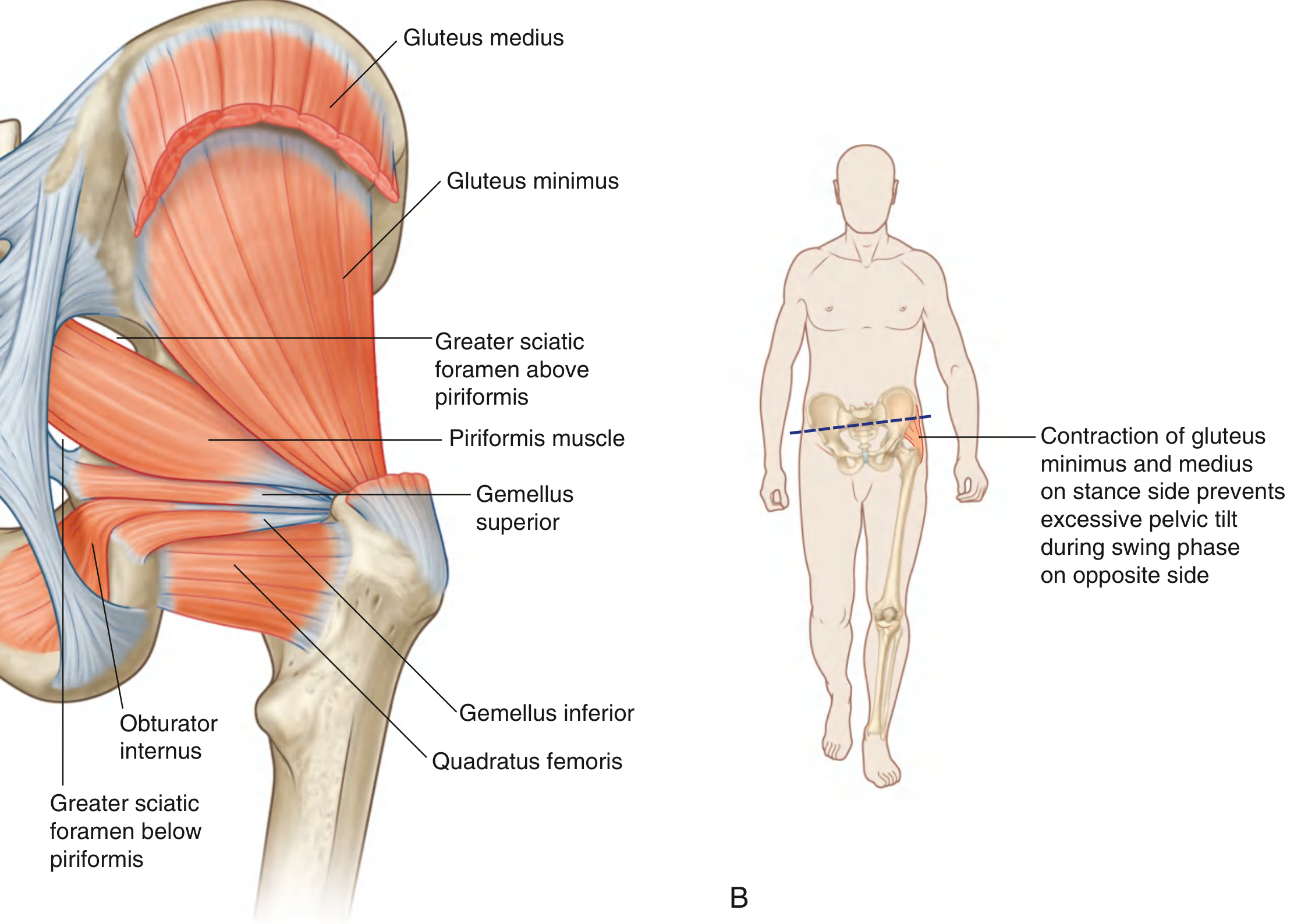
Structures passing ABOVE the piriformis (Suprapiriform foramen):
| Structure |
|---|
| Superior gluteal nerve (L4, L5, S1) |
| Superior gluteal vessels (artery & vein) |
Structures passing BELOW the piriformis (Infrapiriform foramen):
| Structure |
|---|
| Inferior gluteal nerve (L5, S1, S2) |
| Inferior gluteal vessels |
| Sciatic nerve (L4, L5, S1, S2, S3) |
| Pudendal nerve |
| Internal pudendal vessels |
| Posterior cutaneous nerve of the thigh |
| Nerve to obturator internus (L5, S1, S2) |
| Nerve to quadratus femoris (L4, L5, S1) |
"The piriformis muscle passes through the greater sciatic foramen, dividing it into two parts. The superior gluteal nerves and vessels pass through the foramen above the piriformis. Passing through the foramen below the piriformis are the inferior gluteal nerves and vessels, the sciatic nerve, the pudendal nerve, the internal pudendal vessels, the posterior femoral cutaneous nerves, and the nerves to the obturator internus and quadratus femoris." — Gray's Anatomy for Students
4. Relations
- Superiorly: Gluteus medius and minimus
- Inferiorly: Obturator internus (with gemelli), quadratus femoris
- Anteriorly: Hip joint capsule
- Posteriorly: Gluteus maximus covers it
5. Piriformis Fossa — Clinical / Surgical Importance
(a) Piriformis Entry Portal for IM Nailing
The piriformis fossa is the classical starting point for antegrade intramedullary (IM) nailing of femoral shaft fractures. The nail enters the medullary canal through this fossa, aligned with the femoral axis.
- The fossa is identified with an open or percutaneous (fluoroscopy-guided) approach
- Trochanteric entry nails have largely replaced piriformis entry nails in modern practice to reduce risk at the fossa
(b) Piriformis Syndrome
An uncommon cause of buttock pain and sciatica caused by compression of the sciatic nerve by the piriformis muscle. It mimics L5/S1 radiculopathy clinically.
(c) Anatomical Variation of Sciatic Nerve
- 80–94%: Sciatic nerve passes anterior to the piriformis muscle (normal)
- ~14%: Sciatic nerve passes through the piriformis (splits the muscle)
- Rare: Nerve passes posterior to the muscle
This variation is relevant in piriformis syndrome and injections to the gluteal region.
6. Greater Sciatic Foramen — Boundaries (for completeness)
| Boundary | Structure |
|---|---|
| Anterosuperiorly | Greater sciatic notch of the hip bone |
| Posteriorly | Sacrotuberous ligament |
| Inferiorly | Sacrospinous ligament + ischial spine |
7. Memory Aids
Structures below piriformis (mnemonic: "I Get Scared, Primarily In Pain"):
- Inferior gluteal nerve & vessels
- Gluteal (post. cutaneous nerve of thigh)
- Sciatic nerve
- Pudendal nerve + internal pudendal vessels
- Inferior to piriformis — nerve to obturator internus
- Posterior — nerve to quadratus femoris
Summary Table
| Feature | Detail |
|---|---|
| Origin | Pelvic surface of sacrum (S2–S4) |
| Insertion | Piriformis fossa — superior surface of greater trochanter |
| Nerve supply | S1, S2 (nerve to piriformis) |
| Action | External rotation + abduction of hip |
| Key role | Divides greater sciatic foramen into supra- & infrapiriform parts |
| Clinical relevance | IM nail entry portal; piriformis syndrome; sciatic nerve variation |
Sources: Gray's Anatomy for Students, 4e · THIEME Atlas of Anatomy: General Anatomy & Musculoskeletal System · Imaging Anatomy: Bones, Joints, Vessels & Nerves, Vol. 3
This is a shared conversation. Sign in to Orris to start your own chat.