

Make a power point presentation on this topic
mkdir -p /tmp/workspace/nicu-pptx && ls /tmp/workspace/nicu-pptx/
~/nicu-pptx/build_pptx.py
from pptx import Presentation
from pptx.util import Inches, Pt, Emu
from pptx.dml.color import RGBColor
from pptx.enum.text import PP_ALIGN, MSO_ANCHOR
from pptx.oxml.ns import qn
from lxml import etree
from io import BytesIO

# ── Color palette ──────────────────────────────────────────────────────────
NAVY      = RGBColor(0x0A, 0x2E, 0x5A)   # deep navy
TEAL      = RGBColor(0x00, 0x7E, 0x8A)   # accent teal
LIGHTBLUE = RGBColor(0xD6, 0xEE, 0xF8)   # slide bg light
WHITE     = RGBColor(0xFF, 0xFF, 0xFF)
DARK_TXT  = RGBColor(0x1A, 0x1A, 0x2E)
GOLD      = RGBColor(0xF0, 0xA5, 0x00)
SOFT_GRAY = RGBColor(0xF0, 0xF4, 0xF8)
MED_GRAY  = RGBColor(0x4A, 0x4A, 0x6A)

def new_prs():
    prs = Presentation()
    prs.slide_width  = Inches(13.333)
    prs.slide_height = Inches(7.5)
    return prs

def blank_slide(prs):
    return prs.slides.add_slide(prs.slide_layouts[6])

def fill_solid(shape, color):
    sp = shape.shape_element
    spPr = sp.find(qn("p:spPr"))
    if spPr is None:
        spPr = etree.SubElement(sp, qn("p:spPr"))
    for child in list(spPr):
        if child.tag in (qn("a:solidFill"), qn("a:gradFill"), qn("a:noFill")):
            spPr.remove(child)
    solidFill = etree.SubElement(spPr, qn("a:solidFill"))
    srgbClr   = etree.SubElement(solidFill, qn("a:srgbClr"))
    srgbClr.set("val", f"{color[0]:02X}{color[1]:02X}{color[2]:02X}")

def add_rect(slide, x, y, w, h, color):
    shape = slide.shapes.add_shape(1, Inches(x), Inches(y), Inches(w), Inches(h))
    shape.line.fill.background()
    fill_solid(shape, color)
    return shape

def add_text(slide, text, x, y, w, h, font_size=18, bold=False,
             color=DARK_TXT, align=PP_ALIGN.LEFT, italic=False, wrap=True):
    tb = slide.shapes.add_textbox(Inches(x), Inches(y), Inches(w), Inches(h))
    tf = tb.text_frame
    tf.word_wrap = wrap
    tf.margin_left = tf.margin_right = tf.margin_top = tf.margin_bottom = 0
    p = tf.paragraphs[0]
    p.alignment = align
    run = p.add_run()
    run.text = text
    run.font.size  = Pt(font_size)
    run.font.bold  = bold
    run.font.italic = italic
    run.font.name  = "Calibri"
    run.font.color.rgb = color
    return tb

def add_multiline_box(slide, lines, x, y, w, h,
                       font_size=15, color=DARK_TXT, bullet=True, bg=None, heading=None):
    """lines = list of strings; bullet prepends •"""
    if bg:
        add_rect(slide, x, y, w, h, bg)
    tb = slide.shapes.add_textbox(Inches(x+0.15), Inches(y+0.1),
                                   Inches(w-0.3), Inches(h-0.2))
    tf = tb.text_frame
    tf.word_wrap = True
    tf.margin_left = tf.margin_right = tf.margin_top = tf.margin_bottom = 0
    if heading:
        p0 = tf.paragraphs[0]
        p0.alignment = PP_ALIGN.LEFT
        r0 = p0.add_run()
        r0.text = heading
        r0.font.size = Pt(font_size + 1)
        r0.font.bold = True
        r0.font.name = "Calibri"
        r0.font.color.rgb = NAVY
        first = False
    else:
        first = True
    for i, line in enumerate(lines):
        if first and i == 0:
            p = tf.paragraphs[0]
        else:
            p = tf.add_paragraph()
        p.alignment = PP_ALIGN.LEFT
        r = p.add_run()
        r.text = ("• " + line) if bullet else line
        r.font.size  = Pt(font_size)
        r.font.name  = "Calibri"
        r.font.color.rgb = color

# ═══════════════════════════════════════════════════════════════════════════
prs = new_prs()

# ── SLIDE 1  Title ─────────────────────────────────────────────────────────
s = blank_slide(prs)
add_rect(s, 0, 0, 13.333, 7.5, NAVY)          # full bg

# decorative teal stripe
add_rect(s, 0, 5.6, 13.333, 0.22, TEAL)
add_rect(s, 0, 5.82, 13.333, 0.12, GOLD)

# week tag
add_rect(s, 0.5, 0.4, 2.8, 0.55, TEAL)
add_text(s, "WEEK 3  |  NICU NURSING", 0.5, 0.4, 2.8, 0.55,
         font_size=11, bold=True, color=WHITE, align=PP_ALIGN.CENTER)

# main title
add_text(s,
    "Central Lines, PICC Lines\n& Umbilical Catheters",
    0.7, 1.2, 11.9, 2.3,
    font_size=46, bold=True, color=WHITE, align=PP_ALIGN.LEFT)

# subtitle line 1
add_text(s,
    "Nursing Care  |  Prevention of Device-Associated Infections in NICU",
    0.7, 3.5, 11.9, 0.8,
    font_size=21, bold=False, color=GOLD, align=PP_ALIGN.LEFT)

# bottom note
add_text(s, "Week 3  •  Topics 5 & 6", 0.7, 6.7, 12, 0.55,
         font_size=13, color=RGBColor(0xAA, 0xCC, 0xEE), align=PP_ALIGN.LEFT)

# ── SLIDE 2  Overview ──────────────────────────────────────────────────────
s = blank_slide(prs)
add_rect(s, 0, 0, 13.333, 7.5, SOFT_GRAY)
add_rect(s, 0, 0, 13.333, 1.15, NAVY)
add_rect(s, 0, 1.15, 13.333, 0.09, TEAL)
add_text(s, "Session Overview", 0.5, 0.18, 12, 0.85,
         font_size=32, bold=True, color=WHITE, align=PP_ALIGN.LEFT)

topics = [
    ("Topic 5", "Central Lines, PICC Lines & Umbilical Catheters: Nursing Care",
     [
       "Types: Central lines, PICC lines, Umbilical arterial/venous catheters",
       "Indications and insertion sites in neonates",
       "Nursing assessment and ongoing care",
       "Dressing changes and line management",
       "Monitoring for complications",
     ]),
    ("Topic 6", "Prevention of Device-Associated Infections in NICU",
     [
       "CLABSI: definition, burden, and risk factors",
       "Evidence-based prevention bundles",
       "Hand hygiene and aseptic technique",
       "VAP & CAUTI prevention in NICU",
       "Surveillance and quality improvement",
     ]),
]
for i, (tag, title, pts) in enumerate(topics):
    x = 0.45 + i * 6.45
    add_rect(s, x, 1.45, 6.1, 5.6, WHITE)
    add_rect(s, x, 1.45, 6.1, 0.5, TEAL if i==0 else NAVY)
    add_text(s, tag, x+0.15, 1.45, 1.2, 0.5,
             font_size=14, bold=True, color=WHITE)
    add_text(s, title, x+0.15, 2.05, 5.8, 0.75,
             font_size=14, bold=True, color=NAVY)
    add_multiline_box(s, pts, x+0.05, 2.85, 5.9, 4.0,
                      font_size=13, color=MED_GRAY)

# ── SLIDE 3  Types of Lines ────────────────────────────────────────────────
s = blank_slide(prs)
add_rect(s, 0, 0, 13.333, 7.5, SOFT_GRAY)
add_rect(s, 0, 0, 13.333, 1.15, NAVY)
add_rect(s, 0, 1.15, 13.333, 0.09, TEAL)
add_text(s, "Types of Vascular Access in NICU", 0.5, 0.18, 12, 0.85,
         font_size=30, bold=True, color=WHITE, align=PP_ALIGN.LEFT)

cards = [
    ("Central Venous\nCatheter (CVC)", NAVY,
     ["Placed in large central veins (SVC, IVC)",
      "Sites: subclavian, internal jugular, femoral",
      "Multi-lumen available",
      "Used for TPN, vasoactives, CVP monitoring"]),
    ("PICC Line", TEAL,
     ["Peripherally inserted central catheter",
      "Inserted via arm/leg peripheral vein → advanced centrally",
      "Axillary vein preferred in neonates",
      "Lower complication rate vs CVC",
      "Confirmed by CXR before use"]),
    ("Umbilical Arterial\nCatheter (UAC)", RGBColor(0x8B,0x00,0x35),
     ["Inserted via umbilical artery",
      "Used for arterial BP monitoring & blood sampling",
      "Tip: T6-T9 (high) or L3-L4 (low)",
      "Risk: thromboembolism, infection"]),
    ("Umbilical Venous\nCatheter (UVC)", RGBColor(0x00,0x5F,0x4B),
     ["Inserted via umbilical vein",
      "Preferred immediate vascular access in resuscitation",
      "Tip: above diaphragm at IVC/RA junction",
      "Used for TPN, medications, exchange transfusion"]),
]
for i, (title, col, pts) in enumerate(cards):
    col_x = 0.35 + i * 3.22
    add_rect(s, col_x, 1.4, 3.0, 5.75, WHITE)
    add_rect(s, col_x, 1.4, 3.0, 0.65, col)
    add_text(s, title, col_x+0.1, 1.4, 2.8, 0.65,
             font_size=13, bold=True, color=WHITE, align=PP_ALIGN.CENTER)
    add_multiline_box(s, pts, col_x+0.05, 2.1, 2.9, 4.8,
                      font_size=12, color=MED_GRAY)

# ── SLIDE 4  Nursing Care – Insertion ─────────────────────────────────────
s = blank_slide(prs)
add_rect(s, 0, 0, 13.333, 7.5, SOFT_GRAY)
add_rect(s, 0, 0, 13.333, 1.15, NAVY)
add_rect(s, 0, 1.15, 13.333, 0.09, TEAL)
add_text(s, "Nursing Care: Insertion Phase", 0.5, 0.18, 12, 0.85,
         font_size=30, bold=True, color=WHITE, align=PP_ALIGN.LEFT)

left_items = [
    ("Pre-Insertion Checklist", TEAL,
     ["Verify order and consent documentation",
      "Confirm indication and appropriateness",
      "Gather sterile equipment: drapes, gloves, antiseptic",
      "Position neonate optimally; maintain thermoregulation",
      "Set up monitoring: SpO2, HR, BP",
      "Prepare flush solution (heparinized saline per policy)"]),
    ("During Insertion", NAVY,
     ["Maintain strict sterile field",
      "Assist with patient positioning and stabilization",
      "Monitor vital signs continuously",
      "Document time, site, catheter size, tip position",
      "Confirm placement by X-ray before use"]),
]
right_items = [
    ("Post-Insertion Care", RGBColor(0x00,0x5F,0x4B),
     ["Apply sterile, transparent, occlusive dressing",
      "Label dressing with date and time",
      "Secure catheter to prevent dislodgement",
      "Document in nursing notes and MAR",
      "Assess distal perfusion (color, cap refill, pulses)"]),
    ("PICC-Specific", RGBColor(0x8B,0x00,0x35),
     ["Measure arm circumference pre/post insertion",
      "Upper extremity: immobilize without restricting circulation",
      "Axillary approach preferred (lower complication rate)",
      "Review CXR: tip at SVC-RA junction"]),
]

for i, (title, col, pts) in enumerate(left_items):
    y = 1.4 + i * 2.85
    add_rect(s, 0.35, y, 6.0, 2.6, WHITE)
    add_rect(s, 0.35, y, 6.0, 0.5, col)
    add_text(s, title, 0.5, y, 5.8, 0.5,
             font_size=14, bold=True, color=WHITE, align=PP_ALIGN.LEFT)
    add_multiline_box(s, pts, 0.35, y+0.55, 5.9, 1.95,
                      font_size=12, color=MED_GRAY)

for i, (title, col, pts) in enumerate(right_items):
    y = 1.4 + i * 2.85
    add_rect(s, 6.8, y, 6.15, 2.6, WHITE)
    add_rect(s, 6.8, y, 6.15, 0.5, col)
    add_text(s, title, 6.95, y, 5.9, 0.5,
             font_size=14, bold=True, color=WHITE, align=PP_ALIGN.LEFT)
    add_multiline_box(s, pts, 6.8, y+0.55, 6.05, 1.95,
                      font_size=12, color=MED_GRAY)

# ── SLIDE 5  Ongoing Nursing Care ─────────────────────────────────────────
s = blank_slide(prs)
add_rect(s, 0, 0, 13.333, 7.5, SOFT_GRAY)
add_rect(s, 0, 0, 13.333, 1.15, NAVY)
add_rect(s, 0, 1.15, 13.333, 0.09, TEAL)
add_text(s, "Ongoing Nursing Assessment & Maintenance", 0.5, 0.18, 12, 0.85,
         font_size=30, bold=True, color=WHITE, align=PP_ALIGN.LEFT)

ongoing = [
    ("Daily Assessment", TEAL,
     ["Assess insertion site: redness, swelling, discharge",
      "Check dressing integrity; change per protocol (q7 days for transparent)",
      "Inspect catheter length externally – document if migrated",
      "Assess extremity distal to line for perfusion signs",
      "Review necessity of line daily – remove if no longer needed"]),
    ("Line Care", NAVY,
     ["Use aseptic non-touch technique (ANTT) for all access",
      "Scrub the hub ≥15 sec with 70% alcohol before each use",
      "Flush catheter per protocol (frequency, solution, volume)",
      "Change IV tubing q72-96 h; lipid tubing q24 h",
      "Use closed needleless connectors and change per policy"]),
    ("Umbilical Catheter Care", RGBColor(0x8B,0x00,0x35),
     ["Check for blanching/discoloration of lower extremities (UAC)",
      "Do NOT cover umbilical stump with diaper",
      "Monitor for oozing or bleeding at umbilical stump",
      "Remove UAC by Day 5-7, UVC by Day 10-14 per guideline",
      "Assess liver edge (hepatomegaly from UVC malposition)"]),
]

for i, (title, col, pts) in enumerate(ongoing):
    x = 0.35 + i * 4.35
    add_rect(s, x, 1.4, 4.1, 5.75, WHITE)
    add_rect(s, x, 1.4, 4.1, 0.5, col)
    add_text(s, title, x+0.12, 1.4, 3.9, 0.5,
             font_size=14, bold=True, color=WHITE, align=PP_ALIGN.LEFT)
    add_multiline_box(s, pts, x+0.05, 1.95, 4.0, 5.1,
                      font_size=12.5, color=MED_GRAY)

# ── SLIDE 6  Complications ─────────────────────────────────────────────────
s = blank_slide(prs)
add_rect(s, 0, 0, 13.333, 7.5, SOFT_GRAY)
add_rect(s, 0, 0, 13.333, 1.15, NAVY)
add_rect(s, 0, 1.15, 13.333, 0.09, TEAL)
add_text(s, "Recognizing & Managing Complications", 0.5, 0.18, 12, 0.85,
         font_size=30, bold=True, color=WHITE, align=PP_ALIGN.LEFT)

comp_data = [
    ("Infection / CLABSI",       "Fever, leukocytosis, glucose instability, lethargy; increased C-reactive protein",  "Blood cultures × 2, antibiotics per protocol, consider line removal"),
    ("Thrombosis / Embolism",    "Limb pallor, decreased pulses, mottling; hepatomegaly if UVC",                       "Doppler U/S, anticoagulation per protocol, remove catheter"),
    ("Pneumothorax (CVC/PICC)", "Sudden desaturation, decreased breath sounds, hypotension, difficulty ventilating",   "Emergent needle decompression, chest X-ray, chest tube if needed"),
    ("Catheter Malposition",     "Arrhythmias, pleural/pericardial effusion, failure to infuse",                       "CXR to confirm; reposition or remove catheter"),
    ("Extravasation",            "Swelling, blanching, skin necrosis at infusion site",                                "Stop infusion immediately; aspirate if possible; hyaluronidase per protocol"),
    ("Hemorrhage",               "Blood in dressing, dropping Hct/BP, hemothorax",                                    "Apply pressure, volume replacement, surgical consult as needed"),
]

headers = ["Complication", "Signs & Symptoms", "Nursing Action"]
col_widths = [2.6, 4.8, 5.4]
col_x_starts = [0.25, 2.9, 7.75]
row_h = 0.82
for ci, (hdr, w) in enumerate(zip(headers, col_widths)):
    add_rect(s, col_x_starts[ci], 1.35, w, 0.52, NAVY)
    add_text(s, hdr, col_x_starts[ci]+0.07, 1.35, w, 0.52,
             font_size=13, bold=True, color=WHITE, align=PP_ALIGN.CENTER)

for ri, (c1, c2, c3) in enumerate(comp_data):
    y = 1.9 + ri * row_h
    bg = WHITE if ri % 2 == 0 else LIGHTBLUE
    for ci, (txt, w) in enumerate(zip([c1, c2, c3], col_widths)):
        add_rect(s, col_x_starts[ci], y, w, row_h-0.04, bg)
        add_text(s, txt, col_x_starts[ci]+0.08, y+0.04, w-0.15, row_h-0.1,
                 font_size=11.5, color=DARK_TXT if ci>0 else NAVY,
                 bold=(ci==0), wrap=True)

# ── SLIDE 7  CLABSI Prevention Bundle ─────────────────────────────────────
s = blank_slide(prs)
add_rect(s, 0, 0, 13.333, 7.5, SOFT_GRAY)
add_rect(s, 0, 0, 13.333, 1.15, NAVY)
add_rect(s, 0, 1.15, 13.333, 0.09, GOLD)
add_text(s, "CLABSI Prevention in NICU", 0.5, 0.18, 12, 0.85,
         font_size=30, bold=True, color=WHITE, align=PP_ALIGN.LEFT)

add_text(s,
    "Central Line-Associated Bloodstream Infection (CLABSI) is among the most serious preventable HAIs in the NICU.",
    0.4, 1.35, 12.5, 0.5, font_size=13.5, italic=True, color=MED_GRAY)

bundle_items = [
    ("1. Hand Hygiene",
     "Perform WHO 5 moments; use alcohol-based handrub; gloves do NOT replace hand hygiene"),
    ("2. Maximal Sterile Barrier",
     "Sterile gown, gloves, mask, cap, and large sterile drape during insertion"),
    ("3. Chlorhexidine Skin Prep",
     "Use CHG (≥0.5% in 70% alcohol); avoid in preterm <2 kg (risk of skin injury) – use povidone-iodine instead"),
    ("4. Optimal Site Selection",
     "Avoid femoral in adults; in neonates subclavian/IJ preferred; PICC over CVC when feasible"),
    ("5. Daily Necessity Review",
     "Remove catheter as soon as no longer clinically indicated – the #1 most effective prevention measure"),
    ("6. Hub Decontamination",
     "'Scrub the hub' ≥15 sec before every access; discard needleless connectors per protocol"),
    ("7. Dressing & Tubing Changes",
     "Transparent dressing q7 days or when soiled; IV tubing q72-96 h; lipid tubing q24 h"),
    ("8. Standardized Insertion Checklist",
     "Nurse has authority to STOP procedure if sterile technique is broken during insertion"),
]

for i, (title, desc) in enumerate(bundle_items):
    col = i % 2
    row = i // 2
    x = 0.35 + col * 6.5
    y = 1.95 + row * 1.33
    add_rect(s, x, y, 6.2, 1.22, WHITE)
    add_rect(s, x, y, 0.45, 1.22, TEAL if col==0 else NAVY)
    add_text(s, str(i+1), x+0.06, y+0.35, 0.35, 0.55,
             font_size=15, bold=True, color=WHITE, align=PP_ALIGN.CENTER)
    add_text(s, title, x+0.55, y+0.05, 5.5, 0.4,
             font_size=13, bold=True, color=NAVY)
    add_text(s, desc, x+0.55, y+0.48, 5.5, 0.65,
             font_size=11.5, color=MED_GRAY, wrap=True)

# ── SLIDE 8  Other Device-Associated Infections ────────────────────────────
s = blank_slide(prs)
add_rect(s, 0, 0, 13.333, 7.5, SOFT_GRAY)
add_rect(s, 0, 0, 13.333, 1.15, NAVY)
add_rect(s, 0, 1.15, 13.333, 0.09, TEAL)
add_text(s, "Other Device-Associated Infections: VAP & CAUTI", 0.5, 0.18, 12, 0.85,
         font_size=28, bold=True, color=WHITE, align=PP_ALIGN.LEFT)

sections = [
    ("Ventilator-Associated\nPneumonia (VAP)", TEAL,
     ["Bundle: elevate HOB 30-45° (when feasible in NICU)",
      "Oral decontamination with sterile water/CHG per protocol",
      "Daily sedation vacations and readiness-to-extubate assessment",
      "Inline closed suctioning systems",
      "Change ventilator circuits only when visibly soiled",
      "Maintain appropriate ETT cuff pressure",
      "Hand hygiene before and after any respiratory intervention"]),
    ("Catheter-Associated UTI\n(CAUTI)", NAVY,
     ["Insert urinary catheters only when strictly indicated",
      "Use smallest appropriate catheter size",
      "Aseptic insertion technique",
      "Maintain closed drainage system",
      "Keep drainage bag below bladder level at all times",
      "Reassess need daily; remove at earliest opportunity",
      "Perineal hygiene with catheter in place"]),
    ("Environmental &\nContact Precautions", RGBColor(0x00,0x5F,0x4B),
     ["Cohort infants with confirmed HAI",
      "Dedicated equipment per patient (stethoscope, BP cuff)",
      "Regular environmental disinfection with approved agents",
      "Contact precautions for MRSA, ESBL, VRE carriers",
      "Limit traffic in NICU; enforce visitor hand hygiene",
      "Surveillance cultures per unit protocol"]),
]

for i, (title, col, pts) in enumerate(sections):
    x = 0.35 + i * 4.35
    add_rect(s, x, 1.4, 4.1, 5.75, WHITE)
    add_rect(s, x, 1.4, 4.1, 0.62, col)
    add_text(s, title, x+0.1, 1.4, 3.9, 0.62,
             font_size=13.5, bold=True, color=WHITE, align=PP_ALIGN.LEFT)
    add_multiline_box(s, pts, x+0.05, 2.08, 4.0, 5.0,
                      font_size=12, color=MED_GRAY)

# ── SLIDE 9  Surveillance & QI ─────────────────────────────────────────────
s = blank_slide(prs)
add_rect(s, 0, 0, 13.333, 7.5, SOFT_GRAY)
add_rect(s, 0, 0, 13.333, 1.15, NAVY)
add_rect(s, 0, 1.15, 13.333, 0.09, TEAL)
add_text(s, "Surveillance, Reporting & Quality Improvement", 0.5, 0.18, 12, 0.85,
         font_size=28, bold=True, color=WHITE, align=PP_ALIGN.LEFT)

left = [
    ("NHSN Surveillance (CDC)",
     ["Report CLABSI, VAP, CAUTI per NHSN definitions",
      "Calculate CLABSI rate: events per 1,000 line-days",
      "Benchmark against national NICU rates",
      "Review denominator data: total central line-days"]),
    ("Root Cause Analysis",
     ["Conduct RCA for every CLABSI event",
      "Identify break in bundle: insertion vs maintenance",
      "Track process compliance (bundle adherence audits)",
      "Report findings to unit and hospital leadership"]),
]
right = [
    ("QI Strategies",
     ["Real-time audit and feedback to bedside nurses",
      "Simulation training for insertion bundles",
      "Visual reminders at bedside (bundle checklist laminated)",
      "Celebrate zero-CLABSI milestones with team"]),
    ("Family Engagement",
     ["Educate parents on CLABSI signs and importance of hand hygiene",
      "Encourage parents to alert staff if dressing appears loose",
      "Include family in daily rounds discussions about line necessity",
      "Provide written materials on device care"]),
]

for i, (title, pts) in enumerate(left):
    y = 1.45 + i * 2.9
    add_rect(s, 0.35, y, 6.05, 2.65, WHITE)
    add_rect(s, 0.35, y, 6.05, 0.5, NAVY)
    add_text(s, title, 0.5, y, 5.85, 0.5,
             font_size=14, bold=True, color=WHITE)
    add_multiline_box(s, pts, 0.35, y+0.55, 5.95, 2.0,
                      font_size=12.5, color=MED_GRAY)

for i, (title, pts) in enumerate(right):
    y = 1.45 + i * 2.9
    add_rect(s, 6.85, y, 6.1, 2.65, WHITE)
    add_rect(s, 6.85, y, 6.1, 0.5, TEAL)
    add_text(s, title, 7.0, y, 5.9, 0.5,
             font_size=14, bold=True, color=WHITE)
    add_multiline_box(s, pts, 6.85, y+0.55, 6.0, 2.0,
                      font_size=12.5, color=MED_GRAY)

# ── SLIDE 10  Key Nursing Roles ─────────────────────────────────────────────
s = blank_slide(prs)
add_rect(s, 0, 0, 13.333, 7.5, SOFT_GRAY)
add_rect(s, 0, 0, 13.333, 1.15, NAVY)
add_rect(s, 0, 1.15, 13.333, 0.09, GOLD)
add_text(s, "Key Nursing Roles & Responsibilities", 0.5, 0.18, 12, 0.85,
         font_size=30, bold=True, color=WHITE, align=PP_ALIGN.LEFT)

roles = [
    ("Educator",      TEAL,
     ["Teach family about line safety",
      "Orient new nurses to bundle compliance",
      "In-service on latest evidence-based practices"]),
    ("Advocate",      NAVY,
     ["Stop procedure if sterile field breached",
      "Question necessity of line daily",
      "Speak up for the neonate"]),
    ("Assessor",      RGBColor(0x00,0x5F,0x4B),
     ["Frequent site assessment",
      "Identify early signs of infection/complication",
      "Document findings accurately"]),
    ("Collaborator",  RGBColor(0x8B,0x00,0x35),
     ["Participate in multi-disciplinary rounds",
      "Liaise with IV therapy and pharmacy",
      "Contribute to unit QI initiatives"]),
]

for i, (role, col, pts) in enumerate(roles):
    x = 0.35 + i * 3.22
    add_rect(s, x, 1.4, 3.0, 5.6, WHITE)
    # circle / icon strip at top
    add_rect(s, x, 1.4, 3.0, 1.0, col)
    add_text(s, role, x+0.1, 1.55, 2.8, 0.75,
             font_size=18, bold=True, color=WHITE, align=PP_ALIGN.CENTER)
    add_multiline_box(s, pts, x+0.1, 2.55, 2.8, 4.3,
                      font_size=13, color=MED_GRAY)

# ── SLIDE 11  Summary / Key Takeaways ─────────────────────────────────────
s = blank_slide(prs)
add_rect(s, 0, 0, 13.333, 7.5, NAVY)
add_rect(s, 0, 1.15, 13.333, 0.09, GOLD)
add_text(s, "Key Takeaways", 0.5, 0.18, 12, 0.85,
         font_size=33, bold=True, color=WHITE, align=PP_ALIGN.LEFT)

takeaways = [
    "Know your lines: CVC, PICC, UAC, and UVC each have specific care requirements and complication profiles.",
    "Sterile technique and hand hygiene are the cornerstones of every line insertion and access.",
    "The CLABSI bundle (hand hygiene, maximal sterile barrier, CHG skin prep, optimal site, daily necessity review) prevents the majority of line infections.",
    "Remove the line as soon as it is no longer needed - the single most effective prevention measure.",
    "Surveillance, bundle audits, and rapid feedback loops are essential for sustaining zero-CLABSI performance.",
    "Nurses are the primary defense: assess daily, document carefully, and advocate for the neonate.",
]

for i, text in enumerate(takeaways):
    y = 1.45 + i * 0.95
    add_rect(s, 0.4, y, 0.55, 0.72, TEAL)
    add_text(s, str(i+1), 0.4, y+0.08, 0.55, 0.55,
             font_size=17, bold=True, color=WHITE, align=PP_ALIGN.CENTER)
    add_text(s, text, 1.1, y+0.04, 11.8, 0.72,
             font_size=14, color=WHITE, wrap=True)

# bottom bar
add_rect(s, 0, 7.1, 13.333, 0.4, TEAL)
add_text(s, "Week 3  •  NICU Nursing  •  Topics 5 & 6", 0.4, 7.1, 12.5, 0.4,
         font_size=12, color=WHITE, align=PP_ALIGN.CENTER)

# ── Save ────────────────────────────────────────────────────────────────────
out = "/tmp/workspace/nicu-pptx/NICU_Central_Lines_Week3.pptx"
buf = BytesIO()
prs.save(buf)
with open(out, "wb") as f:
    f.write(buf.getvalue())
print(f"Saved: {out}")
cd /tmp/workspace/nicu-pptx && python build_pptx.py 2>&1
~/nicu-pptx/build_pptx.py
Successfully replaced 1 instance(s) of the string in '/tmp/workspace/nicu-pptx/build_pptx.py'
cd /tmp/workspace/nicu-pptx && python build_pptx.py 2>&1
python3 -c " from pptx import Presentation prs = Presentation('/tmp/workspace/nicu-pptx/NICU_Central_Lines_Week3.pptx') print(f'Total slides: {len(prs.slides)}') for i, slide in enumerate(prs.slides, 1): texts = [sh.text_frame.text.strip()[:60] for sh in slide.shapes if sh.has_text_frame and sh.text_frame.text.strip()] print(f'Slide {i}: {texts[0] if texts else \"(no text)\"}') "
NICU Central Lines Week3
Presentation · PPTX
| Slide | Content |
|---|---|
| 1 | Title slide - Week 3, Topics 5 & 6 |
| 2 | Session Overview - Topics 5 & 6 side-by-side |
| 3 | Types of Vascular Access (CVC, PICC, UAC, UVC) - 4-column card layout |
| 4 | Nursing Care: Insertion Phase (pre/during/post + PICC-specific) |
| 5 | Ongoing Nursing Assessment & Maintenance (daily assessment, line care, umbilical catheter care) |
| 6 | Recognizing & Managing Complications - table format (CLABSI, thrombosis, pneumothorax, malposition, extravasation, hemorrhage) |
| 7 | CLABSI Prevention Bundle (8 evidence-based components) |
| 8 | Other Device-Associated Infections: VAP & CAUTI prevention |
| 9 | Surveillance, Reporting & Quality Improvement (NHSN, RCA, QI strategies, family engagement) |
| 10 | Key Nursing Roles (Educator, Advocate, Assessor, Collaborator) |
| 11 | Key Takeaways (dark navy closing slide with 6 summary points) |
Approach to thrombocytopenia in adults
thrombocytopenia approach algorithm differential diagnosis
peripheral blood smear thrombocytopenia platelets
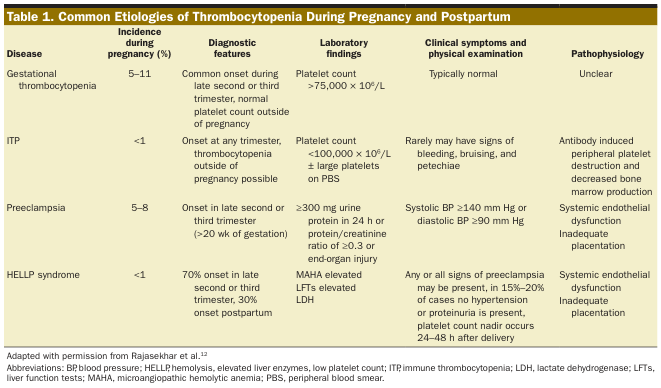
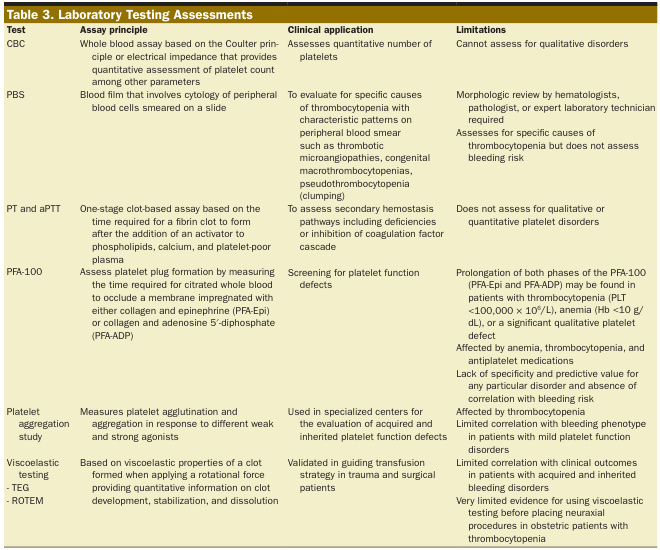
Approach to Thrombocytopenia in Adults
- <150,000 - technically thrombocytopenic but minimal risk
- 20,000-50,000 - increased risk of post-traumatic bleeding
- <20,000 - significant spontaneous mucocutaneous bleeding possible
- <5,000 - severe spontaneous bleeding, including CNS hemorrhage
Step 1 - Always Exclude Pseudothrombocytopenia First
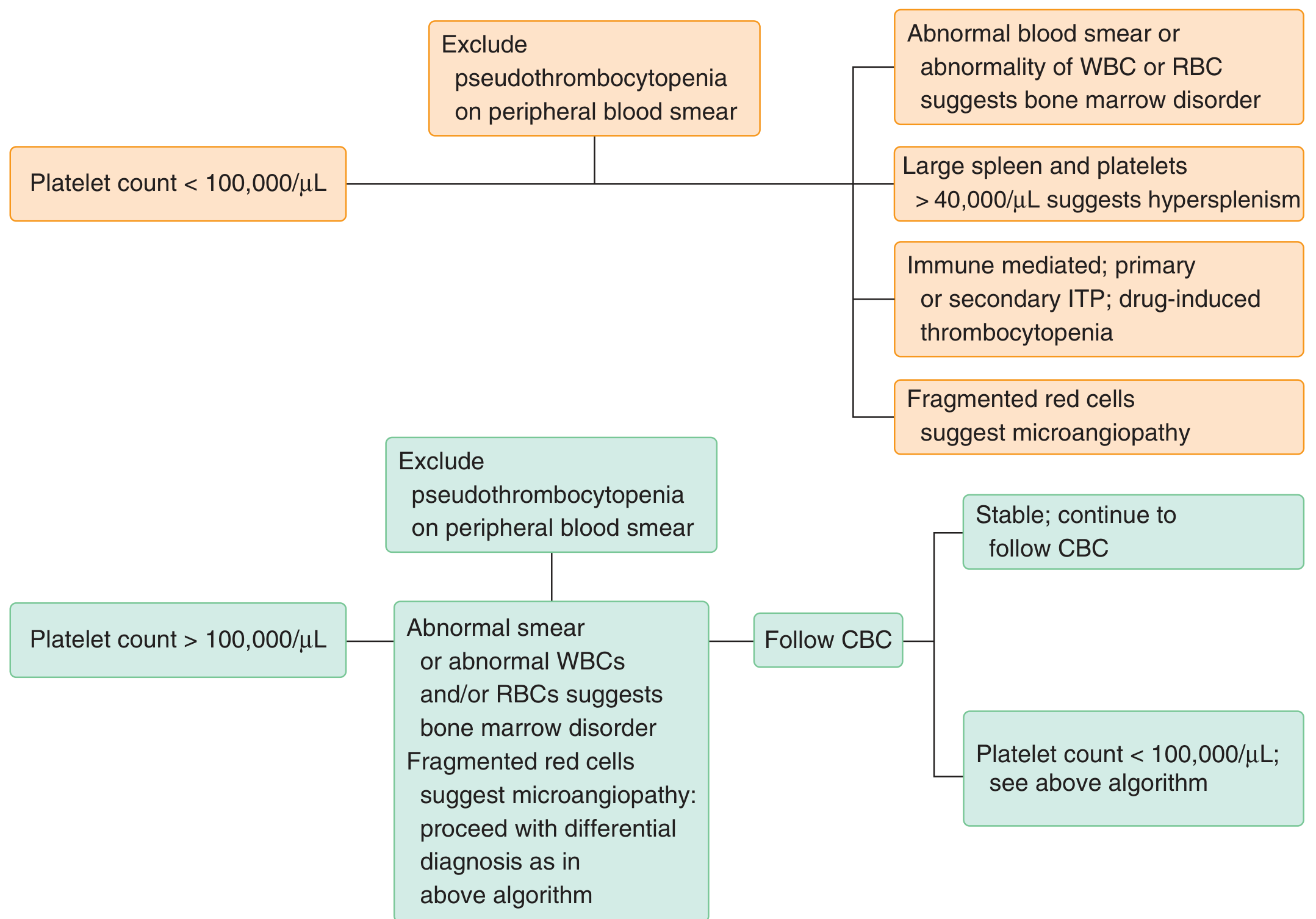
Step 2 - Mechanistic Classification
1. Decreased Production (Hypoproliferative)
| Category | Examples |
|---|---|
| Generalized marrow failure | Aplastic anemia, infiltration (leukemia, lymphoma, metastatic cancer, myelofibrosis) |
| Selective megakaryocyte suppression | Alcohol, thiazide diuretics, cytotoxic chemotherapy |
| Viral infection | HIV, EBV, CMV, varicella |
| Ineffective megakaryopoiesis | Megaloblastic anemia (B12/folate), myelodysplastic syndrome (MDS) |
| Radiation-induced | Myelosuppression |
- Robbins & Kumar Basic Pathology, Table 10.11; Goldman-Cecil Medicine, p. 1807
2. Increased Destruction
A. Immune-Mediated Destruction
| Condition | Mechanism |
|---|---|
| Primary ITP | IgG autoantibodies (anti-GPIIb/IIIa, anti-GPIb-IX-V) → phagocytosis by splenic macrophages + impaired thrombopoiesis |
| Secondary ITP | SLE, CLL, HIV, hepatitis C, H. pylori |
| Drug-induced (immune) | Quinine, quinidine, sulfonamides, β-lactams, vancomycin, procainamide, gold salts - antibody binds drug-platelet complex |
| Heparin-induced (HIT) | Anti-PF4/heparin IgG antibodies (see below) |
| Alloimmune | Post-transfusion purpura, passive alloimmune thrombocytopenia |
B. Non-Immune (Microangiopathic / Consumptive) Destruction
| Condition | Key Distinguishing Features |
|---|---|
| TTP | Pentad: microangiopathic haemolytic anaemia (MAHA), thrombocytopenia, neurological symptoms, renal impairment, fever. ADAMTS13 activity <10% (absent/inhibited). |
| HUS | MAHA + thrombocytopenia + acute kidney injury predominates. Shiga-toxin (typical) or complement dysregulation (atypical/aHUS). |
| DIC | Consumptive coagulopathy: ↑PT/aPTT, ↓fibrinogen, ↑D-dimer. Underlying trigger (sepsis, malignancy, obstetric emergency). |
| Preeclampsia / HELLP | Hypertension, ↑LFTs, haemolysis; obstetric emergency. |
| Sepsis | Platelet activation by thrombin and proinflammatory cytokines. |
| Cardiopulmonary bypass | Platelet losses on artificial surfaces. |
- Goldman-Cecil Medicine, p. 1807; Henry's Clinical Diagnosis, p. 966
3. Sequestration (Hypersplenism)
4. Dilutional
Step 3 - Initial Workup
History (targeted)
- Timing: acute (days) vs chronic (months/years)? New medications (especially heparin, antibiotics, quinine)?
- Symptoms: petechiae, ecchymoses, mucosal bleeding vs thrombosis (points toward TTP/HIT)
- Systemic features: fever, arthralgia, rash (SLE), jaundice, alcohol use, transfusion history
- Family history (congenital thrombocytopenias - MYH9 disorders, Bernard-Soulier)
Examination
- Petechiae - pinpoint non-blanching macules on dependent skin; pathognomonic of thrombocytopenia
- Ecchymoses
- Splenomegaly (hypersplenism)
- Lymphadenopathy, hepatomegaly (haematological malignancy)
- Signs of chronic liver disease
Core Investigations
| Test | What it tells you |
|---|---|
| CBC + differential | Isolated vs pancytopenia; MCV (megaloblastic) |
| Peripheral blood smear | Schistocytes (MAHA/TTP/HUS/DIC), hypersegmented neutrophils (B12/folate), blast cells (leukaemia), clumping (pseudothrombocytopenia), platelet size (large = destruction; small = Wiskott-Aldrich) |
| PT/aPTT/fibrinogen/D-dimer | Coagulopathy (DIC) |
| LDH, indirect bilirubin, haptoglobin, reticulocyte count | Haemolysis (TTP/HUS/DIC) |
| Peripheral smear for schistocytes | If MAHA suspected |
| LFTs, albumin | Liver disease / hypersplenism |
| HIV, hepatitis B/C serology | Viral causes |
| ANA, anti-dsDNA | SLE-associated ITP |
| Blood cultures | Sepsis-driven thrombocytopenia |
| Vitamin B12, folate | Megaloblastic thrombocytopenia |
| Bone marrow biopsy | Hypoproliferative thrombocytopenia, suspected haematological malignancy, MDS |
Step 4 - Key Specific Entities & Their Management
Immune Thrombocytopenia (ITP)
| Agent | Dose | Notes |
|---|---|---|
| Corticosteroids (prednisone) | 1 mg/kg/day; ~80% response | Relapse common on taper |
| High-dose dexamethasone | 40 mg/day × 4 days | Higher initial response rate; may be better tolerated |
| IVIG | 1 g/kg/day × 2 days or 0.4 g/kg/day × 5 days | Faster platelet rise (~80% response, lasts 2-4 weeks); used when rapid increase needed |
| Anti-D immunoglobulin | 50-75 µg/kg IV | Only for Rh+ non-splenectomised patients; causes mild haemolysis |
- Rituximab (anti-CD20): ~40% complete response; B-cell depletion reduces autoantibody production
- TPO receptor agonists - romiplostim (weekly SC) or eltrombopag (daily oral): stimulate thrombopoiesis directly; highly effective in chronic refractory ITP
- Splenectomy: considered after >12 months if ongoing treatment required; can produce lifelong remission; pre-operative vaccinations mandatory (pneumococcus, meningococcus, Haemophilus influenzae)
- Goldman-Cecil Medicine, Table 158-5 and 158-6
Heparin-Induced Thrombocytopenia (HIT)
| Category | 0 pts | 1 pt | 2 pts |
|---|---|---|---|
| Thrombocytopenia severity | <30% fall or nadir <10×10⁹/L | 30-50% fall or nadir 10-19×10⁹/L | >50% fall and nadir ≥20×10⁹/L |
| Timing of fall | ≤4 days (no prior heparin) | 5-10 days unclear; or >10 days; or ≤1 day (exposure 31-100 days ago) | 5-10 days; or ≤1 day (exposure last 30 days) |
| Thrombosis | None | Recurrence/progression or skin lesion | Confirmed new thrombosis; skin necrosis; acute UFH reaction |
| Other causes | Definite | Possible | None apparent |
- Stop all heparin immediately (including flushes and LMWH)
- Start a non-heparin anticoagulant - argatroban (hepatically cleared, preferred in renal failure) or fondaparinux
- Do NOT give platelet transfusions - worsens thrombosis
- Confirm with anti-PF4 ELISA (sensitive but not specific) and/or serotonin release assay (SRA - most specific)
- Bridge to warfarin only after platelets recover above 150,000/µL (premature warfarin causes venous limb gangrene)
- Washington Manual of Medical Therapeutics, p. 761; Goldman-Cecil Medicine, p. 1808-1810
Thrombotic Thrombocytopenic Purpura (TTP)
- MAHA (schistocytes on smear, ↑LDH, ↑bilirubin, ↓haptoglobin)
- Thrombocytopenia
- Neurological symptoms (fluctuating, e.g. headache, confusion, stroke)
- Renal impairment
- Fever
- Plasma exchange (plasmapheresis) - replaces deficient ADAMTS13 and removes inhibitory antibodies; must start urgently
- Glucocorticoids (methylprednisolone)
- Rituximab - increasingly used first-line with plasma exchange for immune-mediated TTP
- Caplacizumab - anti-vWF nanobody; reduces time to platelet normalisation (approved for acquired TTP)
- Do NOT transfuse platelets except for life-threatening haemorrhage - may "fuel the fire"
DIC
- Fresh frozen plasma (FFP) for ↑PT/aPTT
- Cryoprecipitate for ↓fibrinogen (<1.5 g/L)
- Platelets when <20,000/µL or bleeding
- Heparin in chronic/thrombotic DIC (selected cases under expert guidance)
Platelet Transfusion Thresholds (Goldman-Cecil Medicine, Table 158-2)
| Clinical Situation | Platelet Threshold |
|---|---|
| Hypoproliferative (e.g. chemotherapy) - no bleeding | Transfuse at <10,000/µL |
| Elective central venous catheter placement | <20,000/µL |
| Elective diagnostic lumbar puncture | <50,000/µL |
| Major elective non-neuraxial surgery | <50,000/µL |
| Neurological/ocular surgery | 50,000-100,000/µL; maintain ×7-10 days post-op |
| TTP or HIT | Avoid platelet transfusion unless life-threatening haemorrhage |
- Goldman-Cecil Medicine, p. 1811-1813
Summary Diagnostic Algorithm
Low platelet count on CBC
        ↓
Peripheral blood smear
        ↓
Platelet clumping? → Pseudothrombocytopenia (artefact) - recheck in citrate
        ↓ (true thrombocytopenia)
Schistocytes?
  YES → MAHA → TTP / HUS / DIC / HELLP
          → ADAMTS13, PT/aPTT, fibrinogen, renal function
  NO ↓
Abnormal WBC/RBC or smear?
  YES → Bone marrow disorder → Marrow biopsy
  NO ↓
Splenomegaly + platelets >40,000?
  YES → Hypersplenism
  NO ↓
Recent heparin?
  YES → Score 4Ts → HIT work-up
  NO ↓
Isolated thrombocytopenia, otherwise normal smear
       → ITP (primary or secondary)
       → Check HIV, hepatitis C, ANA, anti-dsDNA, H. pylori
       → Drug history (quinine, sulfonamides, β-lactams)
- TTP - do not delay plasmapheresis waiting for confirmation
- HIT - stop heparin, anticoagulate (not platelets)
- DIC - treat the trigger urgently
- Acute leukaemia/aplastic anaemia - marrow failure needing emergency haematology referral
- Pseudothrombocytopenia - avoid unnecessary investigation and treatment
Sources: Goldman-Cecil Medicine International Edition, 2-Volume Set (Abrams CS, Chapter 158); Robbins & Kumar Basic Pathology (Table 10.11); Henry's Clinical Diagnosis and Management by Laboratory Methods (Table 41.2); Washington Manual of Medical Therapeutics (Chapter 20, HIT 4T scoring).
How to do torniquet test in dengue
Tourniquet Test (Rumple-Leede / Capillary Fragility Test) in Dengue
What It Tests
Step-by-Step Procedure
Step 1 - Preparation
- Ensure the patient is resting comfortably with the arm supported and relaxed at heart level
- The forearm skin should be clean and free of pre-existing petechiae or bruising; if petechiae are already present, mark them with a pen so you only count new ones appearing after the test
- Apply a standard sphygmomanometer (BP cuff) to the upper arm in the usual position
Step 2 - Measure Blood Pressure
- Record the patient's systolic and diastolic blood pressure
- Calculate the midpoint pressure:
Inflation pressure = (Systolic + Diastolic) ÷ 2Example: BP 120/80 mmHg → inflate to (120 + 80) ÷ 2 = 100 mmHg
Step 3 - Inflate and Hold
- Inflate the cuff to the calculated midpoint pressure
- Maintain this pressure for exactly 5 minutes
- The patient should remain still; avoid excessive arm movement
Step 4 - Deflate and Wait
- After 5 minutes, deflate the cuff completely
- Wait 2 minutes before reading the result - this allows the petechiae to become clearly visible as blood redistributes
Step 5 - Count the Petechiae
- Examine the volar (inner) surface of the forearm in the area that was distal to the cuff
- Using a ruler or template, identify a 1-inch × 1-inch (2.5 cm × 2.5 cm) square area and count all new pinpoint red non-blanching spots (petechiae) within it
- Count only new petechiae - not pre-existing marks
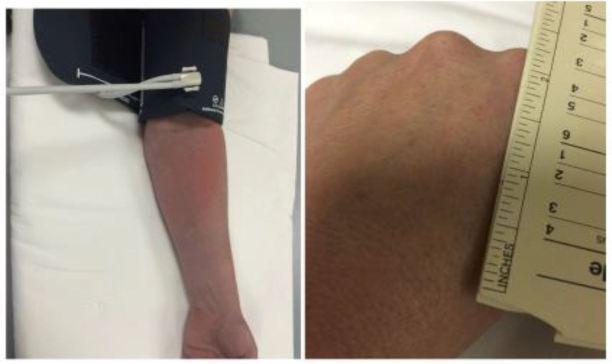
Interpretation
| Petechiae Count (per 1 sq inch / 6.25 cm²) | Result | Interpretation |
|---|---|---|
| < 10 | Negative | Capillary fragility normal |
| ≥ 10 | Positive | Increased capillary fragility - consistent with dengue |
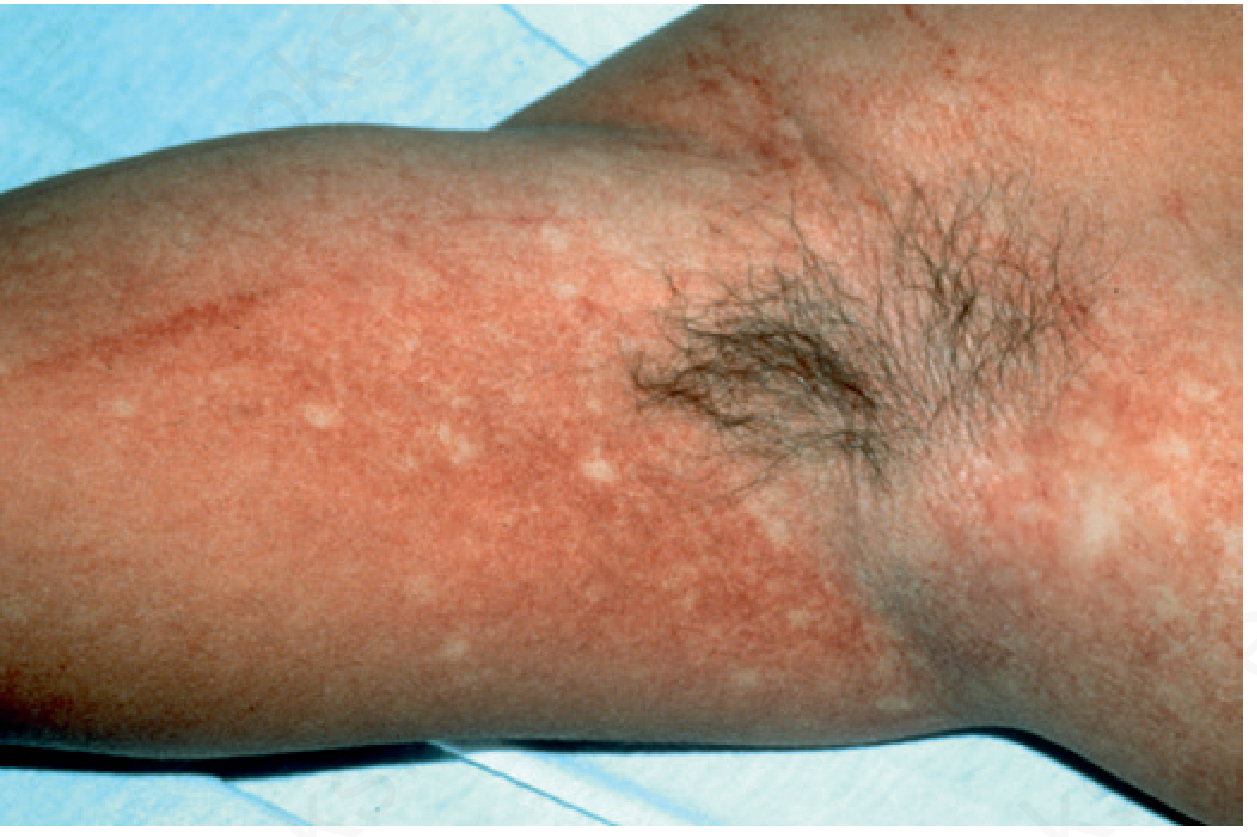
"A positive tourniquet test - the detection of 10 or more new petechiae in one square inch of the upper arm after a 5-min blood pressure cuff inflation to midway between systolic and diastolic pressure - may demonstrate microvascular damage, but this finding is more likely to be associated with severe dengue."
- Harrison's Principles of Internal Medicine, 22e
Clinical Context in Dengue
| Feature | Details |
|---|---|
| When to perform | During febrile phase (days 1-5), especially when dengue is clinically suspected |
| Best time | The test is most often positive near defervescence (days 3-5) when vascular fragility and thrombocytopenia peak |
| WHO criteria | A positive tourniquet test is one of the WHO criteria supporting a clinical diagnosis of Dengue Hemorrhagic Fever (DHF) |
| Sensitivity | Moderate; can be negative early in illness or in mild dengue; positive test is a red flag prompting urgent investigation |
| Specificity | Not specific to dengue - also positive in other viral haemorrhagic fevers, vasculitis, vitamin C deficiency, and thrombocytopenia of any cause |
Other Clinical Clues Supporting a Positive Test
- Petechiae
- Skin rash (morbilliform, "islands of white in a sea of red")
- Myalgia / retro-orbital pain
- Positive tourniquet test
- Gingival bleeding
Quick Summary Card
1. Measure BP → calculate midpoint [(systolic + diastolic) ÷ 2]
2. Inflate BP cuff to midpoint pressure
3. Keep inflated for EXACTLY 5 minutes
4. Deflate → wait 2 minutes
5. Count NEW petechiae in a 1-inch² area on forearm
6. ≥10 petechiae = POSITIVE → consistent with dengue capillary fragility
Sources: Harrison's Principles of Internal Medicine 22e (Chapter: Fever and Myalgia); Andrews' Diseases of the Skin 5e (Dengue); Medical Microbiology 9e
Dengue management protocol in pediatrics
dengue management protocol children WHO classification flowchart
Dengue Management Protocol in Pediatrics
Understanding the Disease Timeline
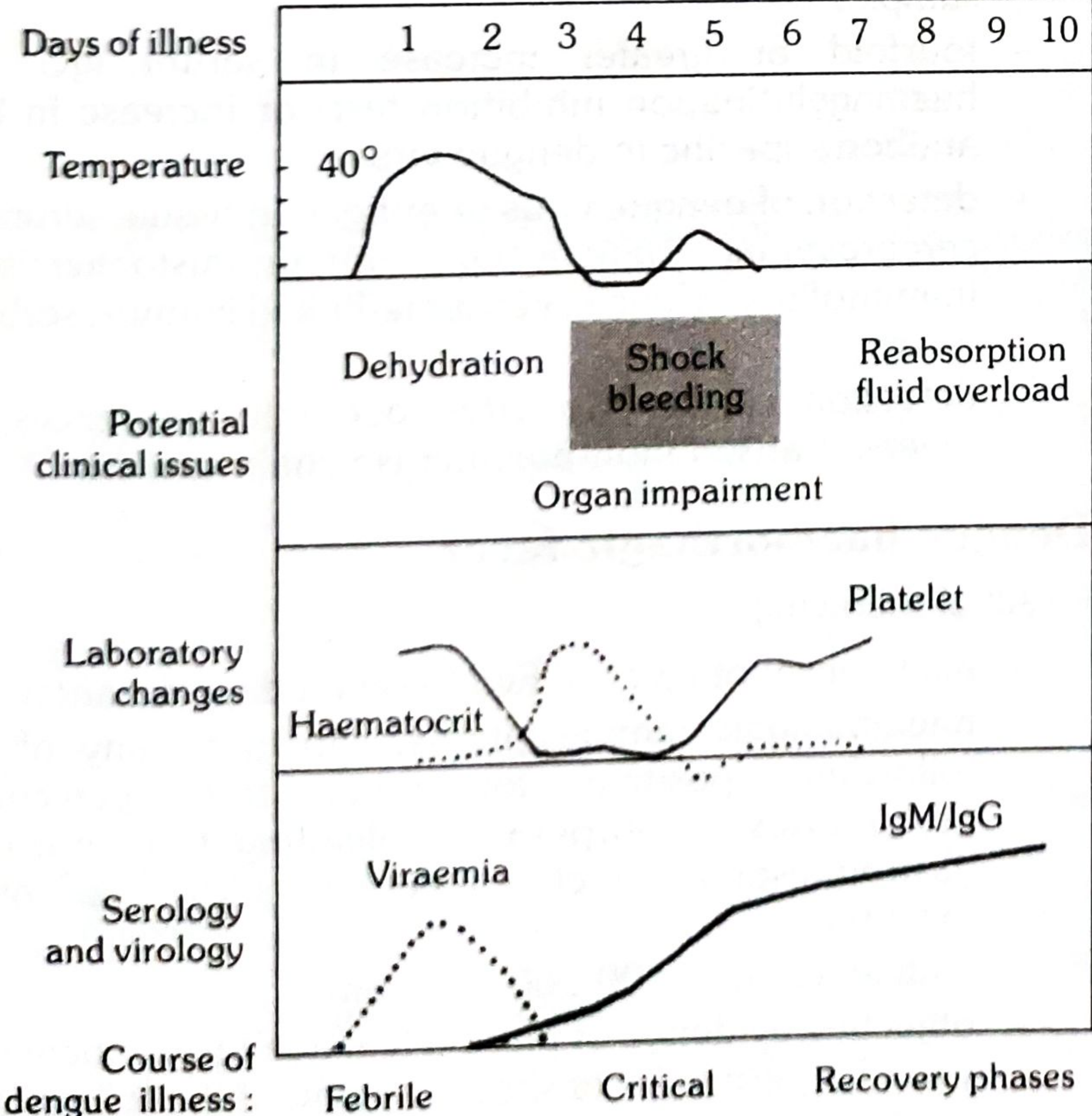
- Febrile phase (Days 1-3): High fever, myalgia, headache, rash, risk of dehydration
- Critical phase (Days 3-6, ~24-48 hrs around defervescence): Plasma leakage, rising haematocrit, falling platelets, risk of shock and bleeding - the danger window
- Recovery phase (Days 6-10): Fluid reabsorption, platelet recovery, risk of fluid overload if excess IV fluids were given
"Children usually have a milder disease than adults" - Park's Preventive & Social Medicine. However, infants, those with second infections, and those with comorbidities can deteriorate rapidly.
WHO 2009 Classification (Used to Guide Triage and Management)
| Category | Definition |
|---|---|
| Dengue without warning signs | Fever + 2 of: nausea/vomiting, rash, aches/pains, positive tourniquet test, leukopenia. No warning signs. |
| Dengue with warning signs | Any of: abdominal pain/tenderness, persistent vomiting, clinical fluid accumulation (ascites/pleural effusion), mucosal bleeding, lethargy/restlessness, liver enlargement >2 cm, rising haematocrit with rapid platelet fall |
| Severe dengue | Severe plasma leakage → shock and/or respiratory distress; severe bleeding; severe organ impairment (liver, CNS, heart, kidneys) |
GROUP A - Dengue WITHOUT Warning Signs (Home/Ambulatory Management)
Who qualifies:
- Tolerating oral fluids adequately
- Passing urine at least once every 6 hours
- No warning signs
- No comorbidities (e.g. diabetes, haemolytic anaemia, obesity)
Management:
- Paracetamol (acetaminophen): 10-15 mg/kg/dose every 4-6 hours; maximum 5 doses/24 h
- NEVER give aspirin, ibuprofen, or other NSAIDs - they increase bleeding risk and can precipitate massive haemorrhage even without severe plasma leakage
- NEVER give corticosteroids - no benefit; may worsen bleeding
- Encourage liberal oral fluids: water, oral rehydration salts (ORS), coconut water, fresh fruit juice, milk
- Target: urine output every 4-6 hours
- Avoid plain water alone in excess (risk of hyponatraemia)
| Red flag - return to hospital immediately |
|---|
| No clinical improvement or deterioration as fever subsides (Day 3-5) |
| Severe abdominal pain |
| Persistent vomiting |
| Cold/clammy extremities |
| Lethargy, confusion, or irritability |
| Bleeding: black stools, vomiting blood, heavy menstrual bleeding |
| Difficulty breathing |
| Not passing urine for >6 hours |
- Baseline CBC on Day 1
- Repeat CBC daily from Day 3 onwards; especially monitor haematocrit and platelet trend
- A haematocrit rise ≥20% from baseline signals plasma leakage → admit
GROUP B - Dengue WITH Warning Signs (Inpatient Management)
Who qualifies:
- Any warning sign present
- Platelet <100,000/µL with haematocrit rising
- Unable to tolerate oral fluids (persistent vomiting)
- Comorbidities (thalassaemia, obesity, infant <1 year)
Fluid Management:
- Isotonic crystalloid: Normal saline (0.9% NaCl) or Ringer's Lactate
- Dose: 5-7 ml/kg/hr for 1-2 hours, then reassess
| Haematocrit | Action |
|---|---|
| Improving (falling toward baseline) + clinical improvement | Reduce to 3-5 ml/kg/hr × 2-4 hrs, then 2-3 ml/kg/hr |
| Not improving + haematocrit still rising | Increase to 10 ml/kg/hr for 1 hour, reassess |
| Deteriorating → signs of shock | Move to Group C shock protocol |
Monitoring Parameters (every 1-4 hours):
- Vital signs: HR, BP, pulse pressure (PP ≤20 mmHg = shock in children), RR, temperature
- Urine output (catheterise if needed): target 0.5-1 ml/kg/hr
- Haematocrit: every 4-6 hours
- Platelet count: every 6-12 hours during the critical phase
- Blood glucose (hypoglycaemia can occur)
- Fluid balance (input/output chart)
GROUP C - Severe Dengue / Dengue Shock Syndrome (ICU-Level Care)
Dengue Shock: Defined in Children As:
- Pulse pressure ≤20 mmHg, OR
- Signs of poor capillary perfusion: cold extremities + delayed capillary refill + rapid/weak pulse
- Hypotension is a late sign; pulse pressure narrowing precedes it
Resuscitation Protocol:
- IV access (two large-bore cannulae) or intraosseous if IV access fails
- Oxygen by face mask
- Rapid IV fluid bolus: Isotonic crystalloid (NS or RL) 10 ml/kg over 15-20 minutes
Response to fluid bolus?
│
├── YES (improving HR, PP, perfusion, urine output)
│     → Reduce to 10 ml/kg/hr × 1 hr → 7 ml/kg/hr → 5 ml/kg/hr → 3 ml/kg/hr
│        (stepwise reduction over 24-48 hrs)
│
└── NO (persistent shock after 2nd bolus)
      → Switch to COLLOID (dextran 70 or 6% HES or 5% albumin)
        10 ml/kg over 30 min → reassess
        If no response → blood transfusion if haematocrit falling (significant bleeding)
- Crystalloid boluses (20-30 ml/kg) have not restored circulation
- Haematocrit is rising (plasma leakage dominant without bleeding)
- Packed Red Cells: if haematocrit is falling despite fluid resuscitation (indicates significant bleeding)
- Platelet transfusion: NOT recommended prophylactically solely based on platelet count; give only if:
- Active significant/severe bleeding AND platelets <20,000/µL
- Prophylactic platelet transfusions do not prevent bleeding and can worsen fluid overload
- Fresh Frozen Plasma (FFP) / Cryoprecipitate: only for documented coagulopathy/DIC with active bleeding
Monitoring in Shock - Every 15-30 Minutes:
- HR, BP, pulse pressure, capillary refill time
- Urine output
- Haematocrit (rising = more plasma leakage; falling = bleeding)
- Blood glucose and electrolytes
- Liver enzymes, coagulation screen if severe
Specific Complications in Children and Their Management
1. Severe Haemorrhage
- Stop aspirin/NSAIDs/corticosteroids if prescribed
- Cross-match blood; transfuse packed red cells 5-10 ml/kg if haematocrit is falling
- Correct DIC with FFP + cryoprecipitate
- ICU care, surgical consult if intra-abdominal bleeding
2. Dengue Encephalopathy / Encephalitis
- Correct hypoglycaemia (common in children), hyponatraemia, hypoxia
- IV dexamethasone (limited evidence but used in practice for cerebral oedema)
- Avoid excess IV hypotonic fluids (worsen cerebral oedema)
- Antiepileptics for seizures
3. Hepatitis / Acute Liver Failure
- Avoid hepatotoxic drugs (paracetamol maximum dose strictly)
- Vitamin K IV if coagulopathy
- Monitor LFTs daily
4. Fluid Overload (Recovery Phase)
- Can occur if IV fluids not tapered appropriately
- Features: respiratory distress, pulmonary oedema, ascites
- Management: stop IV fluids, oxygen, oral/IV furosemide if haemodynamically stable
5. Febrile Convulsions (especially infants)
- Control fever aggressively with paracetamol + tepid sponging
- Benzodiazepine (midazolam or diazepam) for active seizure
- Rule out dengue encephalopathy
Investigations Summary by Phase
| Investigation | Febrile (D1-3) | Critical (D3-6) | Recovery (D6+) |
|---|---|---|---|
| CBC + differential | Daily | Every 4-6 h | Daily until improving |
| Haematocrit | Daily | Every 4-6 h | Daily |
| Platelet count | Daily | Every 4-6 h | Daily |
| NS1 antigen | D1-5 (best D1-3) | - | - |
| IgM/IgG dengue ELISA | - | From D4-5 onwards | Most useful |
| RT-PCR | D1-5 | - | - |
| Blood glucose | If unwell | Every 2-4 h | As needed |
| LFTs, creatinine | If warning signs | If abnormal | Monitor |
| Coagulation (PT, aPTT, fibrinogen) | If severe bleeding | Active bleeding | As needed |
| CXR / Abdominal USG | If pleural effusion/ascites suspected | Yes | If fluid overloaded |
Drugs That Are Strictly CONTRAINDICATED in Dengue
| Drug | Reason |
|---|---|
| Aspirin | Platelet dysfunction + GI mucosal irritation → massive haemorrhage |
| Ibuprofen / Diclofenac / Naproxen | Same as above; can precipitate massive bleeding even without severe dengue |
| Corticosteroids | No proven benefit; can cause major GI bleeding |
| Antibiotics | Not indicated for dengue (viral illness); use only if secondary bacterial infection confirmed |
| Intramuscular injections | Avoid during thrombocytopenic phase (risk of haematoma) |
Discharge Criteria (Paediatric)
- Afebrile for at least 24-48 hours (without antipyretics)
- No warning signs present
- Improvement in clinical status (active, appetite returning)
- Platelet count trending upward (>50,000/µL and rising)
- Haematocrit stable
- Adequate urine output
- At least 48 hours since resolution of the critical phase
Quick Reference Summary Card
DAY 1-3 (Febrile)
  → Paracetamol only; NO aspirin/NSAIDs
  → Push oral fluids (ORS, juices, coconut water)
  → Daily CBC; watch for warning signs

DAY 3-6 (CRITICAL - DANGER ZONE)
  → Admit if any warning sign OR platelet <100,000 + rising Hct
  → IV crystalloid (NS/RL): 5-7 ml/kg/hr; titrate to response
  → Monitor HR, pulse pressure, urine output, Hct every 2-4 h
  → If shock: bolus 10 ml/kg crystalloid over 15-20 min, reassess
  → If refractory shock: switch to colloid
  → Do NOT give prophylactic platelets

DAY 6-10 (Recovery)
  → Taper and STOP IV fluids - risk of fluid overload
  → Platelet count will recover spontaneously
  → Watch for respiratory distress from fluid reabsorption
  → Discharge when criteria met
Sources: Park's Textbook of Preventive and Social Medicine (Dengue Haemorrhagic Fever chapter); The Harriet Lane Handbook, 23rd ed. (Pediatric Viral Illnesses); Tintinalli's Emergency Medicine (Dengue Fever); Brenner and Rector's The Kidney (Dengue Viral Infection); Brenner and Rector - WHO 2009 classification