
Brief information about Circle of willi
That was table of contents, not the actual content. Let me get the actual section at line 5772.
Reading File
I have enough information now to give a solid brief answer with a diagram.
Loading Image
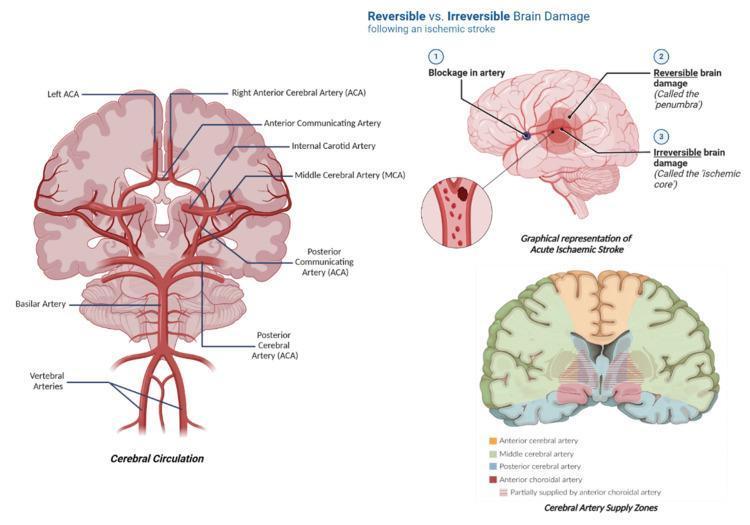
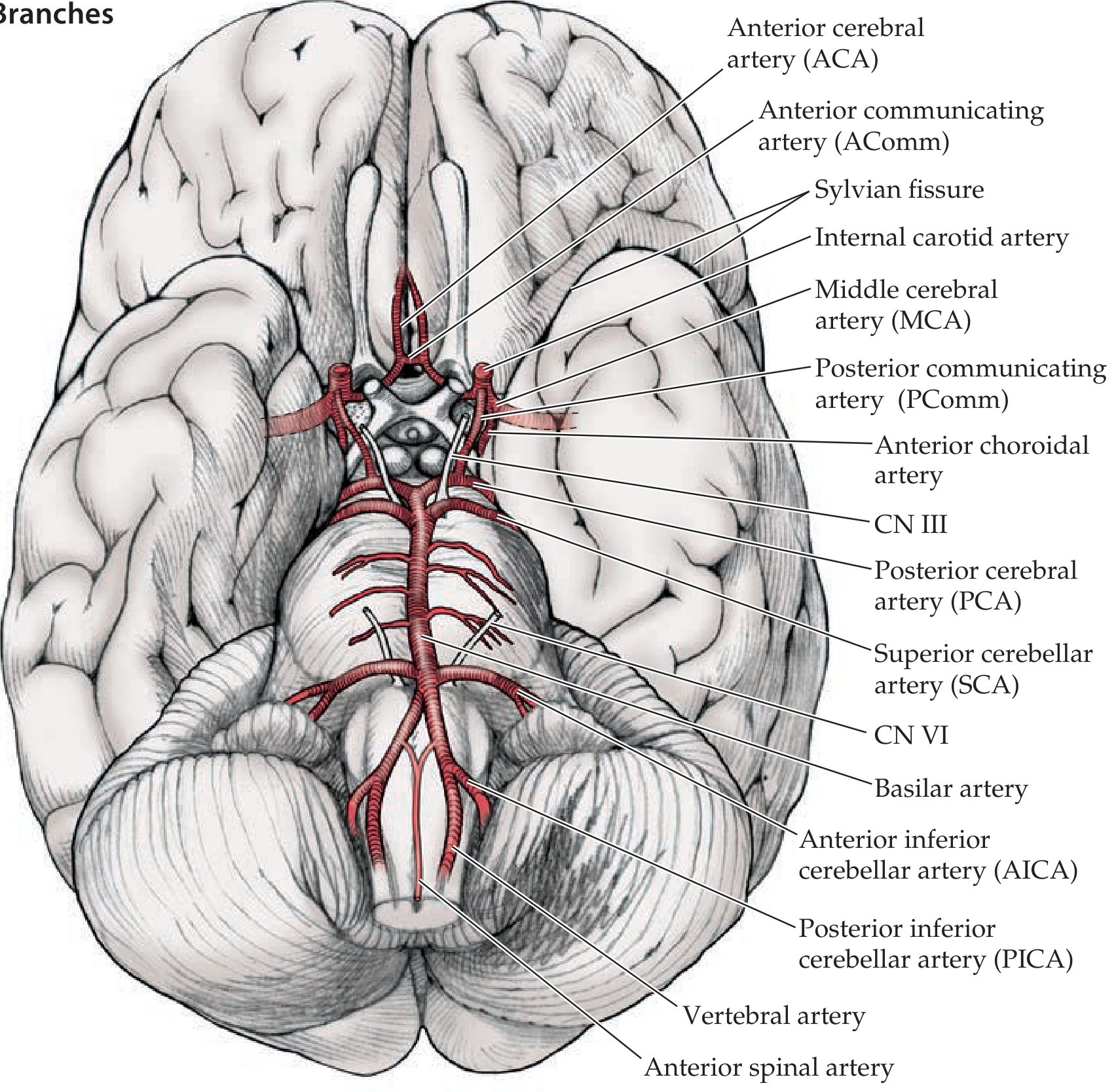
Circle of Willis - Brief Overview
The circle of Willis is an anastomotic ring of arteries at the base of the brain where the anterior circulation (from the internal carotid arteries) and posterior circulation (from the vertebral/basilar arteries) meet, giving rise to all the major cerebral vessels (Neuroanatomy through Clinical Cases, p. 416-417).
Components (anterior to posterior)
- 2 Internal carotid arteries (ICA) - terminal branches, enter the ring anterolaterally
- 2 Anterior cerebral arteries (ACA) - branches of the ICA, joined together by the...
- Anterior communicating artery (AComm) - a single midline vessel linking the two ACAs
- 2 Middle cerebral arteries (MCA) - the other terminal branch of each ICA (technically outside the ring itself, but arise from it)
- 2 Posterior communicating arteries (PComm) - connect each ICA to the corresponding PCA, linking anterior and posterior circulations
- 2 Posterior cerebral arteries (PCA) - arise from the top of the basilar artery
- Basilar artery - formed by the union of the two vertebral arteries, sits at the posterior aspect of the ring
Function
It provides collateral circulation - if one contributing vessel (e.g., a carotid or vertebral artery) becomes narrowed or occluded, blood can be redistributed around the ring from the other vessels to maintain perfusion of the brain. This protects against stroke when a single feeding artery is compromised.
Clinical Notes
- A complete, full-caliber ring is present in only about 34% of people - anatomical variants (hypoplastic or absent segments, most often the PComm or AComm) are common, which affects how well collateral flow can compensate for a blocked vessel.
- The AComm and PComm are the most common sites of saccular (berry) aneurysms, which can rupture and cause subarachnoid hemorrhage.
- Location: it encircles the optic chiasm and infundibulum of the pituitary stalk at the base of the brain (interpeduncular/suprasellar region).
Would you like more detail on clinical correlations (e.g., stroke syndromes by vessel, aneurysm sites) or a labeled image of the anterior/posterior circulation pathways?
This is a shared conversation. Sign in to Orris to start your own chat.