
Fibrous food
high fiber foods health benefits dietary fiber 2025
high fiber foods fruits vegetables legumes whole grains
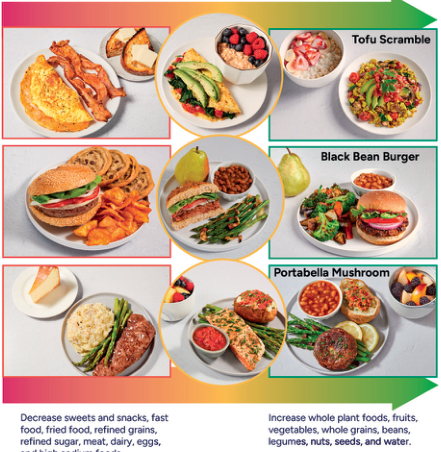
Summary : This figure visually compares typical Western-style meals with more plant-based alternatives for breakfast, lunch, and dinner, illustrating a dietary shift from foods high in sweets, snacks, fast food, fried food, refined grains, refined sugar, meat, dairy, and eggs toward meals rich in whole plant foods, fruits, vegetables, whole grains, beans, legumes, nuts, seeds, and water. photo: # Layout & Structure : • The figure is divided into three horizontal sections, each representing a meal: breakfast (top), lunch (middle), and dinner (bottom). • Each section contains three columns: left (red border, less healthy/Western-style), center (yellow border, transitional), and right (green border, plant-based/healthier). • Each meal section is labeled with a plant-based dish name in the green column: "Tofu Scramble" (breakfast), "Black Bean Burger" (lunch), and "Portabella Mushroom" (dinner). # Meal Comparisons : ## Breakfast : • Left (red): Omelet with bacon, toast, and a cookie. • Center (yellow): Vegetable omelet with avocado toast and a bowl of berries. • Right (green): Tofu scramble with vegetables, oatmeal with strawberries, and a bowl of mixed fruit. ## Lunch : • Left (red): Hamburger with potato chips and chocolate chip cookies. • Center (yellow): Grilled chicken sandwich with asparagus, baked beans, and a pear. • Right (green): Black bean burger with whole grain bun, side salad, and a pear. ## Dinner : • Left (red): Meatloaf with mashed potatoes, asparagus, and a slice of cheesecake. • Center (yellow): Salmon fillet with asparagus, brown rice, and a bowl of fruit. • Right (green): Portabella mushroom steak with baked beans, asparagus, and a bowl of mixed fruit. # Dietary Guidance (Text at Bottom) : • Left (red): "Decrease sweets and snacks, fast food, fried food, refined grains, refined sugar, meat, dairy, eggs." • Right (green): "Increase whole plant foods, fruits, vegetables, whole grains, beans, legumes, nuts, seeds, and water." # Design Encodings : • Color-coded borders (red = less healthy, yellow = transitional, green = more plant-based/healthy). • Each meal is visually represented with realistic food photography. • Plant-based meal names are labeled in the green column. # Analysis : • The figure visually communicates a dietary transition from Western-style meals high in animal products, refined grains, and sweets toward meals centered on whole plant foods. • The color gradient (red to green) reinforces the healthfulness spectrum. • The plant-based options (right column) consistently feature more fruits, vegetables, legumes, and whole grains, while the Western-style options (left column) are higher in processed foods, animal products, and sweets. • The central column offers intermediate choices, suggesting a gradual shift is possible.
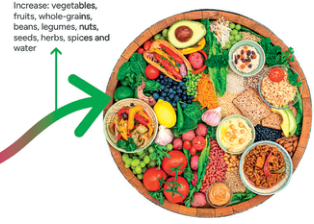
Summary : This image is an illustration of a healthy eating plate, emphasizing the increase of certain food groups for a balanced diet. illustration: Main Message : • The image shows a round plate filled with a variety of foods, primarily vegetables, fruits, whole grains, beans, legumes, nuts, seeds, and herbs. • A large green arrow points to the plate, accompanied by the text: "Increase: vegetables, fruits, whole-grains, beans, legumes, nuts, seeds, herbs, spices and water". Scene Overview : • The plate is visually divided into sections, each containing different plant-based foods such as leafy greens, tomatoes, berries, grains, nuts, and legumes. • The foods are presented in bowls and loose arrangements, with vibrant colors (greens, reds, yellows, browns) dominating the palette. • The background is white, and the plate is bordered with a wooden rim. Technical Details : • No scale bar or magnification is present. • The only on-image text is the dietary recommendation. • The illustration is clear, with high contrast and realistic food depictions. Spatial Relationships : • The arrow and text are positioned to the left of the plate, directing attention to the food selection. • Foods are evenly distributed around the plate, with no single food group dominating the visual space. Analysis : • The illustration visually reinforces the recommendation to increase intake of plant-based foods and water for a healthy diet. • The diversity of foods shown suggests variety and balance, with an emphasis on minimally processed, whole foods. • The absence of animal products or processed foods highlights a plant-forward dietary pattern.
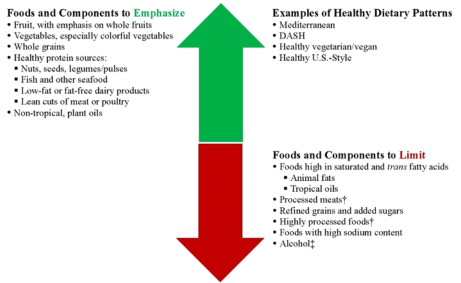
Summary : This diagram summarizes recommended and discouraged foods and dietary patterns for healthy eating, using a green upward arrow for foods to emphasize and a red downward arrow for foods to limit. infographic: # Foods and Components to Emphasize : • Fruit, with emphasis on whole fruits • Vegetables, especially colorful vegetables • Whole grains • Healthy protein sources: – Nuts, seeds, legumes/pulses – Fish and other seafood – Low-fat or fat-free dairy products – Lean cuts of meat or poultry • Non-tropical, plant oils # Examples of Healthy Dietary Patterns : • Mediterranean • DASH • Healthy vegetarian/vegan • Healthy U.S.-Style # Foods and Components to Limit : • Foods high in saturated and trans fatty acids – Animal fats – Tropical oils • Processed meats† • Refined grains and added sugars • Highly processed foods† • Foods with high sodium content • Alcohol‡ # Visual Design : • Green upward arrow for foods to emphasize (healthy choices) • Red downward arrow for foods to limit (unhealthy choices) • Emphasized and limit lists are placed on opposite sides of the arrows for contrast • Examples of healthy dietary patterns are listed near the top right # Analysis : • The diagram visually contrasts foods and dietary patterns to prioritize (emphasize) versus those to avoid or reduce (limit). • Emphasis is placed on whole, minimally processed plant foods, lean proteins, and healthy oils. • Foods to limit are characterized by high saturated/trans fats, added sugars, sodium, and processing. • The inclusion of specific dietary patterns (Mediterranean, DASH, vegetarian/vegan, Healthy U.S.-Style) provides practical frameworks for healthy eating.
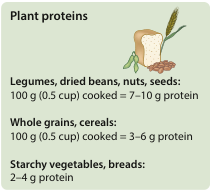
Summary : This figure presents the protein content of various plant-based food groups, including legumes, dried beans, nuts, seeds, whole grains, cereals, starchy vegetables, and breads, with specific values given per 100 g (0.5 cup) cooked. illustration: Scene Overview : • Main subject is a visual grouping of plant-based foods: a loaf of bread, wheat stalk, beans, and seeds. • The illustration is simple, with muted colours and no background details. Technical Details : • No scale bar or magnification. • No on-image UI elements or text beyond the food names. Spatial Relationships : • Foods are clustered together in the upper right of the figure, with bread in the foreground and wheat, beans, and seeds surrounding it. Data Summary : # Plant Proteins : • Legumes, dried beans, nuts, seeds: 100 g (0.5 cup) cooked = 7–10 g protein. • Whole grains, cereals: 100 g (0.5 cup) cooked = 3–6 g protein. • Starchy vegetables, breads: 2–4 g protein. Analysis : • Legumes, dried beans, nuts, and seeds provide the highest protein content per 100 g cooked (7–10 g). • Whole grains and cereals offer moderate protein (3–6 g per 100 g cooked). • Starchy vegetables and breads are the lowest in protein (2–4 g per 100 g). • The figure visually and textually categorises plant-based foods by their protein content, aiding quick comparison.
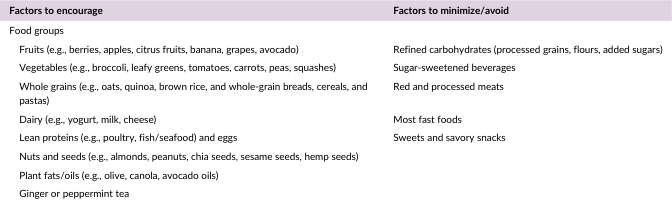
<table> <tr> <th>Factors to encourage</th> <th>Factors to minimize/avoid</th> </tr> <tr> <td> Food groups<br> Fruits (e.g., berries, apples, citrus fruits, banana, grapes, avocado)<br> Vegetables (e.g., broccoli, leafy greens, tomatoes, carrots, peas, squashes)<br> Whole grains (e.g., oats, quinoa, brown rice, and whole-grain breads, cereals, and pastas)<br> Dairy (e.g., yogurt, milk, cheese)<br> Lean proteins (e.g., poultry, fish/seafood) and eggs<br> Nuts and seeds (e.g., almonds, peanuts, chia seeds, sesame seeds, hemp seeds)<br> Plant fats/oils (e.g., olive, canola, avocado oils)<br> Ginger or peppermint tea </td> <td> Refined carbohydrates (processed grains, flours, added sugars)<br> Sugar-sweetened beverages<br> Red and processed meats<br> Most fast foods<br> Sweets and savory snacks </td> </tr> </table>
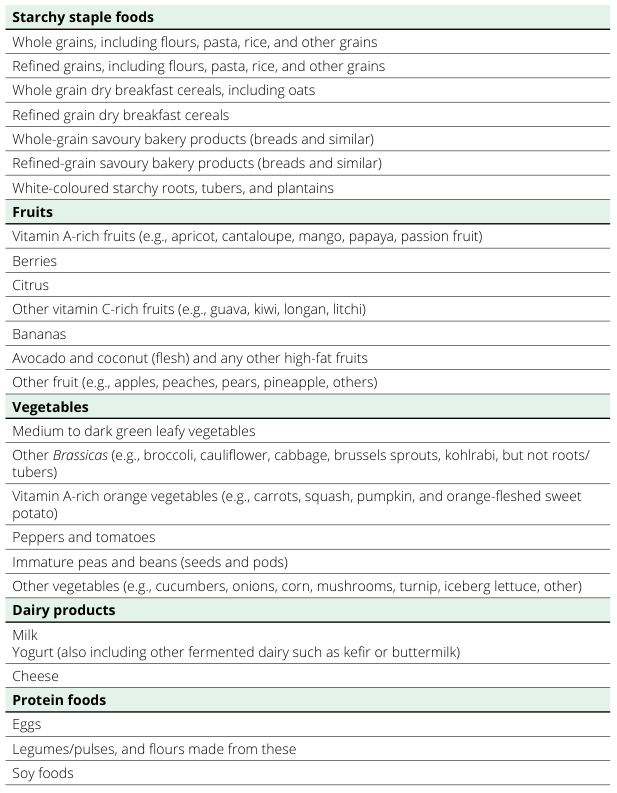
<table><thead><tr><th>Starchy staple foods</th></tr></thead><tbody><tr><td>Whole grains, including flours, pasta, rice, and other grains</td></tr><tr><td>Refined grains, including flours, pasta, rice, and other grains</td></tr><tr><td>Whole grain dry breakfast cereals, including oats</td></tr><tr><td>Refined grain dry breakfast cereals</td></tr><tr><td>Whole-grain savoury bakery products (breads and similar)</td></tr><tr><td>Refined-grain savoury bakery products (breads and similar)</td></tr><tr><td>White-coloured starchy roots, tubers, and plantains</td></tr><tr><th>Fruits</th></tr><tr><td>Vitamin A-rich fruits (e.g., apricot, cantaloupe, mango, papaya, passion fruit)</td></tr><tr><td>Berries</td></tr><tr><td>Citrus</td></tr><tr><td>Other vitamin C-rich fruits (e.g., guava, kiwi, longan, litchi)</td></tr><tr><td>Bananas</td></tr><tr><td>Avocado and coconut (flesh) and any other high-fat fruits</td></tr><tr><td>Other fruit (e.g., apples, peaches, pears, pineapple, others)</td></tr><tr><th>Vegetables</th></tr><tr><td>Medium to dark green leafy vegetables</td></tr><tr><td>Other Brassicas (e.g., broccoli, cauliflower, cabbage, brussels sprouts, kohlrabi, but not roots/tubers)</td></tr><tr><td>Vitamin A-rich orange vegetables (e.g., carrots, squash, pumpkin, and orange-fleshed sweet potato)</td></tr><tr><td>Peppers and tomatoes</td></tr><tr><td>Immature peas and beans (seeds and pods)</td></tr><tr><td>Other vegetables (e.g., cucumbers, onions, corn, mushrooms, turnip, iceberg lettuce, other)</td></tr><tr><th>Dairy products</th></tr><tr><td>Milk</td></tr><tr><td>Yogurt (also including other fermented dairy such as kefir or buttermilk)</td></tr><tr><td>Cheese</td></tr><tr><th>Protein foods</th></tr><tr><td>Eggs</td></tr><tr><td>Legumes/pulses, and flours made from these</td></tr><tr><td>Soy foods</td></tr></tbody></table>
Fibrous Foods: A Complete Guide
What Is Dietary Fiber?
Two Main Types of Fiber
1. Soluble Fiber (Dispersible)
| Type | Source |
|---|---|
| Pectins (galacturonans, β-glucans) | Apples, strawberries, carrots, citrus |
| Gums (galactomannans) | Oats, legumes, guar, barley |
| Mucilages | Flaxseed, psyllium, mustard seed |
2. Insoluble Fiber
| Type | Source |
|---|---|
| Cellulose | Whole wheat flour, unprocessed bran, vegetables |
| Hemicelluloses | Bran cereals, whole grains |
| Lignin | Fruits, edible seeds, mature vegetables |
Top High-Fiber Foods
Legumes (highest fiber density)
- Lentils: ~15g per cooked cup
- Black beans, chickpeas, kidney beans: 12-15g per cup
- Split peas: ~16g per cup
Whole Grains
- Oats (also rich in β-glucan soluble fiber)
- Barley, quinoa, brown rice
- Whole wheat bread and pasta
- Bran cereals
Vegetables
- Artichokes: ~10g each
- Green peas: ~9g per cup
- Broccoli: ~5g per cup
- Carrots, corn, beets, mushrooms: 3-4g per cup
- Sweet potato (with skin): ~4g
Fruits
- Avocado: ~10g per fruit
- Pears (with skin): ~5.5g
- Raspberries, blackberries: ~8g per cup
- Apples (with skin), bananas, oranges: 3-4g
Nuts & Seeds
- Chia seeds: ~10g per 2 tablespoons
- Flaxseed, almonds, pistachios: 3-4g per serving
How Much Do You Need?
| Group | Daily Fiber Target |
|---|---|
| Men 19-50 | 31-34 g |
| Men 50+ | 28 g |
| Women 19-50 | 25-28 g |
| Women 50+ | 22 g |
Health Benefits of Fiber
- Heart health - Soluble fiber (especially oat β-glucan and pectins) lowers LDL cholesterol by reducing bile acid reabsorption; also lowers blood pressure and inflammation
- Blood sugar control - Slows digestion and glucose absorption, improves insulin sensitivity - key for diabetes prevention and management
- Digestive health - Prevents constipation, reduces risk of diverticular disease and colorectal cancer
- Weight management - High-fiber foods are more filling and lower in calorie density, helping reduce overall intake
- Gut microbiome - Fermentable fibers feed beneficial gut bacteria and boost SCFA production
- Longevity - Higher fiber intake is linked to lower risk of death from any cause, including cardiovascular disease (Frontiers in Nutrition, 2024)
Visual: Dietary Shift Toward Fiber-Rich Foods
Practical Tips to Increase Fiber Intake
- Swap refined grains for whole grains (white rice → brown rice, white bread → whole wheat)
- Add legumes to soups, salads, and stews 3-4 times per week
- Eat fruit with the skin whenever possible (apples, pears)
- Start breakfast with oats or high-fiber cereal
- Add chia or flaxseed to smoothies, yogurt, or oatmeal
- Choose vegetables as snacks - carrots, celery, bell peppers
- Increase intake gradually and drink plenty of water to avoid bloating and gas