
Tell the function of Na+ K+ pump
The Na+/K+ ATPase pump is a transmembrane protein that actively transports 3 sodium ions (Na+) out of the cell and 2 potassium ions (K+) into the cell per cycle, using one ATP molecule. This maintains the electrochemical gradients essential for cell function, establishes the resting membrane potential, and regulates cell volume.
Searching sources...
Reading File
Finding Sources
Finding Sources
Reading File
Reading File
Reading File
Loading Image
Here is a detailed breakdown of the Na+/K+ ATPase Pump functions, drawn from Guyton & Hall and Medical Physiology textbooks:
Na+/K+ Pump (Na+-K+ ATPase) - Functions
Structure
The pump is a transmembrane protein complex with two subunits:
- Alpha (α) subunit (~100,000 molecular weight) - the functional unit
- Beta (β) subunit (~55,000 molecular weight) - anchors the complex in the lipid membrane
The α subunit has:
- 3 binding sites for Na+ on the intracellular side
- 2 binding sites for K+ on the extracellular side
- ATPase activity on its intracellular portion
Mechanism of Action
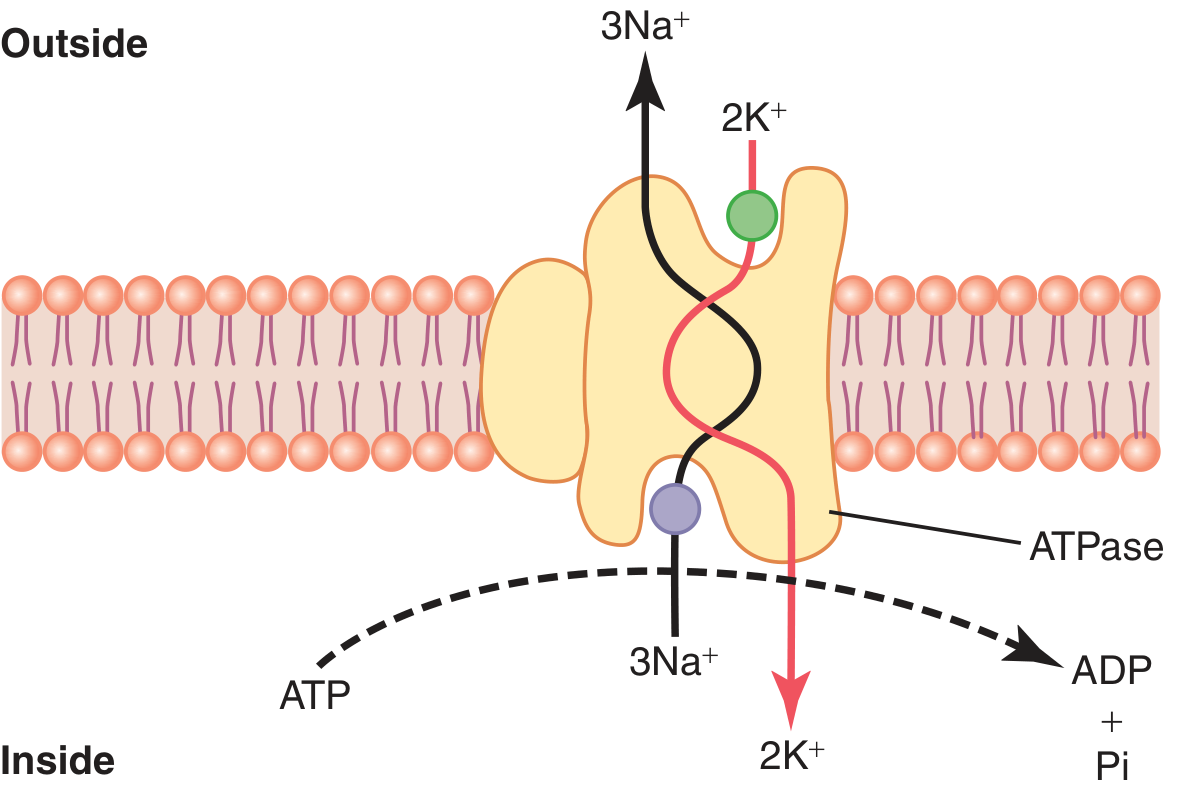
Figure: The Na+/K+ pump transports 3 Na+ out and 2 K+ in per cycle, hydrolyzing one ATP to ADP + Pi. (Guyton & Hall, Medical Physiology)
Per cycle:
- 3 Na+ ions bind inside the cell to the α subunit
- 2 K+ ions bind on the outside
- 1 ATP is cleaved to ADP + phosphate (Pi)
- Released energy causes a conformational change
- 3 Na+ are extruded outside; 2 K+ are pumped inside
The pump cycles through 8 conformational states (E1 and E2 forms), and under extreme conditions can actually run in reverse to synthesize ATP.
Key Functions
1. Maintains Ion Concentration Gradients
The pump keeps intracellular Na+ low and intracellular K+ high relative to extracellular fluid (ECF). This is the only primary active transport mechanism for Na+ in animal cells. - Medical Physiology, Boron & Boulpaep
2. Establishes the Resting Membrane Potential
Because the pump is electrogenic (3 Na+ out vs 2 K+ in = net positive charge leaving the cell), it creates a negative electrical potential inside the cell. This is a basic requirement for nerve conduction and muscle signaling. - Guyton & Hall, p.72
3. Controls Cell Volume
Inside the cell, large negatively charged proteins attract cations (Na+, K+), which drives osmotic water entry. Without the pump, cells would swell and burst. The pump continuously expels more ions (net loss) than it brings in, which draws water out of the cell. If a cell begins to swell, the pump is automatically activated to restore normal volume. - Guyton & Hall, p.72
4. Drives Secondary Active Transport
Many other transporters (co-transporters, antiporters) depend on the Na+ gradient created by the pump. By maintaining low intracellular [Na+], the pump provides the "downhill" gradient that drives secondary transport of glucose, amino acids, and other solutes into cells. - Medical Physiology
5. Energy Demand
In metabolically active cells like neurons, 60-70% of the cell's total energy may be used just by the Na+/K+ pump. This reflects how critical maintaining these gradients is to normal cell function. - Guyton & Hall
Summary Table
| Feature | Detail |
|---|---|
| Ions transported | 3 Na+ out, 2 K+ in (per cycle) |
| Energy source | 1 ATP hydrolyzed per cycle |
| Type | Primary active transport (P-type ATPase) |
| Electrogenic? | Yes (net 1+ charge moves outward per cycle) |
| Inhibitor | Ouabain, cardiac glycosides (e.g., digoxin) |
| Main functions | Ion gradients, membrane potential, cell volume, drives secondary transport |
This is a shared conversation. Sign in to Orris to start your own chat.