
Concept of ponseti cast
I'll read the medical library skill first, then search for Ponseti casting content.
Reading File
Now let me search the library and web in parallel.
Finding Sources
Finding Sources
Searching the Web
Ponseti casting method clubfoot concept technique
Excellent. Now let me read the key textbook sections in parallel.
Reading File
Reading File
Let me read more of the Campbell's section which has the detailed application technique.
Reading File
Loading Image
I have comprehensive textbook content. Let me now compile the full answer.
Ponseti Casting - Concept and Technique
What is the Ponseti Method?
The Ponseti method is a systematic, non-surgical approach to correcting congenital clubfoot (talipes equinovarus) using serial manipulation and casting. Developed by Dr. Ignacio Ponseti at the University of Iowa, it has become the global standard of care, achieving correction in over 90-95% of idiopathic cases without the need for formal surgical release.
- Campbell's Operative Orthopaedics, 15th Ed.
- Bailey and Love's Short Practice of Surgery, 28th Ed.
The Deformity Being Corrected (CAVE)
Clubfoot has four components corrected in a specific order, remembered by the mnemonic CAVE:
| Component | Deformity | Correction Order |
|---|---|---|
| C - Cavus | High arch / plantar flexion of 1st ray | 1st |
| A - Adductus | Forefoot adduction | 2nd |
| V - Varus | Hindfoot varus | 3rd |
| E - Equinus | Plantarflexion of the hindfoot | Last |
The equinus is always corrected last, because attempting to dorsiflex the foot before correcting the varus creates a rocker-bottom deformity.
The Key Anatomical Principle
The head of the talus acts as the fulcrum around which all correction occurs. The navicular, calcaneus, and forefoot are rotated around the talar head. Crucially, the calcaneus is NOT directly manipulated to correct varus - instead, abducting the forefoot against the fixed talar head simultaneously unlocks and corrects the hindfoot varus.
Two Phases of Treatment
Phase 1 - Treatment Phase (Casting)
Timing: Begins ideally within the first 2-4 weeks of life. Older children can also be treated.
Frequency: Weekly cast changes (an accelerated biweekly schedule is an accepted modification).
Cast type: Above-knee (toe-to-groin) long leg plaster cast with the knee at ~90° flexion. This prevents cast slippage and controls rotation.
Step-by-step technique (Campbell's, Technique 31.10):
-
First Cast - Correct Cavus
- Supinate (dorsiflex) the first metatarsal to bring the forefoot in line with the hindfoot.
- This removes the apparent cavus by aligning the forefoot with the heel.
- Applied as a short leg cast first, then extended above the knee once set.
-
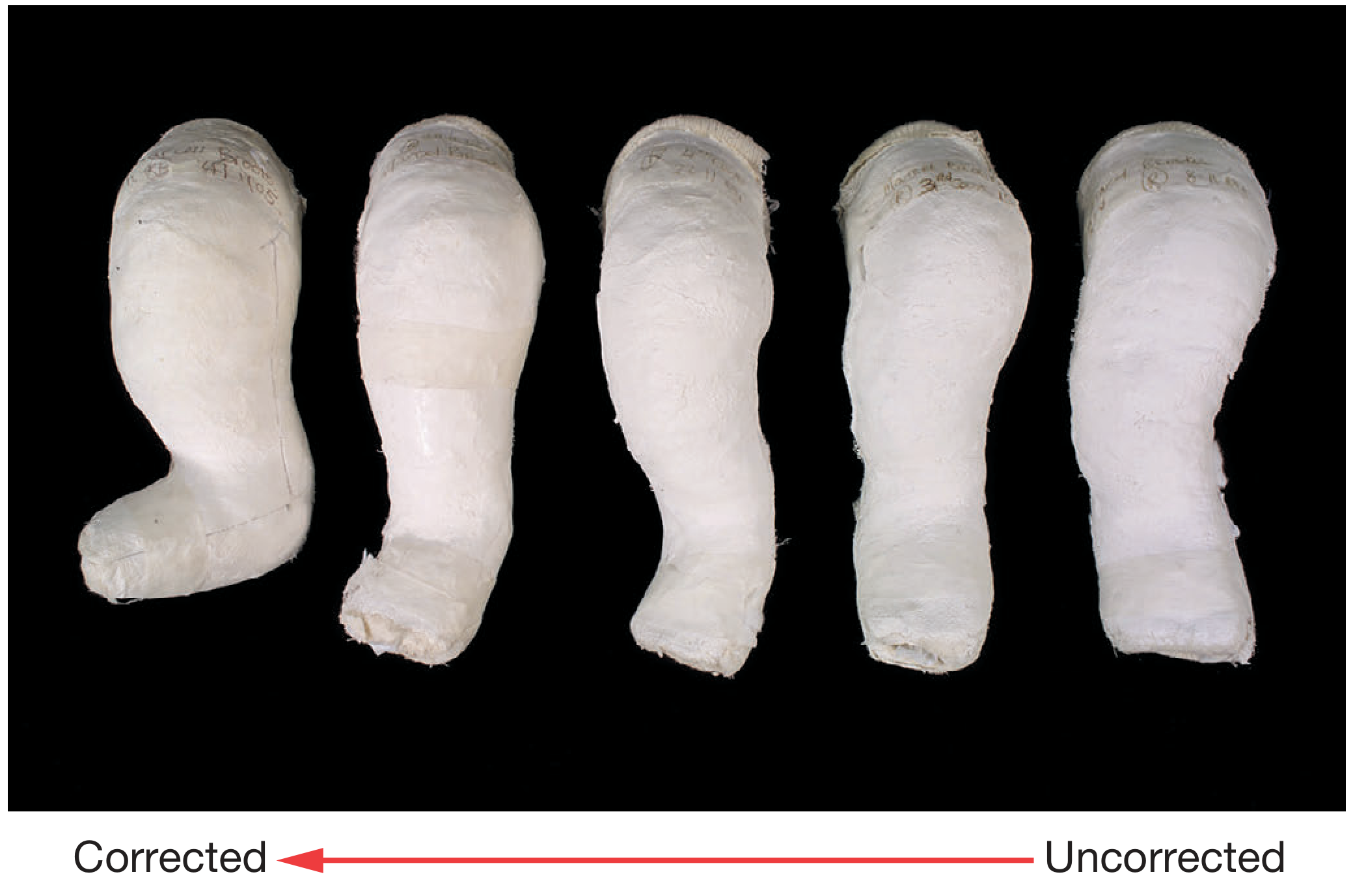
Subsequent Casts - Correct Adductus and Varus simultaneously
- Thumb is placed over the lateral aspect of the talar head (the fulcrum).
- The forefoot is abducted (externally rotated) against the stabilized talar head.
- The varus of the hindfoot self-corrects as the calcaneus rotates under the talus.
- Forefoot is gradually abducted to 60-70° of external rotation over successive casts.
- Never apply direct pressure to the heel or the calcaneus - this causes iatrogenic rocker-bottom.
-
Final Cast - Correct Equinus
- Once 60-70° of forefoot abduction is achieved, dorsiflexion is gently applied.
- ~80% of feet need a percutaneous Achilles tenotomy first (due to tight tendo Achillis preventing dorsiflexion beyond neutral).
- The tenotomy is a minor outpatient procedure under local anaesthesia.
- After tenotomy, a final cast is applied for 3 weeks to allow tendon healing.
Total number of casts: Typically 5-8 casts over 5-8 weeks.
Here is what the serial casts look like - progressing from uncorrected (right) to corrected (left):
Phase 2 - Maintenance Phase (Bracing)
After the final cast is removed, the corrected position must be maintained with a Foot Abduction Orthosis (FAO) - also called a Denis-Browne bar:
- Full-time (23 hrs/day) for the first 3 months
- Night and nap time for the next 4-5 years
The affected foot is held in ~70° external rotation and slight dorsiflexion; in bilateral cases, both feet are abducted. Non-compliance with the FAO is the single most important cause of relapse.
Scoring / Classification Systems Used
-
Pirani Score (0-6 scale): Grades severity using 6 signs - curved lateral border, medial crease, lateral head of talus palpability (midfoot) + posterior crease, rigid equinus, empty heel (hindfoot). Used to track correction progress with each cast.
-
Dimeglio Classification: Grades based on 4 parameters (derotation, adduction, varus, equinus) on a 0-4 scale each (total 0-20).
Outcomes and Recurrence
| Parameter | Data |
|---|---|
| Success rate (idiopathic) | >90-95% |
| Achilles tenotomy required | ~80% of cases |
| Recurrence rate | 10-30% |
| Most important recurrence factor | Non-compliance with FAO brace |
| Recurrence management | Repeat casting +/- tenotomy; TATT at 2.5-4 years if dynamic supination persists |
Feet treated with Ponseti casting are less stiff, less painful, and less subject to overcorrection than surgically treated feet. - Bailey and Love, 28th Ed.
When Ponseti Fails
If conservative treatment fails, surgical intervention (posterolateral soft tissue release) is performed ideally before walking age, using Turco or Cincinnati incisions for sequential release of pathologically tight structures. Surgery is more often required in non-idiopathic clubfoot (e.g., arthrogryposis, myelomeningocele-associated).
Summary Mnemonics
Order of correction: CAVE (Cavus → Adductus → Varus → Equinus)
Key principles:
- Talar head = fulcrum
- Never compress the heel directly
- Abduct forefoot to 60-70° before treating equinus
- Compliance with FAO is everything
This is a shared conversation. Sign in to Orris to start your own chat.