
Nuclei acid
Reading File
"Nucleic acid" is a broad foundational biochemistry topic. Let me search the medical library and web in parallel for comprehensive coverage.
Finding Sources
Searching the Web
nucleic acids DNA RNA structure function biochemistry overview
Finding Sources
Finding Sources
The best source is Basic Medical Biochemistry. Let me read that section directly.
Reading File
Finding Sources
Finding Sources
Found the perfect section. Let me read the key textbook sections on nucleic acid structure, components, and function.
Reading File
Reading File
Excellent content found. Let me fetch the nucleotide structure diagram and read more detail on DNA double helix and RNA types.
Loading Image
Reading File
Reading File
I now have comprehensive content to give a thorough answer. Let me also fetch the DNA helix forms image.
Loading Image
Now I have everything needed for a comprehensive answer.
Nucleic Acids
Nucleic acids are the informational macromolecules of the cell — they store, transmit, and express genetic information. The two main types are DNA (deoxyribonucleic acid) and RNA (ribonucleic acid).
1. Building Blocks: Nucleotides
Every nucleic acid is a polymer of nucleotides. Each nucleotide has three components:
| Component | DNA | RNA |
|---|---|---|
| Nitrogenous base | A, G (purines); C, T (pyrimidines) | A, G (purines); C, U (pyrimidines) |
| Sugar | Deoxyribose (no 2'-OH) | Ribose (has 2'-OH) |
| Phosphate | 1–3 phosphate groups | 1–3 phosphate groups |
Nucleoside = base + sugar (no phosphate)
Nucleotide = nucleoside + phosphate(s) at the 5'-OH
Common abbreviations: ATP, GTP, CTP, UTP (RNA precursors); dATP, dGTP, dCTP, dTTP (DNA precursors). Diphosphates (DP) and monophosphates (MP) are also named accordingly (e.g., GDP, AMP).
Polynucleotide chain
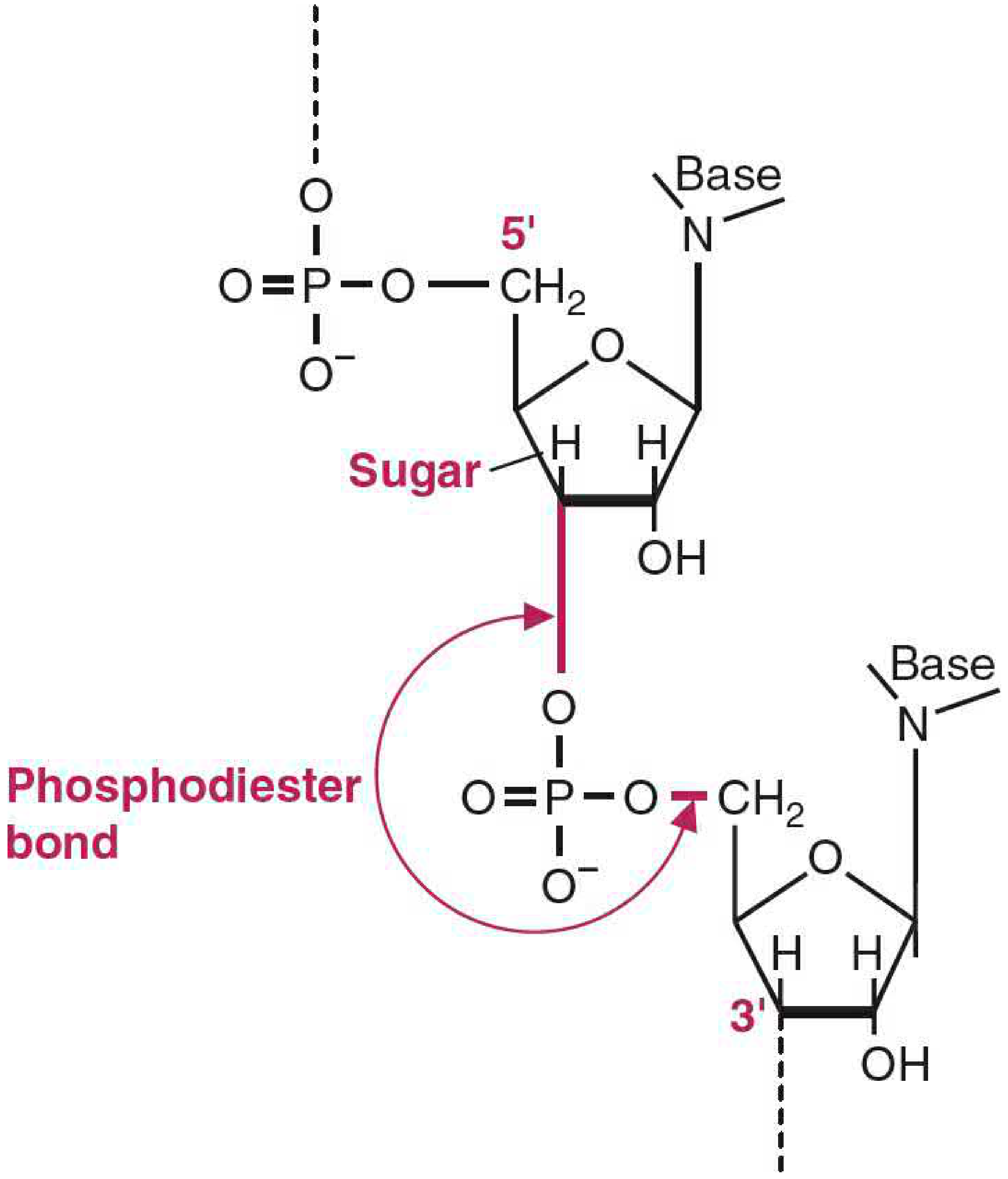
Nucleotides are linked by 3'→5' phosphodiester bonds — the phosphate group bridges the 3'-carbon of one sugar and the 5'-carbon of the next, forming the backbone. The bases project outward and can interact with other bases or proteins.
2. DNA Structure
The Double Helix
Watson and Crick (1953) established that DNA is double-stranded — two antiparallel polynucleotide chains wound into a right-handed helix, held together by hydrogen bonds between complementary base pairs:
- A pairs with T (2 hydrogen bonds)
- G pairs with C (3 hydrogen bonds)
The strands are antiparallel: one runs 5'→3', the other runs 3'→5'. The bases are stacked inside the helix (hydrophobic stacking interactions stabilize the structure), while the phosphate-sugar backbone is on the outside.
Forms of DNA
| Form | Helix | Base pairs/turn | Rise/bp | Notes |
|---|---|---|---|---|
| B-DNA | Right-handed | 10.4 | 3.4 Å | Predominant form in vivo |
| A-DNA | Right-handed | 11 | 2.3 Å | Found in DNA–RNA hybrids; more compact |
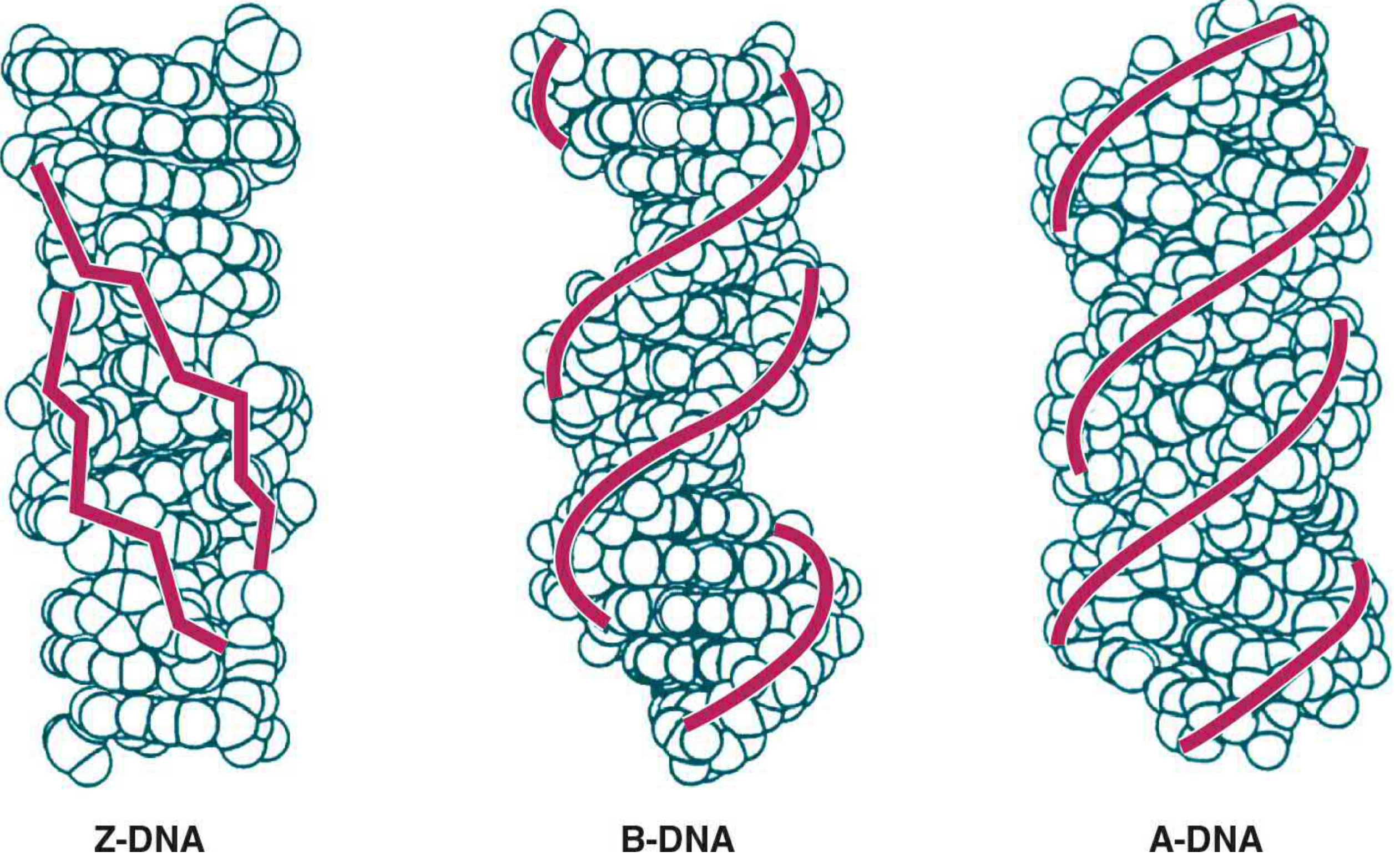
| Z-DNA | Left-handed | 11 | 3.8 Å | Phosphates zig-zag; transiently formed near transcription start sites |
Denaturation and Renaturation
- Alkali causes strand separation but does not break phosphodiester bonds in DNA (in RNA, the 2'-OH is activated → RNA is cleaved).
- Heat also denatures DNA; the Tm (melting temperature) is the temperature at which 50% of the DNA is single-stranded.
- On slow cooling, complementary strands re-anneal (hybridize) — this principle underlies PCR, Southern blotting, and many diagnostic molecular techniques.
3. RNA — Types and Functions
Transcription of a DNA gene produces a single-stranded RNA with the same sequence as the coding strand (with U replacing T).
| Type | Function |
|---|---|
| mRNA (messenger RNA) | Carries the coding sequence (codons) from DNA to ribosomes for translation into protein. In eukaryotes: 5' cap + coding region + 3' poly(A) tail. |
| rRNA (ribosomal RNA) | Structural and catalytic component of ribosomes; has extensive internal base-pairing. Forms ribonucleoprotein particles that bind mRNA and tRNA during translation. |
| tRNA (transfer RNA) | Adaptor molecule that brings the correct amino acid to the ribosome. Has a cloverleaf secondary structure; contains the anticodon (trinucleotide complementary to the mRNA codon) and the amino acid attachment site. |
| snRNA/miRNA/siRNA | Regulatory and processing roles (splicing, gene silencing, etc.) |
4. Central Dogma
DNA → (Transcription) → RNA → (Translation) → Protein
- Replication: DNA → DNA (semi-conservative; DNA polymerase)
- Transcription: DNA → RNA (RNA polymerase)
- Translation: mRNA → Protein (ribosomes, tRNA, amino acids)
5. Key Chemical Differences: DNA vs. RNA
| Feature | DNA | RNA |
|---|---|---|
| Sugar | 2'-deoxyribose | Ribose |
| Bases | A, G, C, T | A, G, C, U |
| Strands | Double | Single (usually) |
| Stability | More stable (no 2'-OH) | Less stable (cleaved by alkali) |
| Location | Nucleus, mitochondria | Nucleus, cytoplasm |
| Function | Information storage | Information expression |
6. Clinical Relevance
- Nucleic acid tests (NATs): PCR and related amplification methods detect pathogen DNA/RNA for infectious disease diagnosis (e.g., HIV viral load, COVID-19 PCR, TB NAAT).
- Intercalating drugs: Doxorubicin (adriamycin) slips between stacked base pairs, inhibiting DNA replication and transcription — used in lymphoma and other cancers. It preferentially affects rapidly dividing cells.
- Nucleoside analog drugs: Antivirals (acyclovir, tenofovir) and chemotherapeutics (5-fluorouracil) are modified nucleotides that disrupt DNA/RNA synthesis.
- Circulating nucleic acids: Free DNA and RNA in plasma are biomarkers for cancer (liquid biopsy), prenatal diagnosis (cell-free fetal DNA), and organ transplant rejection.
Sources: Basic Medical Biochemistry – A Clinical Approach, 6e (Lieberman & Marks), pp. 353–370; Henry's Clinical Diagnosis and Management by Laboratory Methods; Ganong's Review of Medical Physiology, 26e.
This is a shared conversation. Sign in to Orris to start your own chat.