
Member 3: Mechanism of Hydrochloric Acid (HCl) Secretion - 148 Role of parietal cells H⁺/K⁺ ATPase proton pump mechanism Carbonic anhydrase role Chloride movement and formation of HCl Functions of gastric acid Give me points for this based on the slide and u can get more info from other certified books and all of this I want to add in my eposter but give me all the info first and then give me a summarized version of it for me to add in a part of my eposter . It will be good if u add diagrams in this
cd /tmp/workspace/attachments/91ce2096-5684-4245-b747-78d571b60870 && python3 -c " import pdfplumber with pdfplumber.open('L8.pdf') as pdf: print('Total pages:', len(pdf.pages)) for i, page in enumerate(pdf.pages): text = page.extract_text() or '' if 'parietal' in text.lower() or 'hydrochloric' in text.lower() or 'H+/K+' in text or 'proton pump' in text.lower(): print('---PAGE', i+1, '---') print(text[:800]) print() "
parietal cell H+/K+ ATPase proton pump gastric acid secretion diagram
parietal cell proton pump gastric acid secretion
gastric acid secretion parietal cell proton pump
1. Full Detailed Notes
A. Role of Parietal (Oxyntic) Cells
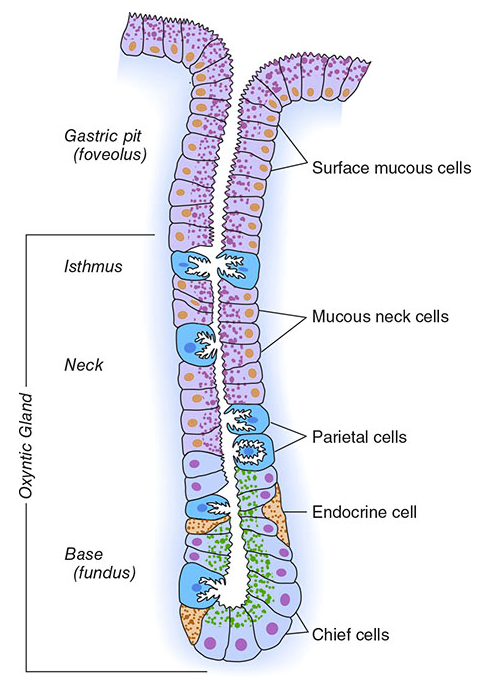
- Located in the oxyntic (gastric) glands of the fundus/body of the stomach, mainly in the neck-to-base region.
- Secrete two products: hydrochloric acid (HCl) and intrinsic factor (needed for vitamin B12 absorption in the terminal ileum; its absence causes pernicious anemia).
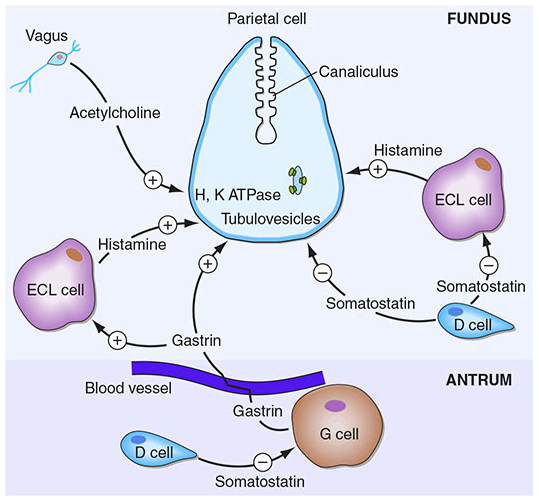
- Ultrastructure changes with activity: a resting parietal cell has few microvilli, short intracellular canaliculi, and abundant cytoplasmic tubulovesicles. On stimulation, the tubulovesicles fuse with the apical membrane, dramatically increasing the canalicular surface area studded with microvilli, which houses the H⁺/K⁺-ATPase pumps and provides more surface for acid secretion. Parietal cells are also rich in mitochondria, reflecting the high energy demand of active transport (Junqueira's Histology, p. 766-767).
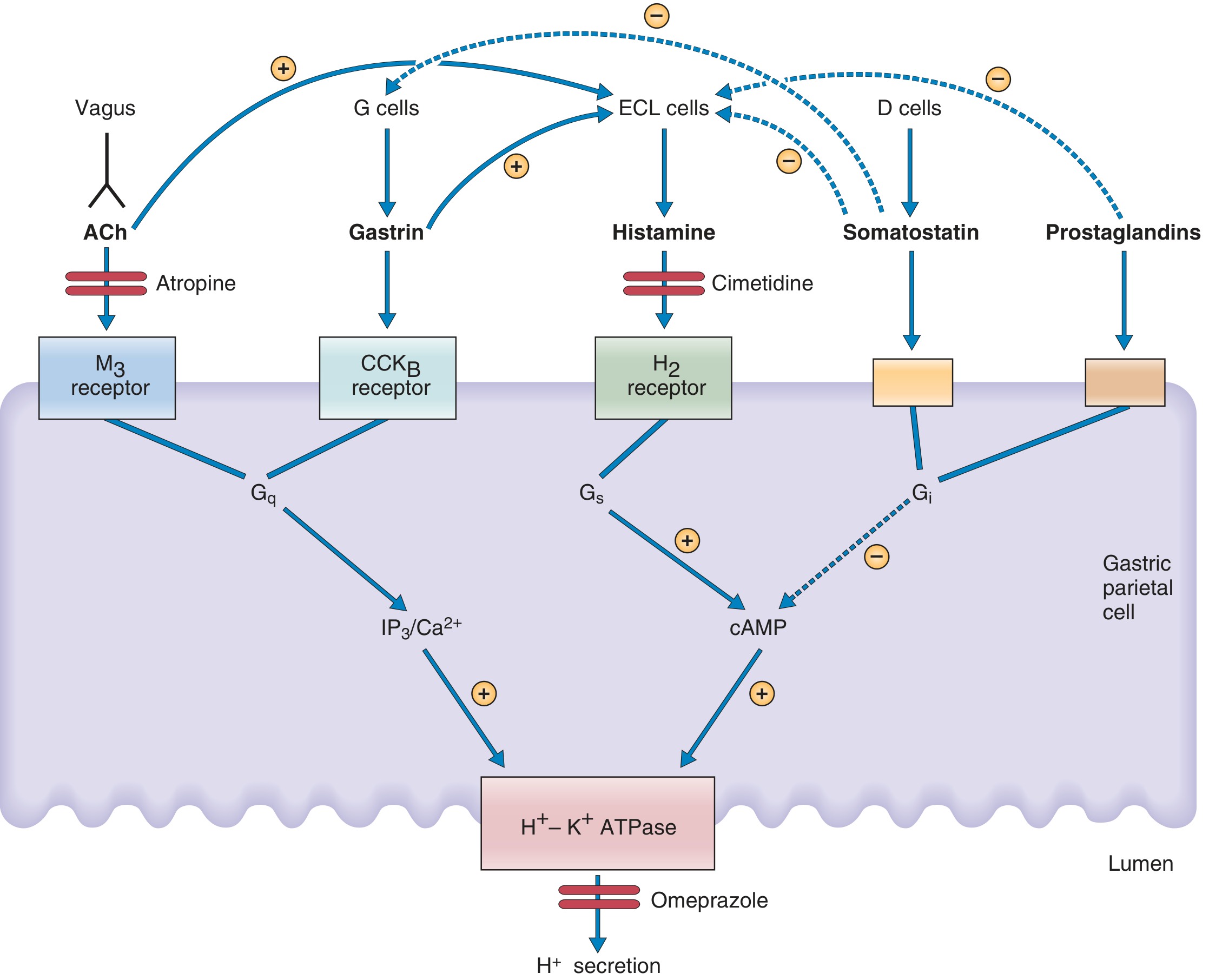
- Regulated by three convergent pathways acting on basolateral receptors: Acetylcholine (M3 receptor, vagal/neurocrine), Gastrin (CCK-B receptor, endocrine, from antral G cells), and Histamine (H2 receptor, paracrine, from ECL cells). All three converge to insert/activate H⁺/K⁺-ATPase pumps into the canalicular membrane.
B. H⁺/K⁺-ATPase Proton Pump Mechanism
- Parietal cells secrete HCl at a concentration of about 160 mmol/L - roughly a million-fold H⁺ gradient compared to blood, driven by the H⁺/K⁺-ATPase (proton pump) located on the canalicular (apical) membrane.
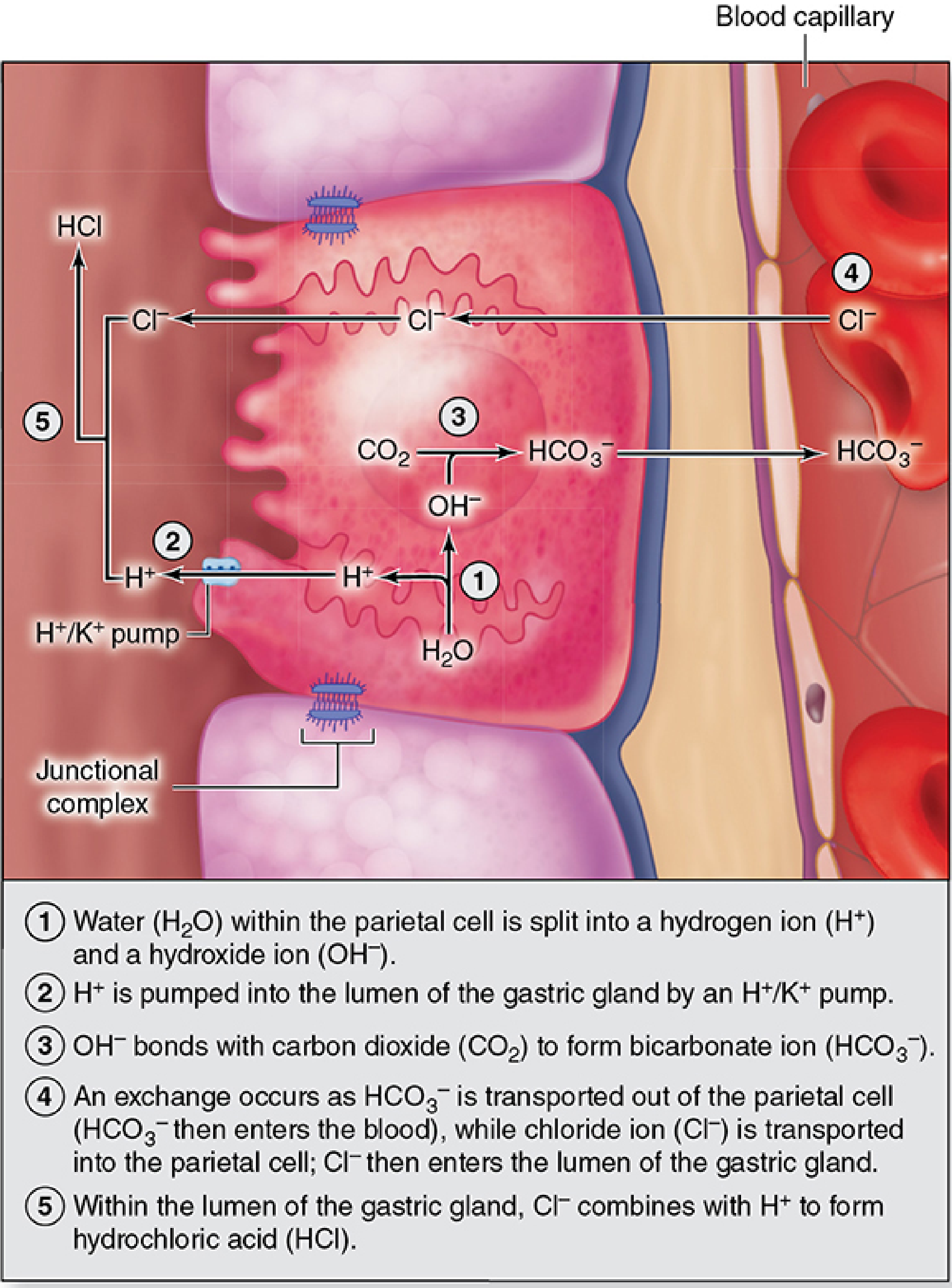
- This is a primary active transport process: it pumps H⁺ out of the cell into the canaliculus in exchange for K⁺, moving both ions against their electrochemical gradients (uphill), at the cost of ATP.
- K⁺ recycling: K⁺ enters the parietal cell across the basolateral membrane via the Na⁺/K⁺-ATPase, then leaks into the canaliculus through K⁺ channels, and is continually recycled back into the cell by the H⁺/K⁺-ATPase - this sustains the exchange without depleting luminal K⁺.
- This pump is the pharmacological target of proton pump inhibitors (omeprazole, etc.), which irreversibly block it to reduce acid secretion in peptic ulcer disease and GERD.
C. Role of Carbonic Anhydrase
- Parietal cells are rich in the enzyme carbonic anhydrase (CA), which catalyzes: CO₂ + H₂O → H₂CO₃ → H⁺ + HCO₃⁻
- CO₂ used in this reaction comes mainly from aerobic metabolism within the cell (and diffuses in from blood).
- This reaction is the source of the H⁺ that is extruded by the H⁺/K⁺-ATPase into the canaliculus.
- The HCO₃⁻ produced simultaneously is transported out across the basolateral membrane via a Cl⁻/HCO₃⁻ exchanger (antiporter) - this HCO₃⁻ enters the bloodstream and is responsible for the postprandial "alkaline tide" (transient rise in blood/urine pH after a meal). This basolateral HCO₃⁻ is eventually resecreted into the gut in pancreatic secretions.
D. Chloride Movement and Formation of HCl
- The same basolateral Cl⁻/HCO₃⁻ exchanger that expels HCO₃⁻ simultaneously brings Cl⁻ into the parietal cell from the blood.
- Cl⁻ then diffuses down its electrochemical gradient through Cl⁻ channels on the apical (canalicular) membrane into the canaliculus/gland lumen.
- In the canalicular lumen, the secreted H⁺ combines with Cl⁻ to form HCl, which is released into the gastric gland lumen.
- Water follows osmotically into the canaliculus because of the high concentration of secreted ions.
- Net result - final gastric juice composition: HCl ≈ 150-160 mEq/L, KCl ≈ 15 mEq/L, plus water. Overall, the parietal cell achieves net HCl secretion coupled to net HCO₃⁻ absorption into blood.
E. Functions of Gastric Acid
- Activates pepsinogen → pepsin (optimal pepsin activity at pH 1.8-3.5), initiating protein digestion.
- Denatures dietary proteins, aiding their digestion.
- Antimicrobial/bactericidal - kills most ingested bacteria and pathogens, limiting enteric infection and bacterial overgrowth (an evolutionary driver of gastric acid secretion).
- Facilitates absorption of non-heme iron, calcium, and vitamin B12 (indirectly, since intrinsic factor-B12 uptake and acid-dependent cofactor release depend on an acidic milieu).
- Stimulates release of secretin from duodenal S cells when acid enters the duodenum, which in turn triggers pancreatic bicarbonate secretion.
- Contributes to overall gastric motility/emptying regulation via feedback loops (gastrin/somatostatin).
- Clinically, deficient acid secretion (achlorhydria, e.g., in autoimmune atrophic gastritis) leads to B12 deficiency, iron deficiency anemia, and susceptibility to enteric infection/small bowel bacterial overgrowth.
Diagrams for your poster
2. Summarized Version (Poster-Ready)
- Parietal cells (oxyntic glands) secrete HCl (~160 mmol/L) and intrinsic factor; activated by ACh, gastrin, and histamine acting on basolateral receptors.
- Step 1 - H⁺ generation: Carbonic anhydrase catalyzes CO₂ + H₂O → H₂CO₃ → H⁺ + HCO₃⁻ inside the cell.
- Step 2 - Proton pump: H⁺/K⁺-ATPase on the canalicular membrane actively pumps H⁺ into the gland lumen in exchange for K⁺ (target of PPIs, e.g. omeprazole); K⁺ is recycled via Na⁺/K⁺-ATPase and K⁺ channels.
- Step 3 - Cl⁻ movement: Basolateral Cl⁻/HCO₃⁻ exchanger brings Cl⁻ into the cell (releasing HCO₃⁻ into blood = "alkaline tide"); Cl⁻ then exits through apical Cl⁻ channels into the canaliculus.
- Step 4 - HCl formation: H⁺ + Cl⁻ combine in the canaliculus → HCl; water follows osmotically. Final juice: HCl ~150-160 mEq/L, KCl ~15 mEq/L.
- Functions of gastric acid: activates pepsinogen → pepsin; denatures dietary protein; kills ingested bacteria; aids iron, calcium & B12 absorption; triggers secretin release in the duodenum.
Can I get a more summarised version of it that covers all of the things I asked . Can I get a infographic diagram that covers all of it that u said in the summarised version
Ultra-Condensed Summary (HCl Secretion Mechanism)
- Parietal cells (in gastric/oxyntic glands) secrete HCl + intrinsic factor; stimulated by ACh, gastrin, histamine.
- Carbonic anhydrase: CO₂ + H₂O → H₂CO₃ → H⁺ + HCO₃⁻ (inside the cell).
- H⁺/K⁺-ATPase (proton pump): pumps H⁺ into gland lumen in exchange for K⁺ (site of action of PPIs like omeprazole); K⁺ recycled via Na⁺/K⁺-ATPase.
- Cl⁻ movement: basolateral Cl⁻/HCO₃⁻ exchanger brings Cl⁻ in (HCO₃⁻ exits to blood = "alkaline tide"); Cl⁻ exits apically via Cl⁻ channels into the lumen.
- HCl formation: H⁺ + Cl⁻ unite in the canaliculus → HCl (~150-160 mEq/L) + KCl + water.
- Functions of gastric acid: activates pepsinogen → pepsin, digests protein, kills ingested bacteria, aids Fe/Ca/B12 absorption, triggers secretin release.
A medical infographic diagram titled "Mechanism of HCl Secretion by Gastric Parietal Cells". It shows a cross-section of a parietal cell with a canaliculus opening into the gastric gland lumen. Step 1: inside the cell, CO2 + H2O are converted by the enzyme carbonic anhydrase into H2CO3, which splits into H+ and HCO3-. Step 2: an H+/K+ ATPase proton pump on the apical (canalicular) membrane pumps H+ into the gland lumen in exchange for K+, with K+ recycling shown via a Na+/K+ ATPase on the basolateral membrane. Step 3: a Cl-/HCO3- exchanger on the basolateral membrane brings Cl- into the cell while HCO3- exits into the bloodstream (labeled "alkaline tide"); Cl- then exits through apical chloride channels into the canaliculus. Step 4: H+ and Cl- combine in the canaliculus lumen to form HCl, with water following osmotically, flowing into the gastric gland lumen. Include small labeled arrows numbered 1-4 tracing the sequence. Add a side panel labeled "Functions of Gastric Acid" listing with small icons: activates pepsinogen to pepsin, digests protein, kills bacteria, aids absorption of iron/calcium/vitamin B12, stimulates secretin release. Add a small panel showing stimulatory inputs (acetylcholine, gastrin, histamine) arriving at receptors on the basolateral membrane of the parietal cell. Clean scientific textbook style, labeled parts, arrows showing direction of ion movement, color-coded ions (H+ red, K+ purple, Cl- green, HCO3- blue), white background, clear readable labels suitable for an academic eposter panel.
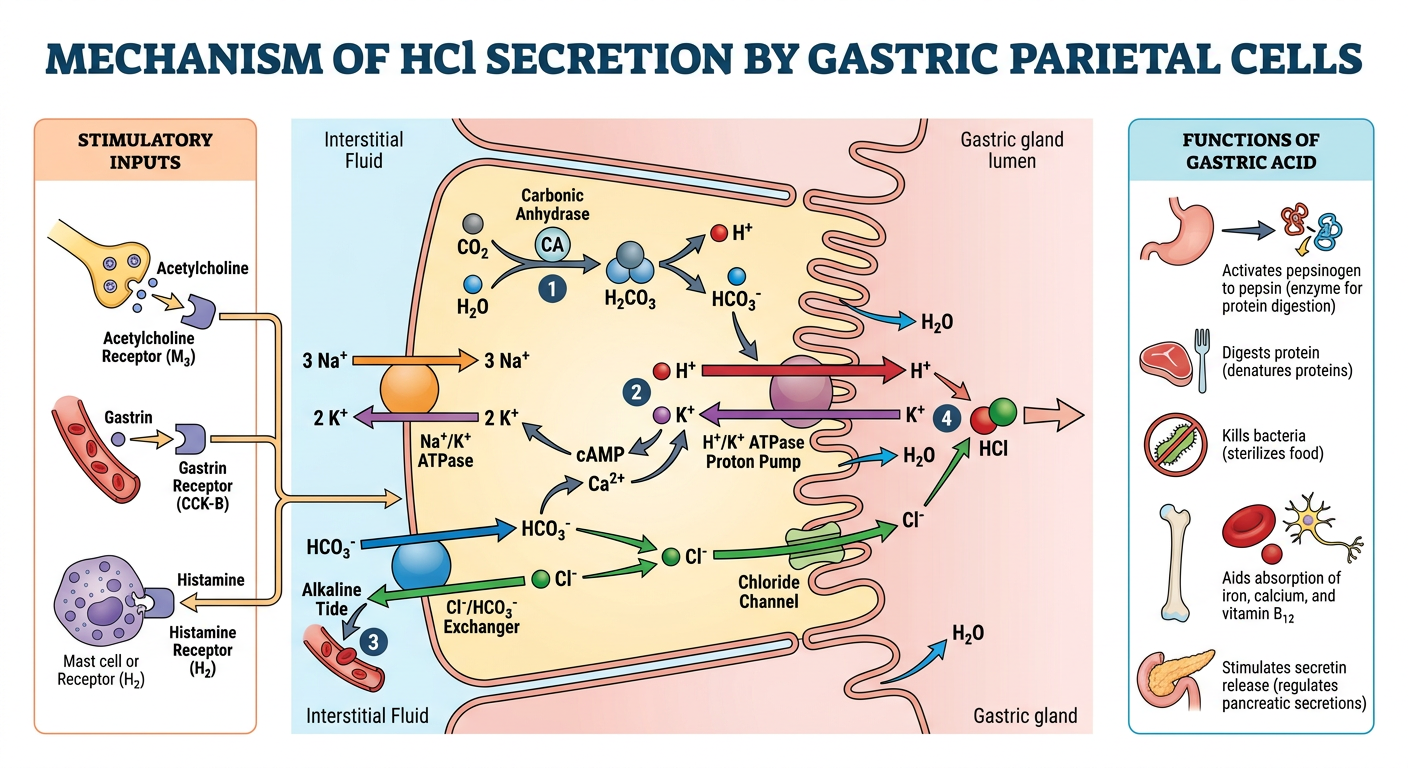
- Carbonic anhydrase generating H⁺ and HCO₃⁻ from CO₂ + H₂O inside the parietal cell
- H⁺/K⁺-ATPase proton pump pushing H⁺ into the gland lumen in exchange for K⁺ (with K⁺ recycling via Na⁺/K⁺-ATPase)
- Cl⁻/HCO₃⁻ exchange at the basolateral membrane (HCO₃⁻ out to blood = alkaline tide; Cl⁻ in, then out apically via Cl⁻ channels)
- HCl formation in the canaliculus as H⁺ and Cl⁻ combine, with water following osmotically
- A side panel of the stimulatory inputs (ACh, gastrin, histamine) driving the pump
- A side panel of the functions of gastric acid (pepsinogen activation, protein digestion, bactericidal action, Fe/Ca/B12 absorption, secretin release)
Can I get more summarised version of it where like some key points only for it so that I can elaborate when explaining
- Parietal cells – secrete HCl + intrinsic factor; activated by ACh, gastrin, histamine
- Carbonic anhydrase – CO₂ + H₂O → H⁺ + HCO₃⁻ inside the cell
- H⁺/K⁺-ATPase (proton pump) – pumps H⁺ out, K⁺ in, on canalicular membrane (blocked by PPIs)
- Cl⁻/HCO₃⁻ exchange – HCO₃⁻ leaves into blood ("alkaline tide"), Cl⁻ enters cell then exits into lumen
- HCl formation – H⁺ + Cl⁻ combine in canaliculus; water follows
- Functions of gastric acid – activates pepsin, digests protein, kills bacteria, aids Fe/Ca/B12 absorption