
Hii
Hi there! How can I help you today?
Hydatid cyst imaging and radiological signs
Reading File
This is a visual/radiology topic. Running parallel searches now.
Searching sources...
Finding Sources
Finding Sources
Searching the Web
hydatid cyst radiology imaging signs CT ultrasound MRI
Good results. Now reading the key textbook sections in parallel.
Reading File
Reading File
Reading File
Excellent content. Let me fetch the key textbook images and read a bit more of Fischer's for the WHO staging details.
Reading File
Loading Image
Loading Image
Now I have enough comprehensive data. Let me also fetch the water lily sign image.
Loading Image
Here is a complete, well-organized reference on hydatid cyst imaging and radiological signs, drawn from Bailey & Love, Sabiston, Fischer's Mastery of Surgery, and supplemented by current radiology sources.
Hydatid Cyst - Imaging and Radiological Signs
Background
Hydatid disease (cystic echinococcosis) is caused by the larval stage of Echinococcus granulosus. The liver is the most common site (~75% right lobe), followed by the lungs. The cyst has three layers:
- Pericyst - outer fibrous host-derived capsule
- Ectocyst - acellular laminated membrane
- Endocyst (germinal layer) - inner living layer that produces daughter cysts and "hydatid sand"
Modality of Choice
| Modality | Role |
|---|---|
| Ultrasound | Primary modality worldwide - for diagnosis, staging, and follow-up |
| CT | Best for surgical planning, extrahepatic disease, calcification; sensitivity ~94% |
| MRI | Superior for biliary involvement, cyst wall defects, soft tissue detail |
| MRCP/ERCP | When biliary communication is suspected |
| Plain X-ray | Limited - may show curvilinear pericyst calcification (20-30% of cases) |
WHO/CE Classification (Ultrasound-Based Staging)
This is the standard classification that guides management:
| Stage | Activity | US Description | Key Feature |
|---|---|---|---|
| CL | Active | Unilocular anechoic cyst, no visible wall | Non-specific |
| CE1 | Active | Unilocular cyst, well-defined wall, mobile echoes within | "Snowstorm sign" (hydatid sand) |
| CE2 | Active | Multivesicular, multiseptated; daughter cysts in mother cyst | "Spoke-wheel" / "honeycomb" / "rosette" pattern |
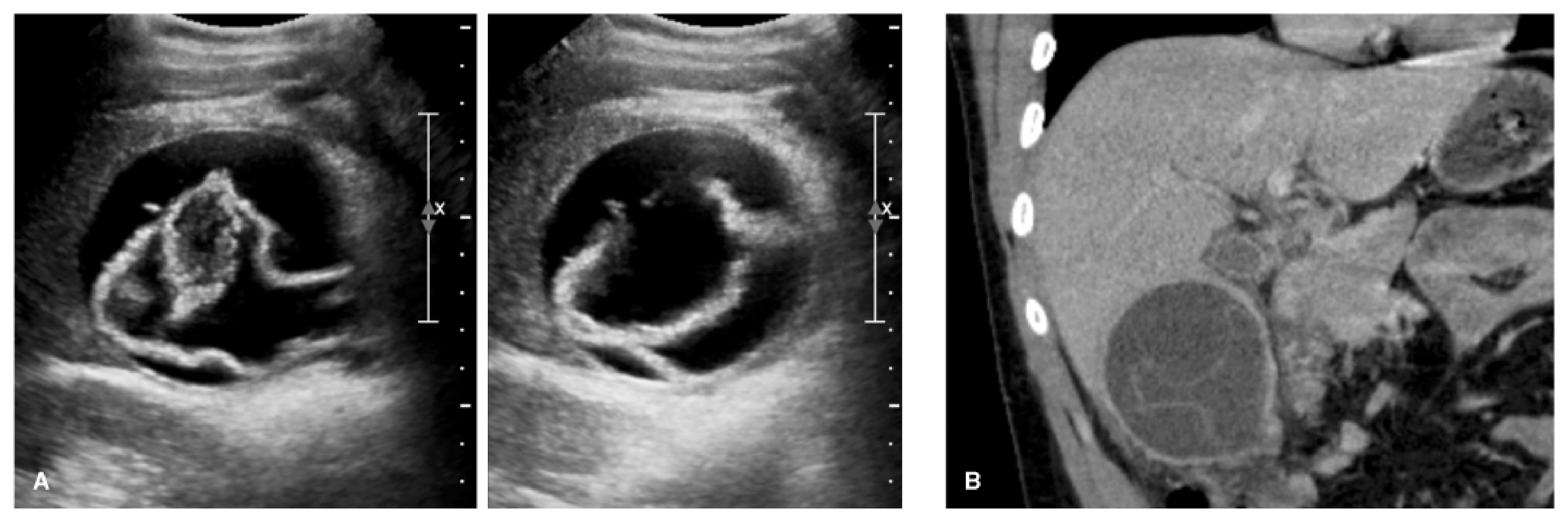
| CE3a | Transitional | Unilocular with detached inner membrane floating | "Water lily sign" |
| CE3b | Transitional | Predominantly solid with some daughter cysts | Hyperechoic matrix |
| CE4 | Inactive | Mixed hypo/hyperechoic, no daughter cysts | "Ball of wool" appearance |
| CE5 | Inactive | Partially or completely calcified wall | Complete calcification = nonviable |
Named Radiological Signs
1. Water Lily Sign (Nymphaea Sign)
- Modality: Ultrasound, CT
- Stage: CE3a
- Detached inner (endo)cyst membrane floats in the hydatid matrix, resembling a water lily
- On CT: linear hyperattenuating areas within the mother cyst
- Pathognomonic of ruptured/degenerated endocyst
2. Snowstorm Sign
- Modality: Ultrasound
- Stage: CE1
- Fine mobile echoes (protoscolices = "hydatid sand") lying dependently in the cyst fluid
- Move when the patient changes position
- Highly specific when combined with the clinical picture
3. Daughter Cyst Sign / Spoke-Wheel / Rosette Pattern
- Modality: Ultrasound, CT
- Stage: CE2
- Multiple smaller daughter cysts within the mother cyst (true replicas of the parent cyst)
- On CT: daughter cysts are more hypoattenuating than the hydatid matrix
- Creates a "honeycomb," "cartwheel," or "rosette" appearance
4. Double Wall Sign
- Modality: Ultrasound
- Separation between the ectocyst (laminated membrane) and pericyst (host fibrous layer)
- Indicates early detachment of the endocyst-ectocyst complex
5. Pericyst Calcification
- Modality: Plain X-ray, CT (best), Ultrasound
- Curvilinear or ring-like calcification of the outer fibrous pericyst
- Seen on abdominal plain films in ~20-30% of cases
- Complete circumferential calcification usually indicates no active infection (CE5)
- Calcification does NOT always mean the cyst is dead
- CT is the gold standard for detecting and characterizing calcification
6. "Bag of Wool" Appearance
- Modality: Ultrasound
- Stage: CE4
- Mixture of hypoechoic and hyperechoic areas without daughter cysts
- Represents degenerating membranes
CT Findings - Summary
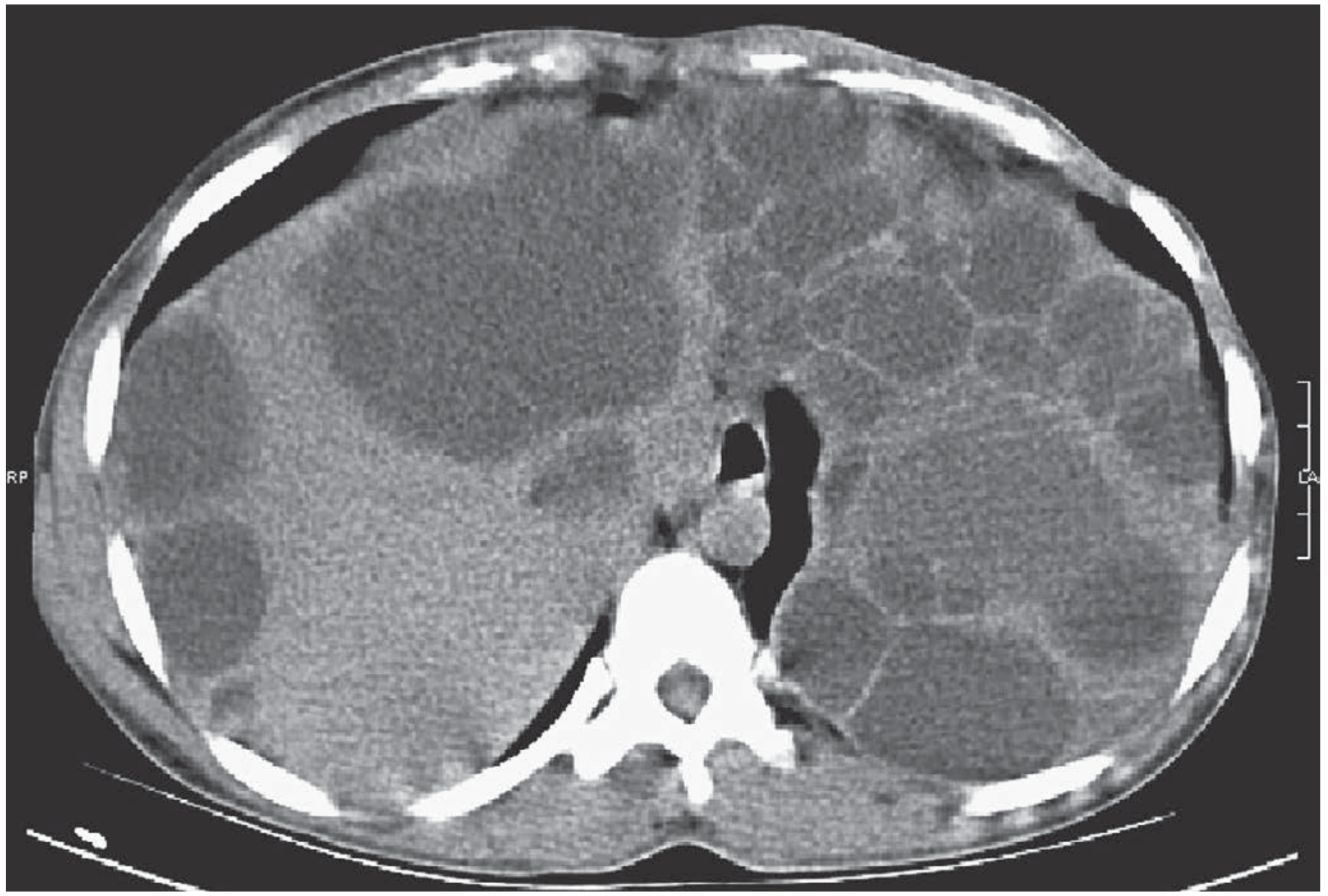
- Well-defined, hypodense (near-water density) uni- or multilocular cysts
- Daughter cysts are more hypoattenuating than the mother cyst matrix - distinguishes hydatid from simple cysts
- Curvilinear ring-like pericyst calcification
- Enhancement of cyst wall and septa (no internal enhancement)
- Water lily sign: linear hyperattenuating detached membranes
- Dilated intrahepatic bile ducts if biliary rupture has occurred
- CT also defines relationship to vascular structures for surgical planning
MRI Findings
| Sequence | Finding |
|---|---|
| T1W | Hydatid matrix: intermediate to hypointense; pericyst rim: hypointense |
| T2W | Matrix: intermediate to hyperintense; daughter cysts: markedly hyperintense (near CSF/bile signal) |
| T2W rim | Low signal intensity rim (pericyst) = characteristic sign, represents collagen-rich fibrous capsule |
| Post-contrast | No internal enhancement; mild delayed enhancement of fibrous pericyst |
- MRI is superior for demonstrating cyst wall defects and biliary communication
- MRCP can show multiple cysts communicating with the biliary tree
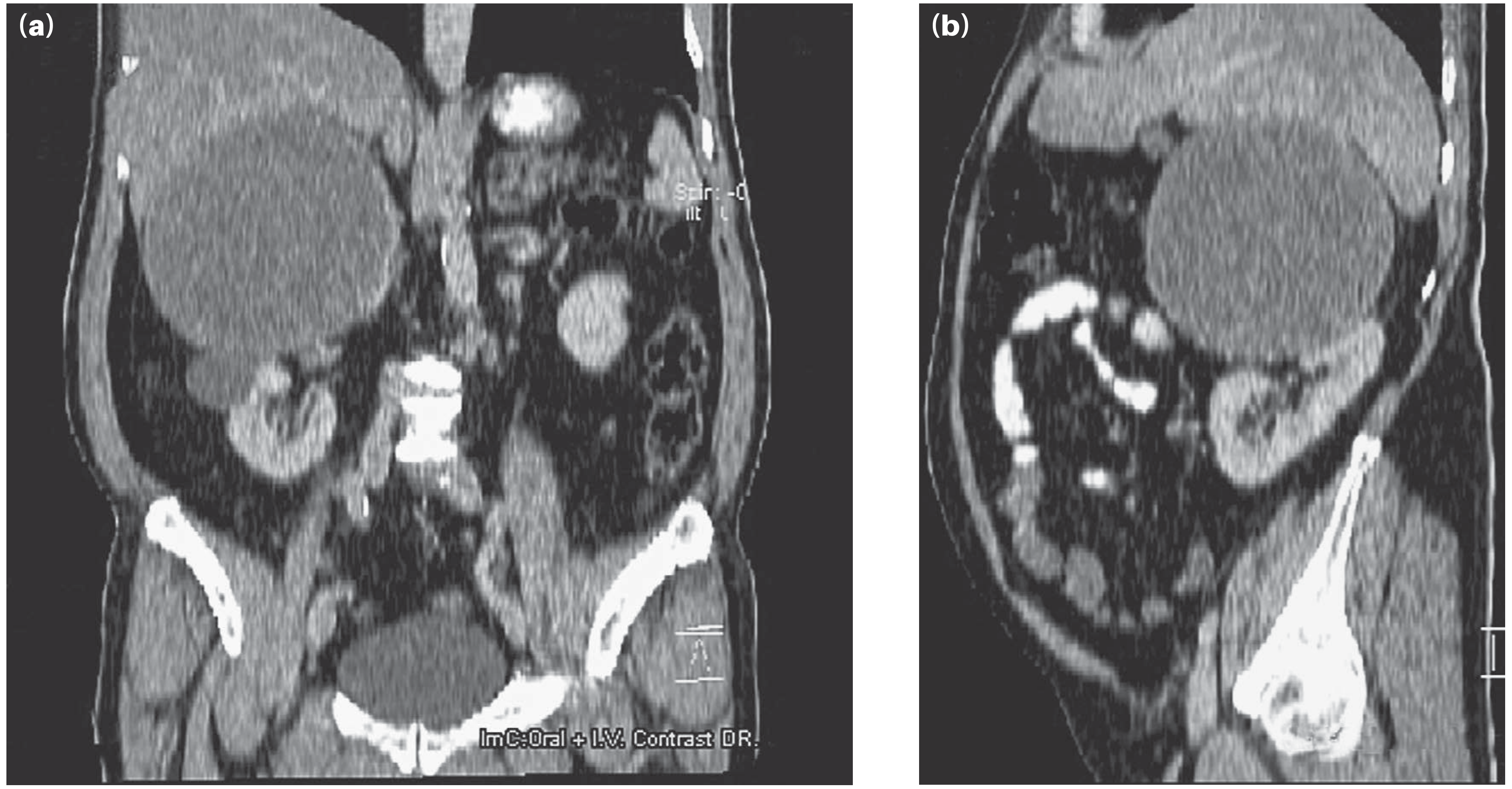
Pulmonary Hydatid Cyst - Additional Signs
| Sign | Description |
|---|---|
| Crescent sign | Air crescent between pericyst and ectocyst on CXR/CT - indicates early rupture into bronchus |
| Camalote sign | Collapsed floating membranes in partially evacuated cyst after bronchial communication |
| Double arch sign | Two air-fluid levels: one in the pericyst, one in the endocyst (after rupture) |
| Onion peel sign | Concentric layers on CT from separated membranes |
Gharbi Classification (Older - Ultrasound)
| Type | Description |
|---|---|
| I | Pure fluid collection (unilocular) |
| II | Fluid with split/detached wall |
| III | Fluid with daughter cysts (heterogeneous) |
| IV | Heterogeneous (solid-appearing, degenerating) |
| V | Reflecting thick walls (calcified) |
The WHO-IWGE classification (CE1-CE5 + CL) has largely replaced Gharbi as it better reflects natural history and guides treatment decisions.
Key Diagnostic Pearls
- CT is the best overall imaging technique - features: smooth space-occupying lesion with septa - Bailey & Love, p. 96
- Ultrasound is the primary modality for staging and worldwide use due to availability
- Daughter cysts within a mother cyst are the most specific CT/US finding for hydatid disease
- Complete pericyst calcification does not always mean the cyst is dead (contrast with alveolar disease)
- E. multilocularis (alveolar echinococcosis) looks entirely different: extensive infiltrative solid/cystic masses with irregular margins, amorphous calcifications, and minimal enhancement - mimics malignancy
- MRI's low T2 signal rim (pericyst) is a characteristic distinguishing feature from other cystic liver lesions
Sources: Bailey & Love's Short Practice of Surgery 28th Ed.; Sabiston Textbook of Surgery; Fischer's Mastery of Surgery 8th Ed.
This is a shared conversation. Sign in to Orris to start your own chat.