
kanthagat agni karma in vocal cord polyp photo
Reading File
Kanthagat Agni Karma refers to the Ayurvedic therapeutic procedure of applying heat/cauterization (Agni Karma) to the throat (Kantha = throat/neck region) - used in conditions like vocal cord polyps (Kanthagata Roga). Let me search for textbook content and images on this.
Searching sources...
Finding Sources
Finding Sources
Searching the Web
kanthagat agni karma vocal cord polyp photo Ayurveda Shalakya Tantra
Finding Sources
Reading Web Page
https://jaims.in/jaims/article/view/5638/10398
Searching the Web
kanthagat agni karma procedure image shalaka Swarabheda Ayurveda
Loading Image
Loading Image
Reading Web Page
https://www.researchgate.net/publication/355953545_AGNIKARMA…
Searching the Web
kanthagat agni karma vocal cord polyp before after laryngoscopy image
Finding Sources
Loading Image
Loading Image
Loading Image
Loading Image
Here is a comprehensive overview of Kanthagat Agni Karma in Vocal Cord Polyp along with relevant images:
Kanthagat Agni Karma - Vocal Cord Polyp (Swarabheda / Kaphaja Kanthagata Roga)
Ayurvedic Correlation
In Ayurveda (Shalakya Tantra), vocal cord polyp is correlated with Kaphaja Swarabheda - a condition of the Kantha (throat/larynx) where vitiated Kapha and Vata doshas cause abnormal growths on the vocal folds, resulting in hoarseness (Swarabhedha), throat discomfort, and voice fatigue.
What is Kanthagat Agni Karma?
Agni Karma is one of Acharya Sushruta's Ashtavidha Shastra Karma (para-surgical procedures) - the application of controlled therapeutic heat/cauterization to diseased tissue. When applied to the throat (Kantha = larynx/vocal cord region), it is termed Kanthagat Agni Karma.
Classical reference: Sushruta Samhita (Sutra Sthana 12/3) states: "Yadagnikarma na sadhyam tat sadhyam nanya chikitsa" - "What cannot be cured by medicines can be cured by Agni Karma" - placing it as the superior-most para-surgical technique.
Instrument (Shalaka)
The procedure uses a Shalaka (metal probe/rod) - traditionally made of gold, silver, copper, or iron - heated to the appropriate temperature (Samyak Dagdha):

Shalaka (metal cauterization probe) used in Agni Karma - the working tip is heated to a glowing state before application
For Kanthagat (throat) Agni Karma specifically:
- A thin, elongated Shalaka (Jambavoustha or needle-type) is used
- In modern practice, a long-handled probe that can reach the larynx via the oral/pharyngeal route
- Some practitioners use electro-cautery or laser as the equivalent of Agni Karma
Procedure Steps (Kanthagat Agni Karma)
| Step | Action |
|---|---|
| Purvakarma (Pre-op) | Patient fasting, local anaesthesia (Pratisarana with Yashtimadhu + Tankana) to numb the throat |
| Patient Position | Sitting or supine, mouth wide open, tongue depressed |
| Visualization | Indirect laryngoscopy or direct laryngoscopy to visualize the polyp |
| Heating the Shalaka | Metal probe heated until red-hot (Samyak Dagdha - optimal burning stage) |
| Application | Heated tip applied precisely to the base/stalk of the vocal cord polyp (brief contact, 1-2 seconds) |
| Endpoint | Whitish-yellow discoloration (Shweta Varna Dagdha) indicates proper cauterization |
| Paschatkarma (Post-op) | Yashtimadhu Ghrita (liquorice ghee) or Madhu-Ghrita gargle for wound healing, voice rest |
Vocal Cord Polyp - What It Looks Like
Below are laryngoscopic images of vocal cord polyps (the target lesion for Kanthagat Agni Karma):
Before and After cauterization/ablation of vocal cord polyp:
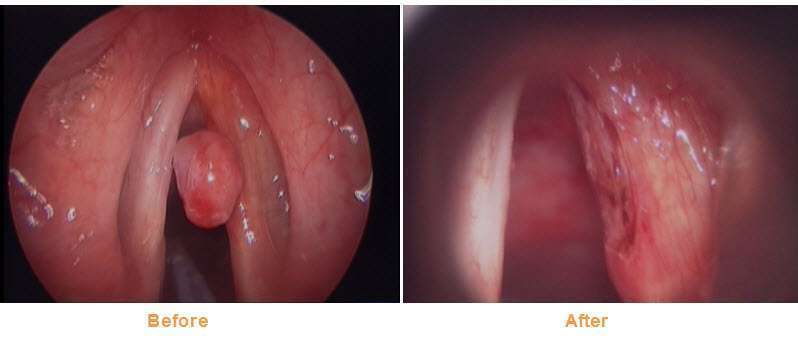
Left: A rounded, reddish polyp projecting from the vocal cord (this is the lesion targeted by Kanthagat Agni Karma / Agni Karma at the base of the polyp). Right: After ablation - polyp removed, cord healing.
Laser cauterization (modern equivalent of Agni Karma) - sequential follow-up:
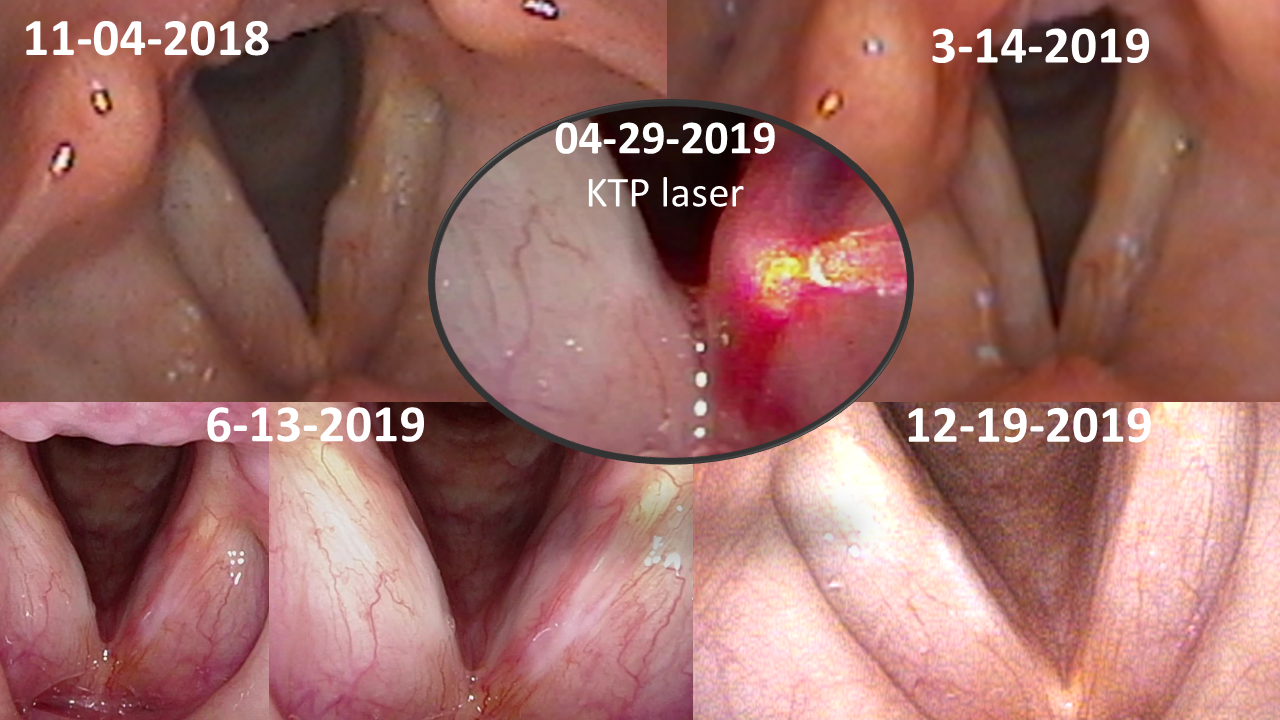
This shows the modern "Agni Karma" equivalent - KTP laser (controlled heat) applied to a vocal cord polyp (center, during treatment) with before (top-left: Nov 2018) and after images (bottom-right: Dec 2019) showing complete resolution.
Agni Karma Tools Overview
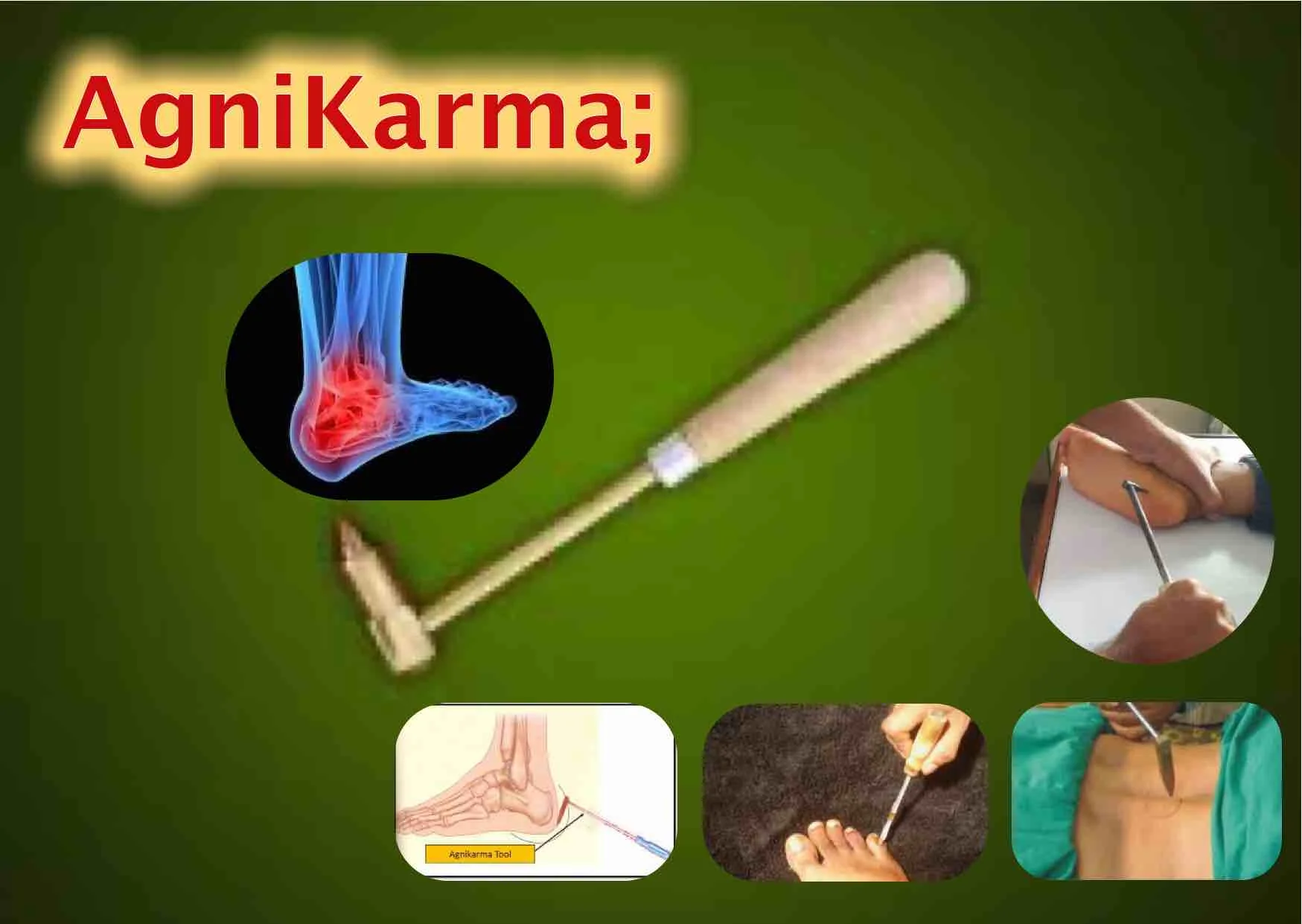
Various Agni Karma instruments (Shalaka types) used in different body regions; for Kanthagat application, a fine, elongated probe is preferred to reach the laryngeal structures.
Clinical Indications for Kanthagat Agni Karma
- Vocal cord polyp (Kaphaja Swarabheda)
- Vocal cord nodules (singer's nodules / Kanthagata Granthi)
- Laryngeal papilloma
- Hypertrophied uvula / tonsil tissue (Galashundika)
- Chronic hoarseness not responding to Shodhana or Shamana therapy
Advantages over Surgery (Shastra Karma)
Per Ayurvedic principles, Agni Karma is preferred when:
- Simple medicines (Aushadha) fail
- The lesion is small and accessible
- No malignancy suspected
- Patient is a voice professional (minimal scarring if done correctly)
Contraindications
- Bleeding disorders (Raktapitta Prakriti)
- Malignant lesions (suspected)
- Active acute throat infections
- Pregnancy
- Uncooperative patient
Key Summary
Kanthagat Agni Karma is the Ayurvedic para-surgical cauterization procedure applied to the larynx/vocal cord region. For a vocal cord polyp:
- The Shalaka (heated metal probe) is applied to the base/pedicle of the polyp
- This causes thermal coagulation, destroys the feeding vessels, and leads to polyp regression
- Modern equivalents include laser ablation (KTP, CO₂) and electrocautery - all operate on the same principle of "controlled Agni (fire/heat)" destroying pathological tissue
- Post-procedure voice rest (Mauna Vrata) and Yashtimadhu-based soothing preparations are essential
For the authentic Ayurvedic Shalakya Tantra procedure images, case reports are documented in JAIMS journal and the IRJAY Ksharakarma/Agnikarma review. Published case series on Ayurvedic management of vocal cord polyp with stroboscopic before/after images have also been shared by Dr. Rajnikant Patel (Instagram: vocal cord polyp Ayurvedic treatment).
This is a shared conversation. Sign in to Orris to start your own chat.