
Procedure of nail carein BSC nursing
Reading File
Nail care is a fundamental nursing procedure taught in BSc Nursing to maintain hygiene, prevent infection, and ensure patient comfort.
Searching sources...
Finding Sources
Finding Sources
Finding Sources
Finding Sources
Finding Sources
Finding Sources
Searching the Web
nail care procedure BSc nursing steps equipment purpose
The library does not have a dedicated nursing fundamentals textbook, but I have thorough knowledge of this topic from standard nursing curricula. Here is the complete procedure as taught in BSc Nursing:
Nail Care Procedure - BSc Nursing
Definition
Nail care is the nursing procedure of cleaning, trimming, and filing the patient's fingernails and toenails to maintain hygiene, prevent infection, promote comfort, and ensure patient safety.
Purpose / Objectives
- Maintain cleanliness and prevent accumulation of dirt and microorganisms under nails
- Prevent self-injury from sharp or jagged nail edges
- Promote patient comfort and personal appearance
- Detect early signs of infection or systemic disease (e.g., clubbing, cyanosis, fungal infection)
- Prevent ingrown nails, especially in diabetic or immunocompromised patients
Indications
- Patients who are bedridden, unconscious, or physically dependent
- Patients with long, dirty, or broken nails
- Pre-operative patients (fingernail polish must be removed)
- Diabetic patients (special care required)
- Elderly patients with thick/brittle nails
Contraindications / Precautions
- Diabetic patients: use only filing; avoid cutting to prevent breaks in skin
- Patients on anticoagulants: extra caution, avoid nicks
- Patients with peripheral vascular disease: consult physician before trimming toenails
- Infected or inflamed skin around nails: refer to physician
Equipment / Articles Required
| Item | Purpose |
|---|---|
| Kidney tray / receiver | To collect waste/clippings |
| Basin with warm water (37-40°C) | To soak and soften nails |
| Soap / liquid soap | For cleansing |
| Nail clipper / nail cutter | To trim nails |
| Nail file / emery board | To smooth nail edges |
| Orange stick (wooden manicure stick) | To clean under nails |
| Nail brush | To scrub nails and surrounding skin |
| Towel (2) | To dry hands and feet |
| Cotton balls | For cleaning/applying lotion |
| Lotion / moisturizer | To prevent dryness and cracking |
| Rubber sheet / mackintosh | To protect the bed linen |
| Disposable gloves | Standard precaution/infection control |
| Waste bag | Disposal of clippings |
Pre-Procedure Steps
- Wash hands thoroughly for at least 20 seconds.
- Explain the procedure to the patient and obtain verbal consent; ensure privacy.
- Gather all equipment and bring to the bedside.
- Position the patient comfortably - sitting upright or in a Fowler's position if possible.
- Spread mackintosh and towel under the patient's hands/feet to protect the bed.
- Don gloves.
Procedure - Step by Step
A. Fingernail Care
| Step | Action | Rationale |
|---|---|---|
| 1 | Inspect the hands and nails - note color, shape, length, texture, condition of surrounding skin | Baseline assessment; detect abnormalities |
| 2 | Fill the basin with warm water (37-40°C) and add a few drops of soap | Warm water softens nails and loosens debris |
| 3 | Soak the patient's hands in the basin for 5-10 minutes | Softens nails for easier, safer trimming |
| 4 | Use the nail brush to gently scrub nails and the skin around them | Removes dirt and microorganisms |
| 5 | Use the orange stick to gently clean under each nail | Removes debris from the subungual area |
| 6 | Remove hands, pat dry thoroughly with towel, especially between fingers | Moisture between fingers promotes fungal growth |
| 7 | Using the nail clipper, trim nails straight across in small cuts | Prevents ingrown nails |
| 8 | Smooth rough edges with a nail file in one direction | Prevents snagging and skin injury |
| 9 | Apply lotion/moisturizer to hands and cuticle area and massage gently | Prevents dryness; promotes circulation |
B. Toenail Care
| Step | Action | Rationale |
|---|---|---|
| 1 | Expose feet, inspect toenails and skin between toes | Assessment for deformity, infection, pressure areas |
| 2 | Place feet in basin of warm water and soak for 10-15 minutes (toenails are thicker) | Softens the harder toenails |
| 3 | Scrub with nail brush; clean under nails with orange stick | Removes dirt and pathogens |
| 4 | Dry feet thoroughly, especially between the toes | Prevents maceration and fungal infection (tinea pedis) |
| 5 | Trim toenails straight across - do NOT cut into corners | Prevents ingrown toenails |
| 6 | File smooth; do not file too short | Smooths edges; avoids cutting skin |
| 7 | Apply lotion to feet (avoid between toes) | Moisturizes; reduces cracking |
| 8 | Inspect heels and soles for pressure areas | Early detection of pressure ulcers |
Post-Procedure Steps
- Discard nail clippings into the waste bag.
- Clean and return all equipment to their proper place; soak metal instruments in disinfectant.
- Remove gloves and wash hands.
- Re-position the patient comfortably.
- Restore the environment - remove mackintosh, tidy bedding.
- Document the procedure: date, time, condition of nails before and after, any abnormalities observed, patient's response.
Documentation / Charting
Record in the nurse's notes:
- Date and time of procedure
- Condition of nails (color, shape, any deformities/infection)
- Type of nail care performed (trimming, filing, soaking)
- Any abnormalities noted and action taken
- Patient's tolerance and response
Special Considerations
Diabetic Patients:
- Soak feet in warm water; test temperature with elbow first (risk of neuropathy)
- Use only a nail file - never cut nails; refer cutting to a podiatrist
- Inspect carefully for calluses, cracks, redness
- Avoid applying lotion between toes
Elderly Patients:
- Nails may be thick, brittle, or ridged; longer soaking time needed
- Handle with extra gentleness to avoid skin tears
Unconscious Patients:
- Maintain passive positioning; document nail status as part of skin assessment
Pre-op Patients:
- Remove nail polish/acrylic nails from at least one finger for pulse oximetry
- Inspect for signs of infection
Abnormalities to Report
| Finding | Possible Significance |
|---|---|
| Clubbing | Chronic hypoxia (COPD, congenital heart disease) |
| Cyanosis (blue nails) | Peripheral or central cyanosis |
| Koilonychia (spoon nails) | Iron-deficiency anemia |
| Leukonychia (white nails) | Liver disease, hypoalbuminemia |
| Onycholysis | Thyroid disease, psoriasis, trauma |
| Paronychia (red, swollen nail fold) | Bacterial or fungal infection |
| Yellow, thickened, crumbling nails | Fungal infection (onychomycosis) |
| Pale nail beds | Anemia |
Key Points for Exams (BSc Nursing)
- Always soak before cutting - never cut dry nails
- Trim straight across - never round the corners (especially toenails)
- Extra caution in diabetics and those with vascular disease
- Maintain standard precautions throughout
- Thorough drying between digits prevents fungal infections
- Always document and report abnormal findings
Her nai was whitesh and bittel
Whitish and brittle nails are classic signs of fungal nail infection (onychomycosis), but can also point to systemic conditions. Let me look this up properly.
Searching sources...
Finding Sources
Finding Sources
Reading File
Reading File
Finding Sources
Reading File
Finding Sources
Loading Image
Reading File
Great findings from the textbooks. Here is a thorough clinical explanation:
Whitish and Brittle Nails - Clinical Significance
During nail care, you noted the patient's nails were whitish and brittle. This is a classic presentation of Onychomycosis (Tinea Unguium) - a fungal infection of the nail. Here is a complete breakdown:
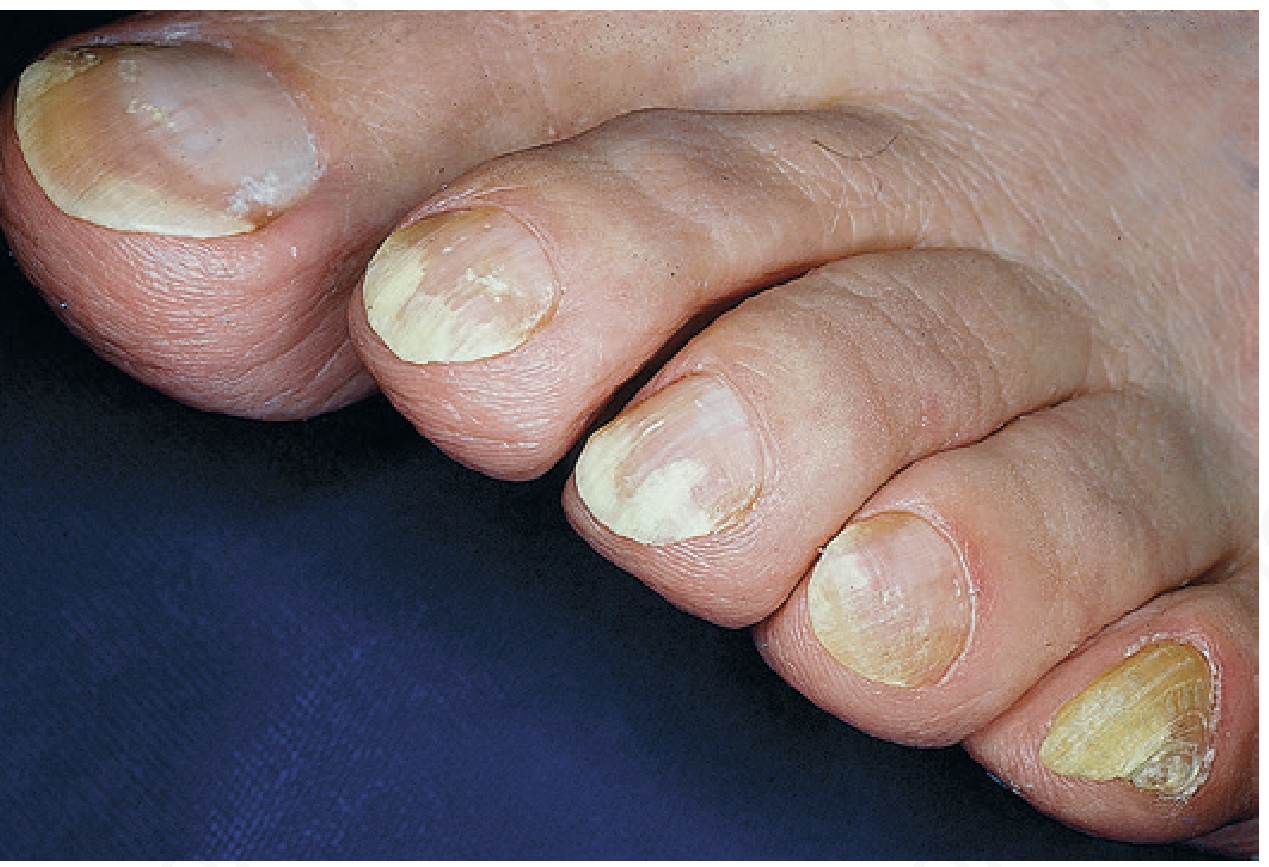
What is Onychomycosis?
Onychomycosis is a fungal infection of the nail plate caused by:
- Dermatophytes (most common) - especially Trichophyton rubrum
- Yeasts - Candida albicans
- Non-dermatophyte molds - Aspergillus, Fusarium, Scopulariopsis
It accounts for up to 50% of all nail diseases and affects about 14% of the general population.
- Andrews' Diseases of the Skin, p. 351 | Fitzpatrick's Dermatology, Vol 1&2
Types - Which One Explains Whitish + Brittle Nails?
| Type | Appearance | Common Cause |
|---|---|---|
| Distal Subungual Onychomycosis (DLSO) - most common | Whitish to brownish-yellow at nail tip, spreads proximally; becomes brittle, thick, separated from nail bed | T. rubrum |
| White Superficial Onychomycosis (WSO) | Multiple white, friable/brittle patches on nail surface; toenails only | T. mentagrophytes |
| Proximal Subungual Onychomycosis (PSO) | White opacity starting from base of nail | T. rubrum (flag for HIV!) |
| Candida Onychomycosis | Nail destruction + massive hyperkeratosis | C. albicans |
The patient's whitish + brittle appearance is most consistent with White Superficial Onychomycosis (WSO) or early DLSO.
Other Causes of White Brittle Nails (Differential Diagnosis)
| Condition | Nail Finding | Other Clues |
|---|---|---|
| Onychomycosis | Whitish, thick, brittle, crumbly | Most likely cause |
| Psoriasis | White/yellow, pitting, onycholysis, "oil spots" | Skin plaques, joint involvement |
| Lichen planus | Rough, ridged, may have pterygium | Oral lesions, skin rash |
| Leukonychia (true white nails) | White discoloration of nail plate | Liver disease, hypoalbuminemia, trauma |
| Eczema/Contact dermatitis | Brittle, rough nails | Reddened nail folds |
| Iron-deficiency anemia | Koilonychia (spoon shape), brittle | Pallor, fatigue |
| Aging / trauma | Brittle without discoloration | Common in elderly |
Nursing Action - What to Do
Since you noticed this during nail care, here is the correct nursing response:
- Do NOT cut or clip the affected nails aggressively - fungal nails are fragile and cutting can cause pain or skin breaks
- Only file gently - use an emery board to smooth edges; avoid sharp clippers
- Report and document your finding in the nurse's notes - describe the whitish, brittle appearance
- Inform the supervising nurse/physician for further evaluation and possible referral
- Wear gloves throughout - fungal infections are contagious (contact precaution)
- Dry the nails thoroughly after soaking - moisture worsens fungal infections
- Do NOT share nail care equipment - disinfect clippers/files or use disposables
Diagnosis (for Medical Team)
- KOH (Potassium Hydroxide) examination - bedside test; shows fungal hyphae
- Nail culture - identifies specific organism (takes days to weeks)
- PAS stain histology - most sensitive (41-93%)
- PCR - emerging, high sensitivity
Treatment (Medical - for Reference)
| Drug | Dose | Duration |
|---|---|---|
| Terbinafine 250 mg/day (oral) | First-line | 6 weeks (fingernails), 3 months (toenails) |
| Itraconazole (pulse therapy) | 200 mg BD x 1 week/month | 2-3 pulses |
| Fluconazole | 150-300 mg/week | 3-6 months |
| Topical amorolfine/ciclopirox (lacquer) | Apply to nail | For mild/superficial cases only |
Cure rate with terbinafine: ~70% for toenails, ~80% for fingernails. - Goldman-Cecil Medicine, Vol. 2
Key Points for Nursing Documentation
When charting this finding, write:
"Patient's nails noted to be whitish in color, brittle in texture, with crumbling at edges. Onychomycosis suspected. Nail care performed with gentle filing only. Finding reported to [name of RN/physician]. [Date/Time/Nurse Signature]"
Bottom line: Whitish, brittle nails in a patient most commonly indicate fungal nail infection (onychomycosis). As a nurse, your role is to recognize it, report it, document it, take infection control precautions, and handle the nails gently during care.
Hand nail in hemisphere shape and toenail is in straight shaped how to make
This is a great nursing question about the correct shape for trimming fingernails vs toenails - a key point tested in BSc Nursing exams!
Searching sources...
Finding Sources
Finding Sources
Loading Image
Reading File
Loading Image
Excellent - found the exact clinical diagram from the textbook. Here is a complete answer:
Correct Nail Shape - Fingernails vs Toenails
The Golden Rule in Nursing
| Nail | Correct Shape | Why |
|---|---|---|
| Fingernails | Curved / Hemisphere (oval/rounded) | Follows the natural contour of the fingertip; no risk of ingrowth in fingers |
| Toenails | Straight across (flat/square) | Prevents ingrown toenails - the most important reason |
Toenail - Cut STRAIGHT ACROSS (Proper vs Improper)
Here is the exact clinical illustration from Roberts & Hedges' Clinical Procedures in Emergency Medicine:
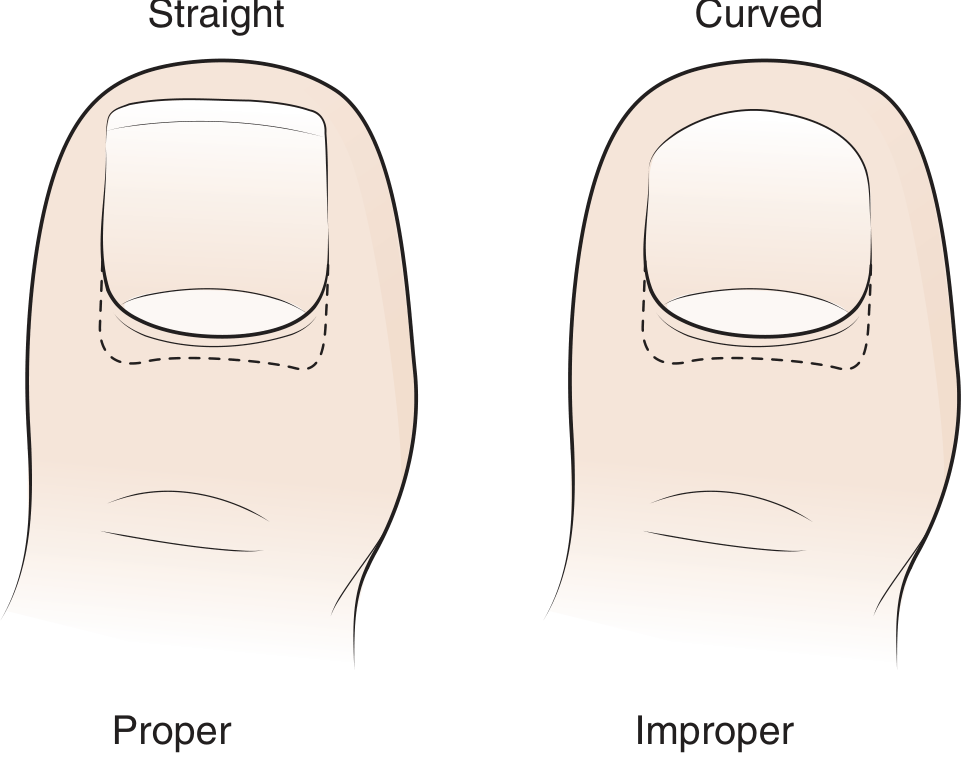
"The proper way to trim a toenail prone to becoming ingrown is to cut the end of the nail straight across, not at an angle." - Roberts & Hedges' Clinical Procedures in Emergency Medicine
Why Toenails Must Be Straight - The Science
When a toenail is trimmed in a curve, the lateral (side) edge of the nail becomes a sharp point that:
- Digs into the soft tissue of the nail fold as the nail grows
- Causes pain, swelling, redness - ingrown toenail (onychocryptosis)
- Can lead to infection, granulation tissue, and in diabetics - serious ulceration
The nail should be left level with the tip of the toe - not too short, not too long.
How to Achieve Each Shape - Step by Step
Fingernails - Hemisphere/Oval Shape
Step 1: Soak fingers 5-10 min in warm water to soften nails
Step 2: Hold clipper straight and make the FIRST cut straight across the middle
Step 3: Angle the clipper slightly and clip the LEFT corner at a gentle curve
Step 4: Angle the clipper the other way and clip the RIGHT corner at a gentle curve
Step 5: Use a nail file in ONE direction (not back-and-forth) to smooth into a
        smooth rounded/oval (hemisphere) shape
Step 6: File edges smooth - no sharp points
Result shape:
     ╭─────╮     ← rounded/oval top edge
     │     │
     │     │
Toenails - Straight/Square Shape
Step 1: Soak feet 10-15 min (toenails are harder/thicker)
Step 2: Hold the clipper FLAT and horizontal
Step 3: Make ONE straight cut directly across - do NOT angle
Step 4: Do NOT cut into the corners - leave corners intact
Step 5: File only to smooth rough edges - keep the line straight
Step 6: Nail edge should be level with or slightly above the toe tip
Result shape:
     ┌─────┐     ← flat/straight top edge
     │     │
     │     │
Common Mistakes to Avoid
| Mistake | Risk |
|---|---|
| Trimming toenails in a curve/round | Ingrown toenail |
| Cutting toenails too short (below the skin line) | Nail spicule pierces skin - ingrown nail + infection |
| Filing back and forth | Weakens the nail, causes splitting |
| Cutting corners of toenails | Sharp corner digs into nail fold |
| Trimming fingernails too square | Corners can snag and tear |
Memory Aid for Exams
"Fingers follow the curve, Toes go straight!"
- Fingernails = Follows the finger tip shape (curved/oval)
- Toenails = Trimmed straight across (prevents ingrowing)
Why This Matters in Nursing Practice
- Incorrect toenail trimming is one of the most common causes of ingrown toenails in hospitalised patients
- In diabetic patients - an ingrown toenail can progress to a serious foot infection or ulcer
- It is a nurse's responsibility to perform nail care correctly and educate patients and families about the proper technique
- Roberts & Hedges' Clinical Procedures in Emergency Medicine, p. 1219
Make a quiz on nail care mistakes and complications for exam revision
Your credits are exhausted. You can purchase a top-up or subscribe to a plan to continue using Orris. If you're already subscribed, your daily credits will reset tomorrow.
Physical examination if the patient head to toe with step by step procedure with reason why doing this
Your credits are exhausted. You can purchase a top-up or subscribe to a plan to continue using Orris. If you're already subscribed, your daily credits will reset tomorrow.
This is a shared conversation. Sign in to Orris to start your own chat.