
Stance phase of gate cycle
Reading File
Finding Sources
Finding Sources
Reading File
Reading File
Reading File
Stance Phase of the Gait Cycle
The stance phase is the portion of the gait cycle during which the foot is in contact with the ground. It accounts for ~60% of the gait cycle (the swing phase makes up the remaining 40%) - Miller's Review of Orthopaedics, 9th Ed.; THIEME Atlas of Anatomy.
Boundaries
- Begins: heel strike (initial contact of the foot with the ground)
- Ends: toe-off (the foot lifts off the ground)
Subphases (Rancho Los Amigos classification)
- Initial Contact (IC) - the instant the heel touches the ground (0% of cycle)
- Loading Response (LR) - weight is transferred onto the stance limb immediately after IC; this is one of the two periods of double-limb support
- Midstance (MSt) - begins with initial swing of the opposite (advancing) limb and ends when the body's center of gravity passes directly over the supporting forefoot
- Terminal Stance (TSt) - begins with heel rise and continues until initial contact of the contralateral (opposite) foot
- Preswing (PSw) - begins with initial contact of the contralateral limb and ends when the stance foot lifts off the ground; this is the second period of double-limb support
(Miller's Review of Orthopaedics, 9th Edition - GAIT EVALUATION)
An older, simpler 3-interval division of stance (used clinically, e.g. Bailey & Love's Short Practice of Surgery) is:
- Heel strike -> foot flat
- Foot flat -> body passes over the ankle
- Ankle plantarflexion -> toe-off
Double-limb support
There are two periods of double-limb support per gait cycle (during IC + loading response, and again during preswing), together making up roughly 20-30% of the cycle, depending on walking speed. As gait speed increases, the stance phase (and double-support time) shortens - it disappears entirely once a person transitions to running, which introduces a "float" phase where neither foot touches the ground.
Functional role
Stance phase provides:
- Weight acceptance and shock absorption (loading response)
- Single-limb support and stability while the opposite limb swings through
- Limb advancement/propulsion at terminal stance and preswing (push-off)
Clinically relevant abnormalities of stance phase
- Antalgic gait: shortened stance phase on the painful side (patient minimizes time bearing weight/loading pressure on that limb) - most commonly due to degenerative joint disease
- Trendelenburg/abductor lurch gait: trunk lurches toward the affected side during stance due to hip abductor weakness
- Varus/valgus knee thrust: abnormal medial or lateral knee displacement during stance, accelerating compartment cartilage degeneration
(Firestein & Kelley's Textbook of Rheumatology; Campbell's Operative Orthopaedics, 15th Ed.)
Below is a labeled diagram of the gait cycle showing the stance and swing phase breakdown:
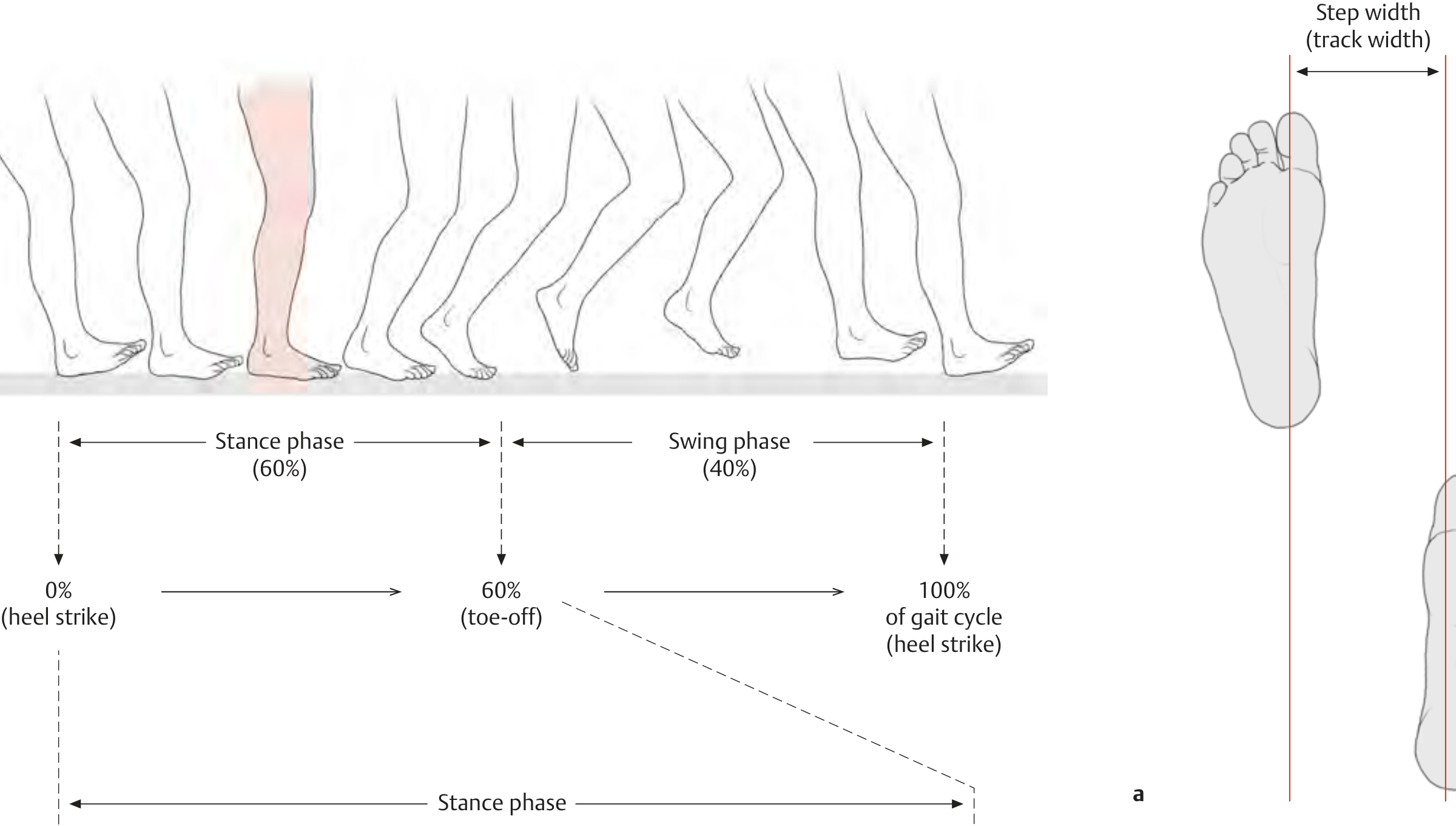
THIEME Atlas of Anatomy - General Anatomy and Musculoskeletal System
This is foundational biomechanics/anatomy content that is well established in the literature; no conflicting recent evidence needed for this topic.
This is a shared conversation. Sign in to Orris to start your own chat.