
Neuroendocrinal tumors of git r
Reading File
GI neuroendocrine tumors (NETs) arise from enterochromaffin and other neuroendocrine cells scattered throughout the GI tract. They are characterized by their ability to secrete peptide hormones and amines, leading to distinct clinical syndromes. Let me pull the full textbook coverage now.
Searching sources...
Finding Sources
Finding Sources
Searching PubMed
"gastrointestinal neuroendocrine tumors"[MeSH Terms] AND management
Finding Sources
Finding Sources
Searching PubMed
"neuroendocrine tumors" AND "gastrointestinal"
Excellent - found rich sources. Let me read the main GI textbook sections in parallel.
Reading File
Reading File
Reading File
Good detail so far. Let me now read more from the main GI textbook on NETs (classification, specific tumor types like gastrinoma, VIPoma, etc.) and from the Current Surgical Therapy section.
Finding Sources
Reading File
Finding Sources
Reading File
Finding Sources
Reading File
Finding Sources
Reading File
I now have comprehensive data from the leading textbooks. Let me fetch the key histology image and compile the full response.
Loading Image
Now I have all the information needed for a thorough response. Here is the comprehensive review:
Neuroendocrine Tumors (NETs) of the GI Tract
1. Overview and Cell of Origin
GI neuroendocrine tumors arise from Kulchitsky (enterochromaffin) cells - scattered neuroendocrine cells found throughout the crypts of Lieberkühn and in other sites of the GI mucosa. They are the most common tumors of the small bowel, accounting for >20% of malignant small bowel tumors. Histologically they show cytoplasmic core granules and stain positive for chromogranin A, synaptophysin, and neuron-specific enolase (NSE).
These tumors frequently have the capacity to secrete clinically relevant vasoactive monoamines, peptides, and hormones - hence the term "neuroendocrine."
- Current Surgical Therapy 14e, p. 190
- Sleisenger and Fordtran's GI and Liver Disease
2. Epidemiology and Distribution
| Site | % of GI NETs |
|---|---|
| Small intestine | 35-45% (most within 60 cm of ileocecal valve) |
| Rectum | ~20% |
| Stomach | ~10% |
| Colon | ~8% |
| Appendix | ~5% |
| Duodenum/pancreas | Variable |
- At presentation: 40% have multifocal tumors >2 cm; 70% have muscularis propria/lymph node invasion; 50% have liver metastasis
- 5-year survival: local disease ~95%, nodal disease ~84%, distant disease ~51% (overall ~32% with distant disease)
3. WHO Classification (2019/2022)
Based on Ki-67 index and mitotic index per 10 high-power fields (HPF):
| Category | Grade | Ki-67 (%) | Mitotic Index/10 HPF |
|---|---|---|---|
| Well-differentiated NET | G1 (Low) | <3 | <2 |
| Well-differentiated NET | G2 (Intermediate) | 3-20 | 2-20 |
| Well-differentiated NET | G3 (High) | >20 | >20 |
| Poorly differentiated NEC | G3 - Small cell type | >20 | >20 |
| Poorly differentiated NEC | G3 - Large cell type | >20 | >20 |
| Mixed neuroendocrine neoplasm (MiNEN) | - | Variable | Variable |
Key distinction: Well-differentiated NETs resemble normal endocrine tissue; poorly-differentiated neuroendocrine carcinomas (NECs) show sheets of pleomorphic cells with necrosis and are highly aggressive.
- Current Surgical Therapy 14e, WHO 2017 classification
- Sleisenger and Fordtran, Table 34.2A & 34.2B
4. Specific Tumor Types and Their Syndromes
A. Carcinoid Tumors (Non-functional/functional midgut NETs)
Location: Primarily ileum (within 60 cm of ileocecal valve), also appendix.
Imaging: Hyperenhancing on CT (vs. adenocarcinoma which moderately enhances). Can cause mesenteric desmoplastic reaction leading to intestinal foreshortening. The primary lesion is often not visible; bulky mesenteric adenopathy is the presenting finding.
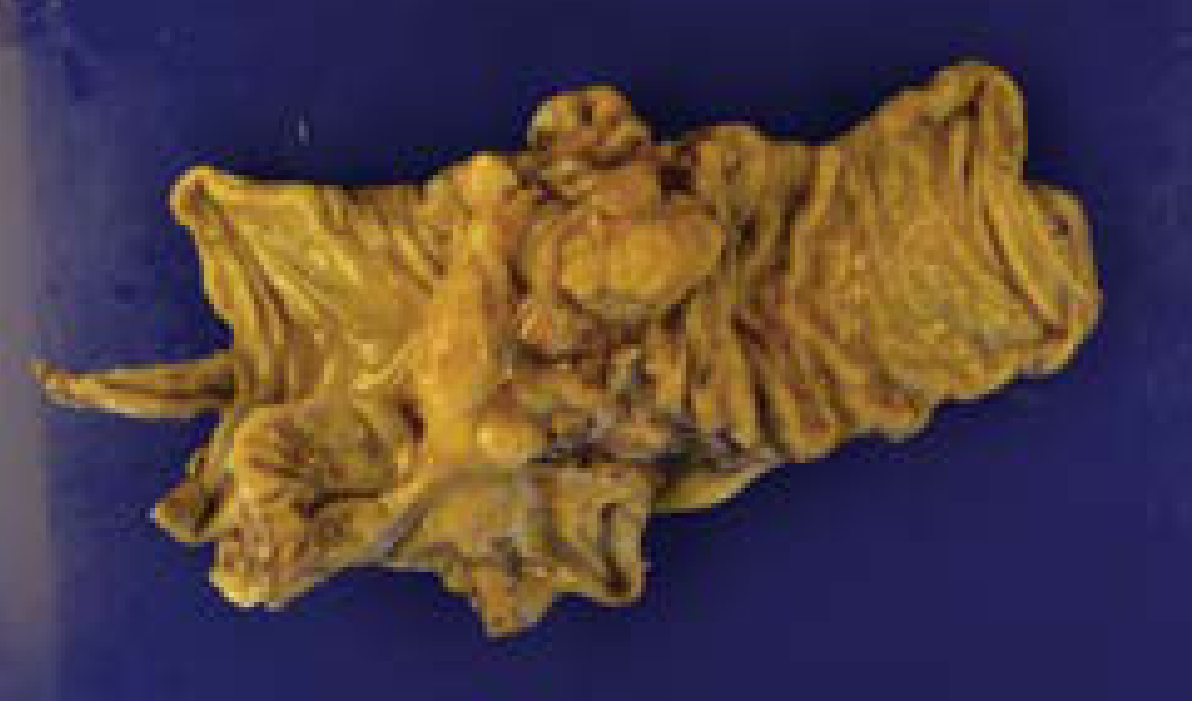
Ileocecal resection specimen: carcinoid tumor extending into serosal surface with regional lymph node metastasis - Current Surgical Therapy 14e
B. Carcinoid Syndrome
Develops in ~8% of patients with GI-NETs (range 2-18%), almost exclusively when liver metastases are present (>90% of cases). The liver normally degrades serotonin - metastases bypass this.
Typical syndrome - serotonin pathway:
- Tryptophan → 5-HTP → (aromatic L-amino acid decarboxylase) → 5-HT (serotonin) → stored in platelets → converted to 5-HIAA (excreted in urine)
Atypical syndrome (foregut NETs): Deficiency of aromatic L-amino acid decarboxylase → 5-HTP secreted directly → elevated urinary 5-HTP and 5-HT
Clinical Features:
| Feature | At Presentation (%) | During Disease Course (%) |
|---|---|---|
| Flushing | 70 (23-100) | 78 (45-96) |
| Diarrhea | 69 (32-93) | 78 (58-100) |
| Carcinoid heart disease | 26 (11-40) | 30 (14-41) |
| Wheezing/asthma | 11 (4-14) | 12 (3-18) |
| Abdominal pain | ~40 | ~40 |
-
Flushing: In gastric NETs, caused by histamine (prevented by H1+H2 antihistamines); other mediators include tachykinins (substance P), bradykinins
-
Carcinoid heart disease: Right-sided valvular lesions (tricuspid regurgitation, pulmonary stenosis) from serotonin depositing fibrous plaques on right heart valves
-
Diagnosis: Elevated 24-hour urinary 5-HIAA is the gold standard
-
Sleisenger and Fordtran, Table 34.11
C. Gastrinoma (Zollinger-Ellison Syndrome)
- Source: G-cells (gastrin-secreting), primarily in duodenum and pancreas
- Most common pNET in MEN-1 patients (almost always duodenal in MEN-1)
- Zollinger-Ellison triad: Refractory peptic ulcers + hypersecretion of gastric acid + non-beta islet cell tumor
- Presents with severe/recurrent PUD, diarrhea, esophagitis
- Diagnosis: Fasting serum gastrin >1000 pg/mL (or >200 with low gastric pH) + secretin stimulation test (paradoxical rise in gastrin)
D. Insulinoma
- Most common functional pNET
- Whipple's triad: Hypoglycemic symptoms + blood glucose <50 mg/dL + relief with glucose
- Diagnosis: 72-hour fast; plasma insulin-to-glucose ratio >0.3; inappropriately elevated C-peptide; elevated proinsulin
-
90% are benign and solitary
- Imaging: Multiphasic CT, EUS; Ga-68 DOTATATE PET only if metastases suspected
E. VIPoma (Verner-Morrison Syndrome / WDHA)
- Secretes Vasoactive Intestinal Polypeptide (VIP)
- WDHA syndrome: Watery Diarrhea + Hypokalemia + Achlorhydria (pancreatic cholera)
- Large volume secretory diarrhea (>3L/day)
F. Glucagonoma
- Secretes glucagon → hyperglycemia + catabolism
- Classic: "4 Ds" - Dermatitis (necrolytic migratory erythema), Diabetes, Deep vein thrombosis, Depression
- Necrolytic migratory erythema is pathognomonic - migratory, crusting rash on legs/perineum
- Usually large and malignant at diagnosis
G. Somatostatinoma
- Inhibits multiple GI functions
- Inhibitory triad: Diabetes mellitus (inhibits insulin) + Steatorrhea/cholelithiasis (inhibits CCK/pancreatic enzymes) + Hypochlorhydria (inhibits gastrin/acid)
- Rare; most are pancreatic or duodenal
5. Inherited Syndromes Associated with GI-NETs
| Syndrome | Genetic Defect | NET Types |
|---|---|---|
| MEN-1 (Werner) | Chromosome 11q13 - MEN1 (menin) | pNETs (80-100%), gastrinoma (most common functional), insulinoma; pituitary adenoma, hyperparathyroidism |
| VHL Disease | Chromosome 3p25 - pVHL | pNETs (10-17%), insulinoma, glucagonoma |
| NF-1 (von Recklinghausen) | Chromosome 17q11.2 - NF1 (neurofibromin) | Duodenal somatostatinomas, periampullary NETs |
| TSC (tuberous sclerosis) | TSC1/TSC2 | pNETs (rare) |
MEN-1 pathogenesis follows Knudsen's 2-hit model: germline mutation + somatic deletion of second allele removes tumor suppressor function of menin.
- Sleisenger and Fordtran, Table 34.3
6. Diagnosis and Imaging
Biochemical Markers
- Chromogranin A - universal marker for all NETs (elevated in >80%)
- Urinary 5-HIAA - carcinoid syndrome (sensitivity 70-75%, specificity >90%)
- NSE (neuron-specific enolase) - particularly for poorly differentiated NETs
- Specific hormones (gastrin, insulin/C-peptide, VIP, glucagon, somatostatin) for functional tumors
Imaging
- CT/MRI: First-line; NETs are hyperenhancing on arterial phase (unlike adenocarcinomas)
- Ga-68 DOTATATE PET scan: Somatostatin receptor scintigraphy - most sensitive for localization and staging of well-differentiated NETs (>90% express somatostatin receptors). Preferred over older In-111 octreoscan
- EUS (endoscopic ultrasound): Best for small pancreatic and duodenal lesions
- Hepatic venous sampling after arterial calcium stimulation: Rarely needed; used when imaging fails to localize insulinoma
7. Management
Surgery
- Curative intent: Wide en bloc resection with mesenteric lymphadenectomy for small bowel NETs
- Inspect for multicentric disease (40% are multifocal) and liver metastases
- Even with liver metastases, resect primary for local control and symptom relief
- Debulking: Aim to remove >90% of tumor burden for durable symptomatic relief
- Carcinoid crisis (during operative manipulation): Hemodynamically significant surge in vasoactive peptides - managed with high-dose IV somatostatin analogues + hemodynamic support
Medical Management
- Somatostatin analogues (octreotide, lanreotide): First-line for symptom control in carcinoid syndrome; block release of serotonin and tachykinins; prevent flushing in 20-30%, diarrhea in 50-60%; also have antiproliferative effect (PROMID, CLARINET trials)
- Telotristat ethyl (tryptophan hydroxylase inhibitor): Added for refractory diarrhea despite SSA therapy
- mTOR inhibitors (everolimus): For progressive well-differentiated pNETs and GI-NETs
- Sunitinib: For advanced well-differentiated pNETs
- PRRT (Peptide Receptor Radionuclide Therapy with Lu-177 DOTATATE): For somatostatin receptor-positive advanced/metastatic NETs refractory to SSA
- Streptozocin-based chemotherapy: Primarily for poorly differentiated NECs
- PPIs: High-dose for gastrinoma (ZES)
Liver Metastases
- Hepatic resection if >90% debulking achievable
- Liver-directed therapies: TACE (transarterial chemoembolization), hepatic artery embolization, radiofrequency ablation
- Liver transplantation in highly selected patients with unresectable liver-only disease
8. Prognosis by Location
- Appendiceal NETs <2 cm: Almost never metastasize; simple appendectomy curative
- Rectal NETs <1 cm: Very low metastatic potential; local endoscopic resection sufficient
- Small bowel NETs: Indolent but high rate of nodal/hepatic spread at diagnosis
- Poorly differentiated NECs: Highly aggressive; similar to SCLC behavior; treated with platinum-etoposide
Summary mnemonic for functional tumor syndromes:
| Tumor | Key hormone | Classic syndrome |
|---|---|---|
| Carcinoid | Serotonin (5-HT) | Flushing + diarrhea + wheezing + right heart disease |
| Gastrinoma | Gastrin | Refractory peptic ulcers + diarrhea (ZES) |
| Insulinoma | Insulin | Whipple's triad (fasting hypoglycemia) |
| VIPoma | VIP | WDHA (watery diarrhea + hypoK + achlorhydria) |
| Glucagonoma | Glucagon | 4Ds (dermatitis + DM + DVT + depression) |
| Somatostatinoma | Somatostatin | Inhibitory triad (DM + steatorrhea + hypochlorhydria) |
Sources: Sleisenger and Fordtran's GI and Liver Disease; Current Surgical Therapy 14e; Yamada's Textbook of Gastroenterology 7e; Robbins Pathologic Basis of Disease; Goldman-Cecil Medicine. Recent review: Management update in GEP-NETs (Cancer, 2024 - PMID 39012928).
This is a shared conversation. Sign in to Orris to start your own chat.