
MANAGEMENT of status epilepyicus
I'll look up the medical library skill first, then research status epilepticus management comprehensively.
Reading File
Now let me search the library and PubMed in parallel for status epilepticus management.
Finding Sources
Searching PubMed
"status epilepticus" AND management
Excellent - multiple textbook sources found. Now let me read the most relevant and comprehensive ones in parallel.
Reading File
Reading File
Reading File
Reading File
I found a management flowchart image and rich content. Let me fetch the image and read the Katzung pharmacology and Harriet Lane sections in parallel.
Loading Image
Reading File
Reading File
Reading File
I now have very comprehensive content from multiple authoritative textbooks. Let me compile the full, well-structured answer.
Management of Status Epilepticus (SE)
Definition
Status epilepticus is defined as:
- A single seizure lasting ≥5 minutes, OR
- Two or more seizures without recovery of consciousness between them
After 5 minutes, seizures rarely terminate spontaneously, are less responsive to antiepileptic drugs, and begin causing neuronal damage. Treatment must begin at the 5-minute mark - do not wait for 30 minutes.
- Focal impaired awareness SE: diagnosis at 10 minutes
- Long-term neuronal injury threshold: ~30 min (convulsive) / ~60 min (focal)
(Goldman-Cecil Medicine, Tintinalli's Emergency Medicine, Katzung's Pharmacology)
Classification
| Type | Features |
|---|---|
| Generalized convulsive SE | Prominent tonic-clonic motor activity, impaired consciousness - most dangerous |
| Nonconvulsive SE (NCSE) | Persistent behavioral/cognitive change, continuous epileptiform EEG, no major motor signs; includes absence SE, focal SE, NCSE in coma |
| Refractory SE | Seizures persist after adequate first-line AND second-line treatment (20-30% of cases) |
| Super-refractory SE | Seizures persist/recur after ≥24 hours of third-line therapy |
Common Causes (MNEMONIC: SEAT)
- Subtherapeutic antiepileptic drug levels
- Electrolyte/metabolic abnormalities (glucose, Na, Ca, Mg), anoxia, hypoxia
- Acute CNS insult - stroke, infection, trauma, autoimmune encephalitis (most common cause in one study), posterior reversible encephalopathy syndrome (PRES)
- Toxic - alcohol/drug intoxication or withdrawal
Management Protocol
The management is time-critical and proceeds in three phases:
PHASE 1 - Stabilization (0-5 minutes)
Simultaneously with any seizure activity:
- Airway, Breathing, Circulation (ABCs) - position to maximize ventilation, prevent aspiration
- Administer oxygen (nasal cannula or face mask)
- Large-bore IV access (or IO if IV cannot be established)
- Cardiac monitor, pulse oximetry, end-tidal capnography
- Point-of-care glucose - give IV dextrose if hypoglycemic (give thiamine 100 mg IV first if alcoholism suspected)
- Normal saline IV fluid (avoid glucose-containing solutions - phenytoin incompatible)
- Blood samples: electrolytes, glucose, calcium, magnesium, renal function, liver function, CBC, antiepileptic drug levels (when indicated), urine toxicology
- Treat hyperthermia with antipyretics and cooling blankets
- Correct metabolic abnormalities
Important: Delays in benzodiazepine initiation >10 minutes are associated with higher mortality, longer seizure duration, and more complications.
PHASE 2 - Active/Established SE: First-Line Treatment (5-30 minutes)
Benzodiazepines are the first-line drugs - terminate seizures ~70% of the time.
| Drug | Route | Adult Dose | Notes |
|---|---|---|---|
| Lorazepam | IV | 0.1 mg/kg (2-4 mg) at 2 mg/min | Preferred IV agent; longer duration than diazepam due to less peripheral redistribution |
| Diazepam | IV | 5-10 mg bolus at 5 mg/min; up to 20 mg total | Rapid CNS entry but shorter effective duration |
| Midazolam | IM | 10 mg IM | Preferred if NO IV access; shown non-inferior to IV lorazepam in prehospital setting |
| Diazepam | Rectal | 0.5 mg/kg | Prehospital/home use |
| Midazolam | Intranasal/buccal | Weight-based (see pediatric dosing) | Acceptable if IV/IO unavailable |
Protocol note: Give a second benzodiazepine dose only after 5 minutes of continued seizure. Consider a third benzodiazepine dose and simultaneously begin loading a second-line agent if seizure persists 5 minutes after the second dose.
PHASE 2b - Established SE: Second-Line Treatment (concurrent with benzodiazepines or if benzodiazepines fail)
Three options are equally effective (~45-50% cessation after benzodiazepine failure):
| Drug | Dose | Rate | Notes |
|---|---|---|---|
| Fosphenytoin (preferred over phenytoin) | 15-20 mg PE/kg IV | 150 mg PE/min | Water-soluble; can give IM; less cardiotoxic than phenytoin; given as phenytoin equivalents (PE) |
| Levetiracetam | 30-60 mg/kg (or 2000-4500 mg) IV over 10 min | Rapid infusion | Favorable safety profile; no drug interactions; no hepatic monitoring needed |
| Valproic acid | 30-40 mg/kg at 5 mg/kg/min | Contraindicated in liver disease, thrombocytopenia, possible metabolic disease, pregnancy (1st trimester) | |
| Phenytoin (if fosphenytoin unavailable) | 20 mg/kg IV | 50 mg/min | Must use NS (incompatible with dextrose); cardiotoxic risk; ECG monitoring required |
| Lacosamide | IV loading dose | Alternative second-line; ECG monitoring needed (risk of arrhythmia) | |
| Phenobarbital | 10 mg/kg at 100 mg/min | Highly effective but prolonged sedation, respiratory depression, hypotension |
Consider endotracheal intubation for airway protection at this stage. Use a short-acting paralytic (succinylcholine preferred) - avoid long-acting paralytics as they mask ongoing seizure activity. Arrange continuous EEG monitoring if paralytics are used.
PHASE 3 - Refractory SE: Third-Line Treatment (>30 minutes, or failed 1st + 2nd line)
Requires ICU admission, intubation, ventilation, and continuous EEG monitoring.
Goal: Suppress epileptiform EEG activity (burst suppression pattern).
| Drug | Dose |
|---|---|
| Midazolam (most commonly used) | Load 0.2 mg/kg IV, then infusion 0.05-2 mg/kg/hr |
| Propofol | 1 mg/kg IV bolus, then 1-10 mg/kg/hr infusion |
| Phenobarbital | 20 mg/kg at 50-75 mg/min |
| Ketamine | 5 mg/kg/hr infusion (or 2.2 mg/kg/hr); emerging evidence, useful especially in pediatric refractory SE |
| Pentobarbital/Thiopental | 0.5-3 mg/kg/hr (pentobarbital); 3-5 mg/kg/hr (thiopental) |
(Tintinalli's Emergency Medicine, Miller's Anesthesia, Goldman-Cecil Medicine)
PHASE 4 - Super-Refractory SE (seizures >24 hours despite 3rd-line therapy)
Options with limited but growing evidence:
- Inhaled anesthetics (isoflurane, desflurane)
- Ketamine (NMDA antagonist - mechanistically attractive as glutamate receptors upregulate in prolonged SE)
- Vagal nerve stimulation (VNS)
- Electroconvulsive therapy (ECT)
- Surgical resection (systematic review PMID 38456595 supports surgical management in select refractory cases)
- Evaluation for rare/treatable etiologies (autoimmune encephalitis - NMDA receptor antibody, etc.)
- Transfer to specialized epilepsy center with continuous EEG capability
Management Flowchart
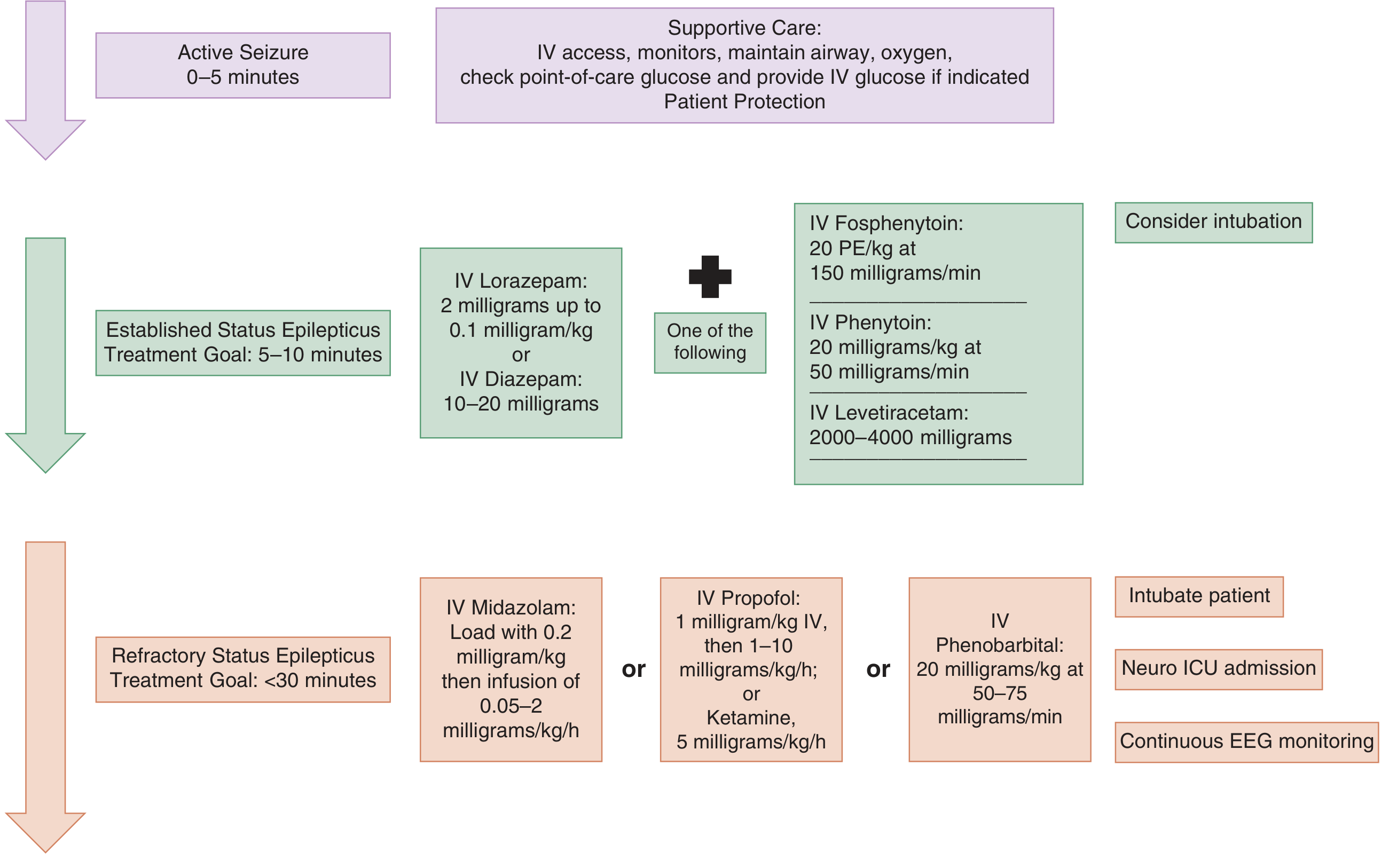
Figure: Three-phase treatment protocol from Tintinalli's Emergency Medicine
Nonconvulsive SE - Special Considerations
- Diagnosis confirmed by EEG (mandatory)
- Clinical clues: prolonged postictal state, subtle twitching/eye deviation/blinking, fluctuating altered mental status, unexplained stupor/coma
- Less urgency than convulsive SE; treatment can be initiated more cautiously with lower doses
- Must suspect in any comatose patient without explanation - begin continuous EEG monitoring
Systemic Complications to Monitor
| Complication | Action |
|---|---|
| Hypoxic respiratory failure / acidosis | Early airway management |
| Hypoglycemia or hyperglycemia | Glucose monitoring and correction |
| Hyperthermia | Antipyretics + cooling blanket |
| Rhabdomyolysis | Monitor CK, urine output, renal function |
| Cardiac arrhythmias / hypotension | Continuous cardiac monitoring, vasopressors if needed |
| Aspiration / pulmonary edema | Respiratory support |
| Raised ICP | Elevate head of bed 30°, treat underlying cause |
(Miller's Anesthesia, Rosen's Emergency Medicine)
Pediatric Considerations (Harriet Lane Handbook)
| Drug | Age | Dose |
|---|---|---|
| Diazepam IV | <5 yr | 0.2-0.5 mg/dose Q2-5 min; max 5 mg |
| Diazepam IV | ≥5 yr | 1 mg/dose Q2-5 min; max 10 mg |
| Diazepam rectal | Any | 0.5 mg/kg then 0.25 mg/kg in 10 min PRN |
| Midazolam IN | 6-11 yr | 0.3 mg/kg/dose (weight-based table) |
| Midazolam IN | ≥12 yr | 0.2 mg/kg/dose (weight-based table) |
| Ketamine infusion | Pediatric | Supported by 2024 systematic review (PMID 38881333) |
Recent Evidence Updates (2024-2026)
- A 2024 systematic review of clinical practice guidelines (Vignatelli et al., Epilepsia 2024) confirmed the three-phase treatment approach and highlighted significant variability in guideline recommendations internationally, especially for second-line agents - levetiracetam, valproate, and fosphenytoin remain equally recommended.
- A 2024 meta-analysis on ketamine in pediatric SE (Epilepsia 2024) supports ketamine as a viable option in refractory pediatric SE.
- A 2026 systematic review on brivaracetam for SE (J Neurol 2026) suggests brivaracetam may be a promising second- or third-line IV option, though routine use is not yet established.
Summary: Time-Action Table
| Time | Phase | Action |
|---|---|---|
| 0-5 min | Pre-treatment | ABCs, IV/IO access, glucose check, labs, monitors |
| 5-10 min | 1st line | Benzodiazepine IV (lorazepam 0.1 mg/kg or diazepam 10-20 mg); IM midazolam 10 mg if no IV |
| 10-30 min | 2nd line | Fosphenytoin 20 PE/kg OR levetiracetam 2000-4500 mg OR valproate 30-40 mg/kg; consider intubation |
| >30 min | 3rd line (Refractory) | Intubate + ICU; midazolam/propofol/pentobarbital continuous infusion + EEG monitoring |
| >24 hr | Super-refractory | Ketamine, inhaled anesthetics, VNS, ECT; workup rare etiologies |
Sources: Tintinalli's Emergency Medicine (9780323757898) - Rosen's Emergency Medicine (9781260019933) - Miller's Anesthesia 10e (9780323935920) - Goldman-Cecil Medicine (9780323930345) - Katzung's Pharmacology 16e (9781260463309) - Harriet Lane Handbook 23e (9780323876988)
This is a shared conversation. Sign in to Orris to start your own chat.