
What is heroine and brown sugar
- Heroin is the pharmaceutical/chemical name for diacetylmorphine, an illegal Schedule I opioid narcotic.
- Brown sugar is one of its most common street names, especially in South Asia (India, Pakistan), referring to an impure, brownish form of heroin (also called No. 3 heroin).
- It acts on opioid receptors in the brain, causing intense euphoria, pain relief, and sedation - followed by severe physical and psychological dependence.
heroin brown sugar drug pharmacology effects addiction
Heroin (Brown Sugar) - A Complete Overview
What Is It?
Chemical Nature & Forms
| Form | Appearance | Common Route |
|---|---|---|
| No. 4 (pure) | White powder | Intravenous injection |
| No. 3 (brown sugar) | Brown/tan powder | Smoked, snorted |
| Black tar heroin | Dark, sticky | Injection (subcutaneous/IV) |
Mechanism of Action
- Heroin (via its active metabolite morphine) activates μ-opioid receptors on GABAergic inhibitory interneurons
- This inhibits the inhibitors, causing disinhibition of dopamine neurons
- Dopamine floods the nucleus accumbens (the brain's reward center), producing intense euphoria
Acute Effects (Short-Term)
- Intense rush/euphoria - a surge of pleasure often compared to sexual orgasm, lasting 45 seconds to several minutes
- Warm flushing of the skin, dry mouth, heavy limbs
- "On the nod" - an alternating drowsy/wakeful state lasting up to an hour
- CNS depression - slowed breathing, clouded thinking, pinpoint pupils (miosis)
- Nausea and vomiting (especially in new users)
Long-Term Effects & Health Consequences
- Collapsed veins (from repeated IV injection)
- Infective endocarditis (heart valve infection)
- Abscesses and cellulitis (especially from subcutaneous/"skin popping" injection)
- Liver disease (hepatitis B and C from shared needles)
- Pulmonary complications (from insoluble adulterants clogging blood vessels)
- Severe constipation, loss of libido
- Cognitive impairment and psychiatric comorbidities
Addiction & Dependence
- Physical dependence can develop in as little as 2-3 weeks of regular use
- Genetic factors account for 50-60% of the liability for heroin addiction (twin studies) - Kaplan & Sadock's Comprehensive Textbook of Psychiatry
- Addiction may occur after even a single use in some individuals - Tintinalli's Emergency Medicine
- Users constantly oscillate between being "high" and feeling early withdrawal
Withdrawal Syndrome
- Intense dysphoria and anxiety
- Muscle aches, cramps
- Nausea, vomiting, diarrhea
- Tearing (lacrimation), runny nose (rhinorrhea)
- Dilated pupils (mydriasis), goosebumps (piloerection)
- Sweating, fever, yawning
Overdose - A Medical Emergency
- Slow, shallow breathing (respiratory depression - the main killer)
- Blue lips and fingernails (cyanosis)
- Unconsciousness/coma
- Pinpoint pupils
- Clammy skin, convulsions
Treatment of Heroin Addiction
| Treatment | Mechanism |
|---|---|
| Methadone (oral) | Long-acting mu-agonist; reduces craving and withdrawal |
| Buprenorphine/Suboxone | Partial mu-agonist; ceiling effect limits overdose risk |
| Naltrexone | Opioid antagonist; blocks euphoric effects |
| Behavioral therapies | Cognitive-behavioral therapy, contingency management |
| Injectable heroin (supervised) | Used in some countries for treatment-resistant cases |
Legal Status
Acetylation of morphine
acetylation of morphine to heroin diacetylmorphine chemistry mechanism
morphine heroin diacetylmorphine chemical structure acetylation
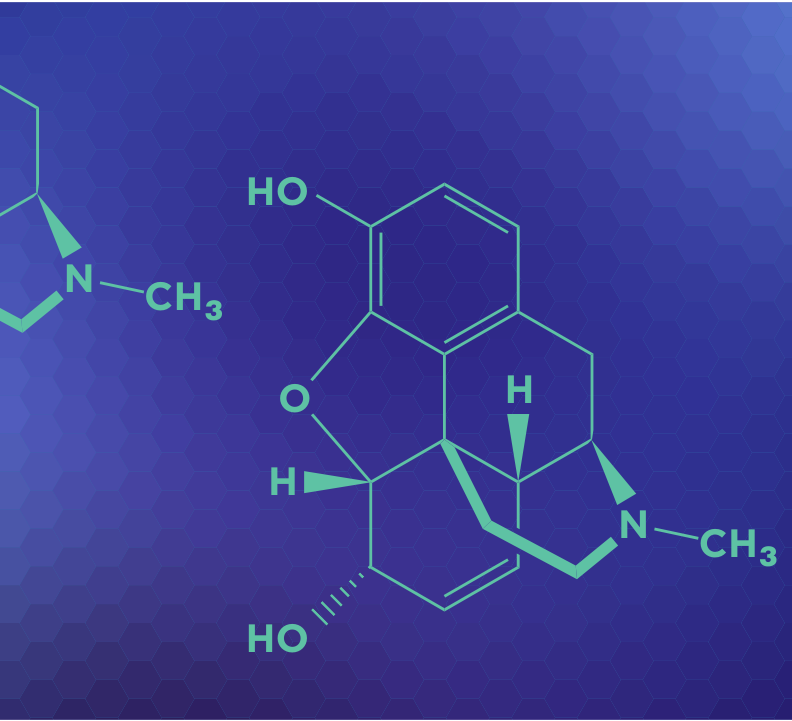
Summary : This image displays the chemical structure of a complex organic molecule, specifically morphine, on a blue hexagonal patterned background. chemical structure illustration: # Main Structure : • The molecule consists of five fused rings, including aromatic and non-aromatic rings. • Functional groups present: two hydroxyl groups (–OH), one ketone (C=O), and one tertiary amine (N–CH₃). • Stereochemistry is indicated with solid and dashed wedges for hydrogen and hydroxyl groups. • The nitrogen atom is bonded to a methyl group (–CH₃). • The structure is drawn in a skeletal formula style, with carbon atoms implied at vertices and hydrogen atoms shown only where necessary for clarity. # Labels & Notation : • Atoms labeled: HO (hydroxyl), H (hydrogen), O (oxygen), N (nitrogen), CH₃ (methyl). • Stereochemistry: solid wedges (out of plane), dashed wedges (into plane). • No explicit atom numbering or additional annotation. # Design & Background : • Molecule is rendered in light teal/green lines. • Background is a blue gradient with a subtle hexagonal pattern. • No axis, scale, or legend present. # Spatial Relationships : • The molecule is centered, with a partial structure visible on the left edge, suggesting a cropped or extended illustration. • The main focus is on the morphine molecule. # Analysis : • The image is a clear, stylized depiction of the morphine molecule, highlighting its key functional groups and stereochemistry. • The background and color scheme are chosen for visual appeal, not for data presentation. • No quantitative or comparative data is present; the image serves as a chemical illustration.
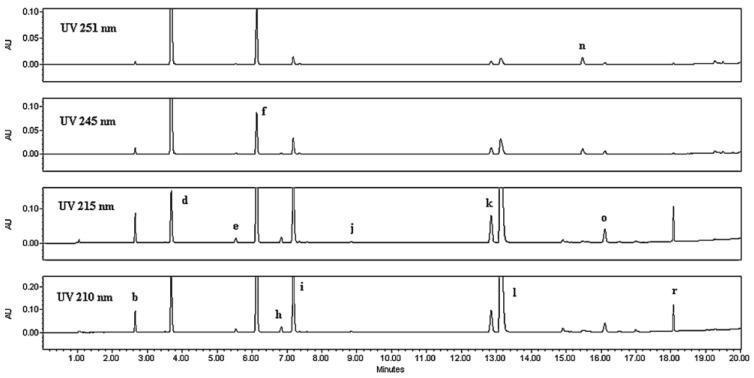
This diagnostic image displays four Ultra-High-Performance Liquid Chromatography (UHPLC) chromatograms stacked vertically, used for the chemical profiling and forensic analysis of illicit drug samples. Each panel represents a different UV detection wavelength: 251 nm, 245 nm, 215 nm, and 210 nm. The y-axis measures absorbance units (AU), while the x-axis represents retention time in minutes (0 to 20 minutes). The visual demonstrates the separation and identification of multiple compounds within a Southwest Asian heroin sample. Key labeled peaks correspond to morphine (b), acetaminophen (d), codeine (e), caffeine (f), O3-monoacetylmorphine (h), O6-monoacetylmorphine (i), lidocaine (j), acetylcodeine (k), heroin (l), papaverine (n), noscapine (o), and methorphan (r). The varying peak heights across different wavelengths illustrate the specific UV absorbance characteristics of each component. This comparative visualization is essential for forensic toxicology, allowing for the identification of primary drugs and common adulterants or impurities, which aids in determining the geographical origin and composition of seized substances.
![Summary : This flowchart illustrates the metabolic pathways of several opioids, showing how codeine, morphine, heroin, hydrocodone, hydromorphone, oxycodone, and oxymorphone are interconverted, including minor metabolic routes and key intermediates.
flowchart:
# Nodes :
• Codeine (rectangle)
• Morphine (rectangle)
• 6-MAM (rectangle) [abbreviation for 6-monoacetylmorphine]
• Heroin (rectangle)
• Hydrocodone (rectangle)
• Hydromorphone (rectangle)
• Oxycodone (rectangle)
• Oxymorphone (rectangle)
# Connectors :
• Codeine → Morphine (rightward arrow)
• Codeine → Hydrocodone (downward arrow, labeled "<15%")
• Morphine → Hydromorphone (downward arrow, labeled "<5%")
• Morphine ← 6-MAM (leftward arrow)
• 6-MAM ← Heroin (leftward arrow)
• Hydrocodone → Hydromorphone (rightward arrow)
• Oxycodone → Oxymorphone (rightward arrow)
# Layout :
• Top row (left to right): Codeine → Morphine ← 6-MAM ← Heroin
• Bottom row (left to right): Hydrocodone → Hydromorphone; Oxycodone → Oxymorphone
• Vertical arrows connect Codeine to Hydrocodone and Morphine to Hydromorphone.
• All nodes are rectangles with black arrows indicating direction of metabolic conversion.
• Minor metabolic routes are indicated by percentage labels on arrows.
# Analysis :
• The chart shows that codeine and morphine are central to opioid metabolism, with codeine converting to morphine and also to hydrocodone (<15%), while morphine converts to hydromorphone (<5%).
• Heroin is metabolized to 6-MAM, which then becomes morphine.
• Hydrocodone and oxycodone are metabolized to hydromorphone and oxymorphone, respectively.
• The flowchart highlights both major and minor metabolic pathways, with percentage values indicating the relative contribution of minor routes.](https://cdn.orris.care/cdss_images/GLGCA_1971996_1763332212296_0295e6ed-5aba-4fc1-9c69-4dea36c04e7d.png)
Summary : This flowchart illustrates the metabolic pathways of several opioids, showing how codeine, morphine, heroin, hydrocodone, hydromorphone, oxycodone, and oxymorphone are interconverted, including minor metabolic routes and key intermediates. flowchart: # Nodes : • Codeine (rectangle) • Morphine (rectangle) • 6-MAM (rectangle) [abbreviation for 6-monoacetylmorphine] • Heroin (rectangle) • Hydrocodone (rectangle) • Hydromorphone (rectangle) • Oxycodone (rectangle) • Oxymorphone (rectangle) # Connectors : • Codeine → Morphine (rightward arrow) • Codeine → Hydrocodone (downward arrow, labeled "<15%") • Morphine → Hydromorphone (downward arrow, labeled "<5%") • Morphine ← 6-MAM (leftward arrow) • 6-MAM ← Heroin (leftward arrow) • Hydrocodone → Hydromorphone (rightward arrow) • Oxycodone → Oxymorphone (rightward arrow) # Layout : • Top row (left to right): Codeine → Morphine ← 6-MAM ← Heroin • Bottom row (left to right): Hydrocodone → Hydromorphone; Oxycodone → Oxymorphone • Vertical arrows connect Codeine to Hydrocodone and Morphine to Hydromorphone. • All nodes are rectangles with black arrows indicating direction of metabolic conversion. • Minor metabolic routes are indicated by percentage labels on arrows. # Analysis : • The chart shows that codeine and morphine are central to opioid metabolism, with codeine converting to morphine and also to hydrocodone (<15%), while morphine converts to hydromorphone (<5%). • Heroin is metabolized to 6-MAM, which then becomes morphine. • Hydrocodone and oxycodone are metabolized to hydromorphone and oxymorphone, respectively. • The flowchart highlights both major and minor metabolic pathways, with percentage values indicating the relative contribution of minor routes.
Acetylation of Morphine
The Chemical Reaction
Morphine + Excess Acetic Anhydride (CH₃CO)₂O → 3,6-Diacetylmorphine (Heroin) + 2 Acetic Acid
Chemical Comparison
| Property | Morphine | Heroin (3,6-Diacetylmorphine) |
|---|---|---|
| Molecular formula | C₁₇H₁₉NO₃ | C₂₁H₂₃NO₅ |
| Molecular weight | 285.3 g/mol | 369.4 g/mol |
| -OH at C-3 | Free phenolic -OH | Acetylated (-OCOCH₃) |
| -OH at C-6 | Free alcoholic -OH | Acetylated (-OCOCH₃) |
| Lipid solubility | Low | High (2-3× morphine) |
Step-by-Step Process (Industrial/Clandestine)
- Morphine extraction - Morphine base is isolated from raw opium (using calcium hydroxide and ammonium chloride)
- Acetylation reaction - Morphine base is reacted with excess acetic anhydride under heat for several hours
- Neutralization - The solution is neutralized with sodium carbonate
- Salt formation - Treated with hydrochloric acid to form heroin hydrochloride (the white street powder)
Why Acetylation Matters Pharmacologically
"Methylation of the phenolic hydroxyl at position 3, as in codeine, or acetylation of this hydroxyl, as in heroin, drastically reduces binding to the mu-opioid receptor; these compounds are converted in vivo to morphine and 6-acetylmorphine, respectively, to afford analgesia."
- Heroin itself is actually a prodrug - it has lower direct mu-receptor affinity than morphine
- The acetyl groups make it far more lipid-soluble, so it crosses the blood-brain barrier much faster
- Once inside the CNS, it is rapidly deacetylated (hydrolyzed) back to the active metabolites
Metabolic Deacetylation (In Vivo)
| Step | Reaction | Enzyme | Notes |
|---|---|---|---|
| Step 1 | Heroin → 6-MAM | Plasma/tissue esterases | Very rapid; the 3-acetyl group is removed first |
| Step 2 | 6-MAM → Morphine | Brain/plasma esterases | Active intermediate; also binds mu-receptors |
| Step 3 | Morphine → Morphine-6-glucuronide | Liver UGT enzymes | Potent active metabolite |
- 6-MAM (6-monoacetylmorphine) is a unique forensic marker for heroin use - its presence in urine proves heroin (not just morphine/codeine) was used
- The entire conversion from heroin to morphine occurs in minutes
Why Heroin Is More Potent Than Morphine
- Faster CNS entry - Heroin is ~2-3x more lipophilic than morphine, crosses the blood-brain barrier rapidly, giving an almost instantaneous "rush"
- Higher brain concentrations - The rapid transit means more drug reaches the CNS before peripheral distribution occurs
- Active intermediate - 6-MAM itself is a potent opioid agonist, adding to the overall effect
- Final conversion to morphine - Provides the sustained "on the nod" phase
Partial Acetylation (Brown Sugar / No. 3 Heroin)
- 3-Monoacetylmorphine (3-MAM)
- 6-Monoacetylmorphine (6-MAM) - the more active intermediate
- 3,6-Diacetylmorphine (heroin proper)
- Residual morphine and acetylcodeine
Summary
| Aspect | Key Point |
|---|---|
| Reaction type | Esterification (O-acetylation) of two -OH groups |
| Reagent | Acetic anhydride (excess) or acetyl chloride |
| Product | 3,6-Diacetylmorphine (heroin) |
| Effect on lipophilicity | Greatly increased → faster BBB penetration |
| Effect on receptor binding | Reduced directly, but it is a prodrug |
| Active metabolite | 6-MAM, then morphine |
| Forensic marker | 6-MAM is unique proof of heroin use |