
Teratomas
Reading File
Finding Sources
Finding Sources
Searching PubMed
teratoma pathology classification
Good results. Now let me read the most comprehensive textbook sections — Robbins Pathology for core pathology, Campbell-Walsh Urology for testicular teratomas, and the diagnostic radiology section for imaging features.
Reading File
Reading File
Reading File
Now let me fetch the dermoid cyst image and also read more about specific teratoma subtypes (monodermal, sacrococcygeal, mediastinal) from the Schwartz and Sabiston sections:
Loading Image
Reading File
Reading File
Let me also fetch the histology images and look at the Schwartz surgery and Adams neurology sections for CNS teratomas:
Loading Image
Loading Image
Reading File
I now have comprehensive information to write a thorough overview. Let me compile everything.
Teratomas
Teratomas are germ cell tumors (GCTs) that contain elements derived from at least two — and usually all three — embryonic germ cell layers (ectoderm, mesoderm, endoderm). The name derives from the Greek teras ("monster"), reflecting their bizarre admixture of tissues such as hair, teeth, cartilage, and neural tissue within a single mass.
Classification
Teratomas are divided into three major categories:
1. Mature (Benign) Teratomas
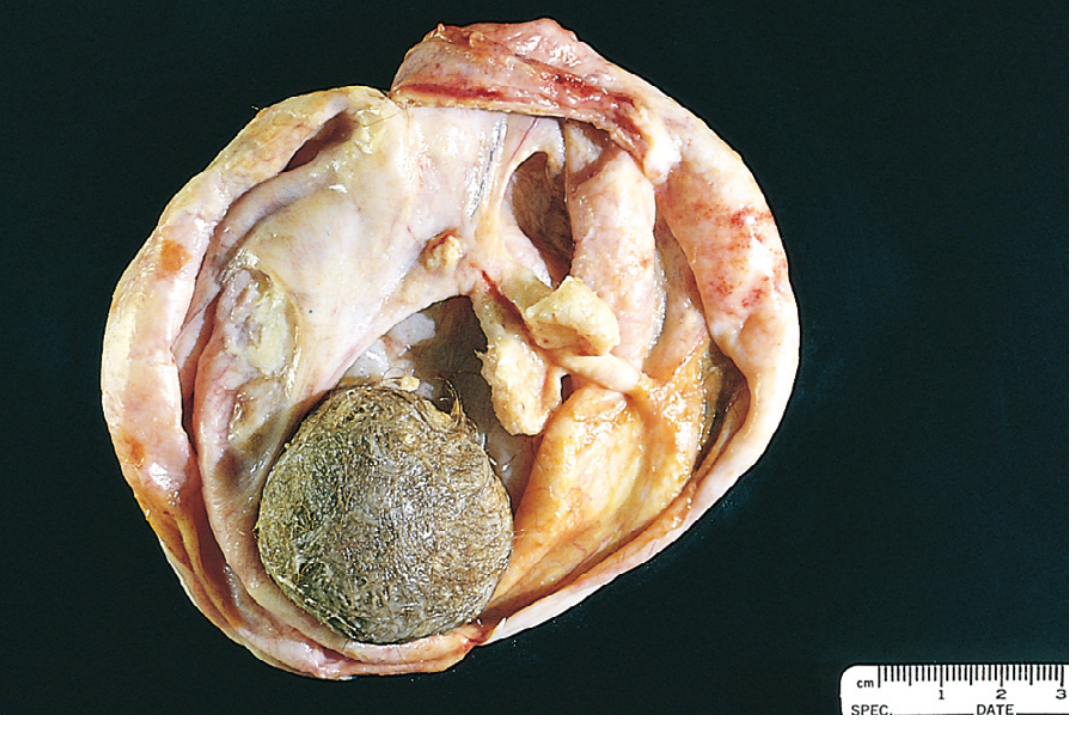
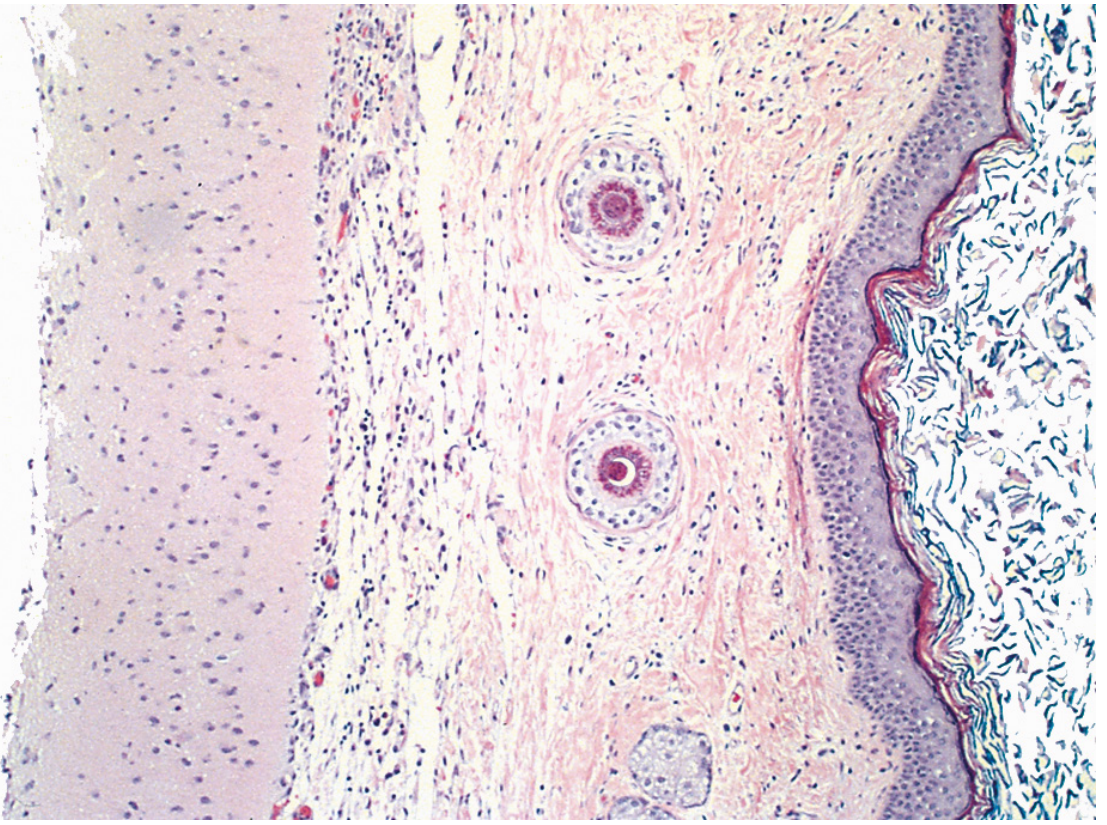
The most common type. Usually cystic and commonly called dermoid cysts, because the lining is predominantly skin-like (squamous epithelium, sebaceous glands, hair follicles). Characteristics:
- Found chiefly in young adult females (ovarian location)
- Bilateral in 10–15% of ovarian cases
- Cyst wall contains hair, sebum, teeth, bone, cartilage, thyroid, neural tissue
- Karyotype: 46,XX; most arise from an ovum after the first meiotic division
- ~1% undergo malignant transformation, most commonly to squamous cell carcinoma
- May cause paraneoplastic syndromes — notably anti-NMDAR encephalitis (inflammatory limbic encephalitis), which can remit after tumor removal
Gross appearance: Unilocular cyst filled with sebaceous material and hair:
Histology: Stratified squamous epithelium with hair shafts and sebaceous glands, with brain tissue from other germ layers:
2. Immature (Malignant) Teratomas
Rare tumors where the component tissues resemble embryonal or fetal tissue rather than mature structures.
- Found chiefly in prepubertal adolescents and young females (mean age ~18 years)
- Macroscopically: bulky, solid, with hair, sebaceous material, areas of necrosis and hemorrhage
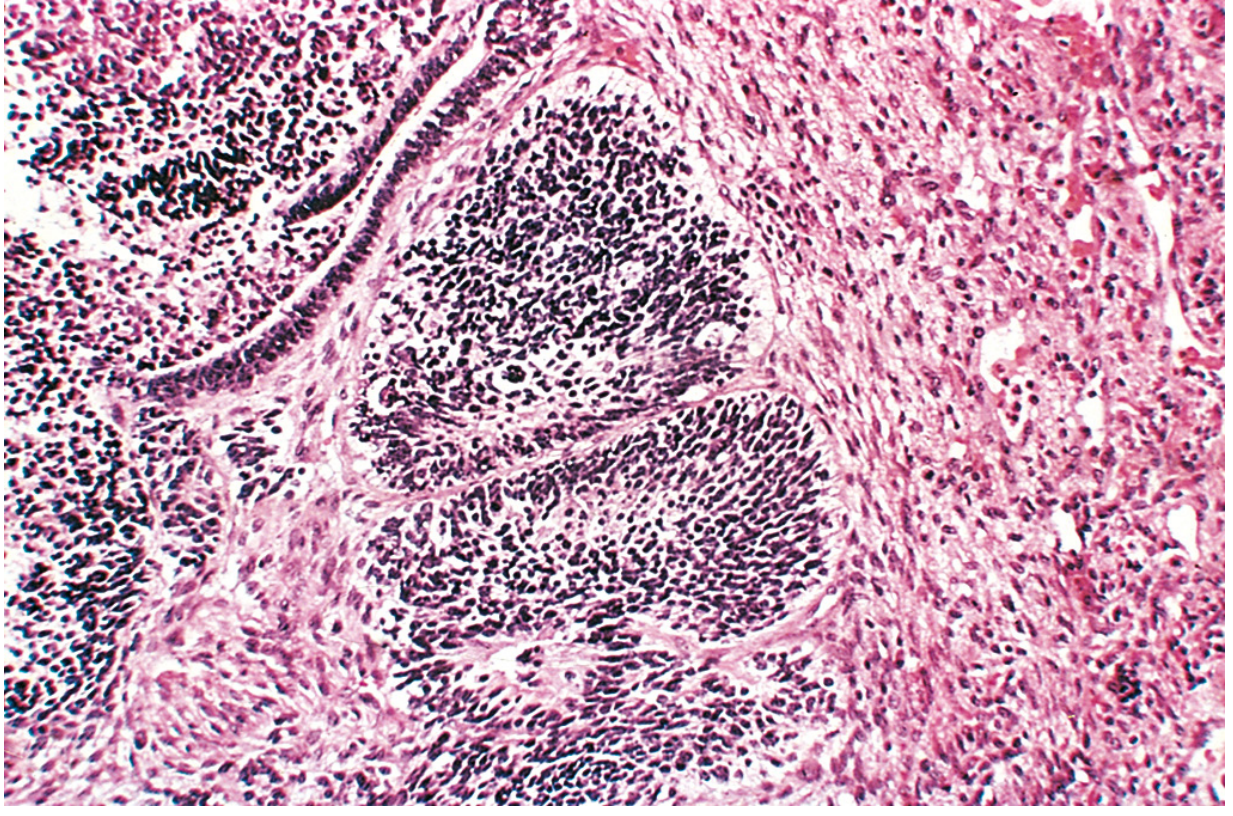
- Microscopically: contains immature neuroepithelium — the proportion of which determines histologic grade I–III
- Grade drives prognosis: Stage I, Grade 1 → excellent prognosis; Grade 2–3 → adjuvant chemotherapy
- Most recurrences occur within the first 2 years
Histology (primitive neuroepithelium):
3. Monodermal (Specialized) Teratomas
A rare group derived from only one germ layer or a specialized tissue type. Always unilateral. Key subtypes:
| Subtype | Tissue | Notes |
|---|---|---|
| Struma ovarii | Mature thyroid | Can cause hyperthyroidism |
| Ovarian carcinoid | Intestinal neuroendocrine | Can produce serotonin → carcinoid syndrome even without hepatic mets (ovarian veins → systemic) |
| Strumal carcinoid | Thyroid + carcinoid | Extremely rare combination |
Only ~2% of carcinoids arising in teratomas metastasize.
Sites & Location-Specific Features
Ovary (most common site in females)
The most common location for teratomas overall. Pure mature cystic teratomas are benign; ~1% undergo malignant transformation.
Testis (males)
- In adults: teratoma is histologically benign-appearing but clinically malignant — it is resistant to chemotherapy and frequently found at metastatic sites in NSGCT
- ~47% of mixed GCTs contain teratoma; pure testicular teratomas are uncommon
- Contains genetic hallmarks of malignancy: aneuploidy, isochromosome 12p [i(12p)]
- Can grow uncontrollably (growing teratoma syndrome), transform into somatic malignancies (rhabdomyosarcoma, adenocarcinoma, PNET) — termed "teratoma with somatic-type malignancy" — aggressive, chemo-resistant, poor prognosis
- In prepubertal boys: pure teratoma IS benign (different biology — no i[12p])
- Management: Residual masses after chemotherapy for NSGCT require surgical resection (retroperitoneal lymph node dissection), since teratoma is chemo-resistant and untreated teratoma → late relapse
Mediastinum (anterior)
- Commonest site for extragonadal GCTs
- CT: well-defined anterior mediastinal mass with mixed density — fat + fluid + soft tissue + calcification
- MRI: fat appears as high T1 with signal drop on fat-saturation; cysts are low T1/high T2; fat signal is virtually diagnostic of teratoma
- Differentiates from thymoma/lymphoma by fat content on MRI
Sacrococcygeal Teratoma
- Most common congenital neoplasm
- Associated with significant neurourologic dysfunction
- Urologic complications in ~33%: neurogenic bladder, urinary incontinence, vesicoureteral reflux
- Prenatal hydronephrosis on imaging significantly predicts urologic sequelae
- Altman classification (I–IV) based on external vs. presacral component
CNS / Pineal Teratomas
- WHO classifies CNS teratomas as: mature teratoma, immature teratoma, and teratoma with somatic-type malignancy
- Located classically in the pineal region
- A clear distinction from hamartomas can be difficult in some pineal teratomas
Pathogenesis
- Most teratomas arise from primordial germ cells that fail to migrate properly during embryogenesis
- Genetic analyses of ovarian teratomas: majority arise from an ovum after the first meiotic division; minority arise before it
- In testicular teratomas: hallmark genetic change is i(12p) — isochromosome 12p — confirming GCT origin even when histologically benign
Tumor Markers
| Marker | Relevance |
|---|---|
| AFP | Usually normal; mildly elevated in some teratomas (cystic fluid contains AFP) |
| β-hCG | Negative in pure teratoma |
| LDH | Nonspecific |
Absence of marker elevation does not exclude teratoma; teratoma is a marker-negative GCT element.
Key Clinical Points
- Testicular teratoma in adults: surgical resection is mandatory — chemo-resistance means chemotherapy alone is insufficient
- Expert pathology review is critical for GCTs: one study showed 31% discrepancy in histologic subtype between community and expert (Indiana University) pathologists
- Anti-NMDAR encephalitis associated with mature ovarian teratoma → oophorectomy is part of treatment
- Sacrococcygeal teratoma → long-term urologic follow-up required
Sources: Robbins, Cotran & Kumar Pathologic Basis of Disease; Campbell-Walsh-Wein Urology; Grainger & Allison's Diagnostic Radiology; Adams & Victor's Principles of Neurology; Sabiston Textbook of Surgery
Pluripotent
Finding Sources
Finding Sources
This is a shared conversation. Sign in to Orris to start your own chat.