
Bohr effect and haldane effect for 5 marks
The Bohr effect describes how increased CO2 and H+ (lower pH) shift the oxygen-hemoglobin dissociation curve to the right, reducing hemoglobin's affinity for O2 and promoting O2 release to tissues. The Haldane effect is the reverse relationship - oxygenation of hemoglobin reduces its ability to carry CO2 and H+, promoting CO2 release in the lungs.
Searching sources...
Reading File
Finding Sources
Finding Sources
Finding Sources
Now let me read the detailed content from the best sources:
Reading File
Reading File
Reading File
Now let me read the Haldane section from Fishman's and also fetch the key diagram image:
Reading File
Reading File
Loading Image
I now have comprehensive content from multiple authoritative textbooks. Here is a complete 5-mark answer:
Bohr Effect and Haldane Effect
Bohr Effect
Definition: The Bohr effect describes how an increase in CO2 and H+ concentration (fall in pH) shifts the oxygen-hemoglobin (Hb-O2) dissociation curve to the right, decreasing hemoglobin's affinity for O2 and promoting O2 release to the tissues.
Mechanism:
Deoxyhemoglobin has a greater affinity for H+ than oxyhemoglobin. When CO2 enters the blood from metabolically active tissues, it is hydrated to carbonic acid (H2CO3), which dissociates to release H+ ions. These H+ ions bind to specific ionizable groups on Hb - particularly histidine residues (His-146 of the beta chain is most important) whose pKa rises in the deoxy state. This protonation:
- Forms ionic bonds (salt bridges) that stabilize the T (tense/deoxy) conformation of hemoglobin
- Lowers O2 affinity - the curve shifts right (increased P50)
This can be summarized as:
HbO2 + H+ ⇌ HbH+ + O2
There are two components:
- pH-Bohr effect (dominant) - direct effect of falling pH
- CO2-Bohr effect (minor) - CO2 directly combines with terminal amino groups of Hb to form carbamino compounds, also stabilizing the T form
Physiological Significance:
-
At active tissues: high CO2/low pH → Hb releases more O2 (right shift)
-
At the lungs: low CO2/high pH → Hb binds O2 more avidly (left shift)
-
The effect is amplified during strenuous exercise due to lactic acid production
-
Deoxyhemoglobin is a stronger base (better H+ buffer), so the Bohr effect also minimizes the pH drop in venous blood by ~50%
-
Fishman's Pulmonary Diseases and Disorders
-
Lippincott Illustrated Reviews: Biochemistry, 8e, p. 105
Haldane Effect
Definition: The Haldane effect states that oxygenation of hemoglobin reduces its ability to carry CO2 - conversely, deoxygenation increases CO2-carrying capacity. Oxygenated blood at any PCO2 carries less CO2 than deoxygenated blood at the same PCO2.
Mechanism:
When O2 binds hemoglobin in the lungs, Hb becomes a stronger acid (HbO2 is more acidic than deoxy-Hb). This displaces CO2 from the blood in two ways:
- Carbamino displacement: OxyHb has less tendency to form carbaminohemoglobin (Hb-NH-COO-), so CO2 previously carried as carbamino is released
- Bicarbonate displacement: More acidic oxyHb releases excess H+; these H+ ions bind HCO3- to form carbonic acid (H2CO3), which dissociates to H2O + CO2, which is then exhaled
This can be summarized as:
Deoxy-Hb + CO2 ⇌ Oxy-Hb + CO2 (released)
Physiological Significance (Quantitative):
The diagram below from Guyton & Hall illustrates this effect:
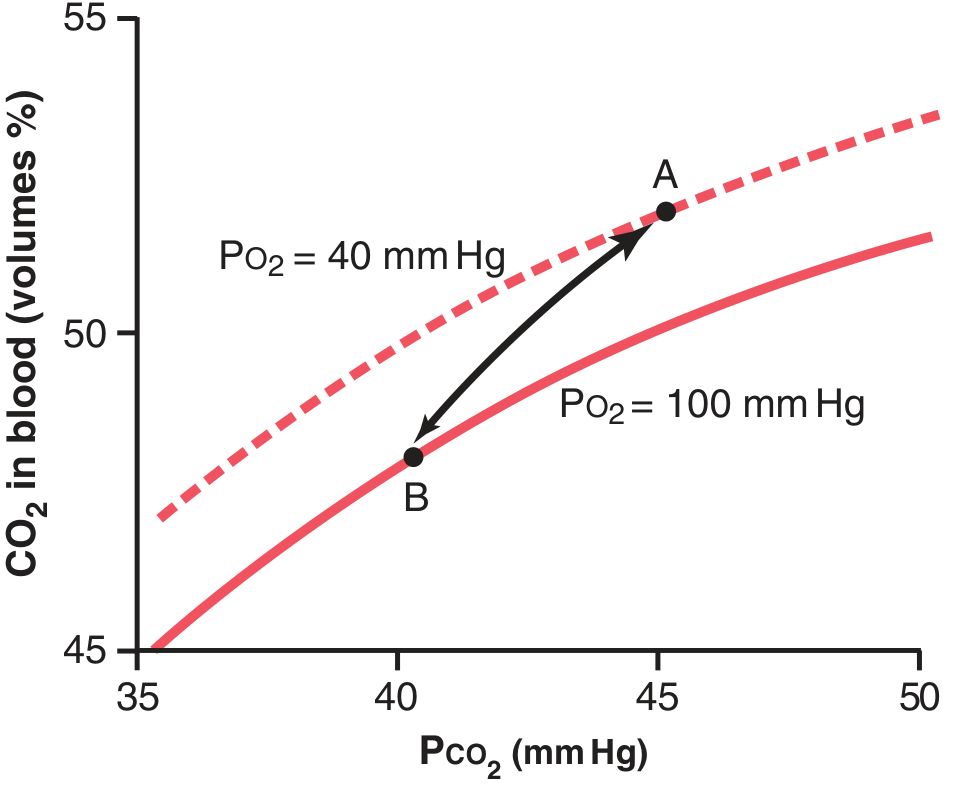
At PCO2 of 45 mmHg in tissues (point A), blood carries 52 vol% CO2. In the lungs, oxygenation shifts the curve down - CO2 content falls to 48 vol% (point B) instead of 50 vol%. Thus the Haldane effect roughly doubles CO2 transport in both directions.
- The Haldane effect accounts for 40-50% of total CO2 exchange in the lung
- Equal contributions come from changes in bicarbonate and carbamino concentrations
Quantitative importance: The Haldane effect is quantitatively far more important in promoting CO2 transport than the Bohr effect is in promoting O2 transport.
- Guyton and Hall Textbook of Medical Physiology
Bohr-Haldane Interrelationship
These two effects are complementary and synergistic:
| Location | Bohr Effect | Haldane Effect |
|---|---|---|
| Tissues | ↑CO2/↑H+ → right shift → O2 released | Deoxygenation → Hb picks up more CO2 & H+ |
| Lungs | ↓CO2/↓H+ → left shift → O2 loaded | Oxygenation → Hb releases CO2 & H+ |
In essence:
- CO2 entering the blood at tissues facilitates O2 unloading (Bohr effect)
- O2 loading in the lungs facilitates CO2 unloading (Haldane effect)
Both effects arise from the same conformational change in the hemoglobin molecule - the shift between the R (relaxed/oxy) and T (tense/deoxy) states - and together they make gas exchange far more efficient than simple diffusion alone.
- Fishman's Pulmonary Diseases and Disorders; Guyton and Hall Medical Physiology; Lippincott Biochemistry, 8e
This is a shared conversation. Sign in to Orris to start your own chat.