
Static progressive elbow orthosis
static progressive elbow orthosis mechanism clinical use flexion contracture
"static progressive" AND "elbow orthosis" AND contracture
"static progressive" AND elbow AND contracture
https://pmc.ncbi.nlm.nih.gov/articles/PMC5610839
Static progressive elbow orthosis diagram
A detailed medical diagram of a static progressive elbow orthosis (splint) showing: - Side view of a human arm wearing the orthosis - Rigid proximal arm cuff (upper arm segment) and distal forearm cuff (lower arm segment) - A central hinge joint at the elbow with an adjustable dial/turnbuckle mechanism - A ratchet or incremental adjustment dial labeled "Adjustable set screw / dial" - Arrows indicating direction of extension and flexion correction - Labels pointing to: Proximal cuff, Distal cuff, Pivot hinge, Adjustment dial, Straps/padding - A small inset illustration showing the biomechanical principle: "Stress relaxation" - tissue lengthening over time under a constant low load - Another inset showing the device set at end-range position (static end-range stretch) - Neutral clinical illustration style, clean white background, annotated with clear text labels
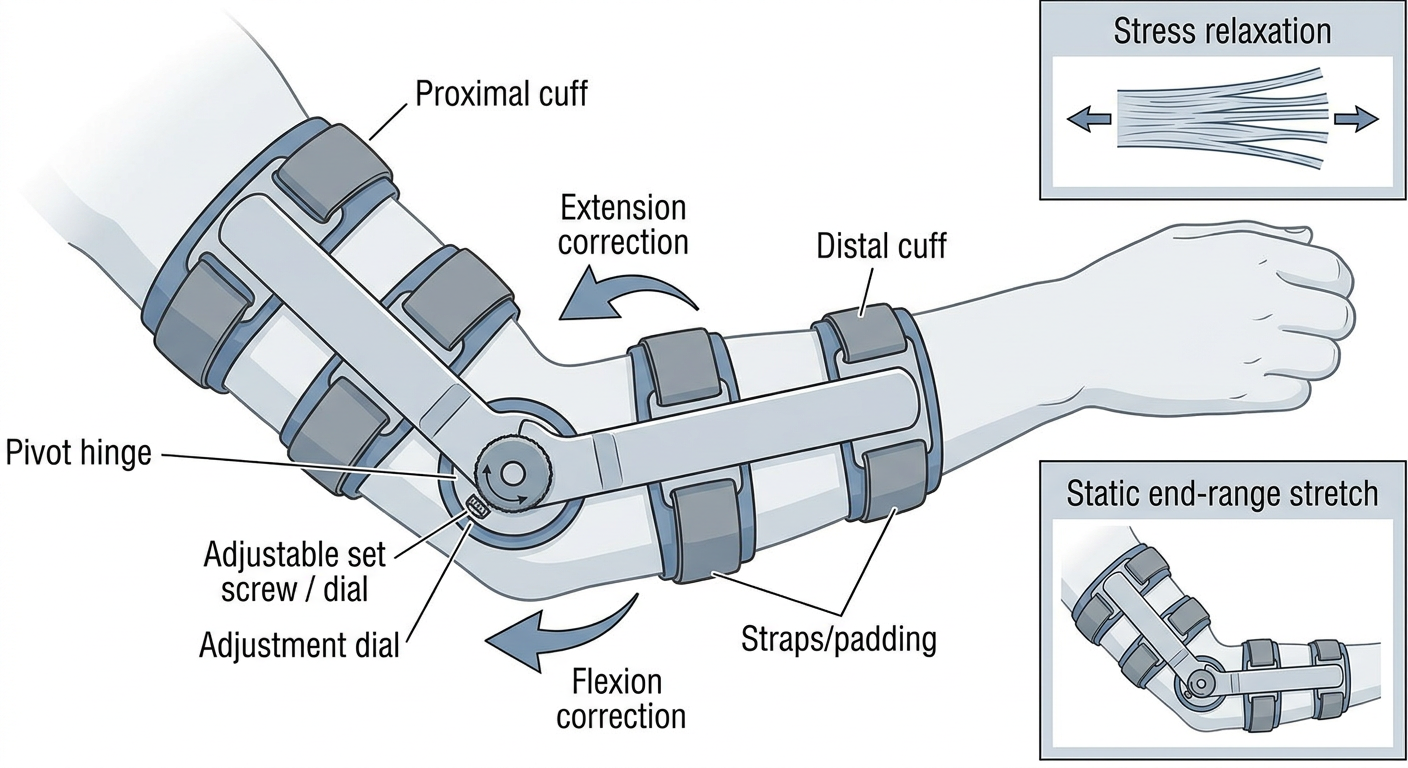
- Proximal cuff - rigid upper arm segment, distributes force along the humerus
- Distal cuff - rigid forearm segment
- Pivot hinge - aligned with the elbow's axis of rotation (lateral epicondyle)
- Adjustable dial / set screw - allows incremental repositioning to the new end-range once tissue relaxation occurs (the defining feature that makes it "progressive")
- Padded straps - maintain cuff position and patient comfort
| Feature | Static Progressive | Dynamic |
|---|---|---|
| Force type | Fixed position, adjusted manually | Constant elastic/spring force |
| Mechanism | Stress relaxation | Creep |
| Adjustability | Patient/therapist-controlled dial | Self-adjusting spring |
| Tissue response | Rapid elongation via relaxation | Gradual elongation under load |