
Long note on oral sub mucous fibrosis in oral pathology with all the important heading and needful for university exam bds 3rd yr
Reading File
Now let me search the medical library for oral submucous fibrosis content in parallel.
Finding Sources
Finding Sources
Searching PubMed
oral submucous fibrosis pathogenesis management
Good. Now let me read the most relevant textbook sections in parallel - the Cummings Otolaryngology block (most detailed) and the Andrews' Dermatology block.
Reading File
Reading File
Finding Sources
Now let me fetch the clinical image and also search for dedicated oral pathology textbook content on OSMF staging/classification.
Loading Image
Finding Sources
Finding Sources
I have sufficient textbook content. Let me also do a quick web search for OSMF clinical staging/classification systems used in BDS exams.
Searching the Web
oral submucous fibrosis classification staging Pindborg Khanna histopathology BDS oral pathology
Reading Web Page
https://pdfs.semanticscholar.org/ddd9/c1dd3fa20878e063c8f66d…
I now have comprehensive content from textbooks and literature. Let me compile the full, exam-ready long note on OSMF.
ORAL SUBMUCOUS FIBROSIS (OSMF)
BDS 3rd Year - Oral Pathology | Long Note
1. DEFINITION
Oral Submucous Fibrosis (OSMF) is a chronic, insidious, potentially malignant disorder of the oral cavity and sometimes the pharynx, characterized by:
- Juxta-epithelial inflammatory reaction followed by
- Progressive fibrosis of the submucosal tissues (lamina propria and deeper connective tissue)
- Ultimately leading to stiffness of the oral mucosa, trismus, and inability to eat
Other names: Atrophic idiopathic mucositis, Idiopathic scleroderma of the mouth, Idiopathic palatal fibrosis, Diffuse oral submucous fibrosis
Cummings Otolaryngology defines it as "a multifactorial disorder with the considered chief etiologic factor being the consistent and habitual use of areca (betel) nut."
2. HISTORICAL BACKGROUND
| Year | Contributor | Contribution |
|---|---|---|
| 1952 | Schwartz | First described as "atrophic idiopathic mucositis" |
| 1953 | JJ Pindborg & S Sirsat | Named and defined "Oral Submucous Fibrosis" |
| 1957 | JV Desa | First classification |
| 1966 | Pindborg & Sirsat | Histopathological staging |
| 1995 | Khanna & Andrade | Combined clinical-histopathological classification for surgical management |
3. EPIDEMIOLOGY
- Prevalence: 0.2-0.5% of general population in India; up to 6.42% in some high-risk groups
- Geography: Predominantly in the Indian subcontinent, Southeast Asia, and western Pacific basin (Taiwan, Papua New Guinea)
- Age: Any age; most common in 2nd-4th decades of life (peaks at 20-40 years)
- Sex: Traditionally more common in females; recent studies show increasing male prevalence due to gutka use
- Malignant transformation rate: Approximately 7-7.6% over 17 years; 2.5% of cases show epithelial dysplasia
4. ETIOLOGY
OSMF is multifactorial. The primary and most important etiological factor is areca nut (betel nut) use.
A. Primary Etiological Factor - Areca Nut
The areca nut (Areca catechu) is consumed in multiple forms:
- Betel quid (paan): Betel nut + betel leaf + slaked lime
- Pan masala: Areca nut + tobacco + catechu + lime + flavourings (no tobacco)
- Gutka: Pan masala + tobacco (most common in India)
- Mawa: Areca nut + tobacco + lime
Mechanism of areca nut toxicity:
- Contains arecoline (main alkaloid) - stimulates fibroblasts to produce excess collagen
- Arecoline upregulates TGF-β (transforming growth factor-beta) - pro-fibrotic cytokine
- Arecoline inhibits collagenase activity - reduces collagen breakdown
- Flavonoids in areca nut (catechin, tannin) cause collagen cross-linking and stabilization
- Copper content in areca nut activates lysyl oxidase - further cross-links collagen
B. Other Etiological Factors
| Factor | Details |
|---|---|
| Chillies (capsaicin) | Dietary - common in South/Southeast Asian diets; causes mucosal irritation |
| Tobacco | Acts as co-carcinogen; accelerates OSMF |
| Nutritional deficiencies | Iron, vitamin B complex, zinc deficiency - impairs mucosal repair |
| Immunological factors | Autoimmune component suspected; high prevalence of HLA-DR3, HLA-DR7 |
| Genetic predisposition | Certain HLA haplotypes increase susceptibility |
| Local trauma | Minor mucosal injuries promote fibroblast activation |
5. PATHOGENESIS
The pathogenesis involves a fibrotic cascade triggered primarily by areca nut alkaloids:
Areca nut exposure
       ↓
Mucosal irritation → Epithelial damage
       ↓
Inflammatory infiltrate (PMNs, Lymphocytes, Plasma cells, Mast cells)
       ↓
Release of pro-fibrotic cytokines (TGF-β, IL-6, TNF-α)
       ↓
Fibroblast activation and proliferation
       ↓
Increased collagen synthesis (Type I and III collagen)
       +
Decreased collagen degradation (↓ collagenase activity)
       ↓
Collagen accumulation → Fibrosis → Hyalinization
       ↓
Atrophy of epithelium + Atrophy of muscle fibres
       ↓
Trismus + Mucosal stiffness
Key molecular events:
- Arecoline directly stimulates fibroblast proliferation and collagen synthesis
- Copper in areca nut stimulates lysyl oxidase (cross-links collagen)
- TGF-β is the master pro-fibrotic cytokine - upregulated throughout the disease
- Mast cells play a significant role in progression and malignant transformation (2026 systematic review, PMID 41410520)
- Altered epithelial-mesenchymal interactions result in formation of collagenous bands in the submucosa and lamina propria
- Failure of collagen remodeling is a central mechanism
- Inducible nitric oxide synthetase (iNOS) is upregulated, contributing to the initial erythema
6. CLINICAL FEATURES
Symptoms (in order of progression)
Early symptoms:
- Burning sensation - the earliest and most common symptom; aggravated by spicy food
- Hypersalivation
- Vesiculation and ulceration of oral mucosa
- Defective gustatory sensation
- Dryness of mouth
- Blanching of mucosa
Advanced symptoms:
7. Progressive trismus - restricted mouth opening (hallmark symptom)
8. Difficulty in eating, swallowing (dysphagia), and speech
9. Restricted tongue mobility
10. Nasal intonation of voice (when soft palate involved)
11. Hearing loss (Eustachian tube involvement)
Signs
Oral mucosal changes:
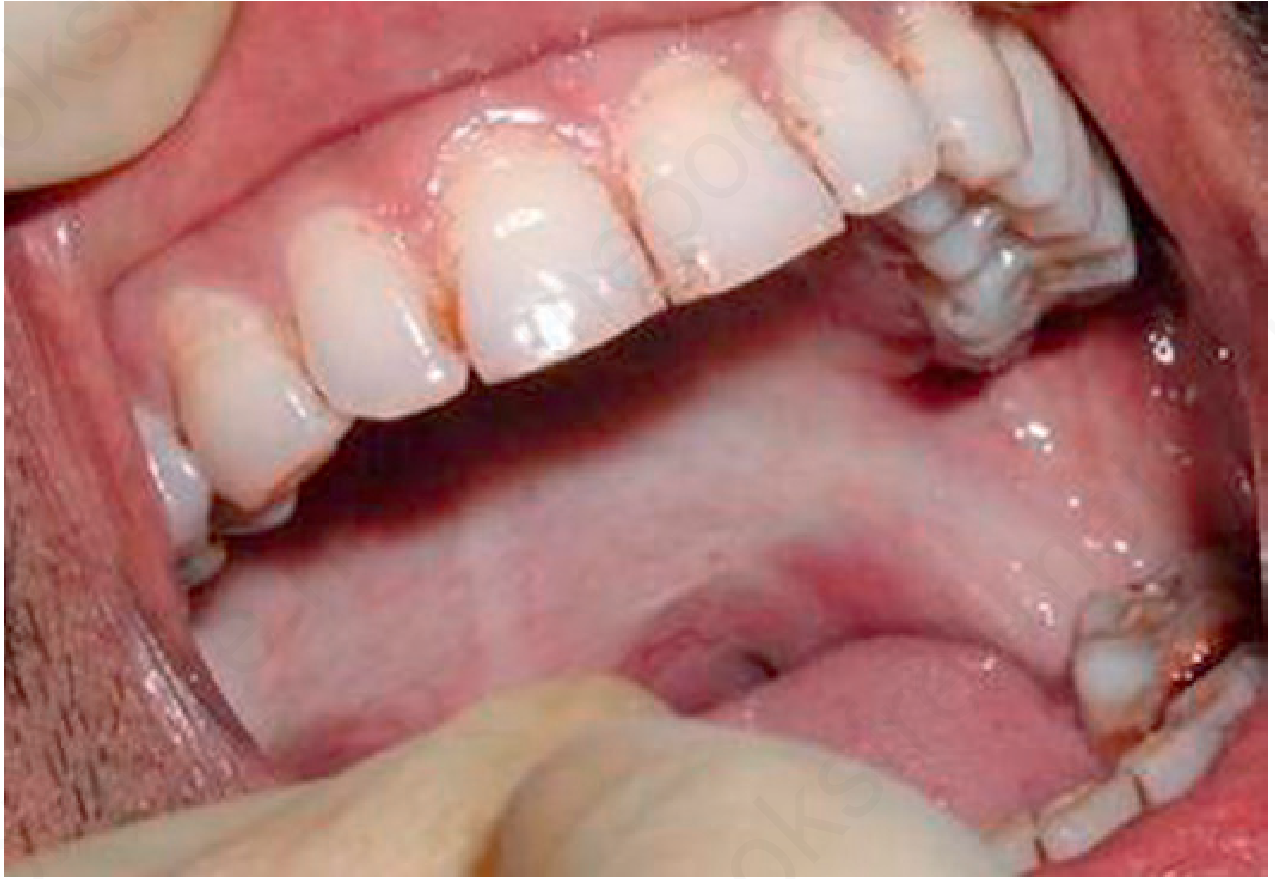
- Initial erythema (due to raised iNOS levels) - earliest sign
- Progressive blanching - marble-white/pale mucosa (as fibrosis replaces vasculature)
- Palpable fibrous bands in buccal mucosa, vestibule, soft palate, fauces, and tongue
- Mucosal feels leathery and stiff on palpation
- Restricted mouth opening (trismus) - measured as inter-incisal distance
- In advanced cases: restricted tongue protrusion
Sites involved (in order of frequency):
- Buccal mucosa (most common - bilateral)
- Soft palate and fauces
- Retromolar area
- Labial mucosa
- Tongue
- Floor of mouth (least common)
7. CLASSIFICATION / STAGING
A. Clinical Classification
1. Desa (1957) - 3 Stages
- Stage I: Stomatitis and vesiculation
- Stage II: Fibrosis
- Stage III: Sequelae (trismus, dysphagia)
2. Pindborg (1989) - 3 Stages
- Stage I: Stomatitis (erythema, vesicles, ulcers)
- Stage II: Fibrosis (pallor, bands in buccal mucosa, restricted mouth opening)
- Stage III: Sequelae (severe trismus, dysphagia, cancer)
3. Kiran Kumar et al. (2007) - Based on Mouth Opening
- Stage I: Mouth opening >45 mm (normal)
- Stage II: Restricted mouth opening 20-44 mm
- Stage III: Mouth opening <20 mm
4. Chandramani More et al. (2011) - Most Comprehensive
| Stage | Description |
|---|---|
| S1 | Stomatitis and/or blanching of oral mucosa |
| S2 | Palpable fibrous bands in buccal mucosa/oropharynx ± stomatitis |
| S3 | Palpable fibrous bands in buccal mucosa AND other parts of oral cavity ± stomatitis |
| S4a | Any of above + other potentially malignant disorders (leukoplakia, erythroplakia) |
| S4b | Any of above + frank malignancy |
Mouth opening sub-classification (M):
- M1: >35 mm
- M2: 25-35 mm
- M3: 15-25 mm
- M4: <15 mm
B. Histopathological Classification
Pindborg & Sirsat (1966) - Classic 4-Stage Histopathological Staging
| Stage | Features |
|---|---|
| Very Early | Finely fibrillar collagen with marked edema; plump young fibroblasts; dilated blood vessels; PMNs and eosinophils |
| Early | Juxta-epithelial hyalinization begins; thick collagen bundles; moderate plump fibroblasts; lymphocytes, eosinophils, plasma cells |
| Moderately Advanced | Collagen bundles coalesce into thick hyalinized bands; fewer fibroblasts; lymphocytes and plasma cells; muscle atrophy begins |
| Advanced | Complete hyalinization of connective tissue; sparse, thin fibroblasts; only lymphocytes and plasma cells; severe muscle fiber atrophy |
C. Combined Clinical-Histopathological Classification
Khanna & Andrade (1995) - For Surgical Management
| Group | Clinical Features | Mouth Opening |
|---|---|---|
| Group I (Very Early) | Burning sensation; acute ulceration; no limitation of mouth opening | Normal |
| Group II (Early) | Buccal mucosa slightly pale; 1-2 bands in buccal mucosa, soft palate | 26-35 mm |
| Group III A (Moderate) | Fibrous bands in buccal mucosa ± tongue, soft palate | 15-26 mm |
| Group III B (Severe) | As Group IIIA + restricted tongue protrusion, shrunken uvula | 15-26 mm |
| Group IV A (Severe + Premalignant) | Group III + leukoplakia/erythroplakia | <15 mm |
| Group IV B (Severe + Malignant) | Group III + frank carcinoma | <15 mm |
8. HISTOPATHOLOGICAL FEATURES
The hallmark of OSMF is the juxtaposition of atrophic epithelium overlying submucosal fibrosis.
Epithelial Changes:
- Atrophic epithelium - thinned, rete ridges flattened or absent
- Loss of normal stratification
- Hyperkeratosis may be present (in areas with concurrent leukoplakia)
- Variable degrees of epithelial dysplasia:
- Mild dysplasia: 46% of cases
- Moderate dysplasia: 52% of cases
- Severe dysplasia: 2% of cases
Connective Tissue Changes (Progressive):
- Very early: Edema, loosely arranged fine collagen fibers, PMN infiltration
- Early: Juxta-epithelial hyalinization; thick collagen bundles; lymphocytes/plasma cells
- Moderately advanced: Coalescing hyalinized collagen bands; reduction in blood vessels; muscle atrophy begins
- Advanced: Complete hyalinization; avascular; severe muscle atrophy; few remaining fibroblasts
Muscle Changes:
- Atrophic and degenerative changes in muscle fibers
- Hyalinization extends into muscle bundles
- Explains the clinical trismus
Vascular Changes:
- Dilated vessels in early stages (erythema)
- Progressive obliteration of small vessels in advanced stages (blanching, pallor)
Inflammatory Infiltrate:
- Variable - lymphocytes, plasma cells, occasional eosinophils
- Mast cells - increased numbers; play a role in fibrosis and malignant transformation
9. DIAGNOSIS
Clinical Diagnosis:
- History of areca nut/tobacco/gutka chewing
- Burning sensation + progressive trismus + blanched mucosa
- Palpable fibrous bands on bimanual examination
Investigations:
| Investigation | Findings |
|---|---|
| Biopsy (Gold Standard) | Atrophic epithelium + hyalinized submucosal connective tissue |
| Toluidine Blue staining | Identifies areas of dysplasia |
| Cytology (exfoliative) | Atypical cells may be seen |
| Ultrasonography | Measures thickness of fibrous bands |
| MRI | Assesses extent of fibrosis and muscle involvement |
| Hematological investigations | Anemia (iron/B12 deficiency); raised ESR |
Differential Diagnosis:
| Condition | Differentiating Feature |
|---|---|
| Scleroderma | Systemic involvement; skin changes; Raynaud's phenomenon |
| Lichen planus | Wickham's striae; no fibrous bands; histology differs |
| Leukoplakia | No fibrous bands; no trismus; different histology |
| Scarring from burns/trauma | History; unilateral |
| Tetanus | Acute onset; no mucosal changes |
10. MALIGNANT POTENTIAL
OSMF is classified as an Oral Potentially Malignant Disorder (OPMD) by WHO.
- Malignant transformation rate: 7.6% over 17 years (India)
- Development of squamous cell carcinoma (SCC) is the main concern
- Characterized by gradual thickening of epithelium with hyperplastic to verrucous surface
- Risk factors for malignant transformation:
- Advanced stage (severe fibrosis)
- Coexisting dysplasia
- Continued use of areca nut/tobacco
- Coexisting leukoplakia or erythroplakia
11. TREATMENT
Management of OSMF is challenging, especially in advanced cases. Treatment aims are:
- Cessation of habit (most important)
- Reducing inflammation and fibrosis
- Increasing mouth opening
- Preventing/detecting malignant transformation
A. Medical Treatment
| Drug | Mechanism/Use | Route |
|---|---|---|
| Corticosteroids (Triamcinolone, Dexamethasone) | Anti-inflammatory; reduce fibrosis | Intralesional injection |
| Hyaluronidase | Breaks down extracellular matrix; enhances drug penetration | Intralesional |
| Placental extracts (Placentrex) | Anti-inflammatory; promotes healing | Intralesional |
| Pentoxifylline | Inhibits fibroblast proliferation; anti-fibrotic | Oral |
| Collagenase | Enzymatic breakdown of collagen | Intralesional |
| Spirulina (antioxidant) | Reduces oxidative stress; anti-fibrotic | Oral |
| Lycopene | Antioxidant; reduces fibrosis | Oral |
| Aloe vera | Anti-inflammatory; mucosal healing | Topical/Oral |
| Iron/Vitamin B complex | Correct nutritional deficiencies | Oral |
| Antifungal (if Candida co-infection) | Treat secondary infection | Topical |
Note: Intralesional injection of triamcinolone with or without hyaluronidase is the most widely used conservative treatment.
B. Physical Therapy
- Mouth opening exercises (jaw physiotherapy)
- Heat therapy to affected areas
- Use of mouth props/dynasplints to maintain and improve opening
- Electrostimulation (experimental)
C. Surgical Treatment
Indicated for Group III and IV (advanced cases) when conservative treatment fails:
| Procedure | Details |
|---|---|
| Fibrotomy | Simple incision/excision of fibrous bands |
| Coronoidectomy | Removal of coronoid process; improves mouth opening |
| Split-thickness skin graft | To resurface after excision; prevents re-scarring |
| Nasolabial flap | Local rotation flap to cover defect |
| Buccal fat pad | Used to fill surgical defect |
| Laser ablation (CO2 laser) | Vaporizes fibrous bands with minimal scarring |
| Tongue flap | For extensive defects |
Important: Surgical treatment must be followed by vigorous physiotherapy to prevent re-fibrosis.
D. Habit Cessation
- Cessation of areca nut/tobacco chewing is the cornerstone of treatment
- Counseling and behavioral interventions
- Nicotine replacement therapy if tobacco dependence is significant
12. PROGNOSIS
- Early stages: Good prognosis with habit cessation + medical therapy
- Advanced stages: Guarded; surgical treatment may help but re-fibrosis is common
- Risk of malignancy: ~7% over 17 years; regular follow-up every 3-6 months is mandatory
- Disease progression is irreversible once advanced fibrosis develops
13. SUMMARY TABLE - QUICK REVISION
| Feature | Detail |
|---|---|
| Nature | Chronic, potentially malignant disorder |
| Most common etiology | Areca nut (gutka, pan masala) |
| Primary mechanism | Arecoline → ↑ TGF-β → ↑ collagen synthesis + ↓ collagenase |
| Earliest symptom | Burning sensation |
| Hallmark sign | Trismus (restricted mouth opening) |
| Most common site | Buccal mucosa (bilateral) |
| Hallmark histology | Atrophic epithelium + juxta-epithelial hyalinization |
| Malignant transformation | ~7% (SCC) |
| Gold standard diagnosis | Biopsy |
| Best conservative Rx | Intralesional triamcinolone ± hyaluronidase |
| Best surgical Rx | Fibrotomy + nasolabial/buccal fat pad flap |
| WHO classification | Oral Potentially Malignant Disorder (OPMD) |
14. EXAM-IMPORTANT POINTS (HIGH-YIELD)
- OSMF is caused primarily by areca nut (arecoline alkaloid)
- The key fibrogenic mechanism is arecoline → ↑TGF-β → ↑collagen + ↓collagenase
- Histopathologically: atrophic epithelium + juxta-epithelial hyalinization is the hallmark
- Earliest clinical symptom: burning sensation; earliest sign: erythema
- Advanced sign: trismus (restricted mouth opening)
- Malignant potential: ~7% → SCC
- Pindborg & Sirsat (1966) gave the first histopathological classification
- Khanna & Andrade (1995) gave the combined clinical-histopathological classification for surgical management
- Treatment of choice (conservative): Intralesional triamcinolone ± hyaluronidase
- OSMF is a WHO-recognized Oral Potentially Malignant Disorder
- Sites in order: Buccal mucosa > Soft palate/fauces > Retromolar > Labial > Tongue
- Dysplasia distribution: Mild 46%, Moderate 52%, Severe 2%
Sources: Cummings Otolaryngology Head and Neck Surgery; Andrews' Diseases of the Skin (Clinical Dermatology); More CB et al. Classification System for Oral Submucous Fibrosis (J Clin Diagn Res); PMID 41410520 (Systematic Review, 2026 - mast cells in OSMF progression)
This is a shared conversation. Sign in to Orris to start your own chat.