
Convert this into crisp notes
Which topic or chapter would you like notes on?
Which condition or topic would you like crisp notes on?
python3 << 'EOF' import pdfplumber pdf_path = "/home/daytona/workspace/attachments/911373c3-adf1-4f65-872b-d0854f8155b7/dokumen.pub_dc-duttas-textbook-of-obstetrics-including-perinatology-and-contraception-9th-reprint-edition-9786222687-9789786222684-9352702425-1 2.pdf" with pdfplumber.open(pdf_path) as pdf: total = len(pdf.pages) print(f"Total pages: {total}") # Search for 'Normal Labour' in first 50 pages to find chapter for i in range(min(60, total)): text = pdf.pages[i].extract_text() or "" if "normal labour" in text.lower() or "normal labor" in text.lower(): print(f"Page {i+1}: Found 'Normal Labour'") if len(text) > 200: print(text[:300]) print("---") EOF
python3 << 'EOF' import pdfplumber pdf_path = "/home/daytona/workspace/attachments/911373c3-adf1-4f65-872b-d0854f8155b7/dokumen.pub_dc-duttas-textbook-of-obstetrics-including-perinatology-and-contraception-9th-reprint-edition-9786222687-9789786222684-9352702425-1 2.pdf" with pdfplumber.open(pdf_path) as pdf: for i in range(len(pdf.pages)): text = pdf.pages[i].extract_text() or "" # Print first 150 chars of each page to find chapter headings first_line = text.strip()[:200].replace('\n', ' | ') print(f"P{i+1}: {first_line}") EOF
Normal Labour - DC Dutta's Obstetrics
Definition
- True labour: Regular uterine contractions + progressive cervical dilatation + descent of presenting part
- False labour (Braxton Hicks): Irregular, painless contractions; no cervical change
Prerequisites for Labour (The 5 Ps)
| P | Component |
|---|---|
| Power | Uterine contractions + maternal bearing down |
| Passage | Bony pelvis + soft tissues |
| Passenger | Fetus (size, lie, presentation, position, attitude) |
| Placenta | Position and cord length |
| Psyche | Maternal psychological state |
Signs of Onset of Labour
- Lightening - engagement of fetal head (primigravidae, 2-4 weeks before)
- Frequency of micturition
- Cervical ripening - softening, effacement ("show")
- Increased vaginal discharge
- Spurious labour (false pains)
- Painful, regular uterine contractions (at least 2 in 10 min, each ≥25 sec)
- Progressive cervical effacement and dilatation
- "Show" - blood-stained mucus plug from cervix
- Rupture of membranes (may occur at any stage)
Stages of Labour
First Stage - Cervical Dilatation
- Primigravida: ~12 hours (range 6-18 h)
- Multigravida: ~6 hours (range 2-10 h)
| Phase | Cervix | Rate of dilatation |
|---|---|---|
| Latent phase | 0-3 cm | Slow (~0.35 cm/hr) |
| Active phase | 3-10 cm | Fast (≥1 cm/hr primigravida; ≥1.5 cm/hr multigravida) |
- Acceleration phase (3-4 cm)
- Phase of maximum slope (4-9 cm) - fastest
- Deceleration phase (9-10 cm)
- Frequency: every 3-5 min
- Duration: 30-60 sec
- Intensity: 25-50 mmHg (Montevideo units)
- Fundal dominance - contraction strongest at fundus, weakest at lower segment
Second Stage - Expulsion of Fetus
- Primigravida: up to 2 hours (3 hours with epidural)
- Multigravida: up to 1 hour (2 hours with epidural)
- Passive (propulsive) phase - full dilatation to urge to push; fetal descent occurs
- Active (expulsive) phase - maternal bearing down + contractions
Third Stage - Expulsion of Placenta
- Calkin's sign - fundus becomes globular, firm, rises in abdomen
- Sudden gush of blood from vagina
- Lengthening of cord outside vulva
- Fundus rises above umbilicus
- Schultze mechanism (80%): Starts centrally; fetal surface delivers first; blood collects behind placenta (retroplacental clot)
- Matthews Duncan mechanism (20%): Starts at lower edge; placenta slides out sideways; bleeding occurs throughout; seen in low-lying placenta
Mechanism of Normal Labour (LOA - Left Occipito-Anterior - most common)
| # | Movement | Details |
|---|---|---|
| 1 | Engagement | Widest diameter (BPD) passes through pelvic inlet; in LOA, sagittal suture in right oblique diameter |
| 2 | Descent | Continuous throughout labour |
| 3 | Flexion | Chin onto chest; reduces presenting diameter from occipitofrontal (11 cm) to suboccipitobregmatic (9.5 cm) |
| 4 | Internal rotation | Occiput rotates anteriorly to lie under symphysis pubis; sagittal suture in AP diameter at outlet |
| 5 | Extension | Head extends around symphysis pubis; occiput, bregma, face, chin delivered in sequence |
| 6 | Restitution | Head turns back 45° to align with fetal shoulders (LOA → occiput to left) |
| 7 | External rotation | Further 45° turn as shoulders rotate internally; shoulders now in AP diameter |
Partograph (WHO)
- Fetal heart rate (FHR) - every 30 min
- Membranes and liquor
- Moulding
- Cervical dilatation plotted against time
- Descent of head (in fifths palpable abdominally)
- Uterine contractions (frequency, duration, strength)
- Oxytocin/drugs
- Maternal pulse, BP, temperature
- Urine output
Active Management of Third Stage (AMTSL)
- Oxytocin 10 IU IM within 1 minute of delivery (drug of choice)
- Controlled cord traction (CCT) - Brandt-Andrews method
- Uterine massage after placenta delivery (controversial - not routine per recent WHO)
Misoprostol 600 mcg oral/sublingual - used where oxytocin unavailable
Monitoring During Normal Labour
Maternal
- BP and pulse every 30 min (active phase) / 1 hour (latent)
- Temperature every 4 hours
- Urine - output, protein, ketones
- State of uterine contractions
Fetal
- FHR - auscultate every 15-30 min in first stage; every 5 min in second stage
- Colour of liquor - clear (normal), meconium-stained (fetal distress)
- Moulding - excessive moulding suggests CPD
Analgesia in Labour
| Method | Details |
|---|---|
| Inhalational | Entonox (50% O₂ + 50% N₂O) - self-administered |
| Systemic opioids | Pethidine 50-100 mg IM / Morphine - causes neonatal respiratory depression |
| Epidural | Gold standard; bupivacaine ± fentanyl; avoid bearing down reflex impairment |
| Pudendal block | For second stage/instrumental delivery |
| Paracervical block | Rarely used; risk of fetal bradycardia |
Normal Puerperium (Post-Delivery)
- Lochia rubra (red, days 1-4) → lochia serosa (pink/brown, days 4-9) → lochia alba (white, day 10+)
- Uterine involution: Returns to non-pregnant size by 6 weeks
- Afterpains: More common in multiparae; due to uterine contractions
- Breastfeeding: Encouraged immediately; stimulates oxytocin → uterine involution
Key Numbers to Remember
| Parameter | Value |
|---|---|
| Period of viability | 28 weeks / 1000 g |
| Full cervical dilatation | 10 cm |
| Normal FHR | 110-160 bpm |
| 1st stage duration (primi) | ~12 hours |
| 1st stage duration (multi) | ~6 hours |
| 2nd stage duration (primi) | Up to 2 hours |
| 3rd stage duration | Up to 30 minutes |
| Engagement (primi) | 36-38 weeks |
| Oxytocin (AMTSL) | 10 IU IM |
| Suboccipitobregmatic diameter | 9.5 cm |
| Occipitofrontal diameter | 11 cm |
| Biparietal diameter | 9.5 cm |
Generate a visual flowchart of labour stages and mechanisms
A detailed medical educational flowchart titled "Stages and Mechanism of Normal Labour" for obstetrics students. The flowchart is clean, professional, on a white background with color-coded sections. Top section: "ONSET OF LABOUR" box with bullet points: Regular painful contractions, Cervical effacement & dilatation, Bloody show, ROM Then flows down into 3 color-coded stage columns arranged vertically as a timeline: STAGE 1 (blue): "Cervical Dilatation" - Onset of labour → Full dilatation (10 cm). Two sub-boxes: Latent Phase (0–3 cm, slow) and Active Phase (3–10 cm, ≥1 cm/hr). Duration: Primi 12 hrs / Multi 6 hrs. Contractions every 3–5 min. STAGE 2 (green): "Expulsion of Fetus" - Full dilatation → Delivery of baby. Duration: Primi up to 2 hrs / Multi up to 1 hr. Two phases inside: Passive phase (descent) and Active phase (bearing down). STAGE 3 (orange): "Delivery of Placenta" - Delivery of baby → Delivery of placenta. Duration: up to 30 min. Signs of separation listed: Fundus globular (Calkin's sign), Cord lengthening, Gush of blood. Schultze (80%) vs Duncan (20%) mechanisms. Below that, a separate horizontal flowchart section titled "7 CARDINAL MOVEMENTS OF LABOUR (LOA)" with 7 connected boxes in sequence with arrows: 1. Engagement → 2. Descent → 3. Flexion → 4. Internal Rotation → 5. Extension → 6. Restitution → 7. External Rotation Each movement box has a small one-line descriptor below it: 1. BPD through inlet 2. Continuous 3. SOB diameter 9.5 cm 4. Occiput under symphysis 5. Head born 6. 45° back 7. Shoulders in AP Bottom box: "ACTIVE MANAGEMENT OF 3RD STAGE (AMTSL)" - Oxytocin 10 IU IM + Controlled Cord Traction + Uterine massage Color scheme: Blue for stage 1, green for stage 2, orange for stage 3, purple for mechanisms, clean sans-serif font, medical diagram style
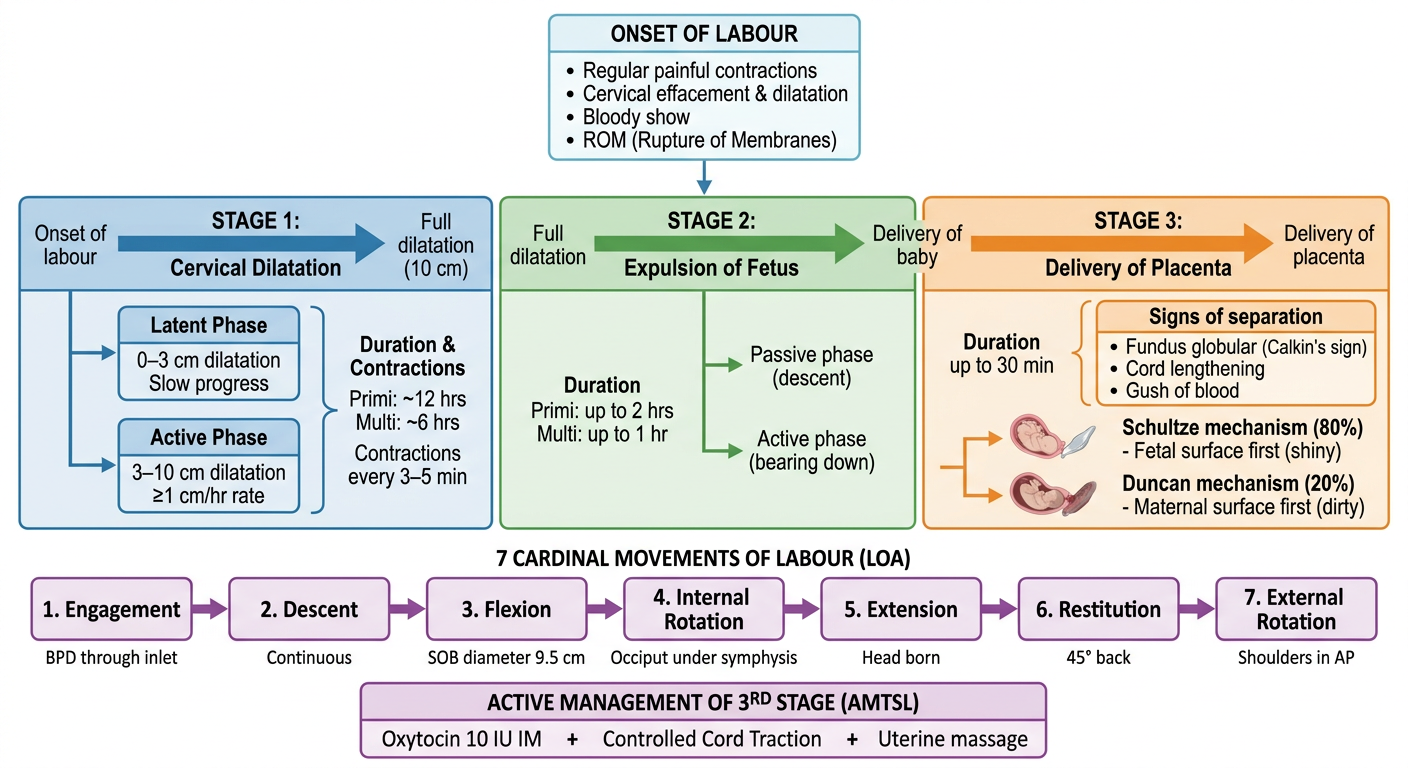
- Onset of Labour triggers at the top
- 3 Stages color-coded (blue → green → orange) with durations, key events, and sub-phases
- 7 Cardinal Movements as a sequential horizontal flow with one-line descriptors for each
- AMTSL summary at the bottom
- Latent vs. Active phase distinction in Stage 1
- Schultze (80%) vs. Duncan (20%) placental separation in Stage 3
- SOB diameter (9.5 cm) noted at the Flexion step