
Physiology of thytoid
Reading File
Now let me search the medical library for thyroid physiology content.
Finding Sources
Finding Sources
Excellent - I have great sources. Let me read the key physiology sections in parallel.
Reading File
Reading File
Reading File
I have rich content. Let me read more from Ganong's (the best physiology textbook) and Harrison's for metabolism, action, and regulation sections.
Reading File
Reading File
I have comprehensive content. Let me also fetch the key diagram images to include them visually.
Loading Image
Loading Image
Reading File
I now have excellent content covering all aspects of thyroid physiology. Let me compose the comprehensive answer.
Physiology of the Thyroid Gland
1. Anatomy and Histology
The thyroid gland is a bilobed structure lying anterior to the trachea. It is composed of follicles - spherical units lined by follicular cells (thyrocytes) that surround a central cavity filled with colloid. The colloid contains thyroglobulin (Tg), the protein scaffold for hormone synthesis. Parafollicular C-cells interspersed between follicles produce calcitonin (a separate function from thyroid hormone production).
2. Iodine Uptake and Transport
Iodine is the critical raw material for thyroid hormone synthesis. The sequence begins:
- Dietary iodine is absorbed and circulates as iodide (I⁻) in plasma.
- Sodium-Iodide Symporter (NIS) on the basolateral membrane of thyrocytes actively cotransports 2 Na⁺ with 1 I⁻ into the cell, against an electrochemical gradient (powered by the Na⁺/K⁺-ATPase).
- The iodide:plasma concentration ratio in the thyroid is normally 25:1, but can rise to 500:1 when TSH is high.
- Pendrin, an apical transporter, then moves iodide from the cell into the colloid lumen.
Low iodine increases NIS expression; high iodine suppresses it - an autoregulatory mechanism.
3. Thyroid Hormone Synthesis (Organification and Coupling)
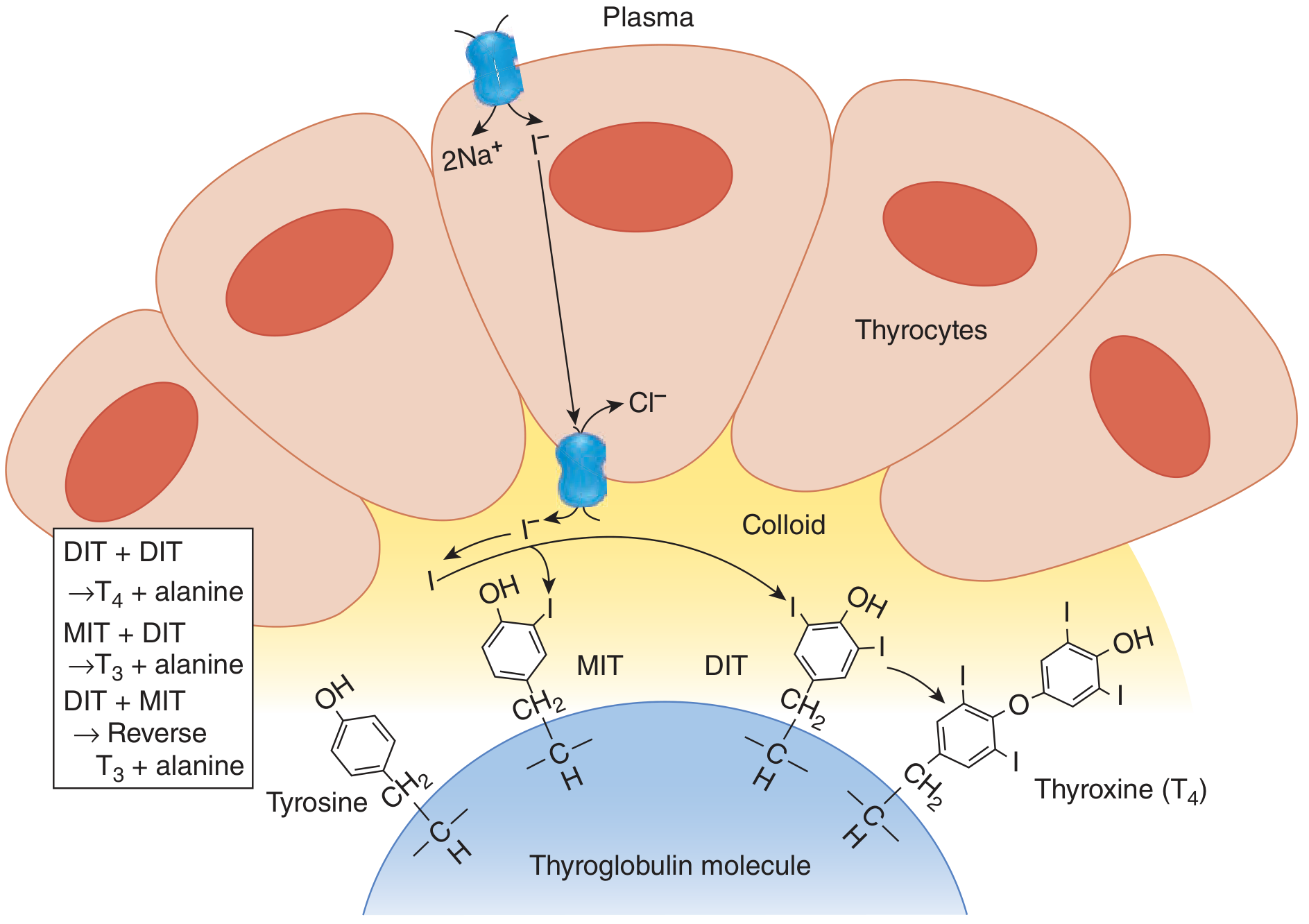
The synthesis occurs in 5 key steps at the apical membrane/colloid interface:
| Step | Process | Enzyme |
|---|---|---|
| 1 | Iodide oxidation to reactive iodine | Thyroid Peroxidase (TPO) + H₂O₂ (from DUOX) |
| 2 | Organification - iodine incorporated into tyrosine residues on Tg | TPO |
| 3 | MIT (monoiodotyrosine) formed - one iodine added | TPO |
| 4 | DIT (diiodotyrosine) formed - two iodines added | TPO |
| 5 | Coupling - two iodotyrosines joined by ether linkage | TPO |
Coupling reactions:
- DIT + DIT → T4 (thyroxine, tetraiodothyronine) + alanine
- MIT + DIT → T3 (triiodothyronine) + alanine
- DIT + MIT → Reverse T3 (rT3) + alanine (biologically inactive)
Thyroglobulin (660 kDa dimer, 2769 amino acids) contains 123 tyrosine residues, but only 4-8 are incorporated into thyroid hormones. The colloid serves as a hormone reservoir - humans can survive up to 2 months on an iodine-free diet before circulating hormone levels drop.
4. Secretion of T3 and T4
When hormone is needed:
- Colloid is endocytosed by thyrocytes from the apical surface.
- Endosomes fuse with lysosomes.
- Proteolysis of Tg releases free T4, T3, MIT, and DIT.
- MIT and DIT are deiodinated by iodotyrosine deiodinase - the iodine is recycled within the gland (this provides ~twice as much iodide as NIS uptake).
- Free T4 and T3 pass into capillaries.
Daily secretion (normal adult):
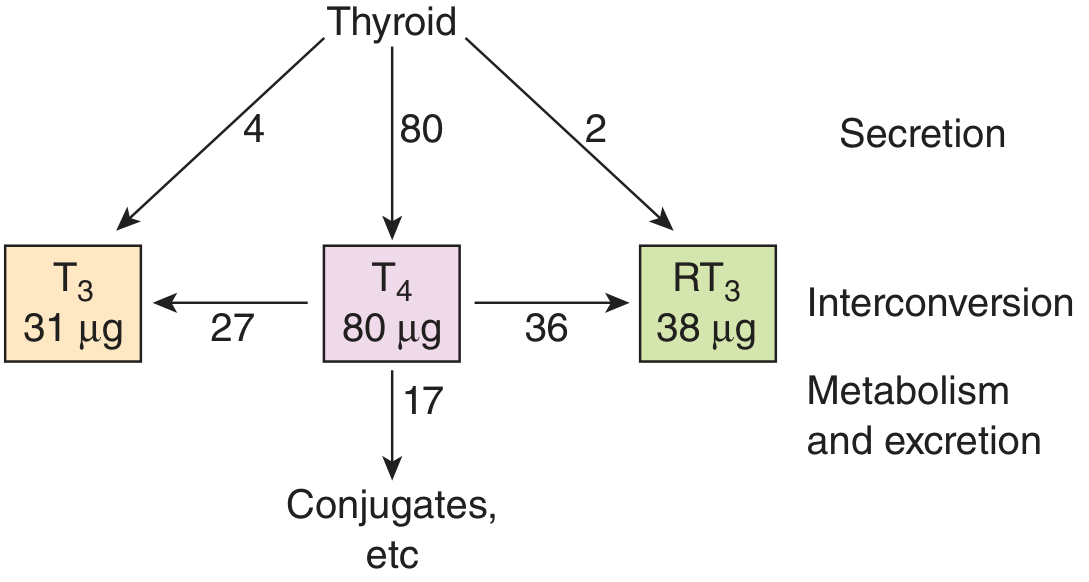
- T4: ~80 µg/day (the predominant secreted product)
- T3: ~4 µg/day
- rT3: ~2 µg/day
5. Transport in the Blood
T4 and T3 are lipophilic - they circulate mainly bound to plasma proteins:
| Binding Protein | Plasma Concentration | % T4 Bound | % T3 Bound |
|---|---|---|---|
| Thyroxine-Binding Globulin (TBG) | 2 mg/dL | 67% | 46% |
| Transthyretin (TBPA) | 15 mg/dL | 20% | 1% |
| Albumin | 3500 mg/dL | 13% | 53% |
- 99.98% of T4 is protein-bound; only ~2 ng/dL is free.
- 99.8% of T3 is protein-bound; only ~0.3 ng/dL is free.
- Only free hormones are biologically active and provide negative feedback.
- T4 half-life: 6-7 days; T3 half-life: ~1 day (less protein-bound = faster action and clearance).
6. Peripheral Metabolism - T4 to T3 Conversion
T4 is the major secretory product but is considered a prohormone. Most active T3 is made peripherally:
- 5'-Deiodination of the outer ring of T4 by deiodinase type 1 (D1, in liver, kidney, thyroid) and type 2 (D2, in brain, pituitary, brown fat) → T3 (active, 3-4× more potent than T4)
- 5-Deiodination of the inner ring → rT3 (inactive)
- In illness/starvation, D1 activity falls and rT3 rises - the basis of Euthyroid Sick Syndrome
7. Regulation - The Hypothalamic-Pituitary-Thyroid (HPT) Axis
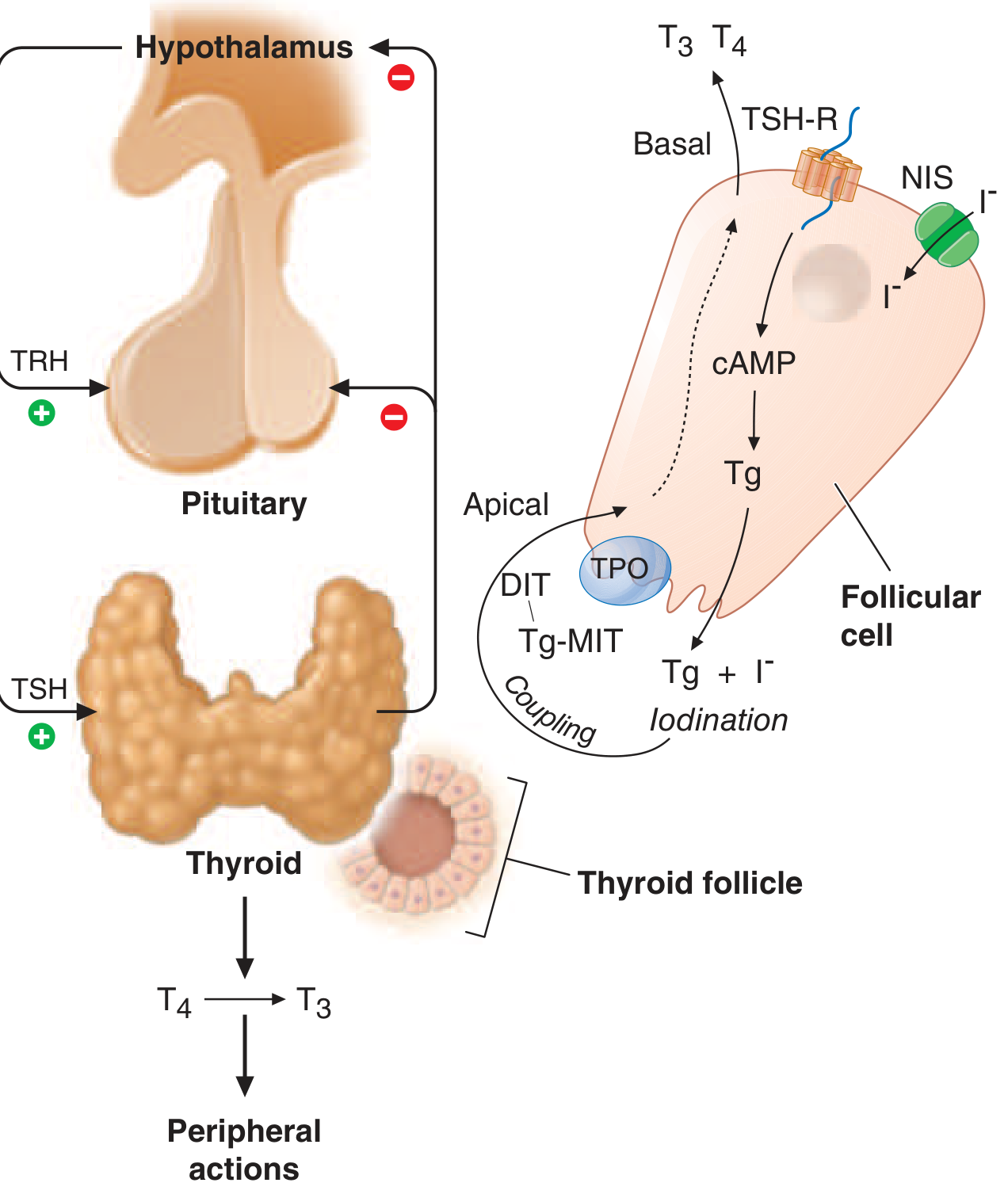
The axis works as follows:
- Hypothalamus secretes TRH (thyrotropin-releasing hormone, a tripeptide) from the paraventricular nucleus into the portal circulation.
- Anterior pituitary thyrotropes respond to TRH by releasing TSH (thyroid-stimulating hormone, a glycoprotein with α + β subunits).
- TSH binds TSH-R (Gs-coupled GPCR) on thyrocytes → activates adenylyl cyclase → ↑cAMP → stimulates:
- NIS expression (iodide uptake)
- Thyroglobulin synthesis
- TPO activity
- Colloid endocytosis and T4/T3 release
- Thyroid growth (goiter if chronically elevated)
- Negative feedback: Free T3 and T4 inhibit both TRH secretion from the hypothalamus and TSH secretion from the pituitary. T4 is converted to T3 locally in pituitary thyrotropes by D2; T3 acts on nuclear thyroid hormone receptors (TRβ) to suppress TSH gene transcription.
8. Mechanism of Action of Thyroid Hormones
- T3 and T4 enter cells; T4 is converted to T3 intracellularly.
- T3 binds thyroid hormone receptors (TRα, TRβ) - nuclear receptors that are ligand-activated transcription factors.
- Receptor-hormone complex binds thyroid hormone response elements (TREs) in DNA.
- This regulates gene expression for hundreds of target genes.
Physiologic effects:
| System | Effect |
|---|---|
| Metabolism | ↑ Basal metabolic rate; ↑ O₂ consumption; ↑ thermogenesis |
| Cardiovascular | ↑ Heart rate, ↑ cardiac output, ↓ systemic vascular resistance |
| Nervous system | Essential for brain development (fetal); maintains alertness/cognition in adults |
| Growth | Synergizes with GH; promotes bone maturation and linear growth |
| GI | ↑ Gut motility |
| Lipids | ↑ LDL receptor expression → ↓ LDL cholesterol |
| Protein | Low levels: anabolic; high levels: catabolic |
| Carbohydrates | ↑ Gluconeogenesis, glycogenolysis, glucose absorption |
9. Wolff-Chaikoff Effect
When iodine load is very high, thyroid hormone synthesis is temporarily inhibited (the Wolff-Chaikoff effect) - a protective mechanism that normally "escapes" after a few days as NIS is downregulated and intracellular iodide falls. Individuals with underlying thyroid disease may fail to escape, leading to hypothyroidism (clinically relevant with amiodarone, iodinated contrast, or high-dose iodine supplements).
Sources: Ganong's Review of Medical Physiology 26e, p. 370-371 | Harrison's Principles of Internal Medicine 22e, p. 3065-3066 | Sabiston Textbook of Surgery
This is a shared conversation. Sign in to Orris to start your own chat.