
benign tumor
Reading File
The query "benign tumor" is broad. Let me clarify before diving deep.
Asking for Preferences
What aspect of benign tumors are you looking for? · Any specific organ or system?
A benign tumor is a non-cancerous growth of cells that does not invade surrounding tissue or metastasize. I'll pull comprehensive textbook content now.
Searching sources...
Finding Sources
Finding Sources
Reading File
Finding Sources
Reading File
Finding Sources
Reading File
I now have rich textbook content. Let me also fetch the key comparison image and the nomenclature table image.
Loading Image
Loading Image
Excellent - I now have comprehensive textbook content and images. Here is the full answer:
Benign Tumors - A Comprehensive Overview
Definition
A tumor (neoplasm) is an abnormal mass of cells that proliferates excessively and largely autonomously, usually forming a distinct tissue mass. Tumors are classified as either benign or malignant - an assessment that is central to predicting behavior and prognosis.
A tumor is called benign when its microscopic and gross characteristics indicate it will remain localized and is amenable to local surgical removal. Patients with benign tumors can generally be cured. However, not all benign tumors are harmless - some produce significant morbidity or can even be lethal, particularly if they are located near a vital structure (e.g., a benign meningioma compressing the brain). - Robbins & Kumar Basic Pathology
Key Characteristics
| Feature | Benign Tumor | Malignant Tumor |
|---|---|---|
| Growth rate | Slow | Rapid (with hemorrhage/necrosis) |
| Borders | Well-demarcated, encapsulated | Poorly demarcated, irregular |
| Invasiveness | Non-invasive | Locally invasive |
| Metastasis | None | Present |
| Differentiation | Well-differentiated (resembles parent tissue) | Poorly differentiated |
| Mitoses | Few / normal | Numerous, atypical |
| Effect on host | Usually localized | Systemic + local |
The diagram below illustrates these contrasts using the uterine smooth muscle tumors as a classic example:
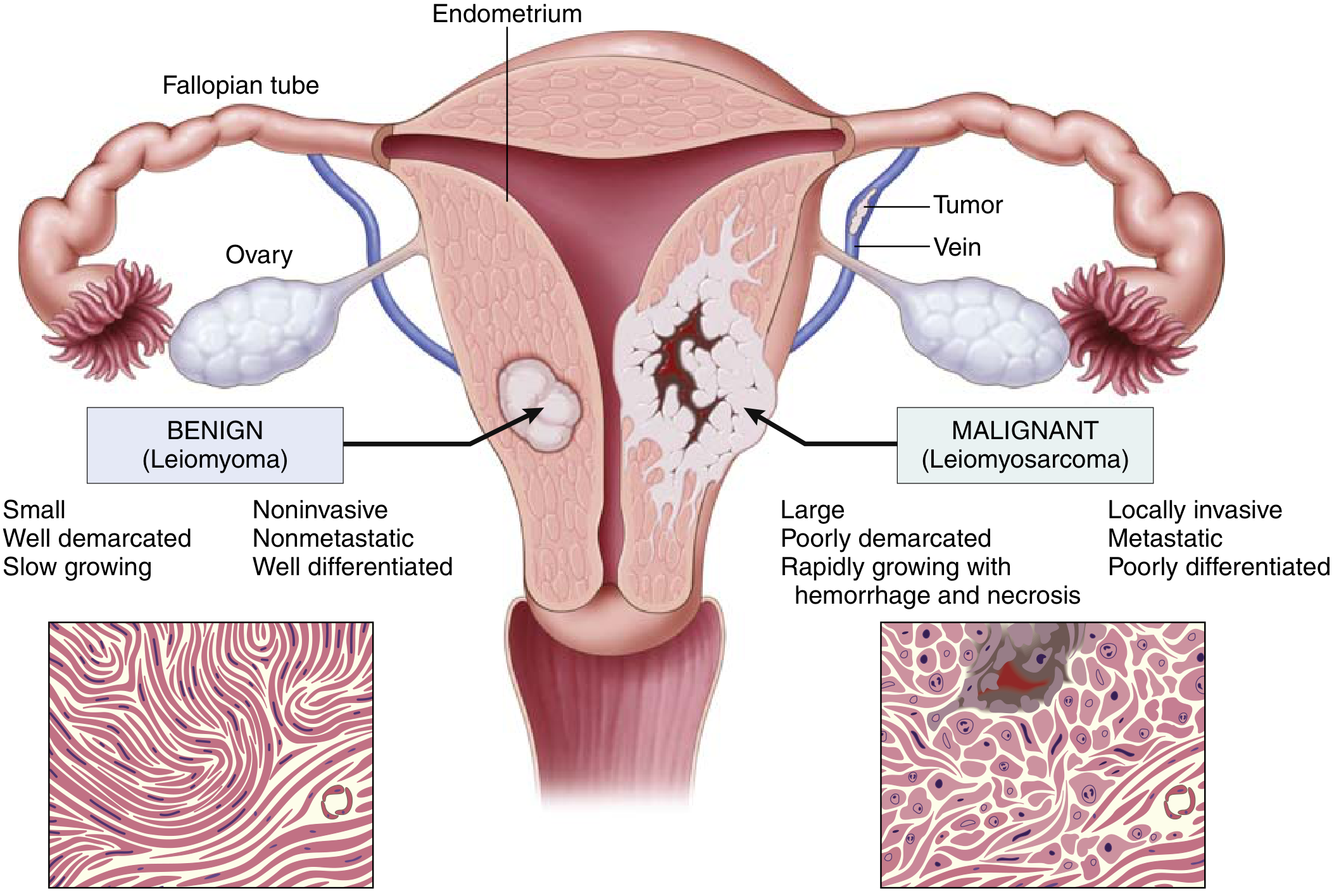
FIG. 6.10 - Comparison between a benign tumor of the myometrium (leiomyoma) and a malignant tumor of similar origin (leiomyosarcoma). Robbins & Kumar Basic Pathology.
Structure of a Tumor
All tumors - benign and malignant - have two basic components:
- Parenchyma - the transformed/neoplastic cells (determines behavior and origin)
- Stroma - the supporting host-derived connective tissue, inflammatory cells, and blood vessels that nourish the tumor
The stroma is essential; tumors cannot grow without a blood supply. - Robbins & Kumar Basic Pathology
Nomenclature (Naming Convention)
Benign tumors are named by attaching the suffix -oma to the cell or tissue of origin. Malignant counterparts typically use -sarcoma (mesenchymal) or -carcinoma (epithelial):
| Tissue of Origin | Benign | Malignant |
|---|---|---|
| Fibrous tissue | Fibroma | Fibrosarcoma |
| Fat | Lipoma | Liposarcoma |
| Cartilage | Chondroma | Chondrosarcoma |
| Bone | Osteoma | Osteosarcoma |
| Blood vessels | Hemangioma | Angiosarcoma |
| Lymph vessels | Lymphangioma | Lymphangiosarcoma |
| Smooth muscle | Leiomyoma | Leiomyosarcoma |
| Striated muscle | Rhabdomyoma | Rhabdomyosarcoma |
| Squamous epithelium | Squamous cell papilloma | Squamous cell carcinoma |
| Glands/ducts | Adenoma | Adenocarcinoma |
| Melanocytes | Nevus | Melanoma |
| Nerve sheath | Schwannoma / Neurofibroma | Malignant peripheral nerve sheath tumor |
Source: Table 6.1, Robbins & Kumar Basic Pathology
Histological Examples
The images below show two benign tumors under the microscope:
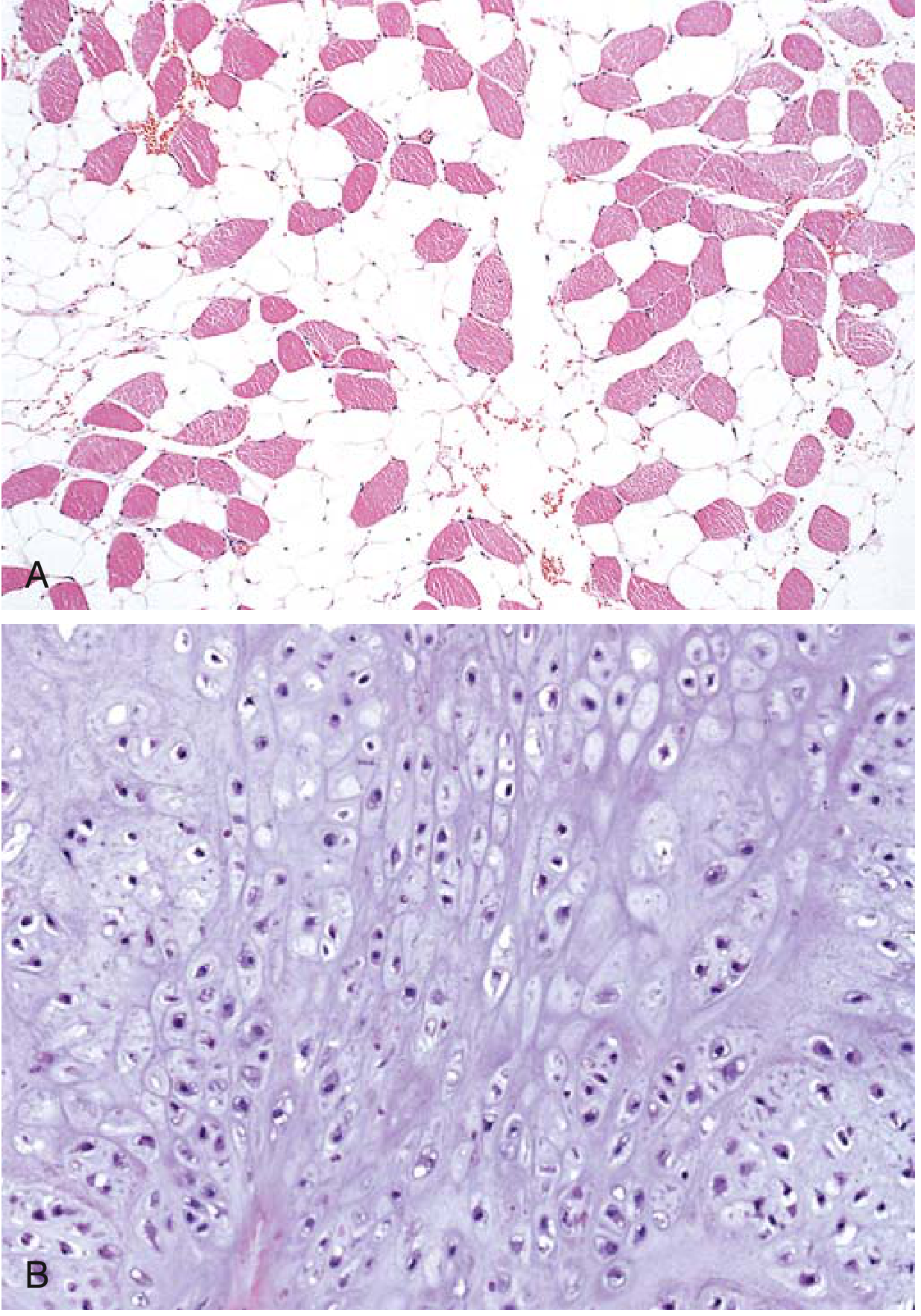
eFIG. 6.3 - (A) Intramuscular lipoma: well-differentiated adipocytes splaying apart normal skeletal muscle cells. (B) Chondroma: disorganized but benign-appearing chondrocytes. - Robbins & Kumar Basic Pathology
Common Examples by System
| System | Common Benign Tumors |
|---|---|
| Skin / Soft tissue | Lipoma, fibroma, nevus, sebaceous cyst |
| Breast | Fibroadenoma, intraductal papilloma |
| GI tract | Adenomatous polyp, leiomyoma |
| Uterus | Leiomyoma (fibroid) - most common pelvic tumor in women |
| Bone | Osteoma, enchondroma, osteochondroma |
| Nerve | Schwannoma (neurilemoma), neurofibroma |
| Salivary gland | Pleomorphic adenoma (most common benign salivary tumor) |
| Ovary | Mature cystic teratoma (dermoid cyst) |
| Liver | Hepatic hemangioma (most common benign liver tumor) |
| Brain coverings | Meningioma |
Important Exceptions - "Benign" Does Not Always Mean Harmless
While benign tumors do not metastasize, they can cause serious harm via:
- Mass effect - compression of adjacent structures (e.g., meningioma compressing brain, pituitary adenoma compressing optic chiasm)
- Hormone secretion - functional adenomas (e.g., insulinoma causing hypoglycemia, pheochromocytoma causing hypertensive crisis)
- Obstruction - leiomyomas causing ureteral obstruction, polyps obstructing bowel
- Malignant transformation - some benign lesions have malignant potential (e.g., adenomatous polyps → colorectal cancer; pleomorphic adenoma → carcinoma ex pleomorphic adenoma)
Summary
Benign tumors are localized, slow-growing, well-differentiated, encapsulated, non-invasive, and non-metastatic growths. They are named by tissue of origin + "-oma." Most are curable with surgical excision, but their clinical impact depends heavily on location, size, and functional activity.
This is a shared conversation. Sign in to Orris to start your own chat.