
prototype drugs
Reading File
Finding Sources
Finding Sources
Reading File
Finding Sources
I have enough confirmed sources to build a solid, well-cited answer combining textbook citations with standard pharmacology knowledge. Let me compile the final answer.
What a "prototype drug" means
In pharmacology, drugs are grouped into classes because members share similar mechanisms, actions, and pharmacokinetic properties. For most classes, one drug (usually the first discovered, most extensively studied, or best characterized) is designated the prototype. Learning the prototype in depth lets you understand the whole class, and other drugs are simply learned as variations from that prototype.
"For most groups, one or two prototype drugs can be identified that typify the most important characteristics of the group. This permits classification of other important drugs in the group as variants of the prototype, so that only the prototype must be learned in detail." - Katzung's Basic and Clinical Pharmacology, 16th Ed., p. 30
Common prototype drugs by class
| Drug Class | Prototype Drug | Notes |
|---|---|---|
| Opioid analgesics | Morphine | "Morphine is the prototype opioid" - Barash, Cullen & Stoelting's Clinical Anesthesia, 9e |
| SSRIs | Fluoxetine | Prototype SSRI; metabolized to active norfluoxetine - Katzung's Pharmacology |
| Tricyclic antidepressants | Imipramine | Prototype TCA - Lippincott Illustrated Reviews: Pharmacology |
| Macrolide antibiotics | Erythromycin | Isolated 1952 from Saccharopolyspora erythraea - Katzung's Pharmacology |
| Anthelmintics (broad-spectrum) | Thiabendazole | Acts on adult and larval nematodes - Sherris & Ryan's Medical Microbiology |
| Antiherpetic antivirals | Acyclovir | Prototype anti-HSV drug - Medical Microbiology, 9e |
| Carbonic anhydrase inhibitor / proximal tubular diuretics | Acetazolamide | Brenner and Rector's The Kidney |
| Dihydropyridine calcium-channel blockers (antihypertensive) | Amlodipine | Goldman-Cecil Medicine |
| Statins (HMG-CoA reductase inhibitors) | Lovastatin (historically) / commonly Atorvastatin or Simvastatin in modern teaching | Statin-induced myopathy is the prototype of drug-induced muscle injury - Rheumatology, 2-Volume Set |
| Benzodiazepines | Chlordiazepoxide (historically, first marketed 1957 as Librium) / Diazepam in modern teaching | Kaplan & Sadock's Comprehensive Textbook of Psychiatry |
| Peptide hormone precursor processing | Insulin | "The prototype is insulin... synthesized as a single-chain precursor" - Harper's Illustrated Biochemistry |
Additional widely-taught prototypes (standard pharmacology curricula, not all pulled directly from the library search above but consistent with standard teaching such as Katzung/Lippincott)
- Penicillins: Penicillin G
- Beta-blockers: Propranolol (non-selective) / Metoprolol (beta-1 selective)
- ACE inhibitors: Captopril
- Loop diuretics: Furosemide
- Thiazide diuretics: Hydrochlorothiazide
- NSAIDs: Aspirin (or ibuprofen for non-aspirin NSAIDs)
- Anticoagulants (vitamin K antagonist): Warfarin
- Anticoagulants (heparin class): Heparin
- Local anesthetics: Lidocaine (amide) / Procaine (ester)
- Inhaled general anesthetics: Halothane (historical) / Isoflurane or Sevoflurane (modern)
- Neuromuscular blockers: Curare (tubocurarine, historical) / Succinylcholine (depolarizing)
- Typical antipsychotics: Chlorpromazine
- Atypical antipsychotics: Clozapine
- Sulfonylureas (oral hypoglycemics): Tolbutamide (first-gen) / Glyburide (second-gen)
- Cardiac glycosides: Digoxin
- H2 receptor antagonists: Cimetidine
- Proton pump inhibitors: Omeprazole
If you had a specific drug class, exam (e.g., NCLEX, USMLE, pharmacology course), or a particular list in mind, let me know and I can narrow this down or verify additional prototypes against the textbook library.
atypical pneumonia
Finding Sources
Finding Sources
Searching PubMed
"atypical pneumonia"[MeSH Terms] AND treatment
Searching the Web
atypical pneumonia causes symptoms treatment 2026
Reading File
Reading File
Reading File
I have comprehensive material now. Let me search for a relevant chest X-ray image to illustrate, then compile the full answer.
Searching Images
atypical pneumonia chest radiograph mycoplasma patchy infiltrate
Atypical Pneumonia
Definition
Atypical pneumonia (also called "walking pneumonia") refers to pneumonia caused by organisms that don't behave or appear like classic Streptococcus pneumoniae infection - they aren't reliably seen on Gram stain, don't grow on standard culture media, and often don't respond to beta-lactam antibiotics because many lack a cell wall.
"The term atypical pneumonia (interstitial pneumonia) was initially applied to the clinical and radiographic appearance of lung infection not behaving or looking like that caused by S. pneumoniae." - Grainger & Allison's Diagnostic Radiology
Typical vs. Atypical Pneumonia
| Feature | Typical Pneumonia | Atypical Pneumonia |
|---|---|---|
| Onset | Abrupt | Gradual/subacute |
| Cough | Productive, purulent sputum | Dry, prolonged (>5 days), non-productive |
| Fever | High-grade | Low-grade |
| Chest X-ray | Distinct, usually lobar infiltrate | Patchy, diffuse interstitial infiltrates |
| Leukocytosis | Marked | Mild or normal WBC, procalcitonin ≤0.1 ug/L |
| Extrapulmonary symptoms | Uncommon | Common (rash, GI symptoms, arthralgia, hemolysis) |
- Quick Compendium of Clinical Pathology, 5th Ed.
- Frameworks for Internal Medicine
Causative Organisms
The "atypical agents" lack a cell wall or are obligate intracellular bacteria, so they evade beta-lactams:
-
Mycoplasma pneumoniae - most common cause of primary atypical pneumonia (10-30% of CAP); affects ages 5-40, spreads in close-contact settings; presents with dry cough, sore throat, headache, retrosternal chest pain; can cause hemolytic anemia, bullous myringitis, rash, and rare neurologic/renal complications
-
Chlamydia (Chlamydophila) pneumoniae - mild subacute illness with sore throat, mild fever, nonproductive cough; ~half the population has antibodies by age 15; linked to adult-onset asthma
-
Legionella pneumophila - ranges from mild illness to multisystem organ failure/ARDS; classically linked to cruise ships, water systems; higher risk in smokers, transplant/immunosuppressed patients; commonly causes GI symptoms (abdominal pain, diarrhea), relative bradycardia, hilar adenopathy, pleural effusions; diagnosed via urinary antigen test
-
Coxiella burnetii (Q fever) - acute pneumonia/hepatitis or chronic disease (often endocarditis months to years later); transmitted from cattle, cats, dried urine/unpasteurized milk
-
Chlamydia psittaci (psittacosis) - from bird exposure, can be fatal in up to 10% of untreated cases
-
Francisella tularensis (tularemia) - associated with hunting/skinning rabbits
-
Respiratory viruses - influenza, parainfluenza, RSV, adenovirus, coronaviruses; antibiotics are not helpful
-
Tintinalli's Emergency Medicine
-
Frameworks for Internal Medicine
-
Harrison's Principles of Internal Medicine, 22E
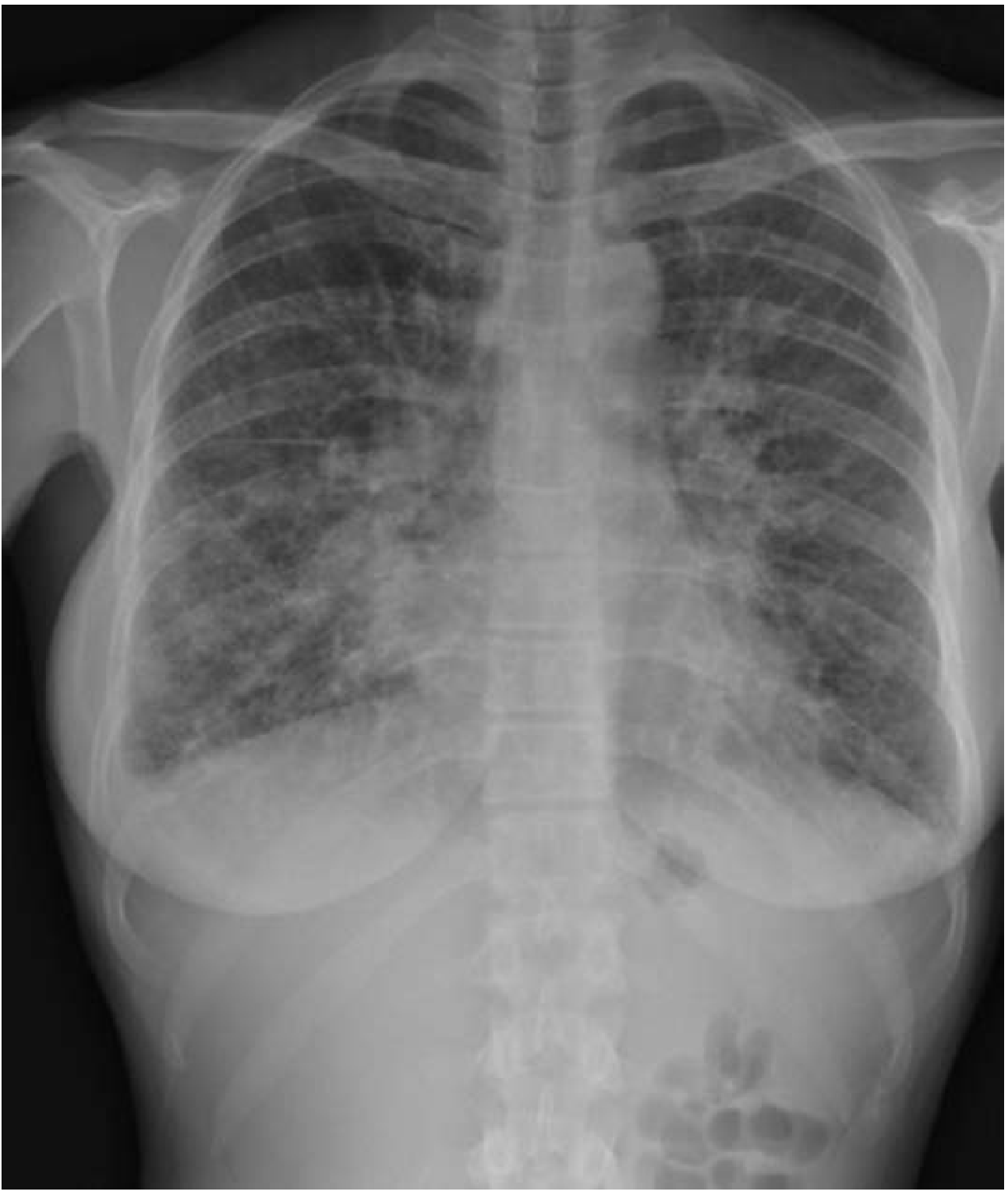
Figure: Chest X-ray in Legionella pneumonia showing mottled/patchy infiltrate pattern (Tintinalli's Emergency Medicine).
Treatment
Since atypical organisms often lack cell walls, they're intrinsically resistant to beta-lactams. Empiric therapy relies on agents that target protein or DNA synthesis:
-
Macrolides (azithromycin, clarithromycin) - first-line, especially for Mycoplasma and Chlamydia
-
Doxycycline - alternative first-line, good for Mycoplasma, Chlamydia, Coxiella
-
Respiratory fluoroquinolones (levofloxacin, moxifloxacin) - covers atypicals plus typical bacteria, useful for Legionella especially
-
Frameworks for Internal Medicine
-
Tintinalli's Emergency Medicine
Most patients with atypical bacterial pneumonia are managed outpatient with good outcomes and low mortality, though Legionella and severe cases may require hospitalization.
Recent evidence note
A 2023 systematic review/meta-analysis (BMJ Open, PMID 37041056) found atypical pathogens (Mycoplasma pneumoniae, Legionella, Chlamydia) account for a substantial proportion of severe pneumonia cases, reinforcing that atypical coverage should be considered even in more severe presentations, not just mild "walking pneumonia." Current clinical guidance (American Thoracic Society CAP guideline, 2026) continues to recommend macrolide or doxycycline-based empiric regimens for outpatient atypical CAP - consistent with the textbook guidance above. No major evidence found that contradicts the standard textbook approach.
This is a shared conversation. Sign in to Orris to start your own chat.