
Biomarkers
I need a bit more context to give you a useful answer. "Biomarkers" is a broad topic spanning many fields and purposes.
Asking for Preferences
What aspect of biomarkers are you interested in?
The user skipped, so I'll provide a solid general overview of biomarkers. Let me pull from the medical library and web in parallel.
Reading File
Searching the Web
biomarkers types classification clinical use overview 2025
Finding Sources
Finding Sources
Reading File
Reading File
Finding Sources
Finding Sources
Finding Sources
Reading File
Finding Sources
Reading File
Reading File
I now have solid textbook content to synthesize a comprehensive overview. Let me fetch the biomarker timeline image as well.
Loading Image
Here is a comprehensive overview of Biomarkers.
Biomarkers
Definition
The NIH defines a biomarker as:
"A characteristic that is objectively measured and evaluated as an indicator of normal biological processes, pathogenic processes, or pharmacologic responses to a therapeutic intervention."
In practical terms, a biomarker is any measurable biological parameter — a molecule, gene, protein, imaging finding, or physiological measurement — that signals something meaningful about health or disease.
Classification by Clinical Purpose
Biomarkers are best classified by how they are used clinically:
| Purpose | What It Answers | Examples |
|---|---|---|
| Diagnostic | Is this disease present? | AFP in hepatocellular carcinoma, troponin in MI |
| Prognostic | How will the disease behave? | NT-proBNP in heart failure predicts outcomes |
| Predictive | Will this patient respond to treatment? | EGFR mutation → benefit from EGFR inhibitor |
| Screening | Is preclinical disease present? | Fecal occult blood for colorectal cancer, hCG for choriocarcinoma |
| Monitoring | Is treatment working / is disease recurring? | CA-125 serial measurement after ovarian cancer treatment |
| Pharmacodynamic | Is the drug hitting its target? | Plasma drug levels, downstream pathway markers |
— Tietz Textbook of Laboratory Medicine, 7th Edition
Major Categories by Biomarker Type
1. Serum / Plasma Proteins
The most widely used class. Secreted into the bloodstream, easily sampled.
- Cardiac: Troponin I/T (myocardial injury), BNP / NT-proBNP (heart failure), CK-MB
- Oncology: PSA (prostate), CEA (colorectal), AFP (liver/testicular), CA-125 (ovarian), CA15-3 (breast), CA19-9 (pancreatic), hCG (gestational trophoblastic disease)
- Hepatic: ALT, AST, GGT, bilirubin
- Renal: Creatinine, cystatin C, eGFR
2. Cellular / Tissue Markers
Measured on tumor biopsies or blood cells:
- Hormone receptors: ER, PR (breast cancer — guides endocrine therapy)
- Oncoproteins: HER2/neu (breast/gastric — guides trastuzumab therapy)
- Immune markers: PD-L1 (predicts response to checkpoint inhibitors)
3. Molecular / Genetic Markers
DNA/RNA-level characteristics:
- Somatic mutations: EGFR, KRAS, BRAF, ALK, KIT — guide targeted therapy in lung, colorectal, melanoma, GI tumors
- Germline mutations: BRCA1/2 — cancer risk and PARP inhibitor eligibility
- Chromosomal alterations: BCR-ABL in CML (monitored by PCR to assess treatment response)
4. Metabolites & Small Molecules
- Lysosphingolipids: lyso-Gb3 in Fabry disease, lyso-Gb1 (glucosylsphingosine) in Gaucher disease — used for diagnosis, severity, and treatment monitoring
- HbA1c: reflects average glycemia over 3 months in diabetes
5. Imaging Biomarkers
- Quantitative MRI parameters (T1 mapping, ECV) in cardiac amyloidosis
- Global longitudinal strain (echocardiographic marker of systolic dysfunction)
- PET SUV measurements in oncology
Historical Evolution
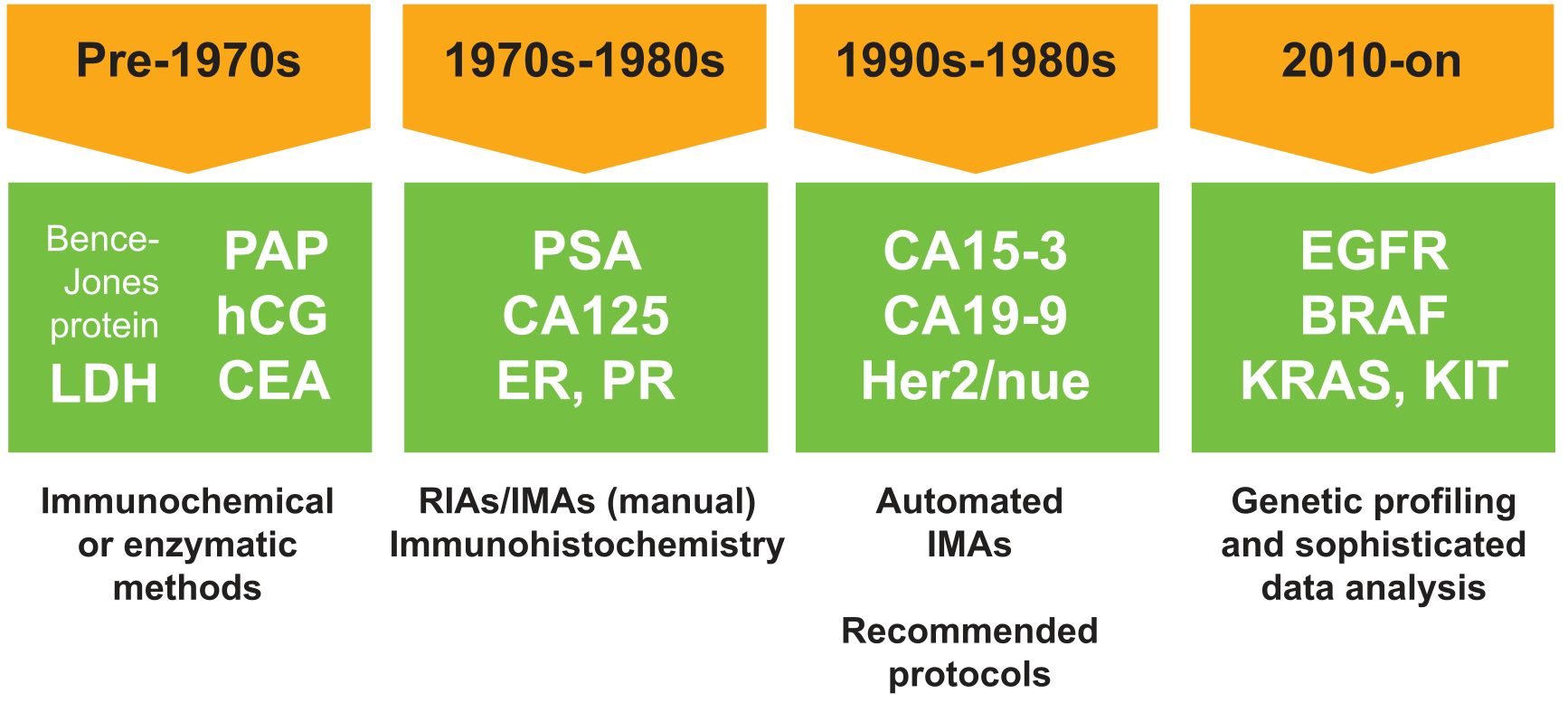
From Tietz Textbook of Laboratory Medicine, 7th Ed — Evolution of biomarker testing from enzymatic/immunochemical methods (pre-1970s) through radioimmunoassay and monoclonal antibody technology (1970s–90s) to modern genetic profiling (2010+)
Key Principles for Clinical Use
- No biomarker is perfectly sensitive or specific. False positives (e.g., BNP elevated in pulmonary embolism, obesity lowering BNP) and false negatives must be anticipated.
- Negative predictive value often exceeds positive predictive value — particularly useful for ruling out disease (e.g., natriuretic peptides ruling out heart failure as a cause of dyspnea). — Braunwald's Heart Disease
- Baseline measurement is essential for monitoring. Only markers elevated at diagnosis reliably track recurrence.
- Context always matters. Troponin elevation in acute heart failure does not equal Type II MI. CA-125 elevation occurs in endometriosis and peritonitis, not only ovarian cancer.
- Standardization and inter-assay variation are critical issues, particularly for cancer markers — results from different platforms may not be interchangeable. — Tietz Textbook of Laboratory Medicine, 7th Ed
Emerging Frontiers
- Liquid biopsy: Circulating tumor DNA (ctDNA), circulating tumor cells (CTCs) — non-invasive cancer monitoring and early detection
- Multi-omics panels: Combining proteomics, metabolomics, and genomics for multiparametric cancer diagnosis
- AI/machine learning: Neural networks applied to biomarker discovery and multivariate classification
- Point-of-care testing: Rapid bedside biomarker measurement (troponin, BNP) improving emergency triage
Let me know if you'd like a deep dive into any specific area — cardiac biomarkers, oncology tumor markers, genetic/molecular markers, a specific disease, or biomarkers in drug development.
This is a shared conversation. Sign in to Orris to start your own chat.