
Show me the images of vitiligo asymmetrical.
Reading File
Now let me search the medical library for vitiligo images.
Finding Sources
Searching the Web
vitiligo asymmetrical distribution clinical images
Let me read the Fitzpatrick's dermatology chapter on vitiligo (the most authoritative source) and fetch images simultaneously.
Reading File
Reading File
Loading Image
Loading Image
Now let me read further in the Fitzpatrick's and Dermatology 2-Volume Set for the images related to asymmetrical vitiligo (segmental/asymmetric patterns), and fetch more images.
Reading File
Loading Image
Loading Image
Now let me fetch the key asymmetrical/segmental vitiligo images from the Fitzpatrick's textbook.
Loading Image
Loading Image
Loading Image
Here is a full visual gallery of asymmetrical vitiligo from authoritative dermatology textbooks and peer-reviewed sources, with clinical context for each image.
Vitiligo - Asymmetrical Patterns
Asymmetrical vitiligo falls mainly under segmental vitiligo (SV) and sometimes focal vitiligo. Unlike the more common non-segmental (generalized) vitiligo - which tends toward bilateral symmetry - segmental vitiligo is defined by its unilateral, block-shaped, asymmetric distribution confined to one body segment.
Image 1 - Segmental Vitiligo: Unilateral Block-like Depigmentation (Lower Abdomen)
(Fitzpatrick's Dermatology, Fig. 76-4)
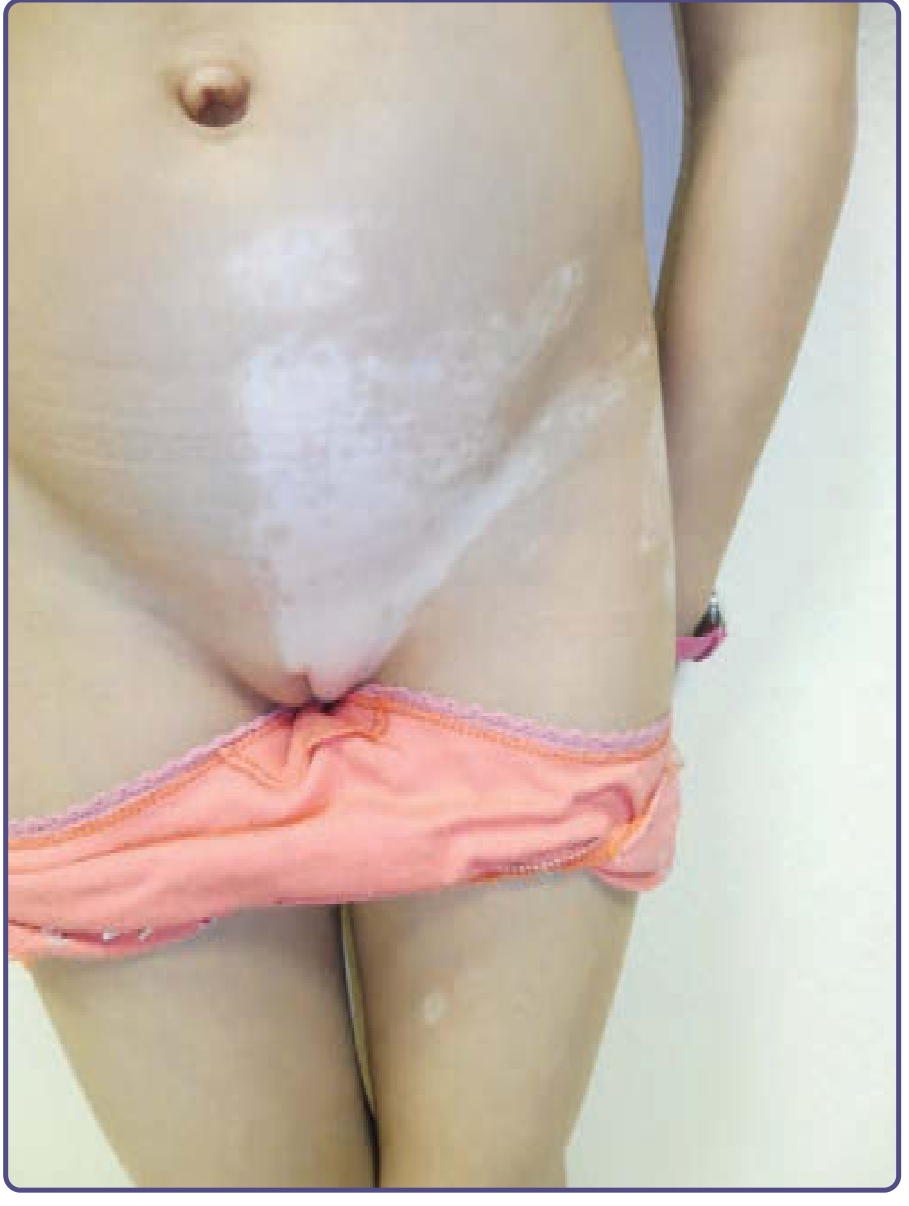
A classic example of segmental vitiligo showing a unilateral, well-defined depigmented patch confined to one side of the lower abdomen. This "block-like" asymmetrical pattern is highly characteristic of segmental disease.
Image 2 - Mixed Vitiligo: Segmental + Remote Bilateral Lesions
(Fitzpatrick's Dermatology, Fig. 76-5)
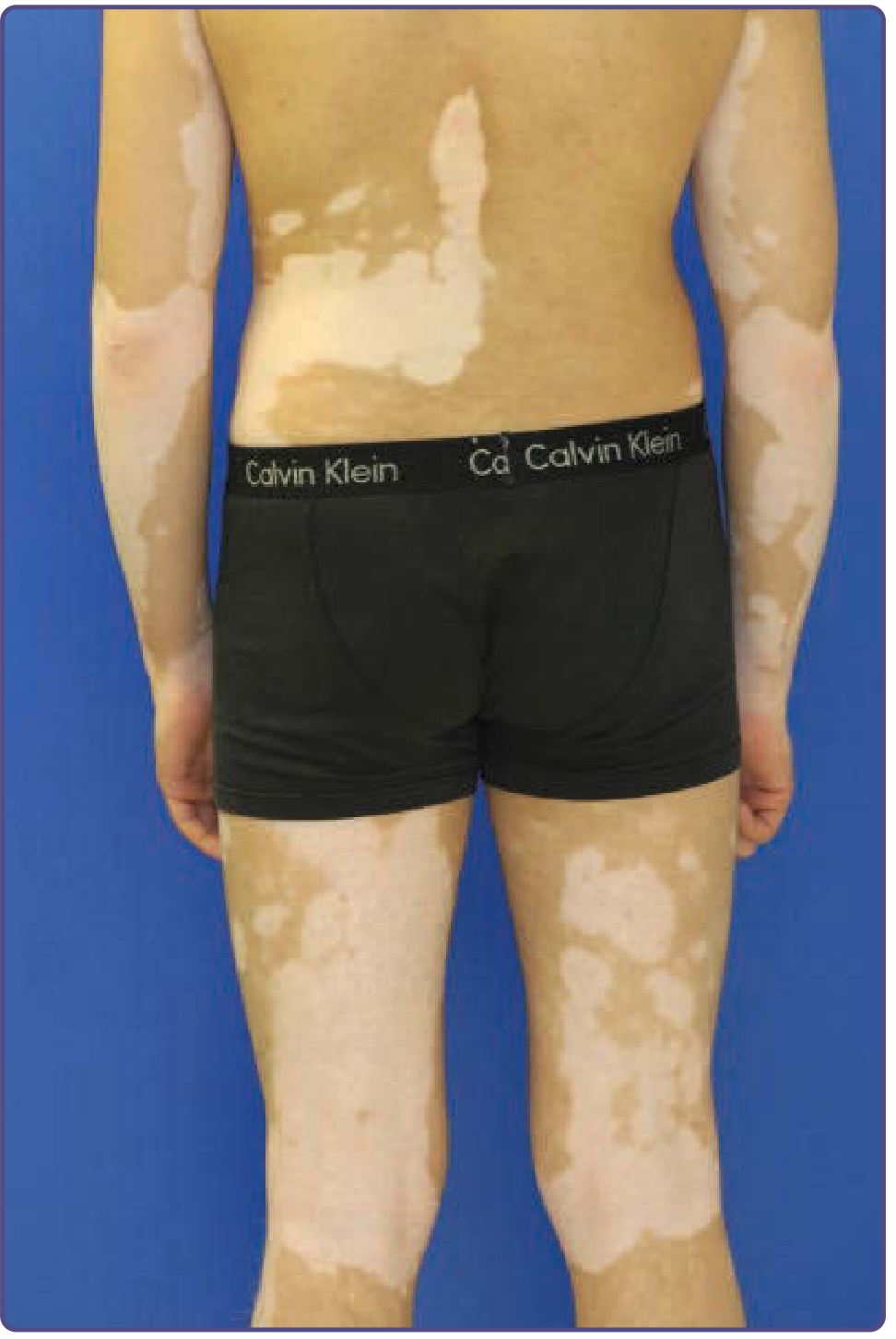
Mixed vitiligo - a segmental lesion on the back (upper left, unilateral) coexisting with additional irregular, asymmetrically distributed patches across the arms, thighs, and legs. The overall pattern is markedly asymmetrical, with heavier involvement on one side.
Image 3 - Generalized Vitiligo with Asymmetrical Confetti-like Patches
(Fitzpatrick's Dermatology, Fig. 76-2)
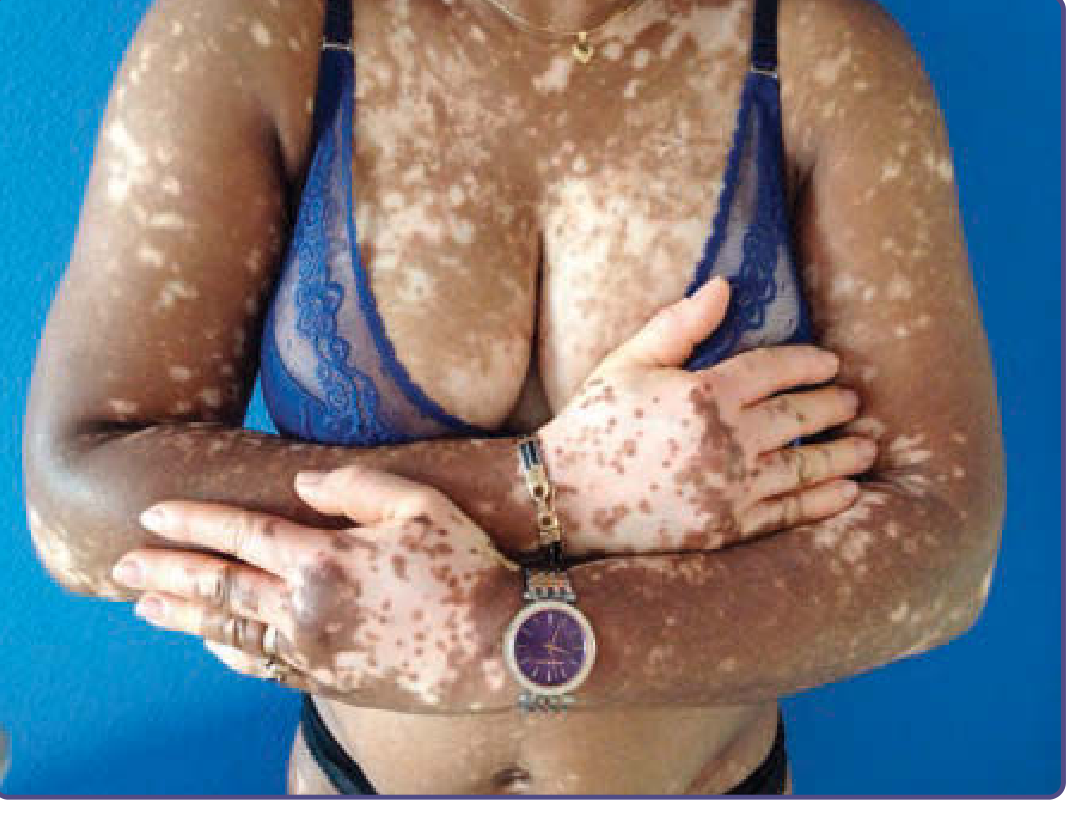
Extensive vitiligo with numerous small and large white macules scattered unevenly across the torso and arms. While generalized vitiligo tends toward symmetry, individual lesions show considerable asymmetry in size, shape, and distribution.
Image 4 - Vitiligo: Multiple Body Sites with Asymmetrical Distribution (JCI)
(Journal of Clinical Investigation)

A composite panel (A-E) showing:
- (A) Torso with unequal, asymmetric depigmented areas
- (B) Large asymmetric confluent patches on trunk/abdomen
- (C) Perioral/lip vitiligo (focal, unilateral involvement)
- (D) Large asymmetric patch on the upper back
- (E) Vitiligo on hands and flank with asymmetric spread
Image 5 - Inflammatory Vitiligo, Focal Asymmetric Lesion, and Lip/Hand Variants
(CosmodermaJournal)

- (a) Single focal asymmetric depigmented patch with an erythematous (inflammatory) border - active disease
- (b) Subtle focal vitiligo on the hand/fingers
- (c) Confetti-like depigmentation on the back - a marker of active, spreading disease
- (d) Lip mucosal vitiligo - focal and asymmetric
Key Clinical Points
| Feature | Segmental (Asymmetric) | Non-Segmental (Symmetric) |
|---|---|---|
| Distribution | Unilateral, one segment | Bilateral, symmetric |
| Prevalence | 10-15% of cases | ~85-90% |
| Progression | Rapid spread within 6-12 months, then stabilizes | Progressive over years |
| Poliosis (white hairs) | Common, early | Less common early |
| Autoimmune associations | Weak | Strong |
| Treatment response | Typically resistant to systemic therapy | Better response to phototherapy/immunosuppressants |
Segmental vitiligo tends to stabilize after its initial rapid spread, whereas non-segmental vitiligo may continue spreading unpredictably over a lifetime. The asymmetrical "block" pattern is considered pathognomonic for the segmental subtype.
- Fitzpatrick's Dermatology, Chapter 76 (Ezzedine & Harris)
- Dermatology 2-Volume Set 5e, Chapter 66
This is a shared conversation. Sign in to Orris to start your own chat.